

Details
Description
Alabaster sculpture "Fille d'Assouan" - The Water Carrier of Aswan
Subject and :
The work is the "Fille d'Assouan" (Girl …
Read more
Alabaster sculpture "Fille d'Assouan" - The Water Carrier of Aswan
Subject and :
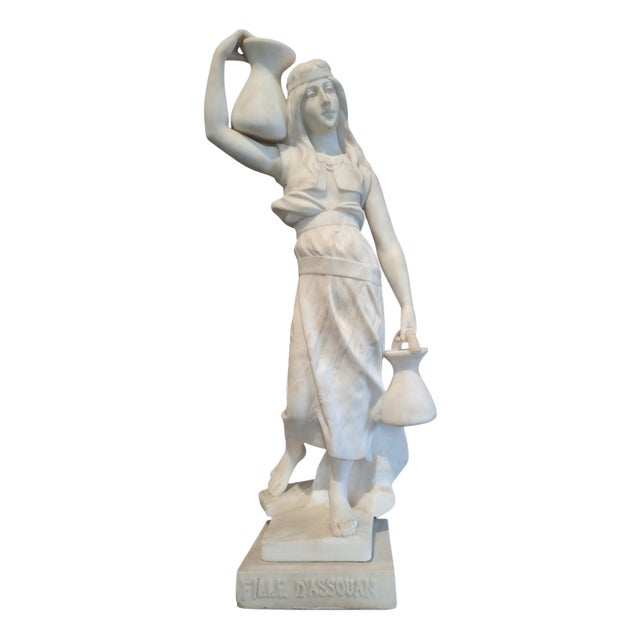
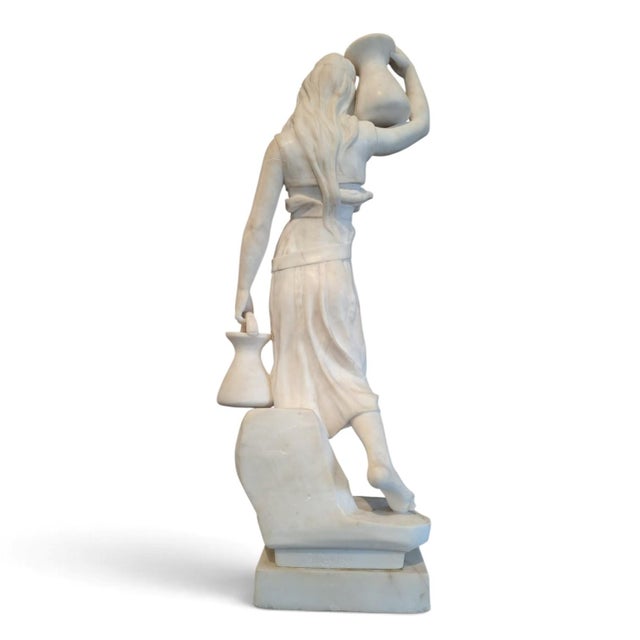
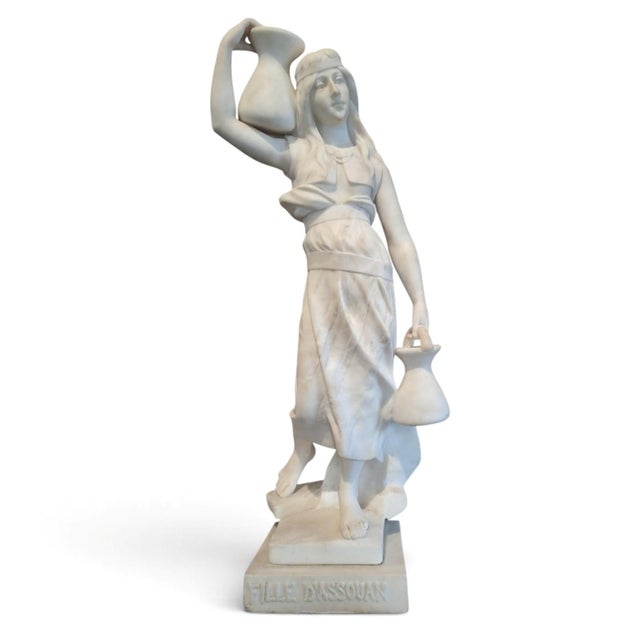
The work is the "Fille d'Assouan" (Girl from Aswan), one of the most famous and replicated Orientalist subjects of the late 19th century.
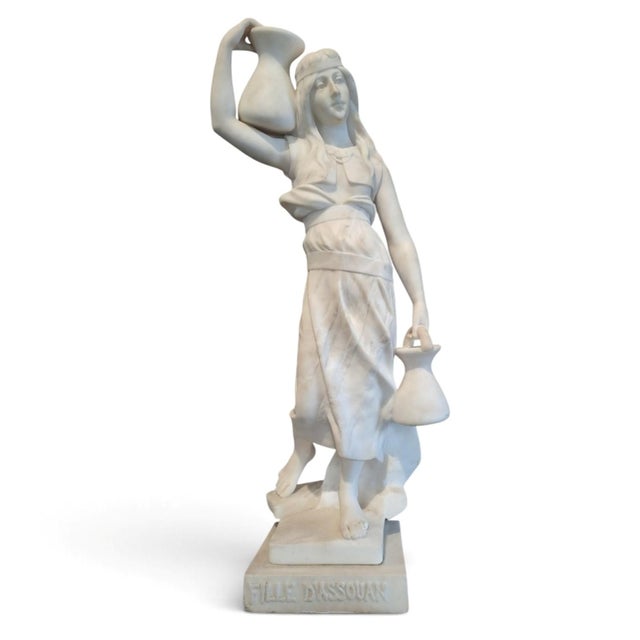
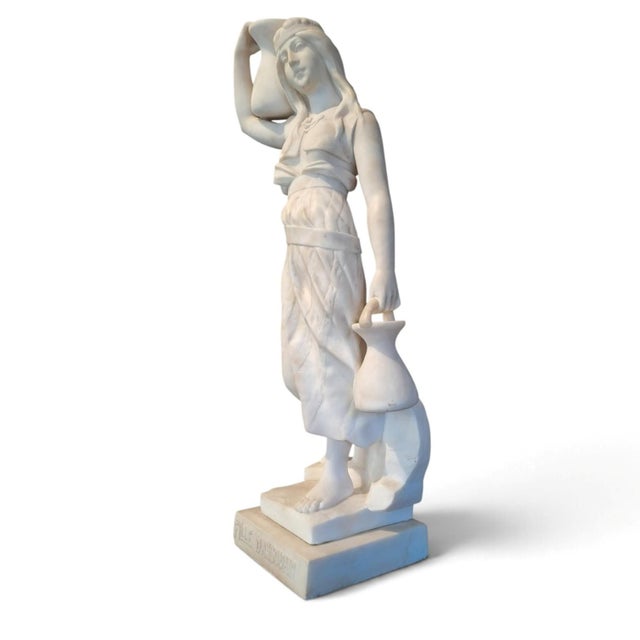
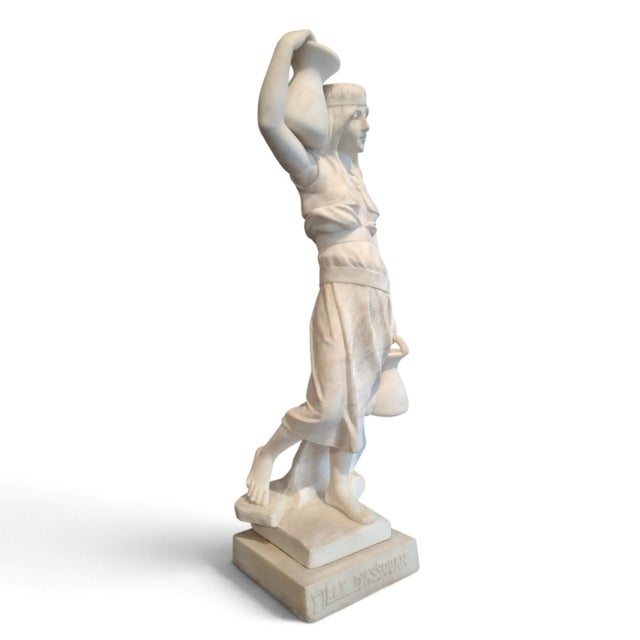
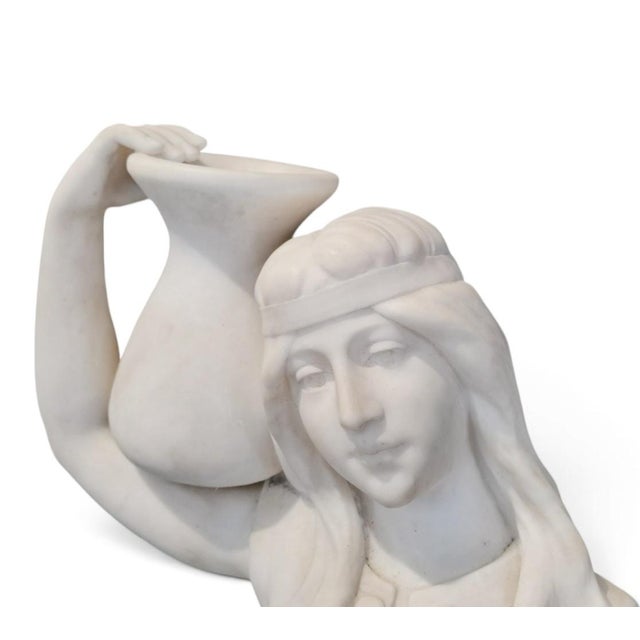
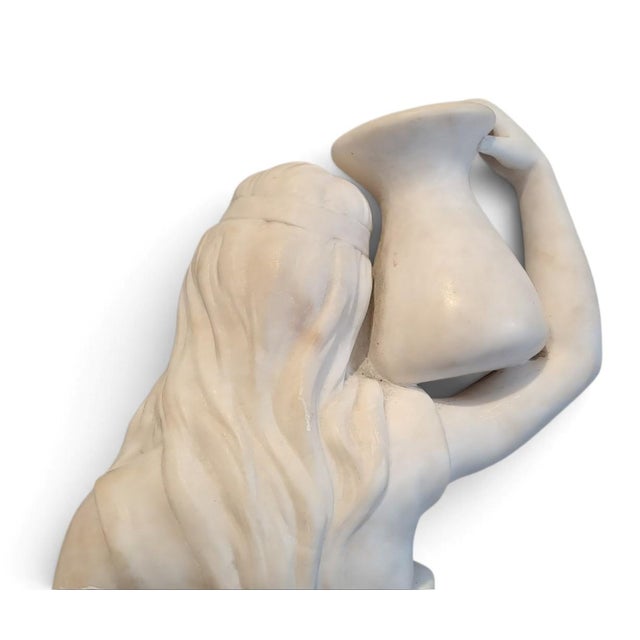
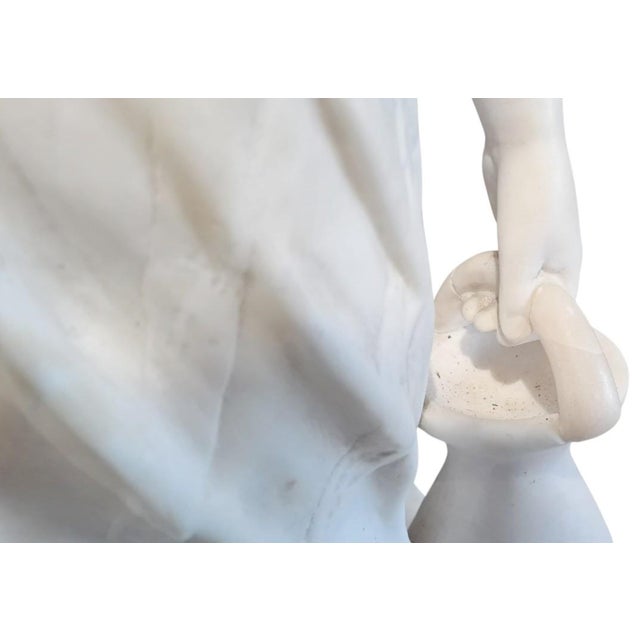
It depicts a young Nubian woman, barefoot, in motion while carrying water. She carries a large amphora on her right shoulder, supported by her hand, and a second, smaller amphora in her left. She wears an exotic costume with a headband, a short top, and a long draped skirt with belts that highlight the soft, flowing drapery, typical of the Art Nouveau style.
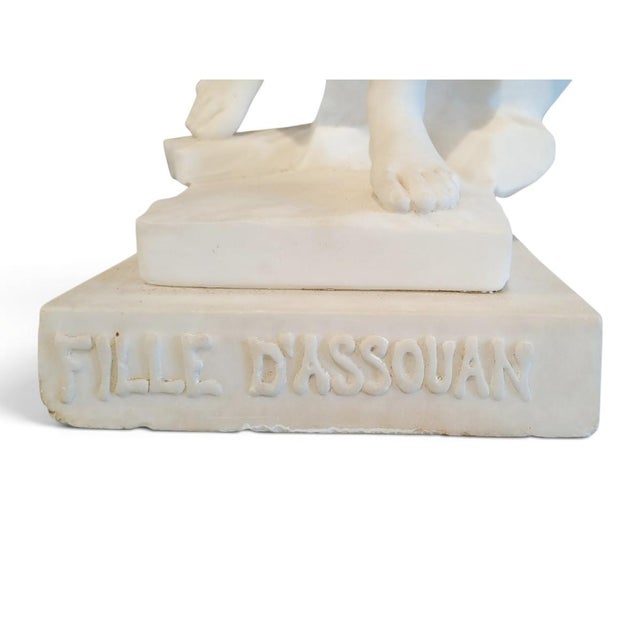
The double-tiered base is made of white marble.
The front is engraved in relief with the title: FILLE D'ASSOUAN.
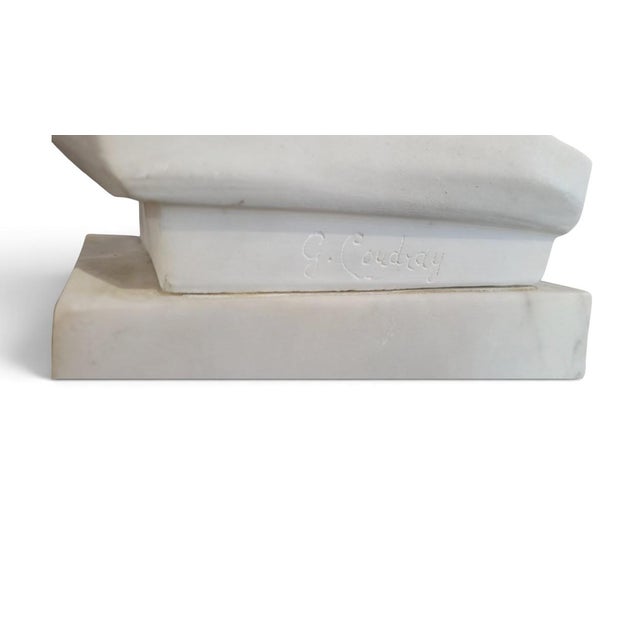
The back is signed in cursive: G. Coudray.
Technique and Material:
The original plaster cast was later translated into both patinated bronze (standard height 62-63 cm) and alabaster, like our example. The workmanship is high-quality: smooth skin, meticulously detailed hair and hands.
Dimensions: 17.5 x 17.5 cm at the base, height 67 cm.
The Sculptor: Georges Charles Coudray (1862 - 1944)
Biography:
Georges Charles Coudray was a distinguished French sculptor and medallist, a master of Orientalist figures.
He was born in Paris in 1862. He was the brother of the more famous medallist Marie Alexandre Lucien Coudray (1864-1932).
He trained at the prestigious École des Beaux-Arts in Paris under the guidance of great academic masters such as Alexandre Falguière, Henri Allouard, and Gabriel-Jules Thomas.
He made his debut at the Salon des Artistes Français in 1883 at a very young age and exhibited continuously until 1903, presenting sculptures in plaster, stone, terracotta, and bronze in the Art Nouveau or Orientalist style. His repertoire ranges from busts, statuettes, and medallions, often featuring female subjects drawn from mythology, literature, or exotic themes. His style is characterized by flowing lines, delicate modeling, and intricate decorative details that combine classical elegance and modernity. Among his best-known works: Tahoser (1892), Les Nénuphars (1899), and Iris (1902). He died in Paris, according to the most reliable sources, in 1932, although some antique galleries cite 1944.
See less
- Dimensions
- 6.69ʺW × 6.69ʺD × 26.38ʺH
- Art Subjects
- Figure
- Period
- 19th Century
- Country of Origin
- France
- Item Type
- Vintage, Antique or Pre-owned
- Materials
- Alabaster
- Condition
- Good Condition, Original Condition Unaltered, Some Imperfections
- Color
- White
Returns & Cancellations
Return Policy - All sales are final 48 hours after delivery, unless otherwise specified in the description of the product.
Cancellation Policy - Prior to shipping or local pickup, buyers may cancel an order for up to 48 hours, unless otherwise specified.
Related Collections
- Fernando Botero Sculpture
- Straw Sculpture
- Constantin Brancusi Sculpture
- Louis XIV Sculpture
- Roman Bronze Works Sculpture
- Gourd Sculpture
- Flavio Poli Sculpture
- Maison Jansen Sculpture
- Georgian Sculpture
- Far Pavilions Sculpture
- Worlds Away Sculpture
- Jute Sculpture
- Blenko Sculpture
- Satinwood Sculpture
- Bakelite Sculpture
- Gold-Plate Sculpture
- Polished Brass Finish Sculpture
- Emmanuel Villanis Sculpture
- Feliciano Béjar Sculpture
- Medium-Density Fibreboard Sculpture
- Sculpture in Panama City, FL
- Barovier and Toso Sculpture
- Photography Sculpture
- Recycled/Repurposed Sculpture
- René Lalique Sculpture