

Details
Description
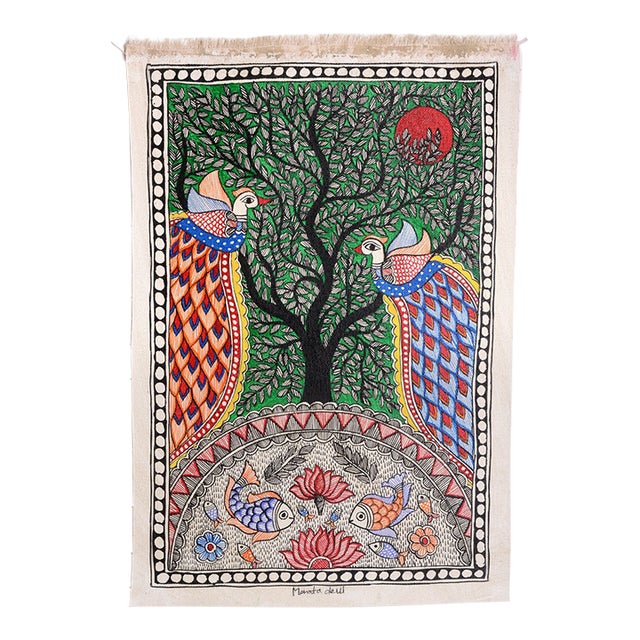
This masterful Madhubani composition balances two interconnected ecological planes divided symmetrically by a stylized, flourishing central tree.
1. The Upper …
Read more
This masterful Madhubani composition balances two interconnected ecological planes divided symmetrically by a stylized, flourishing central tree.
1. The Upper Realm (Flora, Avian & Celestial Elements)
• The Tree of Life: Serves as the central axis of the painting, featuring intricately dense, hand-painted leaves stylized with repetitive parallel linework. It represents interconnectedness, harmony, and vitality in nature.
• Twin Peacocks (Mayura): Facing each other from opposite sides of the tree trunk, two majestic peacocks frame the canvas. One features an elaborate pattern of orange, yellow, and blue scales; the other mirrors it in blue, red, and yellow motifs. In Mithila folklore, peacocks represent love, divine beauty, romance, and the arrival of happiness.
• The Crimson Sun: Positioned in the upper right background is a bright red, fully rendered sun tucked behind the dense foliage, symbolizing energy, optimism, and the divine witness to life.
2. The Lower Realm (The Aquasphere)
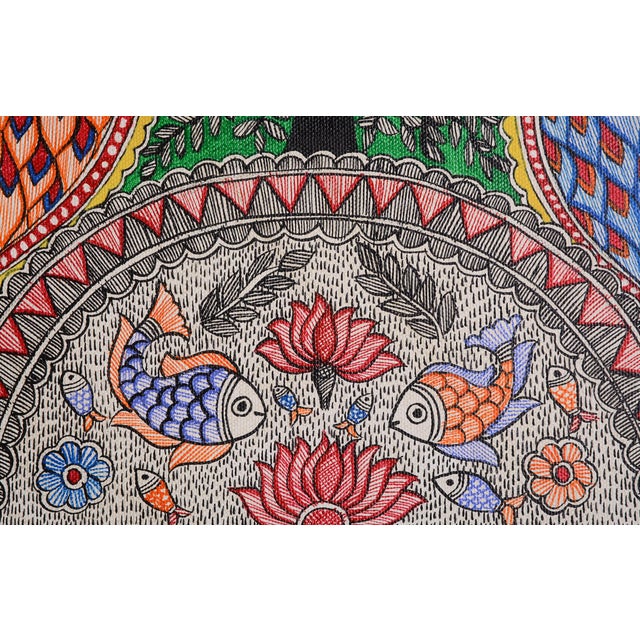
• The Semicircular Pond: Bordered by sharp geometric triangular patterns (Singada border style), the bottom of the canvas depicts an active aquatic ecosystem.
• Sacred Fish (Matsya): Two large, central fish flank a blooming lotus flower. They are joined by smaller accompanying fish. The bodies are detailed with delicate Kachni cross-hatching. Fish traditionally symbolize fertility, procreation, abundance, and auspicious good luck in Madhubani culture.
• Lotus Flowers (Kamal): Prominent pink lotuses sprout gracefully from the water's surface alongside stylized leaves and flanking side blossoms. The lotus embodies divine beauty, spiritual purity, resilience, and feminine power.
ORIGINS AND LIVING TRADITION
Madhubani painting, also known as Mithila painting, is a distinctive folk-art tradition associated with the Mithila region of Bihar in northern India, extending into adjoining areas of Nepal. Practised by generations of women, it began as a way for households to express thoughts, hopes, beliefs and aspirations through paintings on the walls and floors of their homes. Over time, it became part of festivals, weddings and other important occasions. Today, Madhubani painting remains a living tradition, carried forward by artists while reaching art lovers and collectors in India and around the world.
The tradition is closely associated with stories from the Ramayana, including the wedding of Sita, daughter of King Janaka of Mithila, and Lord Rama. Wedding-related Kohbar paintings have traditionally celebrated marriage, fertility and the hopes for a harmonious conjugal life.
Some accounts place the tradition’s roots in the ancient Mithila kingdom, broadly dating its early history to around 800 BCE–500 CE. Its long history is closely tied to household and wedding rituals.
THEMES AND CULTURAL SIGNIFICANCE
Madhubani paintings reflect the cultural identity, social life, values and customs of the Mithila region. Their subjects include Hindu deities such as Rama, Krishna, Shiva, Durga, Lakshmi and Saraswati; mythological events; weddings and community celebrations; and elements of the natural world. The sun, moon, tulsi and other plants, flowers, animals and birds are recurring motifs. Themes of devotion, love, fertility and the relationship between people and nature are central to the art.
Artists often fill open spaces with small floral, animal, bird or geometric motifs, creating richly patterned compositions in which little of the surface is left bare. The paintings commonly use two-dimensional imagery rather than perspective or realistic shading.
The art is also interpreted through the idea of dualism: paired or parallel lines work together to form a harmonious whole, suggesting unity and the interconnectedness of life.
STYLES AND DISTINCTIVE FEATURES
Madhubani painting includes several styles, such as Kachni (also written Katchni), Bharni, Godna, Tantric, Aripan and Kohbar. Kachni is known for fine linework and intricate patterns, while Bharni is associated with the use of colour. Though the styles differ, they share a strong emphasis on outlines, repeated motifs and decorative detail.
A characteristic technique is to draw double outlines and fill the space between them with fine straight or crosshatched lines. Traditionally, colours are applied without shading. The resulting compositions are expressive, patterned and immediately recognisable.
MATERIALS, COLOURS AND TECHNIQUES
Traditionally, paintings were made on freshly plastered mud walls and floors. Artists used tools such as fingers, twigs, brushes, nib pens and matchsticks. Brushes could be fashioned by wrapping cotton around a bamboo stick. Natural materials supplied many of the colours: soot mixed with cow dung for black; turmeric for yellow; indigo for blue; kusam-flower juice or red sandalwood for red; leaves for green; rice powder for white; and palasha flowers for orange. Rice paste, charcoal and other plant-based or organic materials were also used.
Today, artists work on handmade khadi sheets/paper, cloth, and canvas as well as traditional surfaces. Natural pigments remain important, while some contemporary artists also use acrylic paints for durability and permanence. The medium has evolved, but many artists continue to preserve the visual language and techniques passed down through generations.
EVOLUTION AND WIDER RECOGNITION
Madhubani painting has moved from domestic and ceremonial settings into the wider art world. It attracted attention beyond India after the Bihar earthquake of 1934, when British colonial officer William G. Archer encountered paintings on the exposed walls of damaged homes and documented them. Later, during a severe drought in the late 1960s, the All India Handicrafts Board encouraged women artists to transfer wall paintings onto paper as a source of livelihood. This helped the tradition reach new audiences and provided opportunities for artists to earn from their work.
Organisations and initiatives have further supported the tradition through exhibitions, fairer market opportunities and training for younger artists. The Ethnic Arts Foundation, established in 1980, helped build international markets through fair prices and exhibitions; in 2003, it established the Mithila Art Institute to train a new generation of painters. Madhubani painting continues to evolve as artists explore new subjects and media while maintaining connections with its cultural roots. The art form has received Geographical Indication (GI) status associated with Bihar.
A CONTINUING HERITAGE
Madhubani painting is more than a decorative art form: it is a living expression of Mithila’s cultural memory, beliefs and creativity. Practised and sustained by generations of women, it has also become a source of artistic recognition, livelihood and women’s empowerment. Its journey from household walls to handmade paper and canvas demonstrates how a deeply rooted tradition can adapt to changing circumstances while continuing to connect artists, communities and audiences across generations.
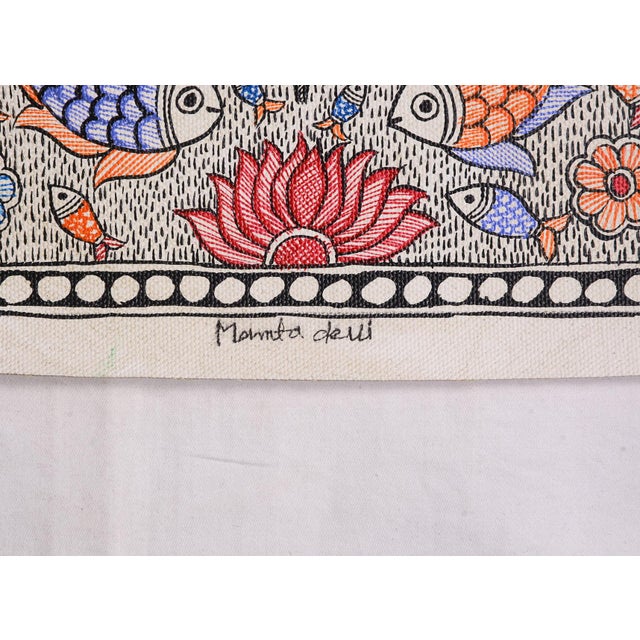
FEATURED ARTIST: MAMTA DEVI
Mamta Devi, a Mithila painting artist and 2016 National Award recipient, was born in Jitwapur village, Madhubani district, Bihar, India, a place renowned for Mithila painting. She began learning the art at age 11 under the guidance of Smt. Shanti Devi, a national awardee.
Her work draws inspiration from the life of Mahatma Gandhi and places a strong emphasis on the environment, conveying messages about the preservation of animals, birds and trees. Based in Delhi, she has trained 30–40 women in Mithila painting and exhibited her work at Pragati Maidan, while contributing to the Make in India initiative.
See less
- Dimensions
- 11ʺW × 0.1ʺD × 16.1ʺH
- Styles
- Folk Art
- Frame Type
- Unframed
- Period
- 2020s
- Country of Origin
- India
- Item Type
- New
- Materials
- Canvas
- Condition
- Mint Condition, No Imperfections
- Color
- Bright Pink
- Condition Notes
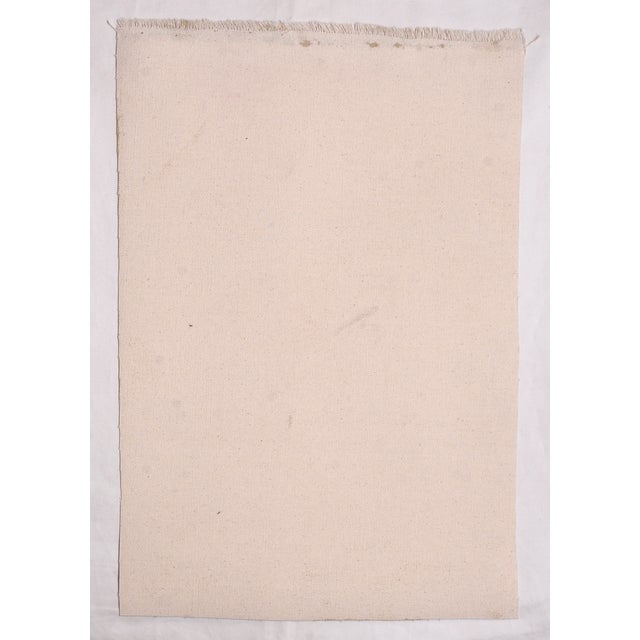
- Excellent. The piece presents outstanding preservation. The fine Kachni linework is crisp, displaying no visible signs of ink fading or … moreExcellent. The piece presents outstanding preservation. The fine Kachni linework is crisp, displaying no visible signs of ink fading or smudging. The color fields (Bharni) are filled cleanly with high saturation and uniform application. The primary structural canvas base appears completely intact, clean, and entirely free from creases, edge tears, water spotting, discoloration, or foxing. The perimeter fringe detailing is uniform and undamaged. less
Questions about the item?
Returns & Cancellations
Return Policy - All sales are final 48 hours after delivery, unless otherwise specified in the description of the product.
Cancellation Policy - Prior to shipping or local pickup, buyers may cancel an order for up to 48 hours, unless otherwise specified.
Related Collections
- Photorealism Paintings in New York
- Photorealism Canvas Paintings
- Ed Ruscha Paintings
- Richard Serra Paintings
- Jo Baskerville Paintings
- Louise Nevelson Paintings
- Karen Offutt Paintings
- Nicola Simbari Paintings
- BDDW Paintings
- Herman Miller Paintings
- Joseph Stella Paintings
- Jaanika Peerna Paintings
- Leroy Neiman Paintings
- Jeff Slemmons Paintings
- Vienna Secession Paintings
- Johannes Andersen Paintings
- Pedro Friedeberg Paintings
- Peter Behrens Paintings
- Piet Hein Eek Paintings
- Raphael Paintings
- Carl-Axel Acking Paintings
- Karl-Erik Ekselius Paintings
- Hans Andersen Paintings
- Jean-Paul Barray Paintings
- Soicher Marin Paintings