




Details
Description
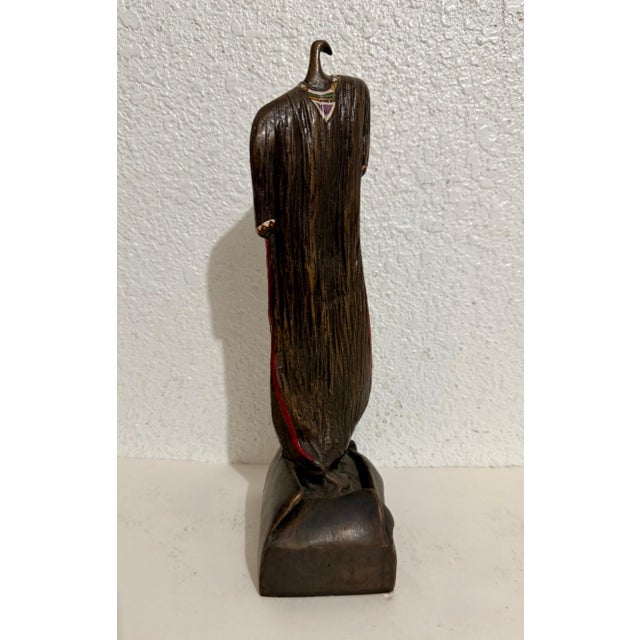
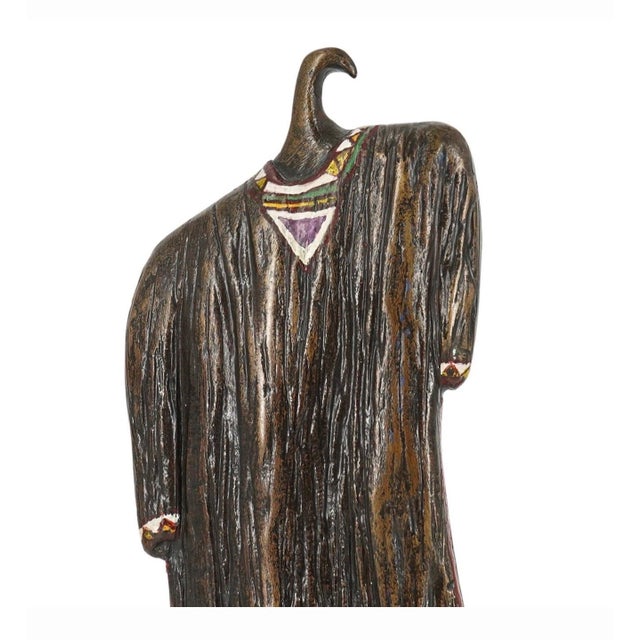
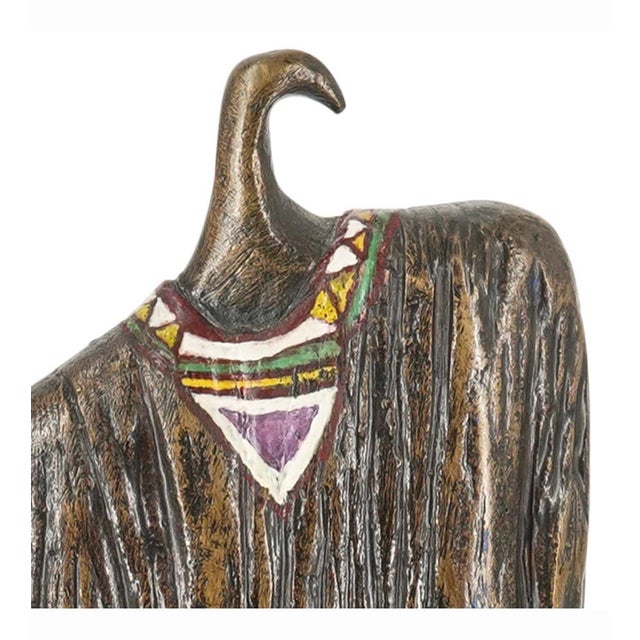
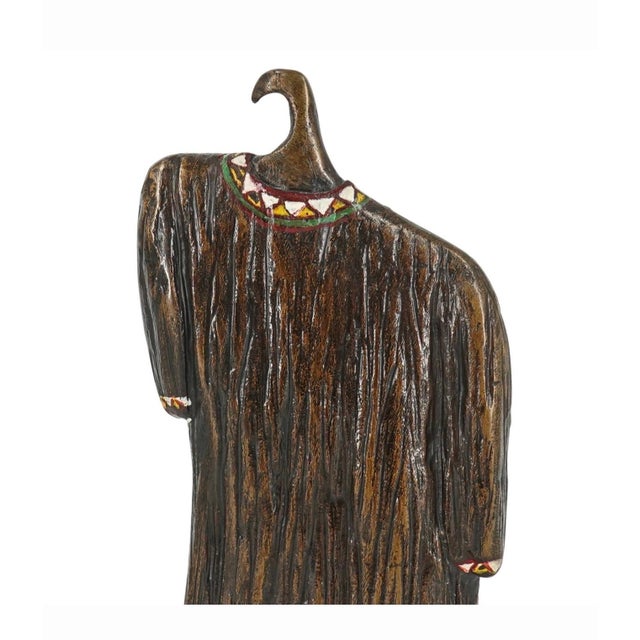
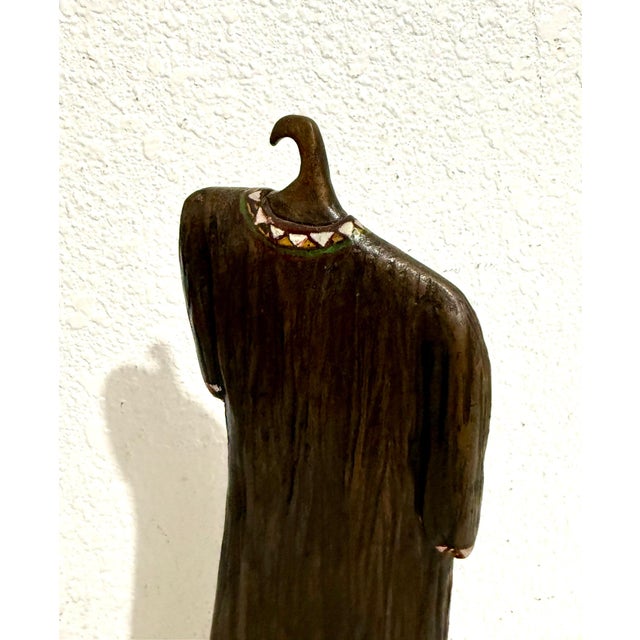
Bronze sculpture by Naomi Siegmann depicting a hanging dress decorated at the hems with geometric patterns. Piece is one with …
Read more
Bronze sculpture by Naomi Siegmann depicting a hanging dress decorated at the hems with geometric patterns. Piece is one with its base which is signed on reverse side: "Naomi Siegmann IV/IX 1992".
Circa: 1992
Dimensions: H: 14" W: 5.5" L: 4"
One of Siegmann’s signature works, a perfect example of her object-displacement hyperrealism. The coat hanging from a hook, rendered in bronze with polychrome painted decorative collar and cuffs, is exactly the kind of everyday object she spent the 1970s and 1980s immortalizing in sculpture.
El Saco (The Coat) or El Abrigo (coat, jacket) Polychrome Bronze Sculpture, Mexico City
With a painted geometric collar and cuffs in red, yellow, green, and white.
Naomi Siegmann (1933–2018)
American-Mexican Sculptor Jewish American Artist Women Artist Wood Carving Bronze Mixed Media Abstract Realism Hyperrealism Salón de la Plástica Mexicana Museo de Arte Moderno Mexico City Mexican Contemporary Art
Naomi Siegmann (October 12, 1933 – February 28, 2018) was one of the most celebrated and distinctive sculptors working in Mexico in the twentieth and twenty-first centuries — a New York-born Jewish American woman artist who built one of the most original and sustained sculptural careers in Mexican art history. Among the very few American Jewish women artists to achieve full membership in the Mexican artistic establishment, Siegmann’s more than five-decade career produced a body of work that moved from virtuosic wood carving through bronze casting, metal assemblage, acrylic, resin, rubber, and mixed media, earning her membership in the prestigious Salón de la Plástica Mexicana and a place in the permanent collections of the Museo de Arte Moderno in Mexico City, as well as major private and institutional collections in Mexico, the United States, and Israel. Over the course of her career Siegmann mounted more than 35 solo exhibitions and participated in more than 75 collective exhibitions across Mexico, the United States, and Europe, becoming one of the most recognized sculptors in the Mexican art world and one of the most significant Jewish women artists working in Latin America in the twentieth century.
Early Life: New York, Jewish Identity, and the Road to Mexico
Born in New York City on October 12, 1933, into a Jewish family, Siegmann came of age in the cultural richness of mid-century New York before moving to Mexico in 1960 with her husband Henry and their family — first to Muzquiz, a small town in the northern state of Coahuila, and then to Mexico City, where she would spend the rest of her life. The move that began as a five-year contract for her husband became permanent, and what began as a housewife’s exploration of clay and paint quickly revealed a sculptor of exceptional gifts. As a Jewish American woman artist finding her voice in Mexico City in the 1960s and 1970s — at a moment when the Mexican art world was dominated by male Mexican-born artists — Siegmann’s achievement in building an internationally recognized career was all the more remarkable. She received her first formal artistic training in the workshop of a Mexico City sculptor, immersing herself in the deep cultural environment of the capital and absorbing the profound influence of pre-Hispanic art and archaeological remains that she would later identify as one of the most powerful stimulants of her creative spirit.
Wood Carving: The First Major Body of Work
In the early 1970s, Siegmann began carving wood — a medium she pursued with extraordinary dedication for over twenty years and which formed the bulk of her production through the 1980s. Her carved wood sculptures depicted everyday objects — tables, leather bags, jackets hanging from chairs, shoes, purses — removed from their normal contexts and rendered in wood with such precision and formal intelligence that they became meditations on perception, materiality, and the uncanny. This approach connected her to the broader international tradition of Hyperrealism and Surrealist object-displacement, while remaining grounded in the specific textures of Mexican daily life. As she described her work: “During many years my work consisted in recreating objects of everyday use: a table, a leather bag, a jacket hanging from a chair... objects that, transplanted from their usual context, acquire a different significance.” Crucially, in over twenty years of carving wood she never once cut down a tree — sourcing all her material from fallen, salvaged, or reclaimed timber, a commitment to conservation that would later inspire her most ambitious environmental project.
Metal, Bronze, and the Carrillo Gil Collaboration
In the 1990s, Siegmann began experimenting with industrial metal, working with discarded molds from a local factory together with the sculptor Inmaculada Abarca — a creative partnership that produced abstract forms exhibited at the Museo de Arte Carrillo Gil in Mexico City, one of the most important contemporary art museums in Latin America. This shift into metal and found industrial materials opened a new phase of her practice, leading to assemblage works, bronze castings, and mixed media sculptures in acrylic, silver, resin, paper, and rubber — including her distinctive use of rubber from car tire inner tubes. Her later work increasingly turned toward the natural world, as she described it — “so imposing, so great, and at the same time so fragile” — as her attention shifted from the quotidian domestic object to the forms and forces of nature itself.
El Bosque / The Forest: Environmental Art and Ecological Activism
Between 2001 and 2006, Siegmann organized and coordinated one of the most ambitious environmental art projects in Mexican art history: El Bosque / The Forest, an artistic and ecological initiative presented in four cities in Mexico and four cities in the United States. Concerned about global deforestation and the potential disappearance of the wood she loved so deeply as a sculptural material, Siegmann invited fifteen sculptors from both the United States and Mexico to create tree forms out of any material except wood — generating a traveling exhibition that functioned simultaneously as artwork, ecological advocacy, and cross-cultural dialogue. The project brought together luminaries of the sculpture world from both countries, underscoring Siegmann’s standing as a central figure in the binational Mexico-United States artistic community and as a Jewish American woman artist who had made Mexico her permanent home and artistic base.
Gallery Representation and Exhibition History
Siegmann’s solo exhibition history spans the most prestigious cultural institutions in Mexico: the Museo de Arte Moderno, Mexico City (1979 and retrospective); the Palacio de Bellas Artes, Mexico City; the Museo de Arte Carrillo Gil, Mexico City; the Museo Casa Estudio Diego Rivera y Frida Kahlo, Mexico City; the Centro Cultural Estación Indianilla, Mexico City; and the Centro Cultural del México Contemporáneo, Mexico City (1982). In the United States, her exhibitions include the Swope Gallery, Los Angeles (1982). In her final years, her work was presented at Proyectos Monclova — one of the leading contemporary art galleries in Latin America — in the two-person exhibition Ensamblajes (Assemblages) with Inmaculada Abarca (November 7 – December 21, 2019). Proyectos Monclova represents artists including Manuel Felguérez, Helen Escobedo, Ángela Gurría, and Eduardo Terrazas — placing Siegmann’s work in the company of Mexico’s most significant contemporary sculptors.
The Salón de la Plástica Mexicana
Siegmann was a member of the Salón de la Plástica Mexicana — the most prestigious association of visual artists in Mexico, founded in 1949, whose membership has included Diego Rivera, David Alfaro Siqueiros, José Clemente Orozco, Rufino Tamayo, and virtually every significant figure in twentieth century Mexican art. As a Jewish American woman artist, her full membership in this most Mexican of institutions was a remarkable testament to the universal power of her work and her standing in the Mexican cultural world.
Jewish Identity and Collections in Israel
Siegmann’s Jewish identity was an integral part of her life and artistic biography — a New York Jewish woman who spent over fifty years building her career in Catholic Mexico, bridging two cultures with extraordinary grace and intelligence. Her work is held in significant collections in Israel alongside her holdings in Mexico and the United States, reflecting the broad reach of her reputation within both the Mexican art world and the international Jewish art collecting community. She stands as one of the most important Jewish women artists to have worked in Latin America in the twentieth century — a figure of genuine historical significance for collectors and institutions focused on Jewish art, women artists, and Latin American modernism alike.
Movements and Artistic Associations
Siegmann’s work has been associated with Abstract Realism, Hyperrealism, Surrealist object-displacement, environmental art, Surrealism, and Mexican Contemporary Sculpture. Her practice connects her to the broader tradition of Mexican Modernism — particularly the generation of artists working in the wake of the Mexican Muralism of Diego Rivera, José Clemente Orozco, and David Alfaro Siqueiros — while her engagement with found industrial materials and ecological themes places her in dialogue with international movements including Arte Povera, assemblage, and environmental sculpture. Her work is documented in the XX Century Dictionary of Mexican Sculpture (1984); Art News (1992); Mexico in the World of Art Collections (1994); A Vision of México and its Artists (2002); and the monographs Naomi Siegmann (1985) and Naomi Siegmann (2014).
Public Commissions
Siegmann was commissioned to create monumental works in both Mexico and the United States, with public sculptures installed at significant sites including the National Auditorium in Mexico City — one of the most prestigious public venues in Latin America.
Museum Collections
Naomi Siegmann’s sculpture is held in the permanent collections of the Museo de Arte Moderno, Mexico City; and major private and institutional collections in Mexico, the United States, and Israel.
Legacy
Naomi Siegmann died in Mexico City on February 28, 2018, from complications of pneumonia, at the age of 84. A New York Jewish woman who became one of Mexico’s most beloved and respected sculptors, she is remembered as an artist of extraordinary range and integrity — a carver, caster, assembler, and environmental activist whose work across five decades tracked the full arc of Mexican contemporary sculpture. As a Jewish American woman artist working in Latin America, she occupies a unique and historically significant position — a figure whose life and work bridge New York and Mexico City, Jewish American culture and Mexican modernism, the domestic object and the natural world. Her sculptures remain among the most original and personally realized works produced in Mexico in the twentieth century, and are actively collected by institutions and private collectors in Mexico, the United States, Israel, and internationally.
Keywords: Naomi Siegmann, Naomi Siegmann sculpture, Naomi Siegmann wood carving, Naomi Siegmann bronze, Jewish woman artist, Jewish American artist Mexico, American Jewish sculptor, women artist Mexico, Latin American women sculptors, Jewish art Latin America, Mexican sculptor, Salón de la Plástica Mexicana, Museo de Arte Moderno Mexico City, Museo de Arte Carrillo Gil, Proyectos Monclova, Inmaculada Abarca, El Bosque Forest Project, Mexican contemporary art, hyperrealism sculpture, abstract realism, assemblage sculpture, environmental art Mexico, Diego Rivera museum, Manuel Felguérez, Helen Escobedo, Ángela Gurría, Mexican modernism, Jewish art collections Israel, Latin American sculpture for sale, wood carving sculpture, mixed media sculpture Mexico, 20th century women artists.
Her work was included in the collection of Graciela Kartofel, an influential art historian, graduate of the Liberal Arts College at the University of Buenos Aires, Argentina in 1976. She created the Latin American Modern and Contemporary Art History Program for UNAM -Mexican National Autonomous University, Mexico City, where she was part of the Faculty for more than a decade before coming to New York. She is lecturer and visiting professor in different universities, among them Cristobal Colón University, Veracruz, Mex.; Universidad Michoacana, Morelia, Michoacán, the Hochschule für Künstlerische und Industrielle Gestaltung in Linz, Austria; and Hunter College, New York City. She works as critic and independent curator specializing in Contemporary Art, and Latin American Art.Even during a time when the art market largely ignored and marginalized Latin American artists and woman artists, Dr. Kartofel championed them. Not only did she give her academic attention to young emerging artists in particular, but she also made their work a part of her personal collection: Marysole Wörner Baz, Mathias Goeritz, Pedro Friedeberg, Pál Kepenyes Naomi Siegmann, Jose Luis Cuevas, Juan Carlos Lasser, Rodolfo Morales and many more.
See less
- Dimensions
- 5.5ʺW × 4ʺD × 14ʺH
- Styles
- Early American
- Art Subjects
- Other
- Period
- 1990s
- Country of Origin
- United States
- Item Type
- Vintage, Antique or Pre-owned
- Materials
- Bronze
- Enamel
- Condition
- Good Condition, Original Condition Unaltered, Some Imperfections
- Color
- Bronze
- Condition Notes
- Good Good less
Questions about the item?
Returns & Cancellations
Return Policy - All sales are final 48 hours after delivery, unless otherwise specified in the description of the product.
Cancellation Policy - Prior to shipping or local pickup, buyers may cancel an order for up to 48 hours, unless otherwise specified.
Related Collections
- Straw Sculpture
- Constantin Brancusi Sculpture
- Fernando Botero Sculpture
- Louis XIV Sculpture
- Roman Bronze Works Sculpture
- Recycled/Repurposed Sculpture
- Gourd Sculpture
- Flavio Poli Sculpture
- Maison Jansen Sculpture
- Georgian Sculpture
- Barovier and Toso Sculpture
- Far Pavilions Sculpture
- Antique Iron Finish Sculpture
- Worlds Away Sculpture
- Photography Sculpture
- Jute Sculpture
- Blenko Sculpture
- Satinwood Sculpture
- Bakelite Sculpture
- Medium-Density Fibreboard Sculpture
- Gold-Plate Sculpture
- Geode Sculpture
- René Lalique Sculpture
- Polished Brass Finish Sculpture
- Sculpture in Panama City, FL