

Details
Description
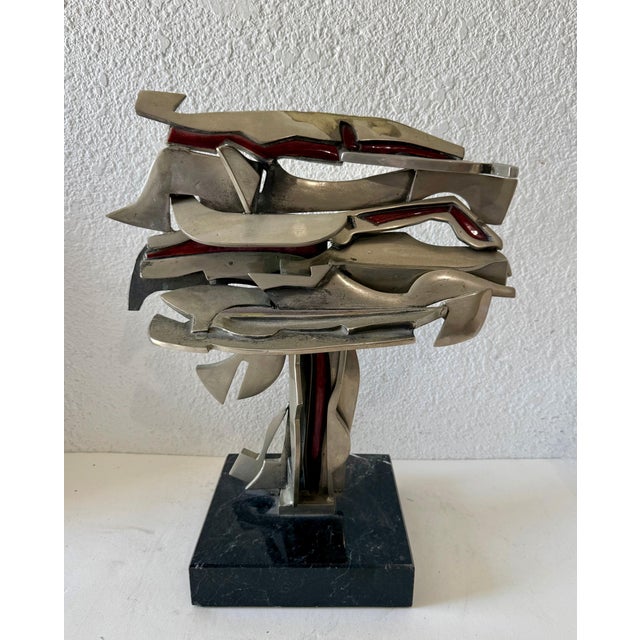
Studio Del Campo, ( most likely Virgilio Bari), Brutalist Abstract Sculpture,
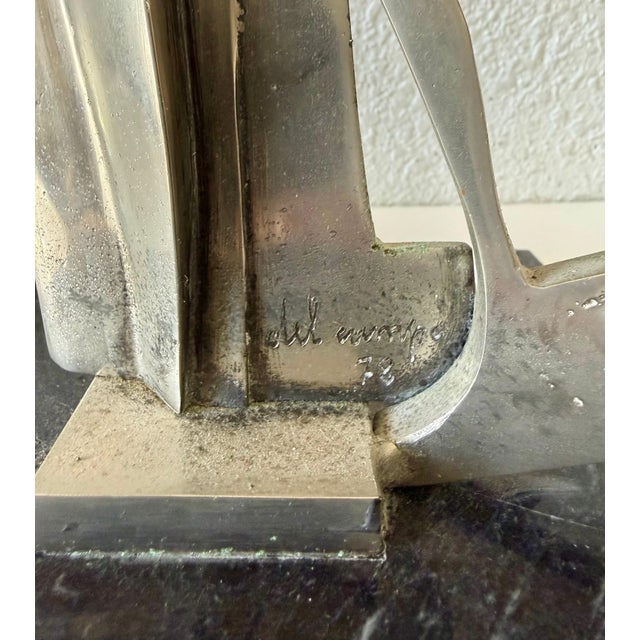
Signed and Dated,
Brushed Steel and High Fire Red …
Read more
Studio Del Campo, ( most likely Virgilio Bari), Brutalist Abstract Sculpture,
Signed and Dated,
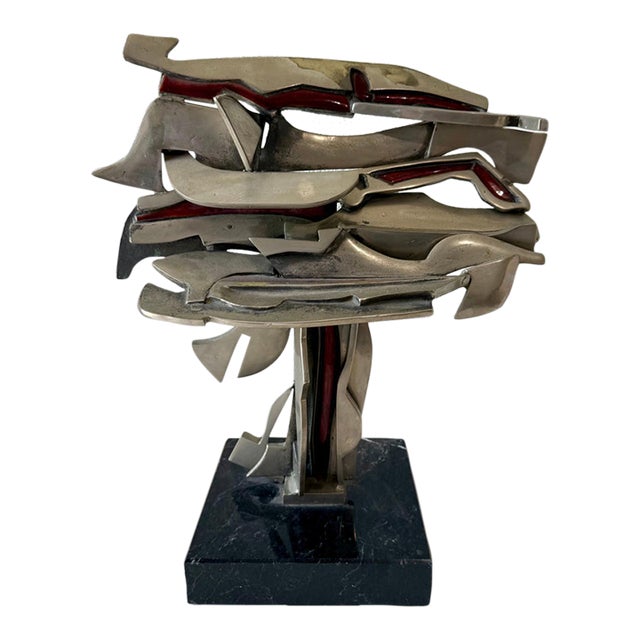
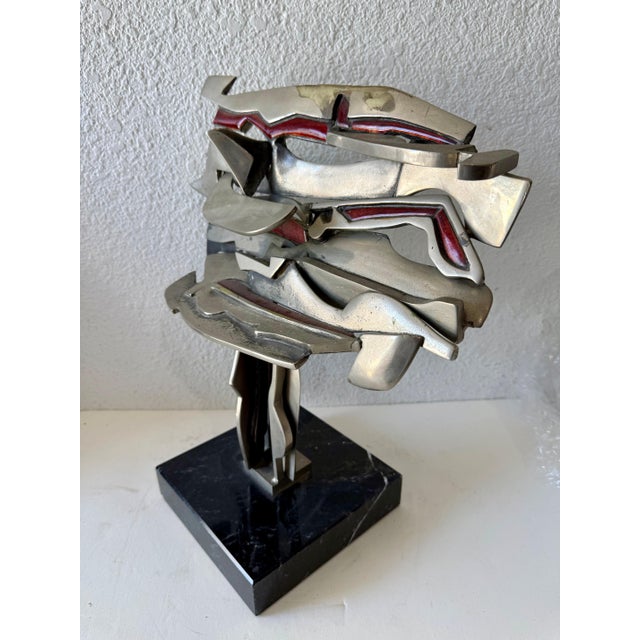
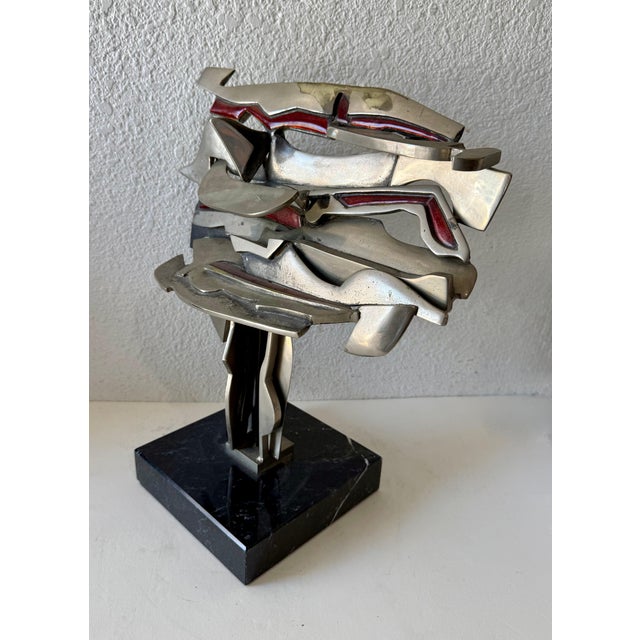
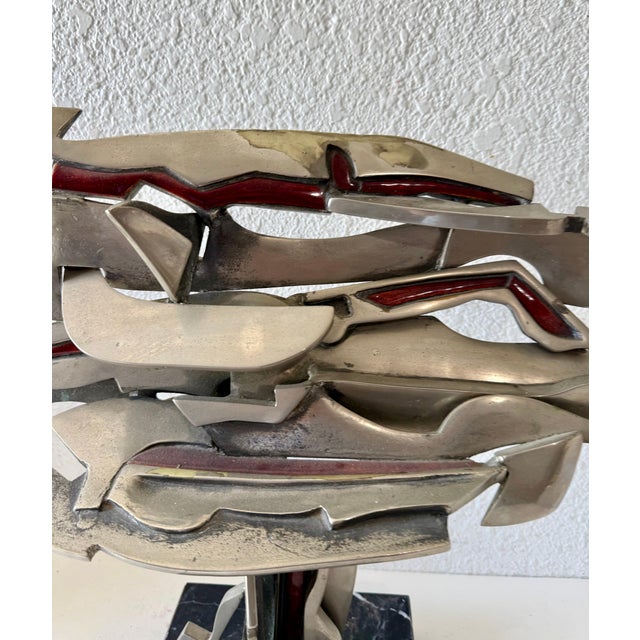
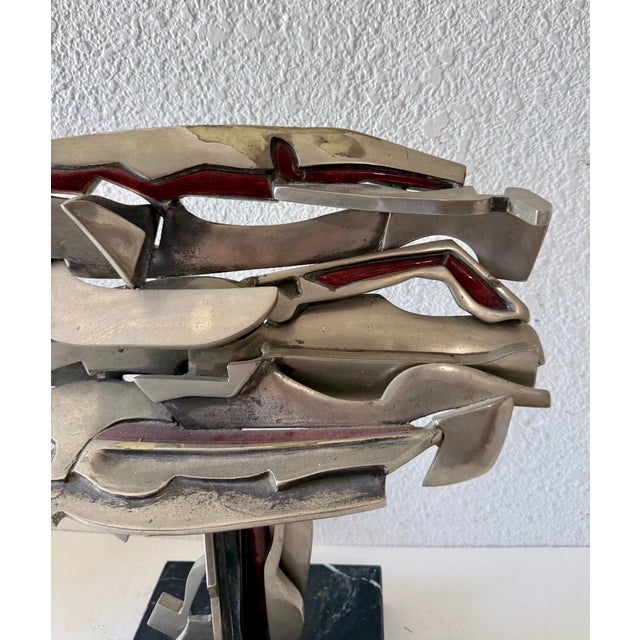
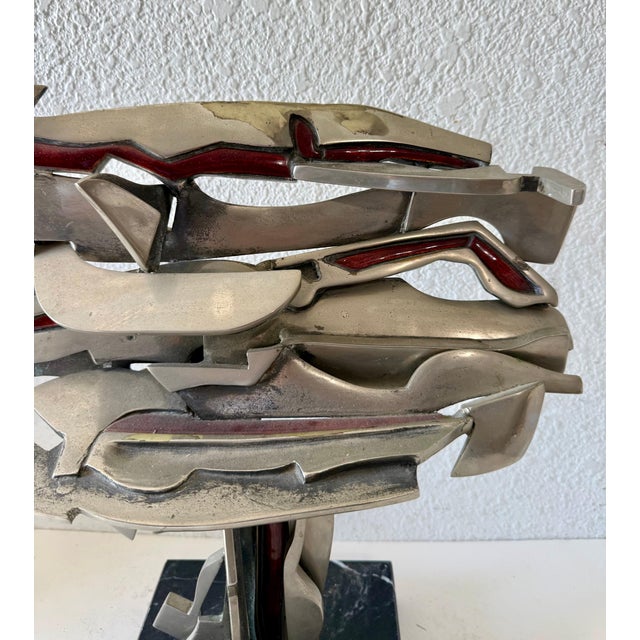
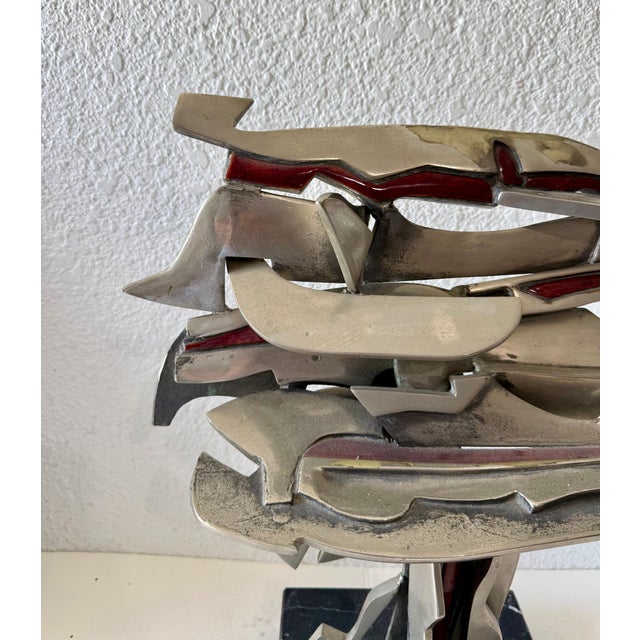
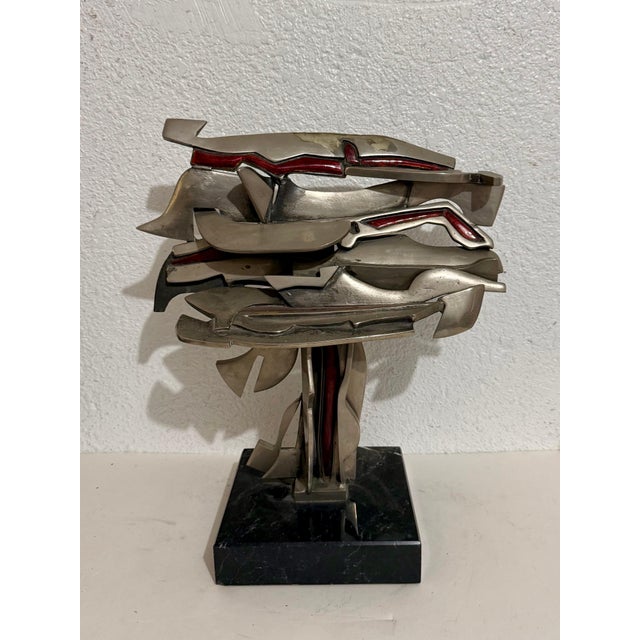
Brushed Steel and High Fire Red Enamel on Black Marble Base, Turin Italy, 1978
Hand engraved, signed directly into the steel at the base of the armature, with the date 78 (1978) just below.
a hallmark of Studio Del Campo’s major sculptural works and an unambiguous authentication of provenance and date.
A rare and exceptional free-standing sculptural work by Studio Del Campo — the celebrated Turin atelier founded in 1957 by craftsman-artists Virgilio Bari, Euclide Chiambretti, Lidia Lanfranconi, and Bianca Tuninetti, and widely considered the finest Italian enamel studio of the twentieth century. This commanding three-dimensional sculpture represents one of the most ambitious categories of Studio Del Campo’s production — a fully sculptural, free-standing work rather than a wall-mounted piece — making it significantly rarer and more collectible than their more commonly encountered bowls, plates, and vide-poches.
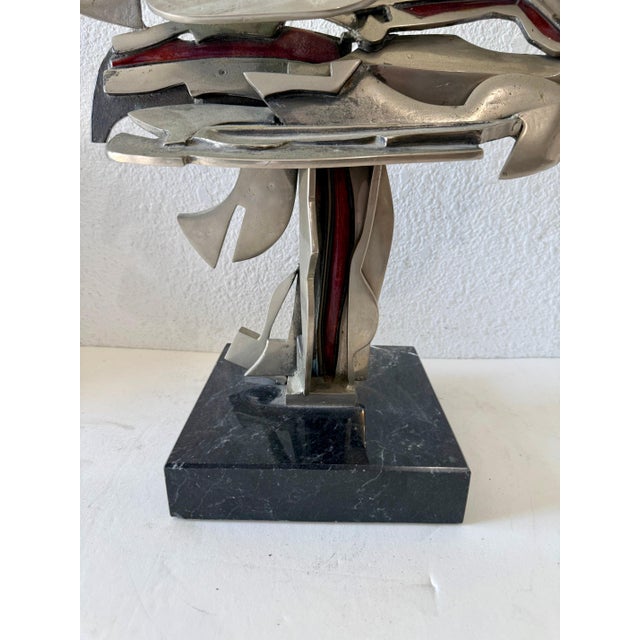
The sculpture is constructed of layered, interlocking planes of brushed and polished steel — cut, bent, and assembled into a dynamic, swirling composition of extraordinary formal complexity and physical presence. Between the steel planes, vivid accents of deep burgundy-red high-fire enamel (smalto a gran fuoco) pulse with color, creating a striking contrast between the cool metallic silver of the steel and the warm, vitreous intensity of the enamel. The layered horizontal planes — each individually worked and fitted — give the composition both a geological quality, suggesting strata of earth or sedimentary rock, and an aerodynamic energy, as though the form is caught mid-rotation. The sculpture is mounted on a slender steel armature that rises from a substantial black marble base, giving the work a commanding vertical presence entirely appropriate for a significant interior.
The combination of brushed steel and red enamel places this work firmly within the Brutalist design tradition of the late 1970s — a moment when Italian design studios were pushing the formal and material possibilities of metal to their limits. The dynamic, fragmented planarity of the composition connects Studio Del Campo’s sculptural work to the broader tradition of Italian postwar abstract sculpture, including the work of Arnaldo Pomodoro, Giò Pomodoro, and Fausto Melotti, while the high-fire enamel accents recall the studio’s deep roots in the Byzantine and Renaissance enamel traditions that underpinned all of their production.
Studio Del Campo collaborated with Gio Ponti, Ettore Sottsass, Toni Cordero, Bruno Munari, Emilio Scanavino, and Fausto Melotti, and their work was included in major survey exhibitions of Italian mid-century design. Their architectural enamel elements can still be found in Turin buildings from this era, and their work is included in the landmark survey Creatività e Innovazione: Gli Smalti dello Studio Del Campo 1957–1977 (Fondazione Plart, Naples, 2019).
A rare opportunity to acquire a major three-dimensional sculptural work by one of the most significant studios in Italian mid-century applied art history.
Studio Del Campo (Turin, Italy, 1957–1998)
Italian Mid-Century Modern Enamel on Copper High-Fire Enamel Applied Arts Italian Design Gio Ponti Ettore Sottsass Turin Craftsmanship Brutalist Design Abstract Decorative Art
Studio Del Campo was one of the most significant and celebrated ateliers in twentieth century Italian applied arts — a Turin-based collaborative studio specializing in the production of high-fire enamels on copper whose work stands as the finest Italian enamel production of the modern era. Founded in 1957 and active until 1998, Studio Del Campo was patronized by the most distinguished architects and designers in Italy, collaborated with figures including Gio Ponti and Ettore Sottsass, and produced objects of such exceptional technical and formal quality that their enameled bowls, plates, sculptures, vases, ashtrays, wall pieces, and architectural elements are now among the most avidly collected Italian mid-century design objects in the world. Studio Del Campo enamels are widely considered the finest produced in Italy in the twentieth century.
Foundation and the Four Founders
Studio Del Campo was founded in 1957 on Via Ludovico Bellardi in Turin — then still a semi-rural street whose open “campo” (field) gave the studio its name — by four craftsman-artists: Virgilio Bari, Euclide Chiambretti, Lidia Lanfranconi (also spelled Lydia, English-born), and Bianca Tuninetto. Together, this quartet formed one of the most remarkable collaborative studios in Italian design history — part artisan workshop, part fine art atelier, part architectural fabricator — working across the full spectrum of enamel production from intimate collectible objects to large-scale architectural installations. Virgilio Bari, the studio’s primary artistic director, was also an independent painter and sculptor of significant standing, and his fine art sensibility permeated every object the studio produced. The studio’s paper label — SMALTI del campo V. Bari — appears on the verso of many of their most important works.
The Art of High-Fire Enamel
Studio Del Campo specialized in smalto a gran fuoco — high-fire enamel, a technically demanding and ancient craft in which powdered glass is fused to metal (primarily copper, but also silver foil, bronze, and steel) at temperatures exceeding 800°C, producing surfaces of extraordinary depth, luminosity, and permanence. Unlike low-fire enamels, high-fire enamel produces colors of incomparable richness and a vitreous surface that is essentially permanent — artistically close to the encaustic and Byzantine mosaic traditions, and technically demanding to an extreme degree. Studio Del Campo elevated this craft to a level that had not been seen in Italy since the Renaissance, producing objects in which the enamel surface itself is the artwork — abstract, painterly, and uniquely beautiful.
Their production ranged across decorative bowls and plates (vide-poche, centrotavola), sculpture and wall-hanging pieces, vases, ashtrays, boxes, candlesticks, architectural handles and plaques, and large-scale Brutalist wall sculptures in steel and enamel. Each piece is hand-produced and unique or near-unique, and the studio’s work bridges the worlds of fine art, decorative art, craft, and architecture in a way that was entirely characteristic of the best Italian mid-century design.
Collaborations: Gio Ponti, Ettore Sottsass, and the Masters of Italian Design
Studio Del Campo’s extraordinary quality attracted the most distinguished names in twentieth century Italian architecture and design. Their documented collaborators include:
Gio Ponti (1891–1979) — the single most important figure in twentieth century Italian design and architecture, designer of Milan’s Pirelli Tower, the Superleggera chair, and the founder of Domus magazine — worked directly with Studio Del Campo, producing enamel designs that the studio fabricated to his specifications. Ponti’s involvement with Del Campo placed the studio at the very summit of Italian modernist design.
Ettore Sottsass (1917–2007) — the visionary designer, architect, and artist who would later found the Memphis Group and whose influence on postwar Italian and international design was immense — also collaborated with Studio Del Campo, encountering the studio’s founders at collective exhibitions and working with them on enamel productions.
Toni Cordero — the distinguished Turin architect and designer — was among the most important collaborators, working with the studio across multiple projects.
Additional collaborators and associates from the Turin and Milan design world included architects and designers Giuseppe Raimondi, Augusto Romano, and Aldo Morbelli. The studio also had stimulating contacts with Nanni Valentini, Bruno Munari — the legendary Italian artist, designer, and writer — Fausto Melotti, Romano Rui, and the painter and sculptor Emilio Scanavino, all encountered through collective exhibitions in which Studio Del Campo participated. The painter Scanavino produced at least one documented unique box executed by Studio Del Campo (Una scatola, un pezzo unico, esecuzione DEL CAMPO, Torino, 1979), demonstrating the studio’s role as fabricator for major Italian fine artists as well as designers.
Architectural Enamel and the Buildings of Turin
Beyond collectible objects, Studio Del Campo produced architectural enamel elements — handles, door plates, decorative panels, and wall installations — that can still be found in Turin buildings constructed between 1955 and the late 1970s. These architectural applications place the studio’s work in the same tradition as Paolo De Poli of Padua — the other great Italian enamellist of the mid-century — and cement their role as essential contributors to the physical fabric of postwar Italian modernist architecture.
Style and Artistic Vision
Studio Del Campo’s aesthetic is rooted in Italian Mid-Century Modernism and abstract art. Their surfaces draw on the Italian Informale movement — the Italian counterpart to Abstract Expressionism, associated with artists such as Emilio Vedova, Alberto Burri, and Emilio Scanavino — translating gestural, painterly abstraction into the demanding medium of high-fire enamel. Their color palettes range from the deep blues, turquoises, and blacks of their 1960s production through the warmer earth tones and Brutalist textures of their 1970s and 1980s work, always achieving a vitreous luminosity and depth that is the hallmark of true smalto a gran fuoco. Their Brutalist wall sculptures in steel and colored enamel — large-scale, textured, and powerfully abstract — are among the most striking Italian decorative art objects of the 1970s.
Exhibition History and Critical Recognition
Studio Del Campo participated in collective exhibitions throughout Italy and was featured in the landmark survey exhibition Creatività e Innovazione: Gli Smalti dello Studio Del Campo 1957–1977 at the Fondazione Plart in Naples (May 9 – July 11, 2019), curated by design historian Anty Pansera — a major retrospective presenting 150 objects from private collections that established the studio’s historical significance definitively. Their work has also been included in major survey exhibitions of Italian mid-century design including the exhibition at Gorizia (2023) in which Studio Del Campo enamels were shown alongside works by Franco Albini, Gio Ponti, Carlo Mollino, Ico Parisi, Piero Fornasetti, Ettore Sottsass, Paolo De Poli, Lino Sabattini, and Alessi — placing Del Campo among the essential names of postwar Italian made in Italy design.
Similar Artists and Comparable Makers
Collectors of Studio Del Campo work typically also collect: Paolo De Poli (Padua) — the other great Italian mid-century enamellist; Piero Fornasetti — the Milan decorator and designer; Carlo Mollino — the Turin architect and designer; Gio Ponti ceramics and objects; Ettore Sottsass early works; Guido Gambone ceramics; Fausto Melotti sculpture; Arnaldo and Gio Pomodoro bronze objects; and the broader tradition of Italian Mid-Century Modern decorative art produced in Turin, Milan, and Venice between 1950 and 1980.
Legacy and Collecting
Studio Del Campo closed in 1998 after forty-one years of continuous production, leaving behind a body of work that is increasingly recognized as among the finest achievements in Italian mid-century applied art. Their enameled copper bowls, plates, sculptures, vases, and wall pieces appear regularly on 1stDibs, Pamono, Incollect, and at Italian auction houses including Aste Bolaffi in Turin, Christie’s Italy, and Capitolium Art. Prices for exceptional pieces range from several hundred to several thousand dollars, with rare large-scale works and documented Gio Ponti collaborations commanding significant premiums.
Keywords: Studio Del Campo, Studio Del Campo enamel, Studio Del Campo Turin, Studio Del Campo bowl, Studio Del Campo sculpture, Studio Del Campo vase, Virgilio Bari, Italian mid-century modern, high-fire enamel, smalto a gran fuoco, enamel on copper, Gio Ponti collaboration, Ettore Sottsass, Toni Cordero, Bruno Munari, Emilio Scanavino, Fausto Melotti, Paolo De Poli, Italian applied arts, Turin design, Italian modernism, Brutalist sculpture enamel, Italian decorative art for sale, mid-century Italian enamel, Studio Del Campo, Italian craft art, postwar Italian design.
See less
- Dimensions
- 16.5ʺW × 8ʺD × 18ʺH
- Styles
- Abstract
- Artist
- Studio Del Campo
- Designer
- Studio Del Campo
- Period
- 1970s
- Country of Origin
- United States
- Item Type
- Vintage, Antique or Pre-owned
- Materials
- Enamel
- Steel
- Condition
- Good Condition, Original Condition Unaltered, Some Imperfections
- Color
- Burgundy
- Condition Notes
- Good minor wear commensurate with age. can use a cleaning or polishing. please see photos. Good minor wear commensurate with age. can use a cleaning or polishing. please see photos. less
Questions about the item?
Returns & Cancellations
Return Policy - All sales are final 48 hours after delivery, unless otherwise specified in the description of the product.
Cancellation Policy - Prior to shipping or local pickup, buyers may cancel an order for up to 48 hours, unless otherwise specified.
Related Collections
- Straw Sculpture
- Constantin Brancusi Sculpture
- Louis XIV Sculpture
- Fernando Botero Sculpture
- Roman Bronze Works Sculpture
- Gourd Sculpture
- Recycled/Repurposed Sculpture
- Barovier and Toso Sculpture
- Far Pavilions Sculpture
- Maison Jansen Sculpture
- Flavio Poli Sculpture
- Georgian Sculpture
- Antique Iron Finish Sculpture
- Worlds Away Sculpture
- Photography Sculpture
- Jute Sculpture
- Blenko Sculpture
- Satinwood Sculpture
- Bakelite Sculpture
- Medium-Density Fibreboard Sculpture
- Geode Sculpture
- René Lalique Sculpture
- Gold-Plate Sculpture
- Sculpture in Panama City, FL
- Emmanuel Villanis Sculpture