





Details
Description
Frank Kleinholz (Brooklyn, 1901 - 1987)
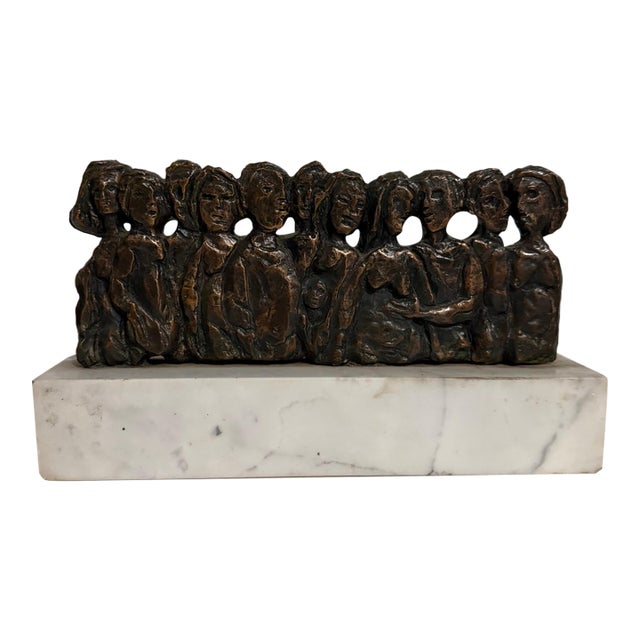
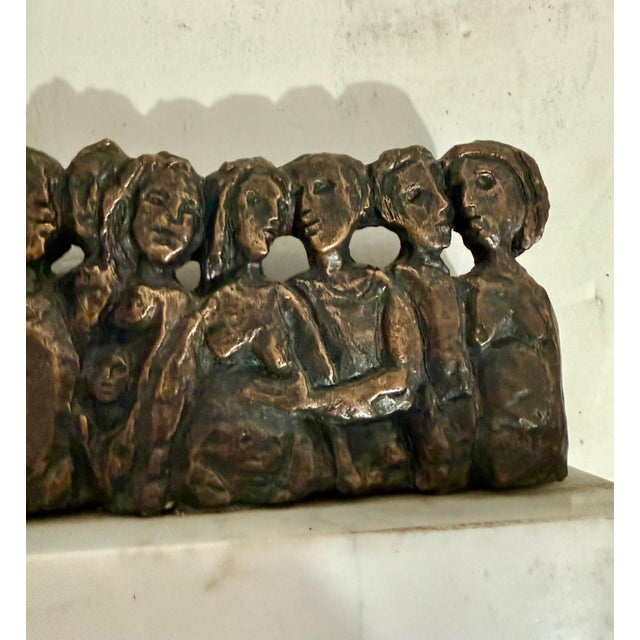
Group of Figures
Bronze on marble plinth base
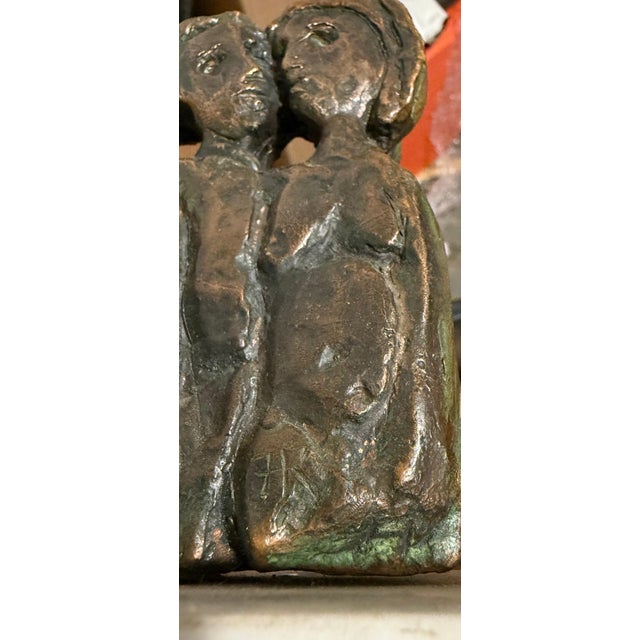
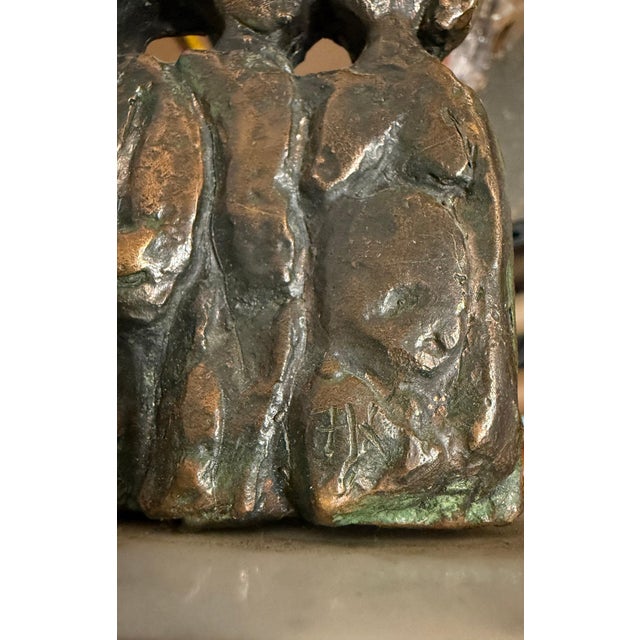
Initialled recto
13.5 X 8 X …
Read more
Frank Kleinholz (Brooklyn, 1901 - 1987)
Group of Figures
Bronze on marble plinth base
Initialled recto
13.5 X 8 X 3.5 inches
c.1950's-1960's
A charming and deeply humanistic bronze relief sculpture by Frank Kleinholz (1901–1987) — the celebrated Brooklyn-born American Modernist painter and sculptor whose work is held in the permanent collections of the Metropolitan Museum of Art, the Brooklyn Museum, the Hirshhorn Museum and Sculpture Garden, the Smithsonian Institution, and the Museum of Modern Art in Tel Aviv.
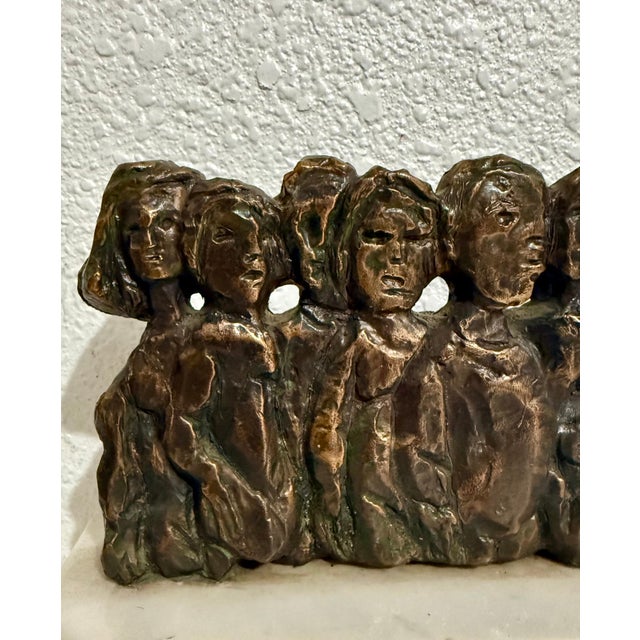
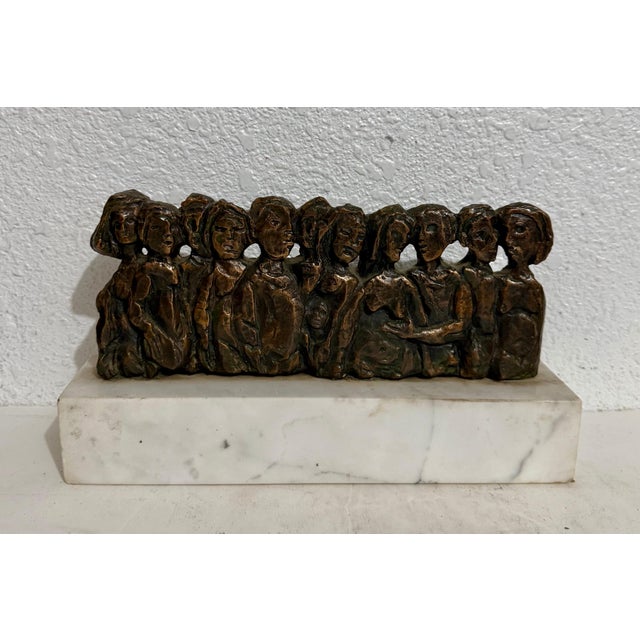
This intimate and beautifully cast bronze presents a frieze of ten closely gathered figures — men and women pressed together in a warm, animated crowd — rendered in Kleinholz’s signature Expressionist style. The figures are modeled with the same loose, gestural energy that characterizes his paintings: faces simplified yet deeply individualized, bodies overlapping and intertwined in a composition that captures the density, warmth, and humanity of urban social life. Each face carries its own quietly distinct expression — one figure appears to speak, another listens, others simply share the proximity of human community — creating a narrative richness entirely characteristic of an artist described by Newsweek as a “Brooklyn-born Gauguin” and compared by critic Jacob Kainen to Marc Chagall for the “Byzantine splendor” of his vision.
The bronze is mounted on a substantial white Carrara marble base, the cool purity of the stone providing an elegant contrast to the warm, dark patina of the bronze frieze above. The work connects Kleinholz’s three-dimensional practice to the great tradition of figurative bronze relief sculpture — from the Renaissance bronze doors of Lorenzo Ghiberti through the social subject reliefs of Ernst Barlach and the humanist figuration of Leonard Baskin — while remaining entirely rooted in the specific world of mid-century American Social Realism and Expressionism that Kleinholz shared with Philip Evergood, Raphael Soyer, Jack Levine, and Ben Shahn.
A rare three-dimensional work by an artist primarily known for his paintings and prints — and a particularly strong example of his lifelong engagement with the beauty and dignity of ordinary human community.
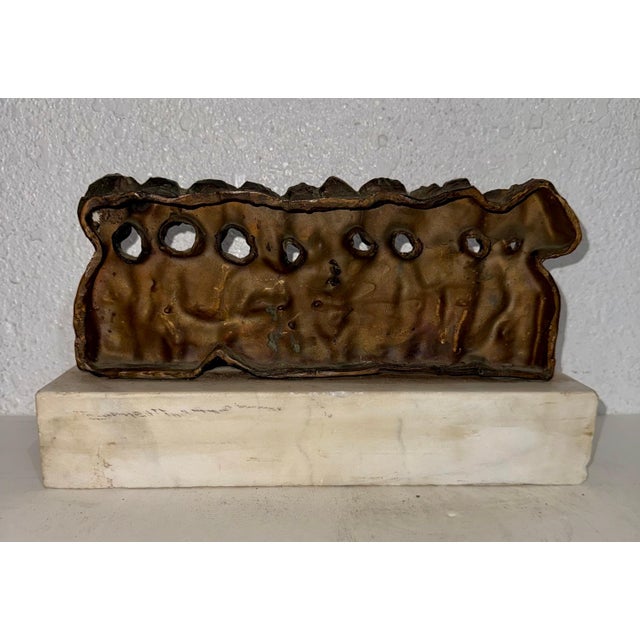
Signed with the artist’s “FK” monogram incised directly into the bronze at lower right — appearing consistently on multiple faces of the sculpture, confirming authenticity.
Frank Kleinholz (1901–1987)
American Modernist Painter Printmaker Social Realism Expressionism Brooklyn Associated American Artists Metropolitan Museum of Art Brooklyn Museum Smithsonian
Frank Kleinholz (1901–1987) was one of the most colorful, humanistic, and genuinely original American Modernist painters of the twentieth century — a Brooklyn-born lawyer who abandoned a legal career in his thirties to become a full-time artist, and whose vivid, Expressionist paintings of urban life, Coney Island, families, children, birds, flowers, and the joyful energy of everyday existence place him in the company of the great American Social Realists and Expressionists of his era. Described by Newsweek as a “Brooklyn-born Gauguin,” and compared by critic Jacob Kainen to Marc Chagall and David Burliuk for his “Byzantine splendor of color,” Kleinholz was a beloved and widely collected figure whose work is held in the permanent collections of the Metropolitan Museum of Art, the Brooklyn Museum, the Hirshhorn Museum and Sculpture Garden, the Smithsonian Institution, the Museum of Modern Art in Tel Aviv, and the Akron Art Institute.
Early Life: Brooklyn, Law School, and the Road to Painting
Born in Brooklyn, New York in 1901 to a blind father and a hard-working mother who supported the family with a delicatessen, Kleinholz grew up in the dense, vivid urban world of early twentieth century Brooklyn that would supply the subjects of his paintings for the rest of his life. A gifted and diligent student, he earned a scholarship to Colby College in Maine and went on to Fordham Law School, passing the bar exam in 1923 at the age of just twenty-two. He practiced law and later insurance for over a decade — building what he described as a “nice bourgeois life” — before boredom and a growing creative restlessness changed everything. In the mid-1930s, through his friendship with artist Alex Dobkin, whose studio was directly across the street, Kleinholz began painting and fell immediately and irrevocably in love with the medium. He spent several years trying to maintain both careers before finally abandoning the law for art entirely — one of the most consequential midlife pivots in American art history.
Education and Artistic Formation
In 1939 Kleinholz was awarded a scholarship to study for one year at the American Artists School in New York — one of the most progressive art schools of the era, with a faculty drawn from the leading figures of Social Realism and American modernism. There he studied under Yasuo Kuniyoshi — the celebrated Japanese-American painter and one of the most important teachers in American art of the mid-twentieth century — and Sol Wilson, the Social Realist painter. The following summer he traveled to Mexico, where he studied and painted — absorbing the direct influence of the Mexican Muralists Diego Rivera, José Clemente Orozco, and David Alfaro Siqueiros, whose monumental, socially committed figurative art was transforming the consciousness of a generation of American painters. Kleinholz subsequently lived in Paris for a period, studying printmaking and spending time on the Île de Bréhat in Brittany — an experience he later commemorated in his book Île de Bréhat: The Flowering Rock (1971) — before returning to New York in 1950.
Artistic Style: Social Realism, Expressionism, and the Joy of Urban Life
Kleinholz’s mature style is a joyful, color-saturated fusion of American Social Realism, German Expressionism, and the chromatic exuberance of the School of Paris. His strongest documented influences include American Social Realists Reginald Marsh and Philip Evergood — both close friends and colleagues; German Expressionists George Grosz and Käthe Kollwitz; Mexican Muralists Rivera, Orozco, and Siqueiros; and the early twentieth century Paris Modernists including Marc Chagall, whose spiritual warmth and Eastern European Jewish sensibility resonates deeply in Kleinholz’s work, and Paul Gauguin, whose bold color and anti-academic directness Kleinholz absorbed and transformed for his own American subjects.
His paintings draw on the rich, vivid world of New York urban life — Brooklyn neighborhoods, Coney Island boardwalks, city parks, street scenes, carnival and circus imagery, and above all the tender, intimate world of parents and children, families at play, sunbathers, birds, and flowers. His palette, which darkened in his early Depression-era works under the weight of social concern, lightened progressively through the 1950s and 1960s into the warm, celebratory color that defines his most beloved paintings. As critic Curtis L. Carter wrote: “These colorful works are inherently a celebration of life.” Jacob Kainen, the distinguished American art critic and printmaker, described Kleinholz’s color as having “Byzantine splendor” and placed him alongside “Chagall and Burliuk” — the great Eastern European Jewish modernists of the Paris School.
Gallery Representation and Exhibition History
Kleinholz exhibited at the most important venues for American modernist and Social Realist art in New York. His one-man exhibitions included the Associated American Artists Gallery, New York — the legendary gallery and print publishing house that brought affordable fine art prints to the American public, and whose roster included Thomas Hart Benton, Grant Wood, John Steuart Curry, Reginald Marsh, and Ben Shahn; the ACA Gallery in New York and Rome — the long-running gallery founded in 1932 that was the primary New York home for Social Realist painting and which showed Philip Evergood, Raphael Soyer, Moses Soyer, Jack Levine, and many of the leading figures of American humanist painting; and the Park Gallery in Detroit. His retrospectives were held at Nassau Community College; Colby College, his undergraduate alma mater; and the Lowe Art Museum at the University of Miami. His work was also exhibited at Susan Teller Gallery in New York — the respected venue for American works on paper and prints — and the Jule Collins Smith Museum of Art at Auburn University.
Colleagues, Contemporaries, and Associated Artists
Through his studies, gallery affiliations, and the broader world of New York Social Realism, Kleinholz was a peer and colleague of Philip Evergood — who wrote the introduction to Kleinholz’s autobiography Frank Kleinholz: A Self-Portrait (1964); Reginald Marsh; Yasuo Kuniyoshi; Sol Wilson; Alex Dobkin; Raphael Soyer; Moses Soyer; Jack Levine; Ben Shahn; and the broader community of American Social Realist and Expressionist painters working in New York from the 1930s through the 1970s. His Mexican sojourn connected him directly to the tradition of Diego Rivera, José Clemente Orozco, and David Alfaro Siqueiros, and his Paris years brought him into contact with the émigré modernist tradition of the School of Paris.
Publications and Writing
Kleinholz was a prolific writer as well as a painter. His published books include Frank Kleinholz: A Self-Portrait (1964), an autobiography with an introduction by Philip Evergood; and Île de Bréhat: The Flowering Rock (1971). Books written about him include Frank Kleinholz: The Outsider by August L. Freundlich (1969) — one of the most substantial monographs devoted to any American Social Realist painter of his generation; and Kleinholz Graphics: Catalogue Raisonné, 1940–1975, which documents his complete graphic output across three and a half decades. His papers — measuring 6.3 linear feet and spanning the 1910s to 1980 — are held in the Archives of American Art at the Smithsonian Institution, Washington, D.C.
Museum Collections
Frank Kleinholz’s paintings and prints are held in the permanent collections of the Metropolitan Museum of Art, New York; the Brooklyn Museum, New York; the Hirshhorn Museum and Sculpture Garden, Washington, D.C.; the Smithsonian Institution, Washington, D.C.; the Museum of Modern Art, Tel Aviv, Israel; and the Akron Art Institute, Ohio.
Legacy
Frank Kleinholz died in 1987, having spent half a century as one of the most productive, warm-hearted, and genuinely original voices in American Modernist painting. A lawyer who became an artist, a Brooklyn boy who absorbed the lessons of Mexico City and Paris and brought them back to Coney Island, a Social Realist who evolved toward pure chromatic joy — Kleinholz’s career is one of the great American art stories of the twentieth century. His paintings, serigraphs, lithographs, and etchings appear regularly at American auction houses and are actively collected by institutions and private collectors, particularly among collectors of American Social Realism, American Expressionism, WPA-era art, and Jewish American art.
Keywords: Frank Kleinholz, Frank Kleinholz painting, Frank Kleinholz print, Frank Kleinholz serigraph, Frank Kleinholz lithograph, American Modernist painter, Social Realism, American Expressionism, Brooklyn artist, Coney Island painting, WPA artist, Associated American Artists, ACA Gallery, Philip Evergood, Reginald Marsh, Yasuo Kuniyoshi, Ben Shahn, Jack Levine, Raphael Soyer, Moses Soyer, Marc Chagall, Metropolitan Museum of Art collection, Brooklyn Museum collection, Hirshhorn Museum collection, Smithsonian collection, Museum of Modern Art Tel Aviv, Archives of American Art, American Social Realist painter, Jewish American art, 20th century American painting for sale.
See less
- Dimensions
- 13.5ʺW × 1ʺD × 8ʺH
- Styles
- Expressionism
- Art Subjects
- Figure
- Period
- 1950s
- Country of Origin
- United States
- Item Type
- Vintage, Antique or Pre-owned
- Materials
- Bronze
- Marble
- Condition
- Good Condition, Original Condition Unaltered, Some Imperfections
- Color
- Bronze
- Condition Notes
- Good minor wear. light soiling to linen mat. please see photos. Good minor wear. light soiling to linen mat. please see photos. less
Questions about the item?
Returns & Cancellations
Return Policy - All sales are final 48 hours after delivery, unless otherwise specified in the description of the product.
Cancellation Policy - Prior to shipping or local pickup, buyers may cancel an order for up to 48 hours, unless otherwise specified.
Related Collections
- Straw Sculpture
- Fernando Botero Sculpture
- Constantin Brancusi Sculpture
- Louis XIV Sculpture
- Roman Bronze Works Sculpture
- Gourd Sculpture
- Recycled/Repurposed Sculpture
- Barovier and Toso Sculpture
- Far Pavilions Sculpture
- Maison Jansen Sculpture
- Flavio Poli Sculpture
- Georgian Sculpture
- Antique Iron Finish Sculpture
- Worlds Away Sculpture
- Photography Sculpture
- Jute Sculpture
- Blenko Sculpture
- Satinwood Sculpture
- Bakelite Sculpture
- Medium-Density Fibreboard Sculpture
- Geode Sculpture
- René Lalique Sculpture
- Gold-Plate Sculpture
- Polished Brass Finish Sculpture
- Emmanuel Villanis Sculpture