

Details
Description
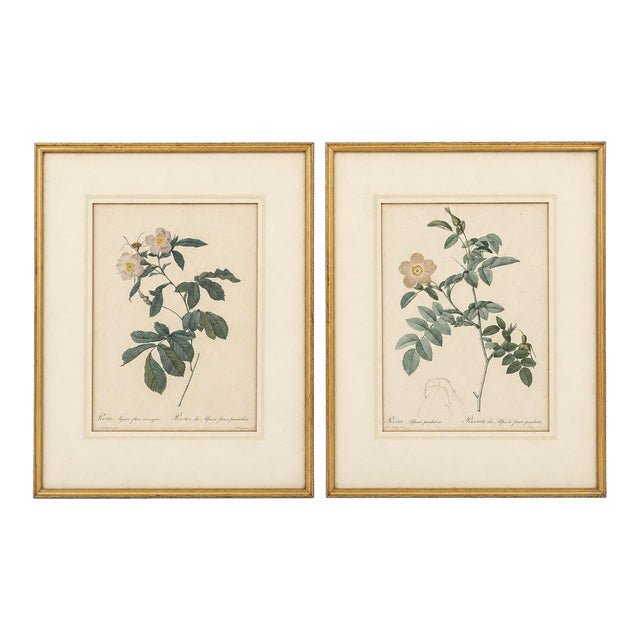
An exceptional coordinated pair of early 19th-century French botanical engravings depicting two varieties of the Alpine rose. The compositions are …
Read more
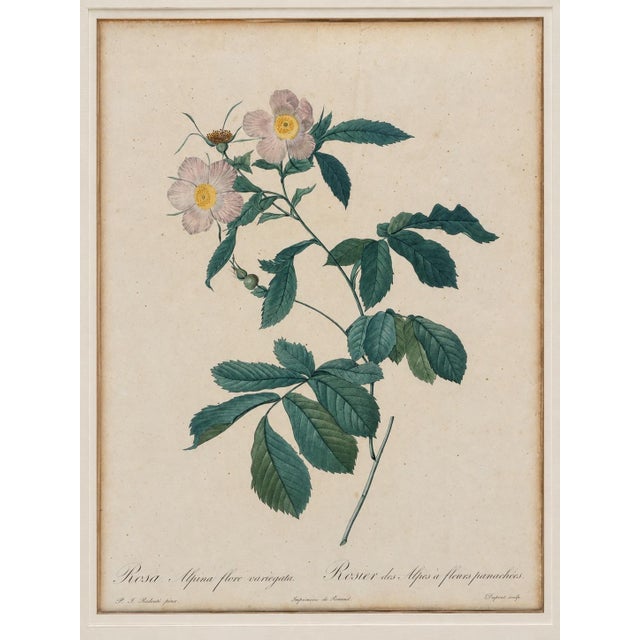
An exceptional coordinated pair of early 19th-century French botanical engravings depicting two varieties of the Alpine rose. The compositions are after botanical paintings by Pierre-Joseph Redouté and are associated with his celebrated publication Les Roses, with accompanying botanical text by Claude-Antoine Thory.
Les Roses was published in Paris by Firmin Didot between 1817 and 1824. These two subjects appear together within the early portion of the publication:
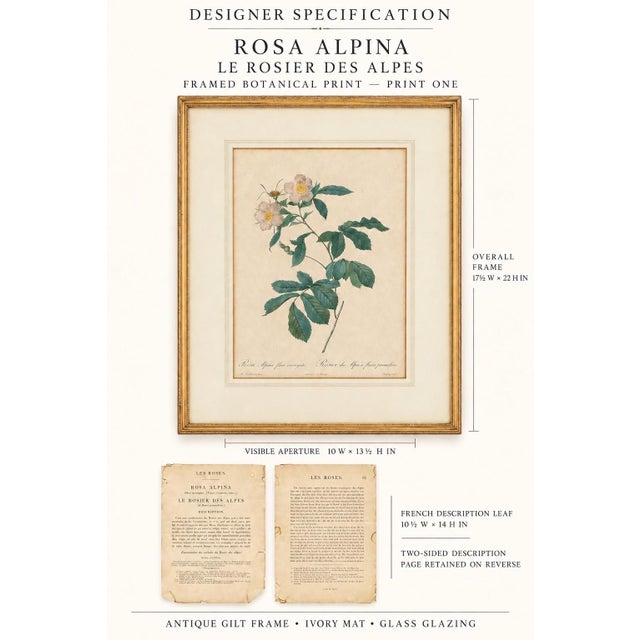
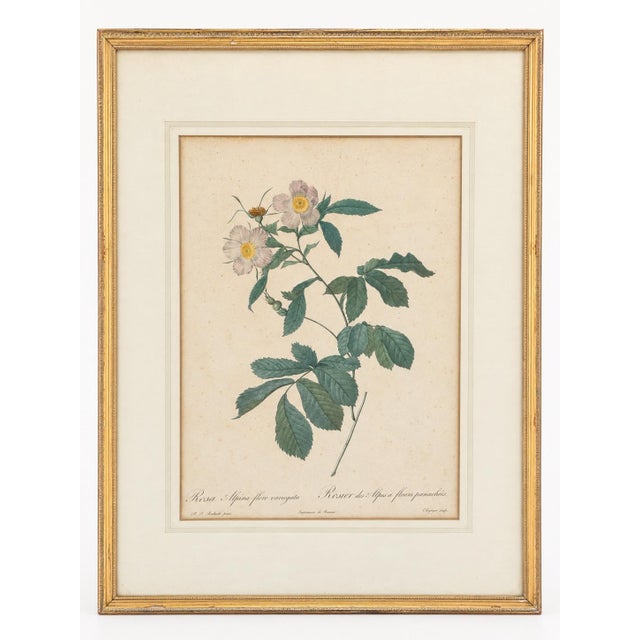
• Rosa alpina flore variegata — Rosier des Alpes à fleurs panachées
Alpine Rose with Variegated Flowers
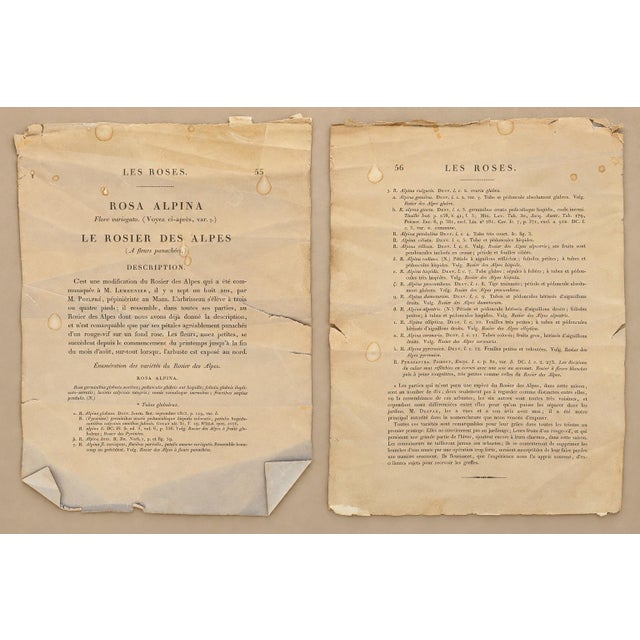
Accompanied by French description pages 55–56
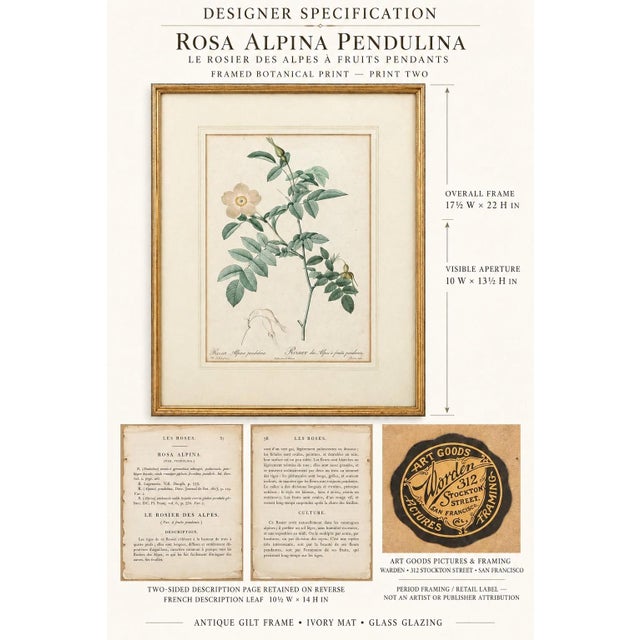
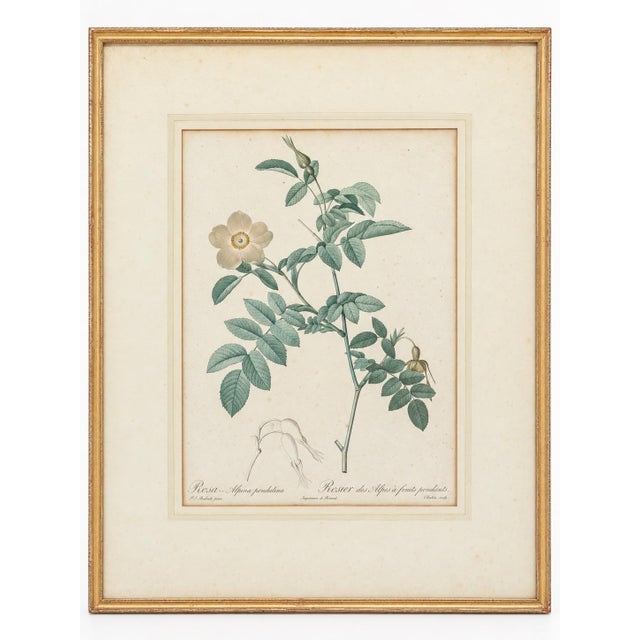
• Rosa alpina pendulina — Rosier des Alpes à fruits pendants
Alpine Rose with Pendant Fruit
Accompanied by French description pages 57–58
Each plate presents a meticulously observed rose specimen accompanied by its Latin botanical name and French common title. The refined stipple work, restrained coloring, graceful composition and precise botanical detail reflect the sophisticated union of art and natural history for which Redouté’s publications became renowned.
PRODUCTION AND PRINTED CREDITS
These works are best described as color-printed stipple engravings after botanical paintings by Pierre-Joseph Redouté, accompanied by botanical descriptions written by Claude-Antoine Thory.
Visible inscriptions beneath the compositions appear to include:
• “P. J. Redouté pinx.” — indicating that Redouté painted or designed the original botanical composition
• “Imprimerie de Rémond” — identifying the specialist Paris color-printing workshop associated with the production
• An engraver’s credit at the lower right, presently partially obscured and to be fully transcribed when the plates are professionally examined outside their mats
The original plates in Les Roses were created by specialist engravers working after Redouté’s paintings. The resulting stipple engravings were printed in color from copperplates and finished by hand. They are not original watercolor paintings or engravings personally cut by Redouté.
ORIGINAL PUBLICATION FORMAT
Les Roses was issued in Paris in approximately 30 subscription installments, known as livraisons, before being assembled into bound volumes.
The botanical images and their scholarly descriptions were produced as separate elements. The illustrations were printed as individual, single-sided plates, while the accompanying descriptions were printed by letterpress on separate paper leaves. These descriptive leaves were printed on both sides—recto and verso—rather than on the reverse of the botanical engravings.
Subscribers or binders could interleave the plates with their corresponding descriptions when assembling the publication. As a result, an original botanical plate and its associated two-sided text leaf are physically separate pieces of paper.
This surviving pair retains both botanical plates and the corresponding French description leaves. The consecutive pagination—pages 55–56 followed by pages 57–58—together with the matching Alpine rose subjects indicates that these were neighboring entries within the same original publication sequence.
SIGNIFICANCE OF THE FRENCH LANGUAGE
Both the engraved captions and the associated two-sided description leaves retain their original French-language presentation, as expected for a botanical work produced and published in Paris for an early 19th-century French scholarly and horticultural audience.
The Latin names provide formal scientific identification, while the French titles and descriptions communicate each plant’s appearance, growth habits, classification and suitability for cultivation.
The use of French is therefore not merely decorative. It is consistent with the language, place of publication and intended audience of the original Paris production. When considered together with the consecutive pagination, corresponding botanical titles, period typography, physical format and visible production credits, the French text provides meaningful bibliographic evidence supporting the association with Les Roses.
The French language alone does not conclusively establish authenticity or edition, since later French editions and facsimiles exist. Its presence is nevertheless an important and appropriate component of the surviving publication history.
DIMENSIONS AND BIBLIOGRAPHIC EVIDENCE
Each accompanying French text leaf measures approximately:
10½ inches wide × 14 inches high
Approximately 267 × 356 mm
These measurements closely correspond to the documented small-folio format of the first edition of Les Roses, recorded at approximately 260 × 360 mm.
This strong dimensional agreement—combined with the French letterpress text, consecutive pagination, matching botanical subjects, printed production credits and apparent age of the paper—provides substantial supporting evidence for an early publication origin.
Final determination of the precise edition and impression remains subject to physical examination.
DATE, EDITION AND ATTRIBUTION
The subjects are associated with Volume I of Les Roses, first published in 1817. The plates and accompanying text leaves are believed to date from the early 19th century and are attributed to the original French publication.
The botanical illustrations are attributed as color stipple engravings after Pierre-Joseph Redouté, with text by Claude-Antoine Thory and publication associated with Firmin Didot in Paris.
The surviving French leaves are original botanical description pages rather than later certificates of authenticity. They provide valuable bibliographic evidence connecting each botanical image to its corresponding entry in Les Roses.
The precise edition, impression, paper and method of coloring have not yet been formally verified. No definitive representation that these are first-edition impressions is made before specialist physical examination.
SPECIALIST EXAMINATION
The works are scheduled for specialist examination. That examination is expected to address:
• Paper type and age
• Watermarks, if present
• Plate marks and sheet dimensions
• Stipple and line-engraving techniques
• Color printing and evidence of hand-finishing
• Printed artist, printer and engraver credits
• Typography and letterpress characteristics
• Mounting and attachment methods
• Comparison with documented first-edition examples
Until that examination is complete, the works are offered as early 19th-century French botanical engravings attributed to the production of Redouté’s Les Roses, with their corresponding period French description leaves.
PRESERVATION AND CONDITION HISTORY
The botanical plates have been well protected beneath glass within their antique or vintage gilt frames. Although the plates display expected age-related toning, scattered foxing and discoloration near the mat openings, they appear substantially better preserved than the accompanying text leaves. Their subtle pink, yellow and blue-green coloration remains attractive.
The French folio description leaves were attached with tape to the exterior backs of the frames, where they were exposed to considerably more handling and environmental wear. Consequently, the text leaves exhibit pronounced toning, staining, folds, tears, edge losses, small areas of paper loss and remnants of earlier attachment materials.
This honest wear forms part of the pair’s history and charm. The survival of the corresponding text leaves with both engravings is bibliographically valuable, as such documentation was frequently separated from individual botanical plates over time.
The description leaves have intentionally been left affixed to the reverse of their respective frames so that their longstanding association with the botanical engravings remains intact and the pair’s provenance is not inadvertently disrupted.
The leaves may be carefully detached for separate archival storage or for a two-sided display presentation. Because the paper is old and fragile and the tape may have affected its fibers, removal should be undertaken by a qualified paper conservator or experienced archival framer rather than pulled away by hand.
If reframed, an ideal museum presentation would preserve each botanical engraving under UV-filtering glazing while placing its corresponding two-sided French leaf in a separate reversible archival mount or double-sided display.
FRAMES AND PRESENTATION
Each botanical print is currently presented under glass with an ivory-colored mat in a narrow gilt frame.
Dimensions for each framed work:
Overall frame:
17½ inches wide × 22 inches high
Visible image aperture:
10 inches wide × 13½ inches high
French description leaf:
Approximately 10½ inches wide × 14 inches high
The frames appear later than the botanical plates and are most likely early-to-mid 20th century or later. They should not be represented as original 1817 publication frames.
They are nevertheless attractive antique or vintage frames that have become part of the pair’s presentation and ownership history. Their traditional gilt finish and aged ivory mats complement the restrained colors and classical botanical subject matter.
WARDEN SAN FRANCISCO LABEL
A period retailer and framing label on the reverse reads:
“Art Goods • Pictures & Framing • Warden • 312 Stockton Street • San Francisco, Cal.”
This label documents a later San Francisco retail or framing association. It is not an artist’s seal, publisher’s mark or certificate of authenticity.
The Warden label nevertheless provides useful evidence concerning the pair’s later history in California and suggests that the engravings were framed, sold or handled by the San Francisco establishment during an earlier period of ownership.
DETAILED CONDITION
The botanical plates display visible age-related toning, scattered foxing and speckling, with discoloration near portions of the mat openings. Their coloration remains visually appealing.
The narrow gilt frames display minor rubbing, finish variation and wear consistent with age. The ivory mats show toning and scattered marks.
The French text leaves are fragile and display considerably more wear than the protected plates. Condition includes tears, losses around the edges, folds, creases, staining, overall toning and old tape or attachment remnants. These conditions are visible in the photographs and form part of the objects’ surviving history.
The prints have not yet been removed from their frames. Concealed margins, complete plate marks, watermarks, reverse surfaces, mounting methods and inscriptions beneath the mats remain unexamined.
ENGLISH TRANSLATION SUMMARY — ROSA ALPINA FLORE VARIEGATA
“Alpine Rose with Variegated Flowers”
The French text describes a variation of the Alpine rose communicated to M. Lemeunier by M. Poilpré, a nurseryman at Le Mans.
The shrub grows approximately three to four feet high and resembles the Alpine rose in most respects. It is distinguished principally by petals attractively variegated with vivid red against a pink ground. Its relatively small flowers appear successively from the beginning of spring through the end of August, particularly when the shrub is planted with a northern exposure.
The remainder of the entry places the plant within the botanical varieties of Rosa alpina and compares it with closely related forms.
ENGLISH TRANSLATION SUMMARY — ROSA ALPINA PENDULINA
“Alpine Rose with Pendant Fruit”
The French description identifies an Alpine rose with long, spreading stems reaching approximately three to four feet and generally lacking prickles.
Its leaves are composed of seven or nine toothed leaflets, bright green above and paler beneath. The plant is especially distinguished by its pendant fruit.
The text records its association with mountainous regions of Europe and praises the attractive autumn effect created by its red, hanging fruits. It recommends the rose for picturesque garden settings, particularly in an open exposure and light soil.
SALE NOTE
Offered as a coordinated pair with their corresponding two-sided French botanical description leaves, antique or vintage gilt frames, ivory mats, glass glazing and documented Warden San Francisco framing label.
The plates are attributed to the early 19th-century Paris production of Pierre-Joseph Redouté’s Les Roses. Formal authentication and determination of the exact edition or impression remain pending.
The original French text leaves remain attached to the backs of the frames to preserve their historical association with the corresponding plates. Their worn condition provides an evocative contrast to the botanical engravings, which remained comparatively protected beneath glass.
SEO TAGS
Pierre-Joseph Redouté, Redoute roses, Les Roses botanical prints, antique French botanical engravings, Rosa Alpina, Alpine rose prints, color stipple engravings, hand-finished botanical prints, early nineteenth-century botanical art, 1817 French botanical folio, Claude-Antoine Thory, Firmin Didot, Imprimerie de Remond, antique rose prints, French botanical wall art, framed botanical pair, gilt framed botanical art, original French botanical text, two-sided folio leaves, rare book plates, natural history prints, antique floral engravings, small folio botanical prints, garden room decor, English country house decor, Grandmillennial wall art, traditional botanical artwork, San Francisco framing label, Warden Art Goods, Chairish botanical art
See less
- Dimensions
- 17ʺW × 1ʺD × 22ʺH
- Frame Type
- Framed
- Art Subjects
- Botanic
- Still Life
- Period
- Early 19th Century
- Country of Origin
- France
- Item Type
- Vintage, Antique or Pre-owned
- Materials
- Engraving
- Condition
- Good Condition, Original Condition Unaltered, Some Imperfections
- Color
- Beige
- Condition Notes
- The pair is in good antique condition overall, with wear consistent with early paper works and later framing. The botanical … moreThe pair is in good antique condition overall, with wear consistent with early paper works and later framing. The botanical engravings have remained protected beneath glass and are considerably better preserved than the accompanying French text leaves. Both plates display age-related toning, scattered foxing and speckling, and areas of discoloration near the mat openings. Their delicate pink, yellow and blue-green coloration remains attractive and the botanical compositions present well. The ivory-colored mats exhibit age-related toning and scattered marks. The narrow gilt frames show minor rubbing, finish variation and surface wear consistent with age, without significant structural damage noted. Glass glazing is present on both frames. The original two-sided French description leaves were taped to the exterior backs of the frames and consequently experienced greater exposure, handling and wear. The leaves exhibit pronounced toning, staining, folds, creases, tears, irregular edges, areas of paper loss and remnants of earlier tape or attachment material. This honest wear contributes to their antique character and documents their long association with the corresponding botanical plates. The description leaves have been left attached to the backs of their respective frames to preserve that historical association. Because the paper is fragile, any removal for separate archival storage or display should be undertaken carefully, preferably by a qualified paper conservator or experienced archival framer. The prints have not yet been removed from their frames. Concealed margins, complete plate marks, watermarks, reverse surfaces and existing mounting methods remain unexamined. Please review all photographs as an integral part of the condition report. less
Questions about the item?
Returns & Cancellations
Return Policy - All sales are final 48 hours after delivery, unless otherwise specified in the description of the product.
Cancellation Policy - Prior to shipping or local pickup, buyers may cancel an order for up to 48 hours, unless otherwise specified.
Related Collections
- Patrick Nagel Reproduction Prints
- Reproduction Prints in Panama City, FL
- William Hogarth Reproduction Prints
- Jute Reproduction Prints
- Reproduction Prints in Mobile
- Hable Reproduction Prints
- Sam Francis Reproduction Prints
- Utagawa Kunisada (Toyokuni Iii) Reproduction Prints
- Leather Reproduction Prints
- Reproduction Prints in Boise
- Alvar Aalto Reproduction Prints
- Daylight Dream Editions Reproduction Prints
- Tuscan Reproduction Prints
- Port 68 Reproduction Prints
- Polychrome Reproduction Prints
- Gold-Plate Reproduction Prints
- Bunny Williams Home Reproduction Prints
- Dorothy Draper Reproduction Prints
- Restoration Hardware Reproduction Prints
- Ralph Lauren Home Reproduction Prints
- Lauren Ralph Lauren Reproduction Prints
- Jonathan Adler Reproduction Prints
- Serena and Lily Reproduction Prints
- Sister Parish Reproduction Prints
- Ralph Lauren Reproduction Prints