

Details
Description
A rare and beautifully detailed Edwardian Sheraton Revival corner chair, crafted in richly toned mahogany circa 1900–1910. More than an …
Read more
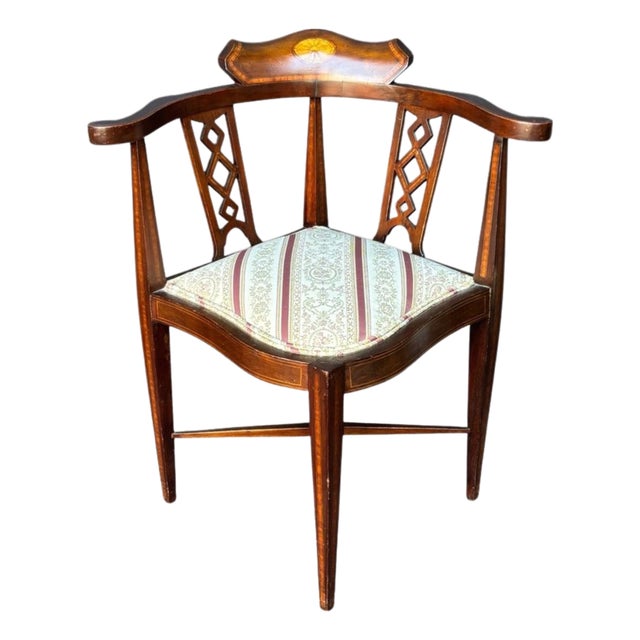
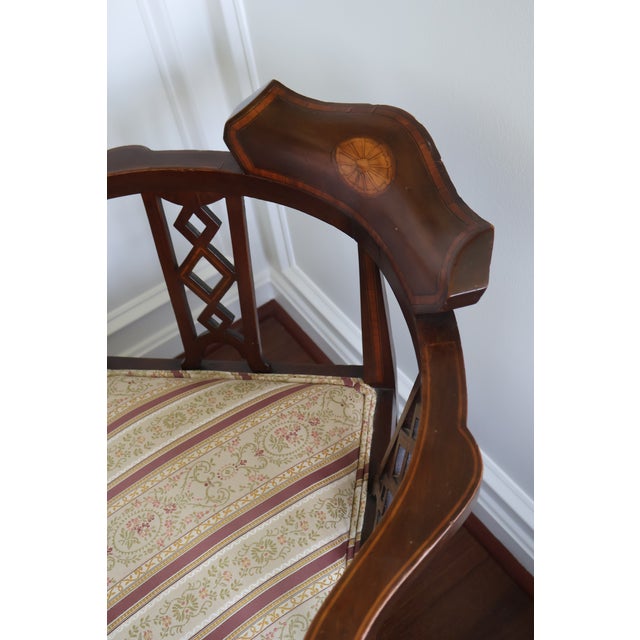
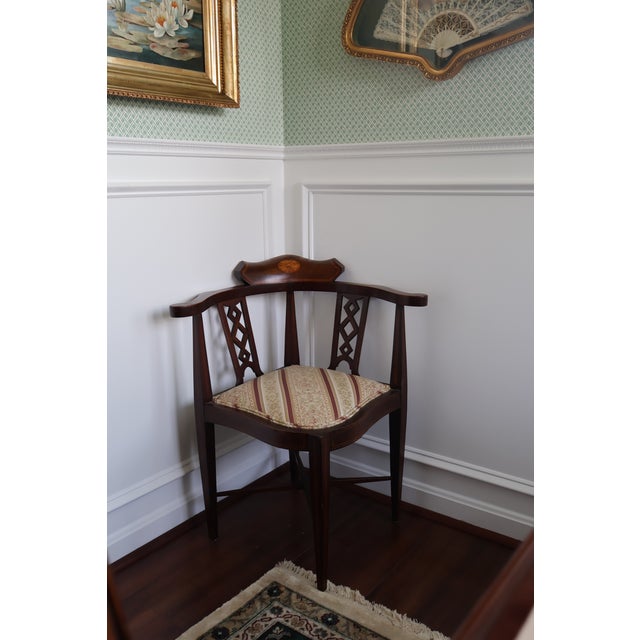
A rare and beautifully detailed Edwardian Sheraton Revival corner chair, crafted in richly toned mahogany circa 1900–1910. More than an unusual accent chair, it represents the Edwardian rediscovery of two much older traditions in British furniture: the early-18th-century corner or “roundabout” chair and the refined neoclassical language associated with Thomas Sheraton.
Corner chairs first appeared in England during the early 18th century. Their distinctive geometry places one point of the seat—and often a corresponding leg—forward, while the back wraps around the sitter in a broad arc. Period inventories used names including “round chair,” “three-cornered chair,” and “roundabout chair.” Historically associated with writing, conversation, and compact placement, the form allowed a sitter to turn naturally toward a desk or into a room rather than facing squarely against a conventional chair back. Corner-chair history
By the beginning of the 20th century, this historic seating form was being reinterpreted through the Sheraton Revival. The movement looked back to the elegant late-Georgian designs disseminated through Thomas Sheraton’s influential furniture pattern books beginning in the 1790s. Sheraton furniture favored visual lightness, tapered supports, mahogany, contrasting woods, fine linear inlay, and restrained classical ornament. Edwardian makers revived that vocabulary as a graceful alternative to the heavier furniture associated with much of the Victorian period.
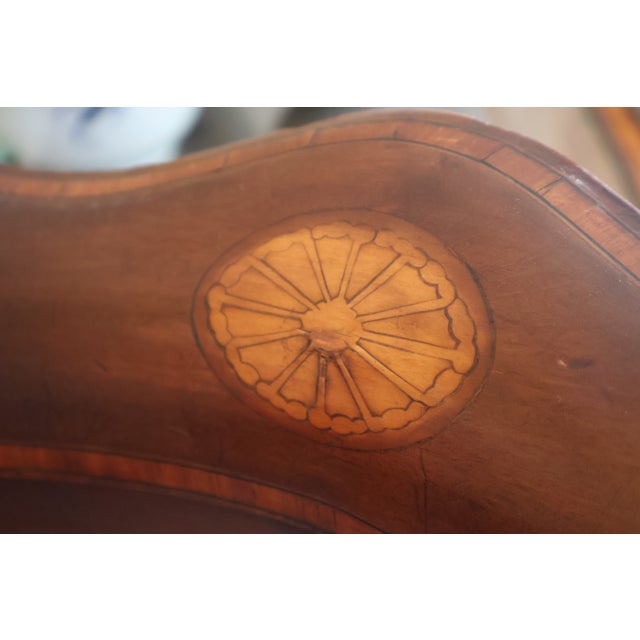
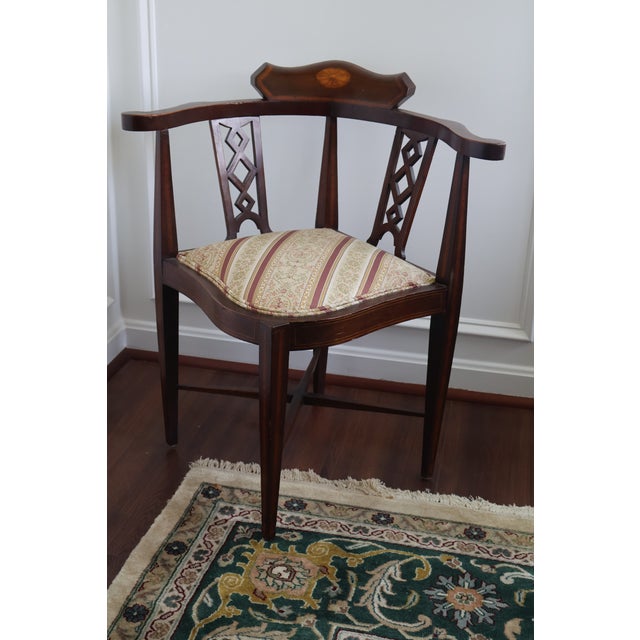
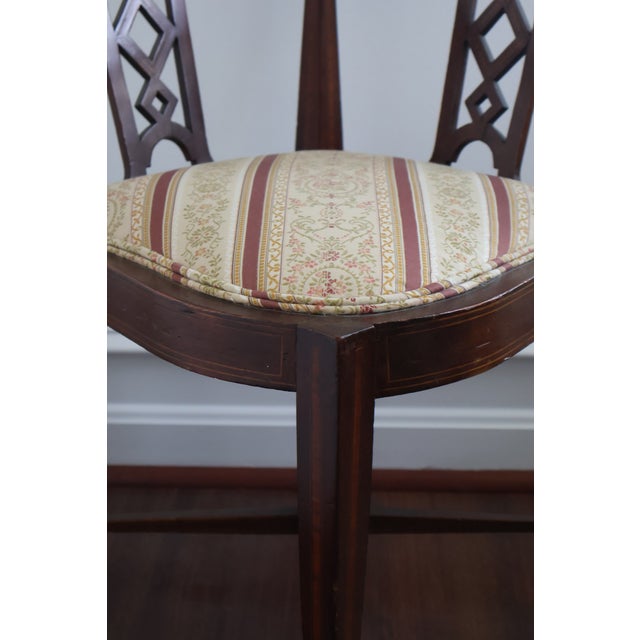
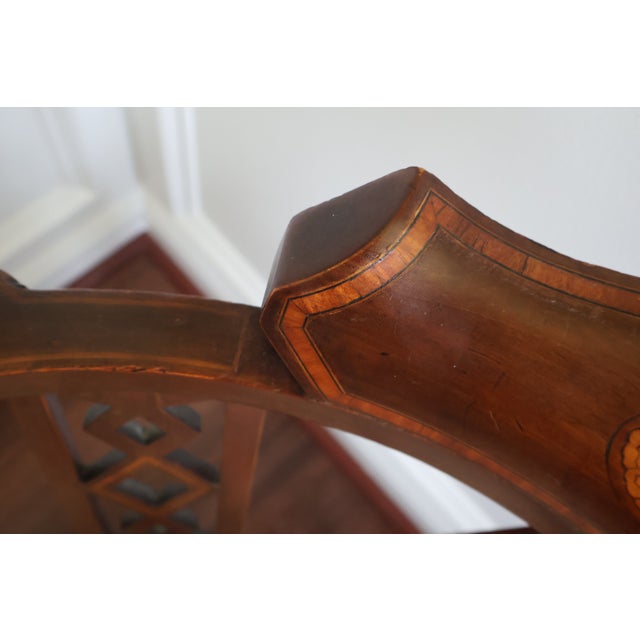
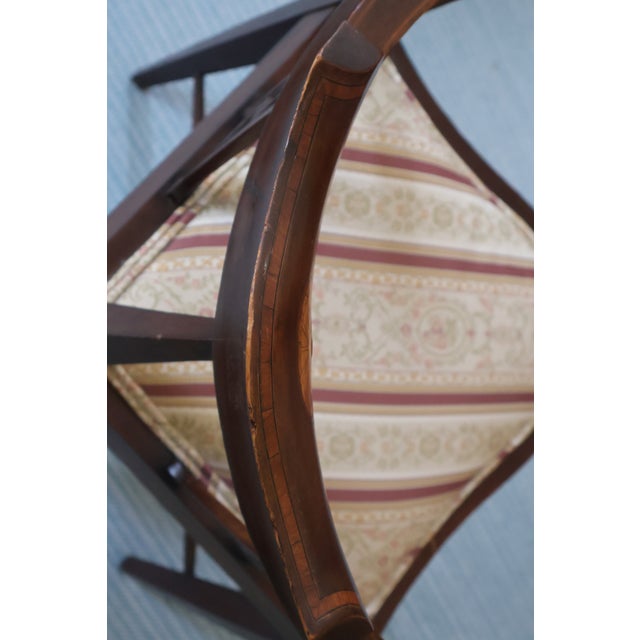
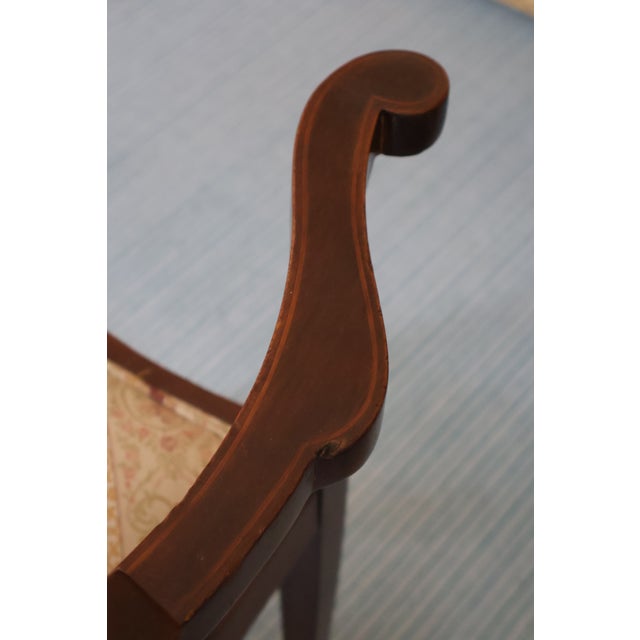
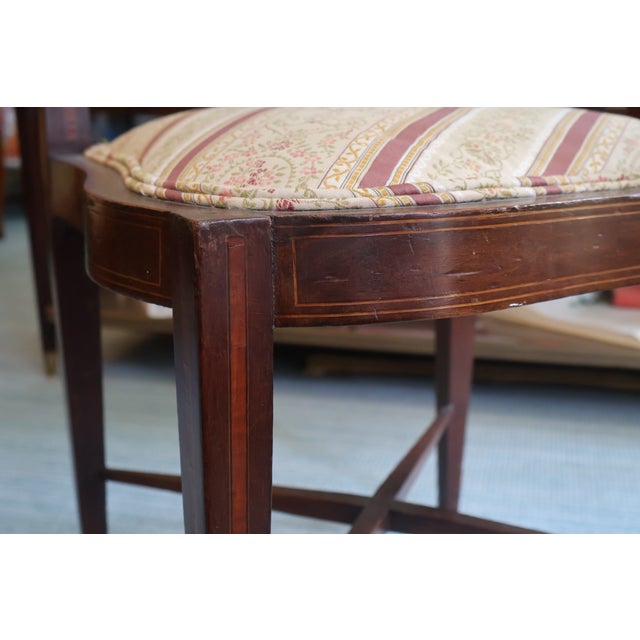
This chair makes that history visible in unusually complete form. Its sweeping wraparound back rises to a shaped crest centered by an intricate satinwood fan or sunburst patera—a neoclassical motif associated with radiance, symmetry, and ordered design. Figured crossbanding follows the crest’s complex outline, while fine contrasting string inlay continues along the curved arms, central support, shaped seat rails, and slender legs.
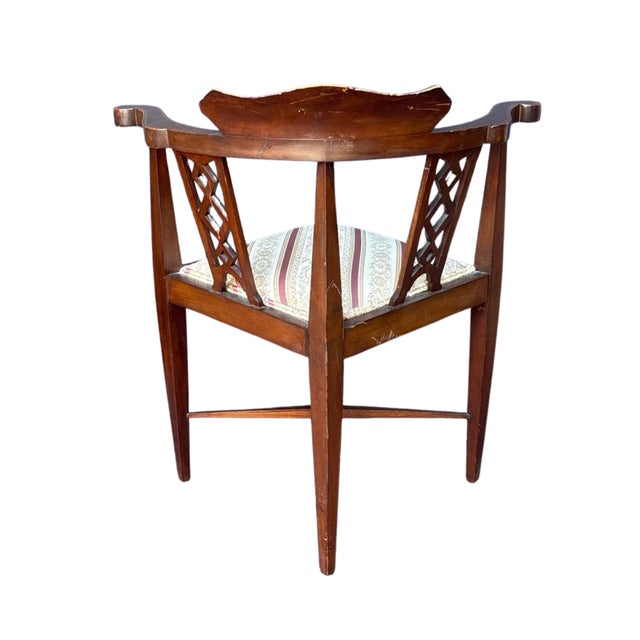
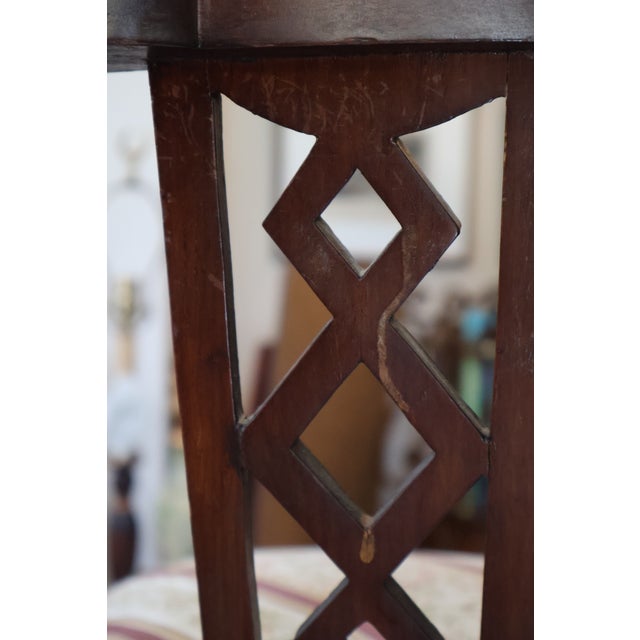
A pair of pierced geometric splats introduces an open architectural rhythm, while the low crossed stretchers preserve the chair’s visual delicacy while reinforcing its distinctive frame. The level of decoration is particularly appealing: the chair does not rely on one central flourish but carries its inlaid vocabulary across nearly every major element.
These details were never meant to be read from only one direction. The chair changes as the viewer moves around it: the patera draws the eye from the front, the pierced splats animate its sides, and the curved rail gives the reverse a sculptural silhouette. Although designed to occupy a corner, it is handsome enough to float beside a writing table or stand where its open back remains visible.
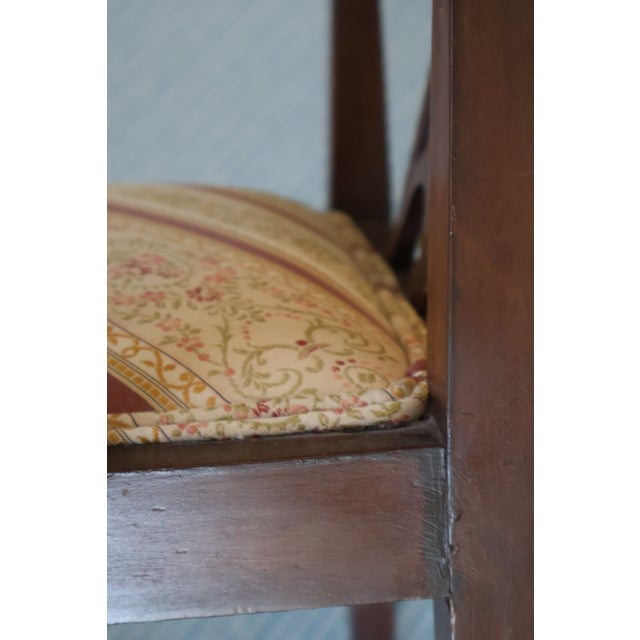
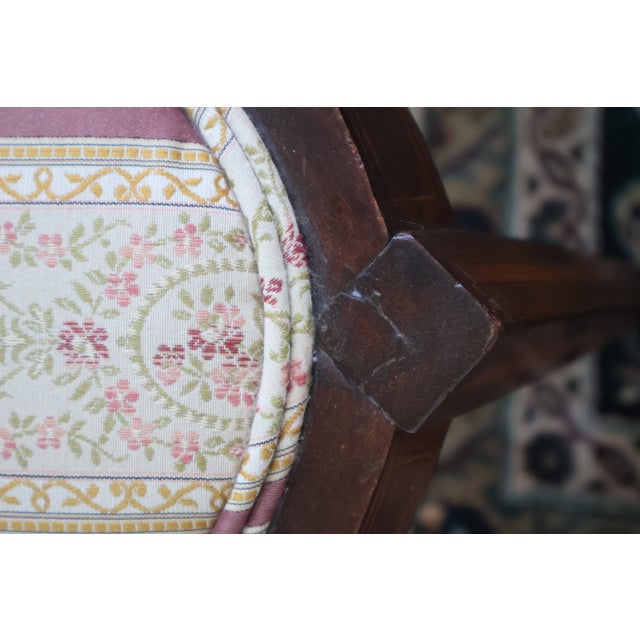
The shaped triangular seat has been professionally reupholstered in a traditional woven textile with an ivory ground and restrained floral ornament in sage, dusty rose, burgundy, and gold. The pattern is carefully centered and finished with coordinating self-welting. Its soft, time-honored palette complements the warm mahogany and gives the chair the welcoming, collected character of an established country-house interior.
For today’s rooms, this is precisely the kind of singular antique that creates a sense of history without requiring a formal setting. It would be especially effective in an English Country bedroom, Cottagecore reading corner, Grandmillennial dressing room, or Nancy Meyers–inspired entry layered with books, botanical art, worn wood, baskets, and patterned textiles. Beside a skirted table or antique desk, it provides both function and the impression of a home assembled thoughtfully over time rather than furnished all at once.
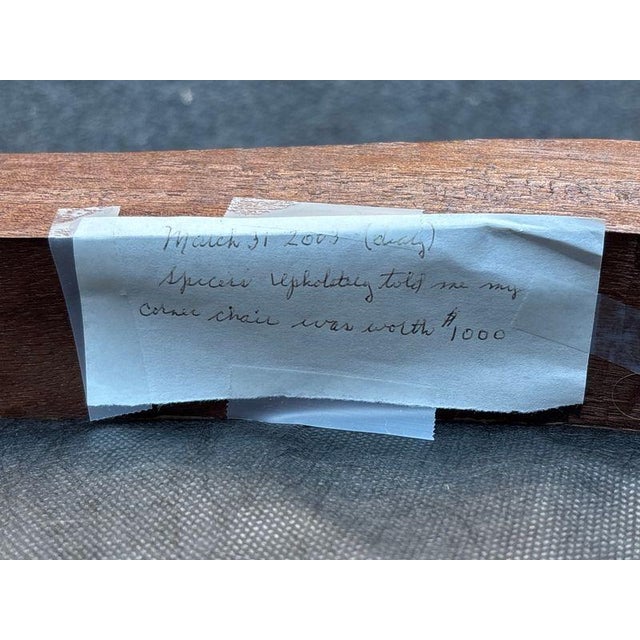
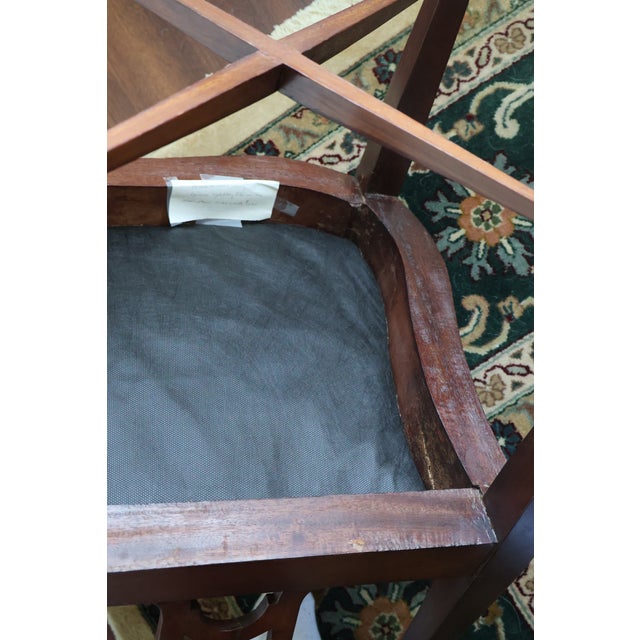
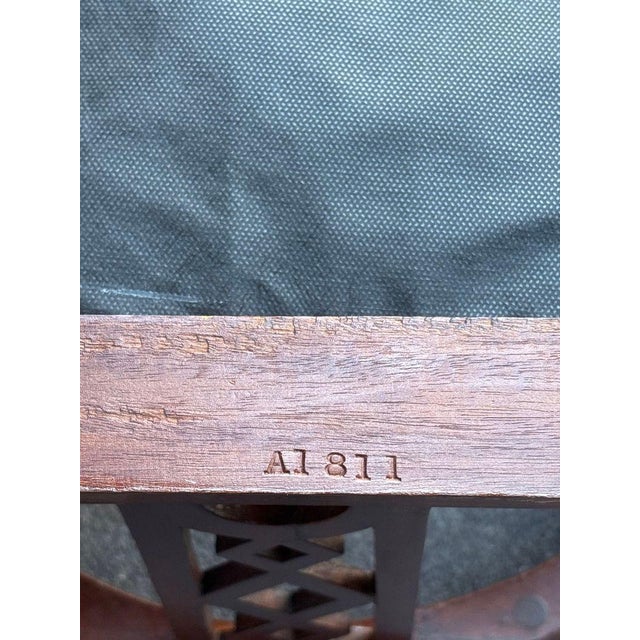
The underside retains an impressed factory or pattern number, “A1811,” although no maker’s name has been found. Also preserved beneath the seat is a handwritten note dated March 31, 2003, recording that Spencer Upholstery advised the previous owner that the chair was worth $1,000. The note remains part of the chair’s ownership history; it records an undocumented verbal opinion rather than a formal appraisal or present valuation.
Uncommon in its combination of historic corner-chair form, elaborate fan patera, extensive crossbanding and stringing, complete pierced splats, and ready-to-place upholstery, this is a chair selected as much for its historic design intelligence as for its decorative presence.
Provenance
Acquired from a private estate.
The underside retains a handwritten note dated March 31, 2003, recording a previous owner’s conversation with Spencer Upholstery and a stated value of $1,000. The note is preserved as ownership history but is not a formal appraisal.
Keywords
Edwardian corner chair, antique mahogany corner chair, Sheraton Revival chair, inlaid mahogany chair, satinwood inlaid chair, fan patera chair, sunburst inlay chair, pierced splat chair, upholstered corner chair, English corner chair, circa 1900 chair, antique accent chair, triangular seat chair, English Country furniture, Cottagecore chair, Grandmillennial furnitureFinder, Nancy Meyers–inspired furniture, Ralph Lauren–inspired chair, antique dressing chair
See less
- Dimensions
- 26ʺW × 23ʺD × 29ʺH
- Number of Seats
- 1
- Seat Interior Depth
- 20.0 in
- Seat Interior Width
- 18.0 in
- Seat Height
- 16.0 in
- Arm Height
- 26.0 in
- Period
- Early 20th Century
- Item Type
- Vintage, Antique or Pre-owned
- Materials
- Mahogany
- Upholstery
- Condition
- Good Condition, Unknown, Some Imperfections
- Color
- Brown
- Condition Notes
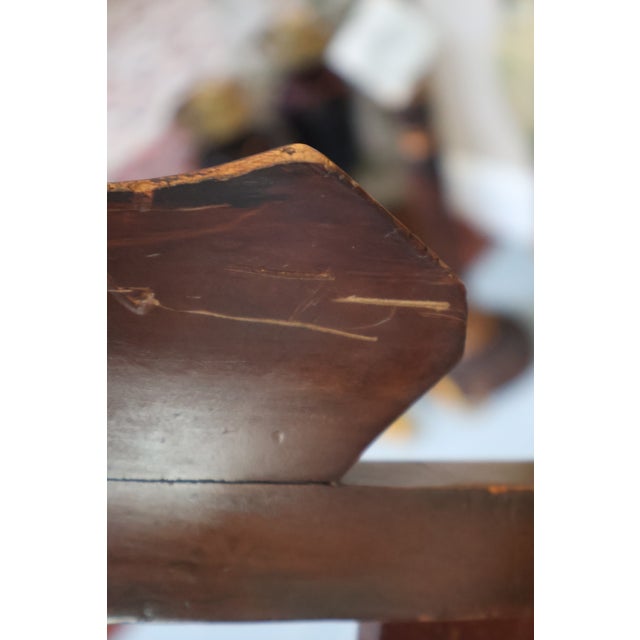
- Good antique condition with wear consistent with more than a century of age and use. The mahogany frame retains a … moreGood antique condition with wear consistent with more than a century of age and use. The mahogany frame retains a warm, naturally aged finish with scattered scratches, abrasions, edge rubbing, finish variation, and small localized losses, most noticeably along the reverse and outer edges of the crest rail and the lower legs. The fan patera, contrasting crossbanding, string inlay, and pierced geometric splats remain substantially intact, with minor age-related separation and surface wear. The chair has been professionally reupholstered in a traditional woven textile that presents cleanly and securely, with no significant stains, tears, or fabric losses observed. No major breaks or missing structural components are apparent in the photographs. The underside retains the impressed number “A1811” and a handwritten ownership note dated 2003. Please review all photographs closely, as they form part of the condition description. less
Questions about the item?
Returns & Cancellations
Return Policy - All sales are final 48 hours after delivery, unless otherwise specified in the description of the product.
Cancellation Policy - Prior to shipping or local pickup, buyers may cancel an order for up to 48 hours, unless otherwise specified.