

Details
Description
Jean jacques bekkers (1814-1872)
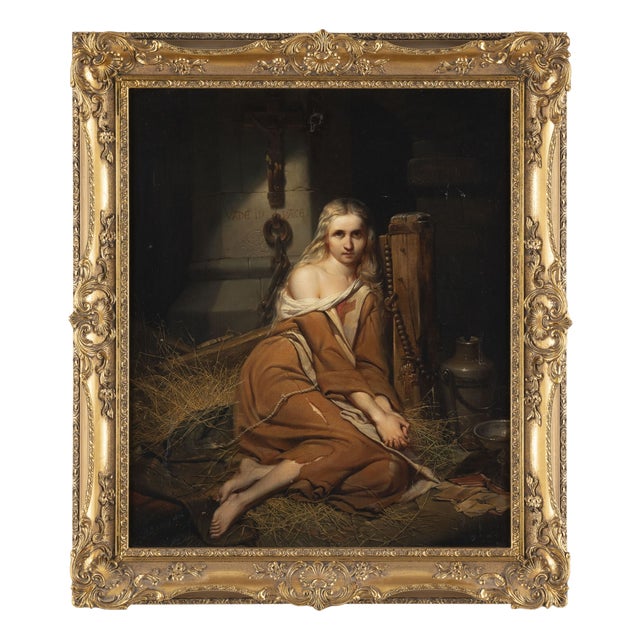
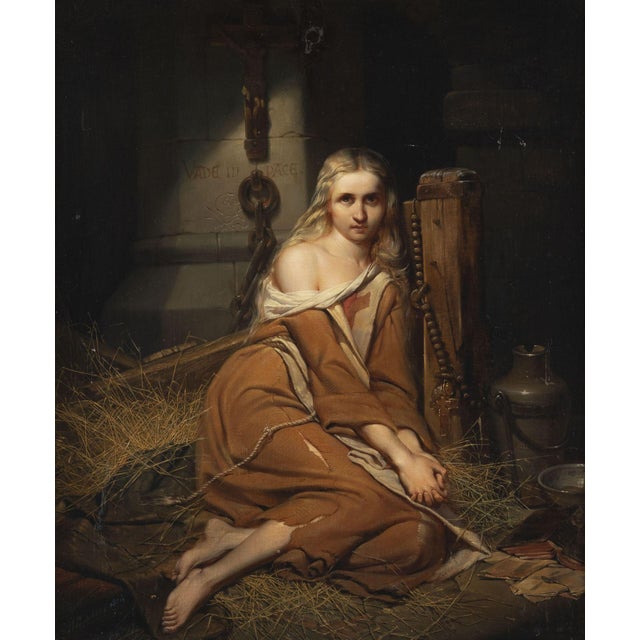
christian captive
oil on canvas
year 1851 (ca)
size (painting): 63 x 52 cm
…
Read more
Jean jacques bekkers (1814-1872)
christian captive
oil on canvas
year 1851 (ca)
size (painting): 63 x 52 cm
size (frame): 73 x 63 cm
very good overall condition:
- the oil on canvas surface is well-preserved, maintaining its rich textures, deep chiaroscuro contrasts, and vibrant details.
- the craquelure is minimal and stable, which is typical for a mid-19th-century work of this age.
- the colours and earth tones remain vivid, without significant fading or heavy past restoration obscuring the original brushwork.
- it is housed in an ornate, heavy gilt frame that complements the piece and is also preserved in very good condition.
- there is a restoration at the top (see photo), and it has been relined.
___
the artwork
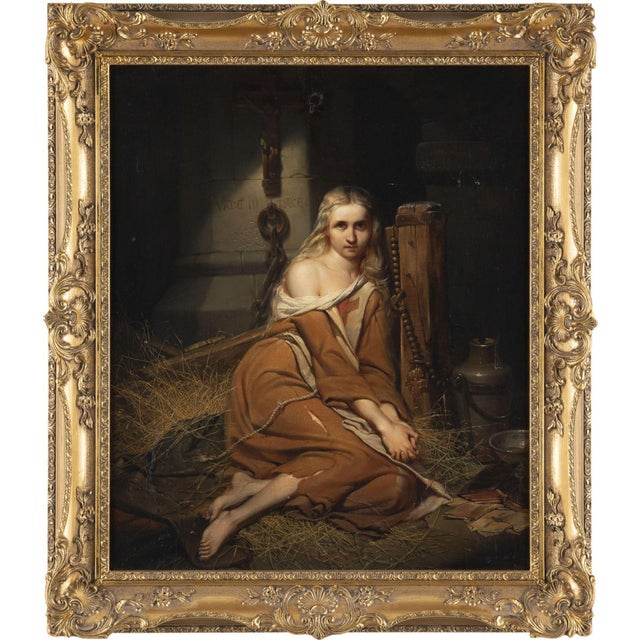
painted around 1851, this artworks stands as a poignant masterpiece of mid-nineteenth-century narrative painting, capturing the profound intersection of historical romanticism and deep spiritual devotion. The composition portrays a young christian captive kneeling in a somber, claustrophobic stone cell, her fair hair framing a face etched with quiet sorrow and unyielding inner strength. Bekkers masterfully employs a dramatic chiaroscuro reminiscent of paul delaroche’s historical martyrdom scenes, directing a sharp, ethereal beam of light onto her bare feet and tattered brown garment. This stark illumination highlights her vulnerable yet steadfast presence against the enveloping gloom of the dungeon.
the haunting inscription "vade in pace" carved into the stone wall behind her, alongside the heavy iron chain and crucifix, evokes the brooding psychological intensity seen in the works of contemporaneous french and belgian academic realists. Much like édouard cibot’s or ary scheffer’s literary and religious interpretations of confinement, bekkers elevates the scene from a mere depiction of suffering into a timeless meditation on faith enduring under the weight of tyranny. Through exquisite textural contrast—from the fragile straw beneath her knees to the heavy, polished metal of her chains—the canvas remains a brilliant testament to the era's fascination with moral resilience and emotional pathos.
___
the artist
born in maastricht in, 1814 and trained at the académie des beaux-arts de louvain, jean jacques bekkers approached the historical genre and created, in gouache, la mort de jeanne de flandre in 1837. He exhibited for the first time at the salon de bruxelles de 1839. A professor at the académie des beaux-arts de louvain since 1850, he was appointed drawing master at the école moyenne de louvain.
jean jacques bekkers is known for his history paintings, genre scenes, religious paintings, and portraits.
at the salon de bruxelles de 1845, when the artist exhibited, the critic victor joly wrote:
"the death of attila by mr. Bekkers of louvain: this composition is not original, there is a lot of vernet's judith in it; we speak neither of vernet's dignity nor of his style. Attila even looks too much like holofernes, for mr. Bekkers's honor. We much prefer to this painting the following one, the crucifixion of the savior, which has fine parts"
at the salon de bruxelles de 1851, when the artist exhibited le christ protégeant les faibles , the critic frédéric de reiffenberg wrote:
"mr. Bekkers has translated the verses of mr. Fortuné henry onto canvas. In our opinion, the painter was superior to the poet. The composition of the painting is excellent, the arrangement is well understood. Mr. Bekkers composes admirably. We would like to be able to say the same for the drawing and the color, but in this regard, he still has progress to make".
exhibitions:
. Salon de bruxelles de 1839: catherine howard, wife of henry viii of england, listening with terror to the reproaches and threats of her lover whom she had treacherously abandoned in order to become queen.
. Salon de bruxelles de 1842: john i, duke of brabant delivering his sister in 1276.
. Salon de bruxelles de 1845: the death of attila and the crucifixion of the savior.
. Salon de bruxelles de 1848: the good samaritan.
. Salon de bruxelles de 1851: christ protecting the weak and oppressed.
.salon de bruxelles de 1869: a wreck; shipwreck of the american ship l'eveningstar.
museum collection:
. M museum in leuven: the crucifixion (1845), oil on canvas, inventory no. S/13/b this piece has an attribution mark,
i am sure that it is completely authentic and take full responsibility for any authenticity
issues arising from misattribution
See less
- Dimensions
- 24.8ʺW × 2.36ʺD × 28.74ʺH
- Art Subjects
- Figure
- Period
- 19th Century
- Country of Origin
- Monaco
- Item Type
- Vintage, Antique or Pre-owned
- Condition
- Good Condition, Unknown, Some Imperfections
- Color
Returns & Cancellations
Return Policy - All sales are final 48 hours after delivery, unless otherwise specified in the description of the product.
Cancellation Policy - Prior to shipping or local pickup, buyers may cancel an order for up to 48 hours, unless otherwise specified.
Related Collections
- Photorealism Canvas Paintings
- Ed Ruscha Paintings
- Photorealism Paintings in New York
- Richard Serra Paintings
- Herman Miller Paintings
- BDDW Paintings
- Louise Nevelson Paintings
- Karen Offutt Paintings
- James McCray Paintings
- Milton Avery Paintings
- Carl-Axel Acking Paintings
- Joseph Stella Paintings
- Karl-Erik Ekselius Paintings
- Leroy Neiman Paintings
- Photorealism Paintings in Los Angeles
- Jaanika Peerna Paintings
- Jo Baskerville Paintings
- Nicola Simbari Paintings
- Soicher Marin Paintings
- Cassina Paintings
- Lawson-Fenning Paintings
- Black Photorealism Paintings
- Jean-Paul Barray Paintings
- Hans Andersen Paintings
- Johannes Andersen Paintings