

Details
Description
Why This Work Matters
The work is important because it shows Palmer treating the human body not just as a …
Read more
Why This Work Matters
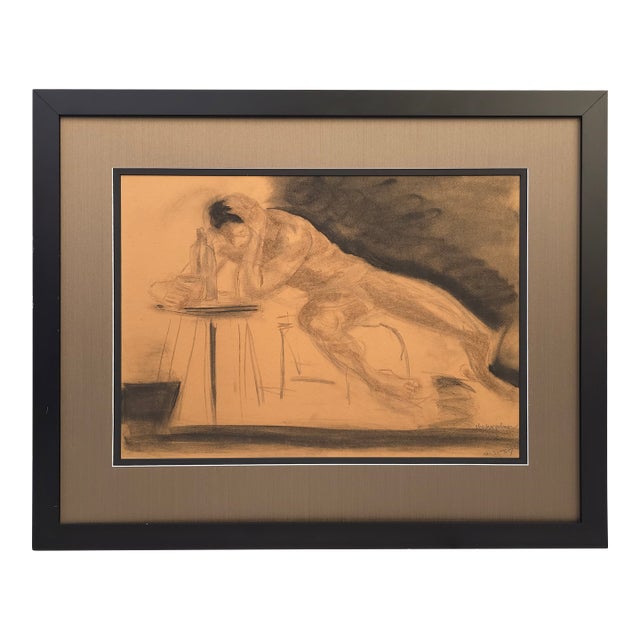
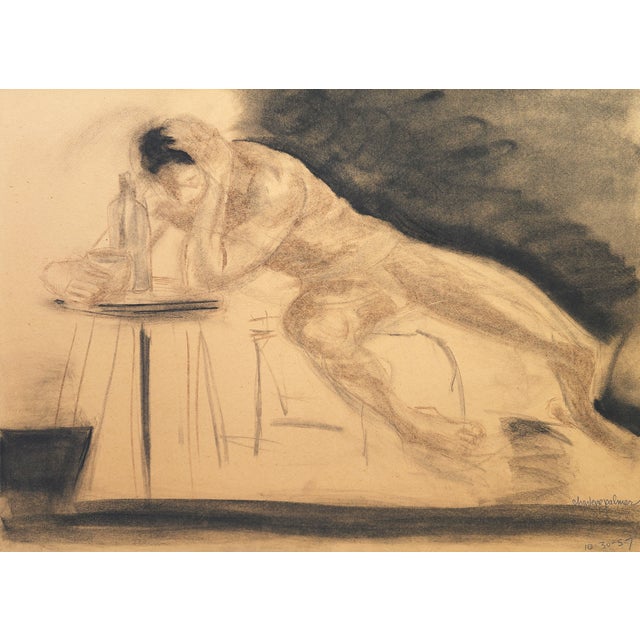
The work is important because it shows Palmer treating the human body not just as a subject to be rendered, but as a vehicle for mood. The man’s slumped posture, the loosely worked contours, and the heavy charcoal surrounding him suggest exhaustion, contemplation, or emotional weight without ever fixing the scene to a single narrative.
Artwork Description
Male Figure at Table*
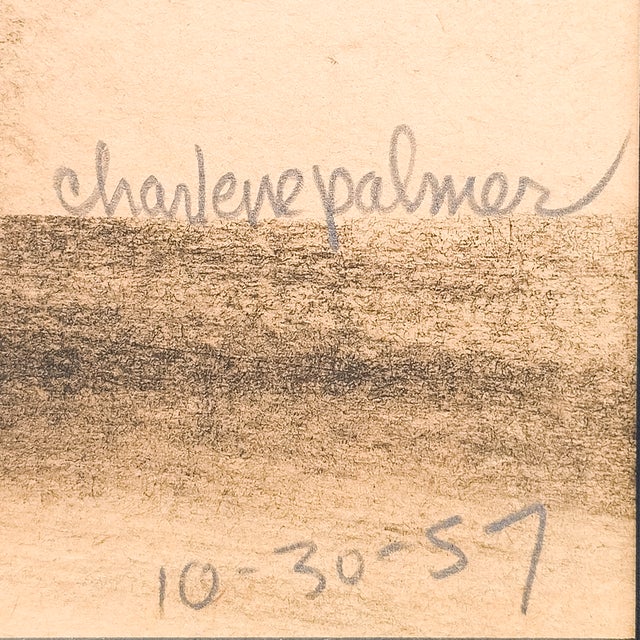
Charlene Palmer, c. 1957
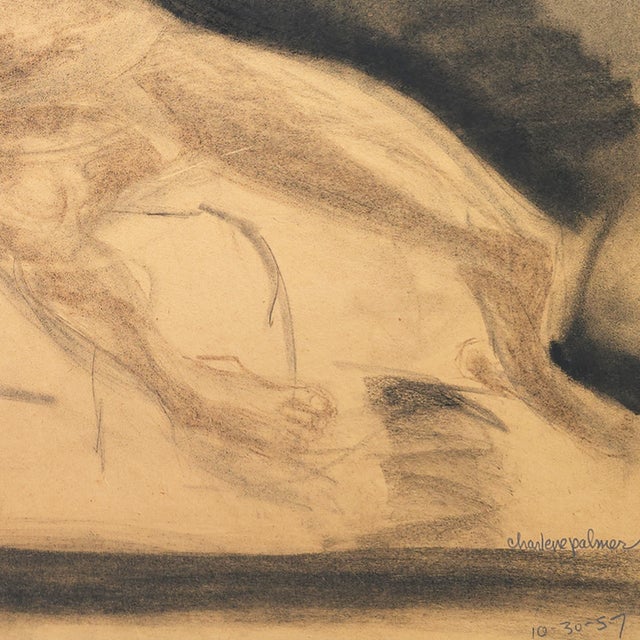
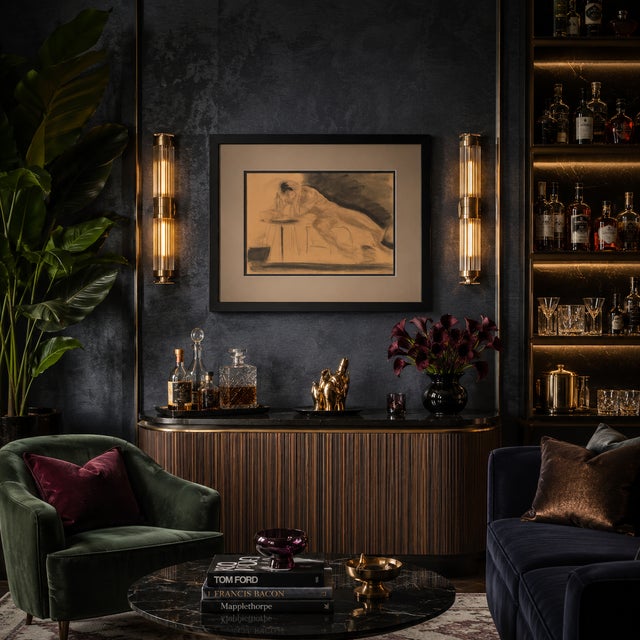
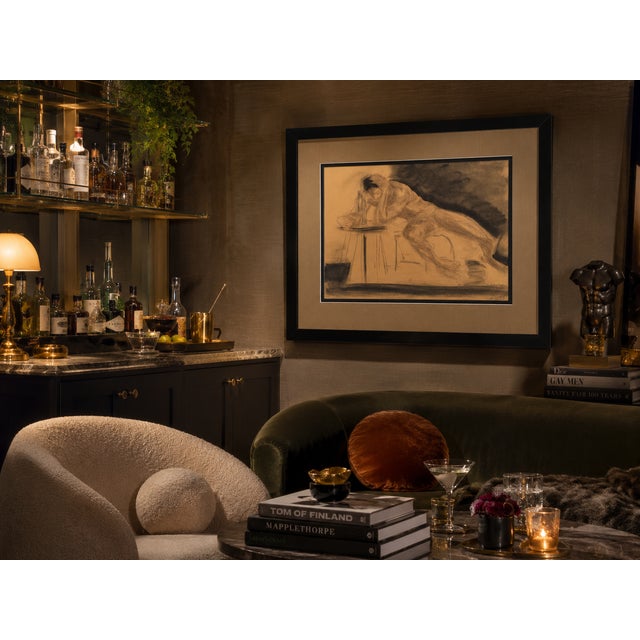
Charlene Palmer’s Male Figure at Table dated1957 is a psychologically charged charcoal drawing in which posture, tonal contrast, and incompletion carry more expressive weight than conventional portraiture. Palmer presents a solitary male figure slumped dramatically across a small table, his body extending in a broad diagonal from the upper left toward the lower right. The pose immediately establishes a sense of physical heaviness. Rather than sitting upright within the room, the man appears almost to surrender himself to the furniture, allowing the table to support both his body and the emotional atmosphere of the scene.
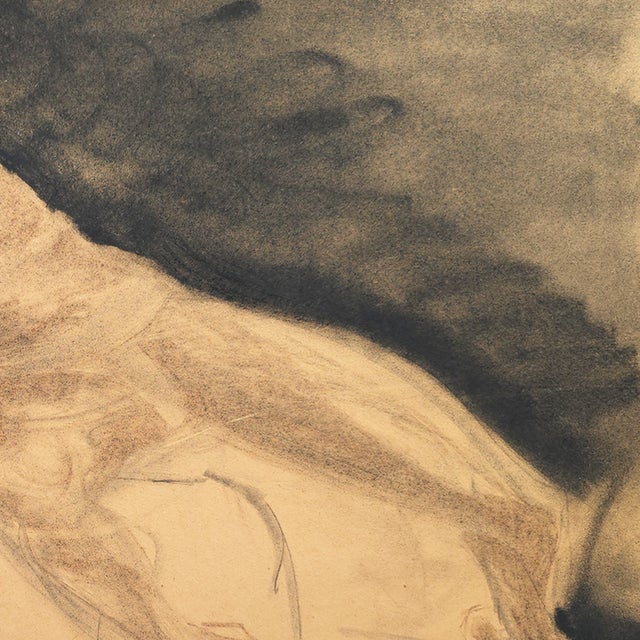
The drawing’s strongest formal device is the contrast between the lightly articulated figure and the dense charcoal field behind him. Palmer builds the upper-right portion of the sheet into an expansive, almost oppressive darkness. Against it, the man’s clothing and limbs are rendered with comparatively delicate strokes, rubbed passages, and partially erased contours. The figure therefore seems to emerge from—and at points dissolve back into—the surrounding shadow. This instability gives the work an unusually modern psychological quality: Palmer does not fully describe the body because precise anatomy is less important than the sensation of weight, fatigue, and interiority.
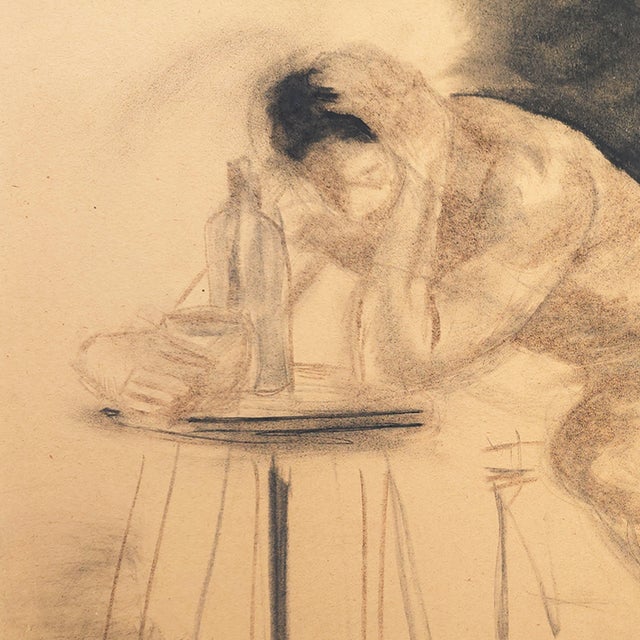
Her handling of charcoal is notably varied. Certain passages are vigorously worked and saturated, while others remain little more than exploratory lines. The head receives concentrated attention, but the extended body becomes increasingly abbreviated as it moves across the sheet. Palmer allows overlapping marks to remain visible, preserving evidence of the drawing process rather than disguising it beneath a polished surface. The approach gives the work immediacy, as though the viewer is witnessing both the observation of the model and Palmer’s search for the essential structure of the pose.
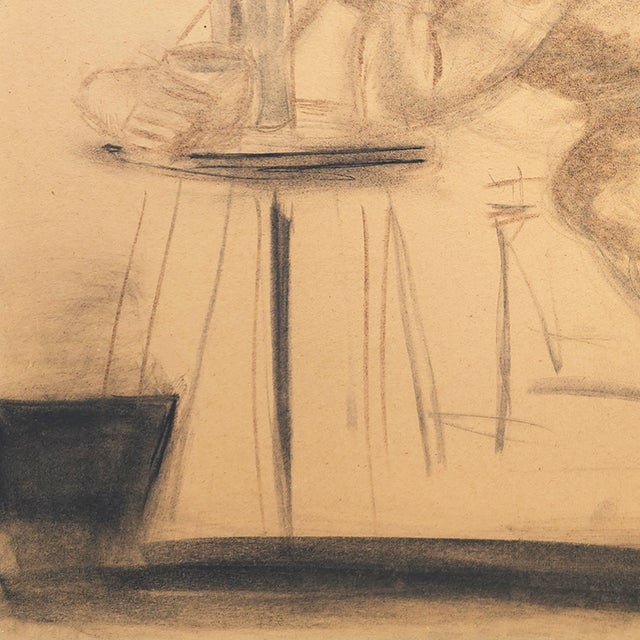
The small table provides a crucial geometric counterpoint. Its narrow vertical legs interrupt the figure’s sweeping diagonal, while the bottle, dish, and loosely indicated objects on its surface introduce the ordinary language of domestic life. These modest details prevent the scene from becoming purely formal. They suggest an inhabited interior and, more importantly, invite narrative speculation. The man may be exhausted, contemplative, intoxicated, despondent, or simply resting. Palmer provides enough information to establish a mood but deliberately withholds enough to prevent a definitive reading.
That ambiguity is one of the work’s greatest strengths. Male Figure at Table does not function simply as a study of anatomy or posture. The exaggerated extension of the figure, compressed space, and encroaching darkness transform an everyday seated pose into something approaching psychological portraiture. The body becomes a vehicle for emotional expression.
Dated 1957, the drawing is particularly compelling within the context of postwar American figuration, when artists increasingly permitted recognizable subjects to coexist with abstraction, distortion, and gestural handling. Palmer remains committed to the human figure, yet she is willing to allow atmosphere and material to disrupt its boundaries. The resulting image feels intimate without becoming sentimental and expressive without requiring an explicit narrative.
Male Figure at Table derives its strength from restraint. Palmer does not tell us what has happened to this man. She simply places him before us—weighted against the table, partially absorbed by shadow—and allows posture alone to suggest an inner life.
-Jonathan Flike
*The title of this work was assigned by Visard Gallery.
About the Artist
Charlene Noel Goldenberg Palmer (1930 - 2018) was an American artist, poet, and later iconographer whose creative life extended for nearly seven decades, from the postwar California art and poetry communities of the 1950s to Michigan exhibitions and religious icon painting at the turn of the twenty-first century. Born February 23, 1930, in Los Angeles to Robert and Ruth Galfond Goldenberg, Palmer developed parallel interests in visual art and literature while still a young woman. Her obituary remembered painting, poetry, and the writing of icons as enduring parts of her life.
A particularly valuable early source clarifies Palmer's education. In 1955, the Berkeley Gazette reported that she had graduated from UCLA in art and literature, while discussing an exhibition to which she contributed paintings. The same article documented her participation in a 1953 Walnut Creek exhibition and the Oakland Art Museum's Spring Watercolor Annual. Interestingly, a 1962 newspaper profile later described Palmer as a “self-taught artist.” These accounts are not necessarily irreconcilable: Palmer may have received a broad university education in art while regarding her development as a painter as largely independent. For scholarship, however, the contemporary UCLA reference is significant and should prevent her from being characterized simply as an untrained amateur.
Palmer married poet and librarian David Palmer in Los Angeles on June 16, 1952. His professional life would eventually take the family through several regions of the country, but the couple's earliest years were closely connected to California's literary and artistic circles.
A Painter Who Was Also a Published Poet
Palmer's literary career is more substantial than her later obscurity might suggest. In 1953, Golden Goose Press of Sausalito published her book Long Stems Colored Poems, a fact documented both in contemporary newspaper coverage and in a surviving bookseller record.
The publisher itself is noteworthy. Golden Goose Press was a small but important participant in the postwar literary avant-garde. Christie's describes its roster and circle as including figures such as William Carlos Williams, E. E. Cummings, Kenneth Rexroth, Robert Creeley, Denise Levertov, and Ezra Pound. Its surviving archive later became famous as the place where Neal Cassady's long-lost “Joan Anderson Letter” was rediscovered. Palmer's publication by Golden Goose therefore places her poetry within a much more serious literary environment than a local or vanity publication would suggest.
There is another remarkable surviving trace of this literary world. The National Library of Scotland's Gael Turnbull archive contains a photograph album in which Charlene and David Palmer are separately photographed in Austria in 1954. The same album contains photographs of writers including Robert Creeley, Charles Olson, Robert Duncan, Denise Levertov, Jonathan Williams, and others associated with the transatlantic experimental poetry community. The archive does not by itself establish close relationships between Palmer and each of these writers, but it does provide unusually strong evidence that the Palmers moved within the broader literary network surrounding poet Gael Turnbull.
The Bay Area Years
Palmer continued exhibiting her paintings while writing poetry. Her 1950s work appears to have encompassed watercolor, painting, drawing, and psychologically expressive figuration.
By 1959 she had achieved something more substantial than occasional group-show participation: the Berkeley Gazette announced a one-person exhibition of Palmer's paintings and drawings at City Lights Gallery, 261 Columbus Avenue, San Francisco, continuing through November. The paper continued to list her paintings and drawings at City Lights the following month.
That is particularly relevant when evaluating works such as Male Figure at Table of 1957. The drawing was produced only about two years before a documented San Francisco solo exhibition of her paintings and drawings, placing it firmly within Palmer's active Bay Area period rather than outside a discernible artistic career.
By the early 1960s, Palmer and her family had moved north to Humboldt County, where David worked as a reference librarian at Humboldt State College. A 1962 Times-Standard feature on Palmer's exhibition at the Red Barn in Eureka reported previous exhibitions at the Oakland Art Museum, City Lights Gallery, Phoenix Gallery, and other venues. It also noted her published poetry and reproduced photographs of Palmer installing her work with her children nearby. Contemporary commentary described the paintings as strong and individualistic, emphasizing vivid color, dramatic composition, and emotional force.
Her regional visibility continued. In November 1963, the Lemon Tree Art Gallery in Arcata presented 27 paintings and drawings by Palmer. The works reportedly ranged from portraits and still lifes to what the newspaper intriguingly described as “philosophical comments.” The article again noted her Oakland Art Museum and Bay Area exhibition record and reported that her Portrait of a Woman had been exhibited in New York earlier that year. It also identified Palmer as a widely published poet.
That description of “philosophical comments” is useful in understanding Palmer's surviving figurative work. Her drawings need not be interpreted as straightforward academic studies; contemporary evidence indicates that she was interested in using imagery to express ideas and psychological states.
A Creative Life Beyond California
Palmer did not simply stop making art after her Northern California period. Her husband's career eventually brought the family to Michigan, where he became associated with the University of Michigan–Flint.
In January 1984, Palmer appeared in the University of Michigan–Flint's first community art exhibition. Flint Journal critic James E. Harvey singled out a work by Palmer—a pastel study of St. Peter—as evidence that contemporary artists remained capable of psychologically integrated portraiture, describing the work as a “vigorous study.”
The evidence extends even later. In 1995, recent work by Palmer was exhibited at The Artists' Cooperative in Detroit, alongside Elizabeth Crank, Karen Lewis, and Reena Krunt. That discovery is important because it demonstrates that Palmer was still publicly exhibiting more than forty years after her earliest documented California appearances.
From Painting to Sacred Icons
By the late 1990s, Palmer's art had taken a distinctly spiritual direction. A substantial 2000 Flint Journal profile photographed her at St. Paul's Episcopal Church beneath one of her icons and reported that she had been writing icons for approximately four years. The article estimated that a single icon required roughly 120 hours of work. Palmer's icons could be found at St. Paul's as well as churches in Windsor, Buffalo, and Detroit and in private homes.
It is in this article that we finally recover Palmer's own voice. Explaining why she did not sign her religious icons, she said:
“We never sign because this is being done through God's hand.”
It is a remarkably revealing statement from an artist whose earlier work could be forcefully individualistic. By this later period, Palmer understood at least part of her artistic practice not principally as self-expression but as an act of spiritual mediation.
Charlene Noel Goldenberg Palmer died on August 25, 2018, at age 88. She was survived by four children, grandchildren, great-grandchildren, and her sister. David had died in 2008. Her obituary distilled her creative life into three pursuits—painting, poetry, and writing icons—which, with the benefit of the surviving record, can now be understood not as casual hobbies but as interconnected activities she pursued across much of her adult life.
Underrepresented Artist Information
As a woman building a multidisciplinary creative life in the mid-20th century, Charlene Noel Goldenberg Palmer represents the many accomplished female artists whose careers have largely disappeared from contemporary art history. Palmer exhibited throughout Northern California, including a San Francisco solo exhibition and appearances associated with the Oakland Art Museum, while simultaneously working as a published poet and later as an iconographer.
Yet despite decades of sustained creative work, Palmer left little contemporary market presence or scholarship behind. Recovering her work helps restore visibility to a woman whose artistic life was far more substantial than her present-day obscurity suggests.
See less
- Dimensions
- 32.5ʺW × 1ʺD × 26.5ʺH
- Frame Type
- Framed
- Period
- 1950s
- Country of Origin
- United States
- Item Type
- Vintage, Antique or Pre-owned
- Materials
- Charcoal
- Graphite
- Condition
- Good Condition, Original Condition Unaltered, Some Imperfections
- Color
- Tan
- Condition Notes
- Please note that this item is vintage and shows wear consistent with age, use, and history. Signs of wear may … morePlease note that this item is vintage and shows wear consistent with age, use, and history. Signs of wear may include, but are not limited to, minor surface marks, patina, fading, or imperfections typical of older items. All items are sold as-is, which is standard with vintage and pre-owned goods and cannot be returned on the basis of condition. Measurements are approximate. We do our best to describe items accurately; however, condition assessments are subjective. If you would like additional details, images, or clarification before purchasing, please contact us. Special Condition Notes Historical framing and matting present. We recommend replacement with archival framing. All framing can be removed upon request. less
Questions about the item?
Returns & Cancellations
Return Policy - All sales are final 48 hours after delivery, unless otherwise specified in the description of the product.
Cancellation Policy - Prior to shipping or local pickup, buyers may cancel an order for up to 48 hours, unless otherwise specified.
Related Collections
- Jeff Slemmons Drawings
- Maison Jansen Drawings
- Tempera Drawings
- John James Audubon Drawings
- Guillaume Azoulay Drawings
- Joseph Stella Drawings
- Erté Drawings
- Salvador Dalí Drawings
- Leroy Neiman Drawings
- Piet Hein Eek Drawings
- Carl-Axel Acking Drawings
- Charcoal Drawings
- Fashion Drawings
- 1950s Fashion Drawings
- Pencil Drawings
- Ink Drawings
- Gustavian (Swedish) Drawings