






Details
Description
Why This Work Matters
This portrait is an exceptionally early example of Evelyn Enola Rockwell’s developing portrait practice, created when …
Read more
Why This Work Matters
This portrait is an exceptionally early example of Evelyn Enola Rockwell’s developing portrait practice, created when the artist was only about twenty-two years old. Its subject is especially significant in hindsight: Rockwell would go on to build a decades-long professional career distinguished by her portraits of children, a specialty repeatedly praised for her ability to capture both physical likeness and individual character.
Artwork Description
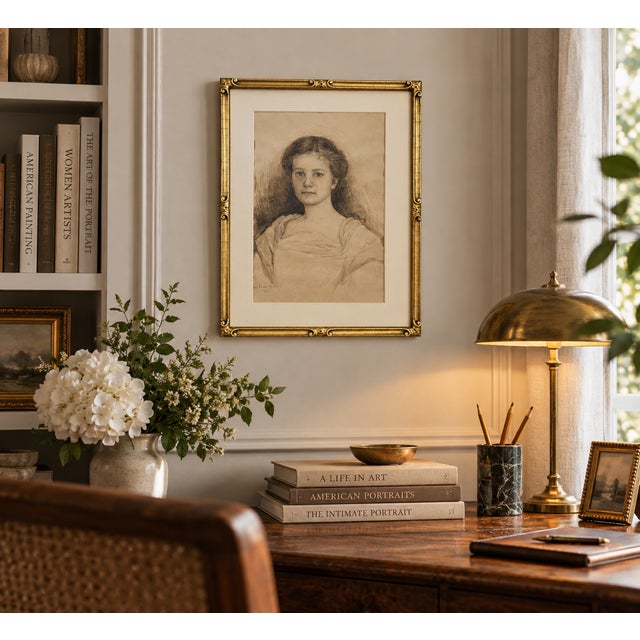
Portrait of a Young Girl
Evelyn Enola Rockwell, c. 1909
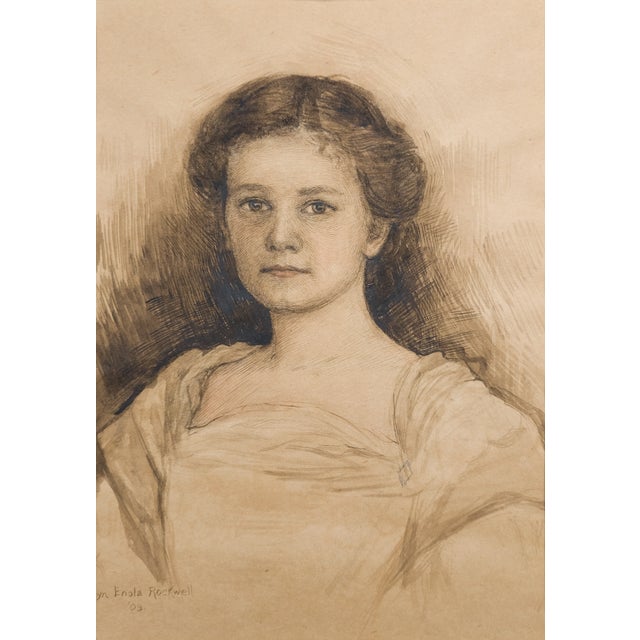
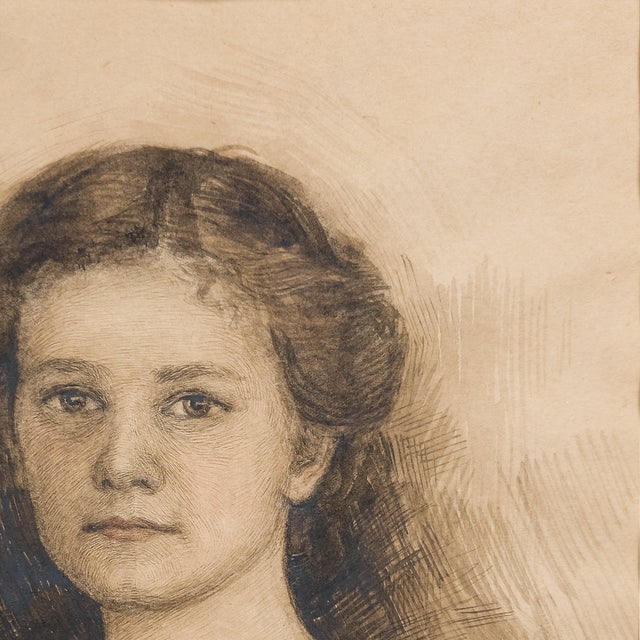
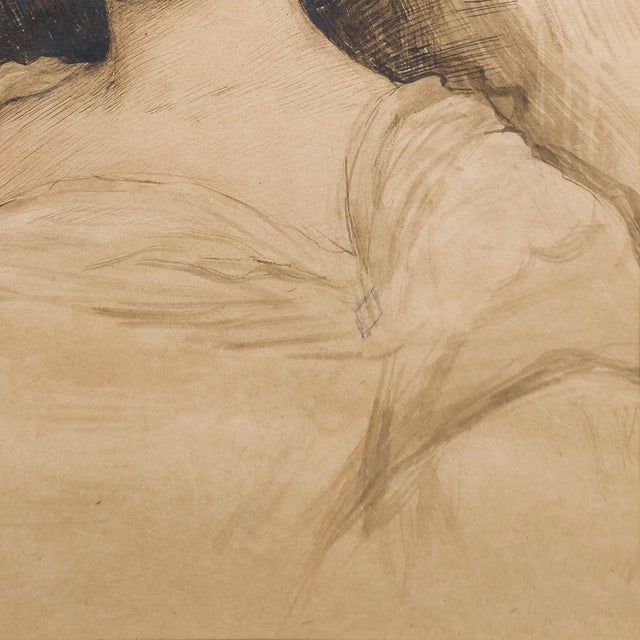
In Portrait of a Young Girl, Evelyn Enola Rockwell builds the sitter through a careful balance of precision and abbreviation. The face receives the greatest concentration of detail, articulated through fine layers of cross-hatching that model the cheeks, eyes, nose, and mouth with considerable subtlety. By contrast, the dress and lower body are handled more loosely, allowing the drawing to gradually dissolve toward the edges.
This selective finish directs attention toward the sitter’s expression. Rather than idealizing childhood through sweetness or animation, Rockwell presents the girl with unusual gravity. Her gaze is steady but slightly removed, while the restrained mouth and softly modeled features suggest introspection rather than performance. The effect is psychologically observant without becoming overly dramatic.
Rockwell uses the dark volume of the hair and the surrounding field of energetic hatch marks to frame the comparatively luminous face. These repeated lines create both atmosphere and depth, giving the figure presence without requiring a fully developed interior setting. The broad, almost unfinished passages of the clothing further emphasize the carefully observed head.
Dated 1909, the portrait is particularly notable for the confidence of its handling. Created when Rockwell was approximately twenty-two years old, it already demonstrates the sensitivity to character and likeness that would later become central to her professional reputation as a portraitist of children.
-Jonathan Flike
About the Artist
Evelyn Enola Rockwell was an American portrait artist whose career spanned more than four decades and whose particular distinction was the portraiture of children. Working primarily in pastel, but also in oil, crayon, pencil, and pen and ink, Rockwell developed a professional practice that carried her from Philadelphia and New York to the artists’ colony at Ogunquit, Maine, and eventually to Palm Beach, Florida. Although her name has largely disappeared from the broader history of American art, contemporary newspaper coverage reveals an artist who exhibited regularly, studied with important figures in American painting, maintained professional studios in several cities, and earned particular praise for her ability to capture both the likeness and character of young sitters.
Rockwell was born in Chicago in 1887 into a family in which art and invention were closely intertwined. Contemporary profiles identified her father, Frank Rockwell, as an artist and portrait painter and described several of her brothers as inventors. A lengthy 1926 profile in the Brooklyn Daily Eagle presented artistic ability as something almost innate in Rockwell: she reportedly told the interviewer that she could not remember a time when she had not wanted to become an artist. The article even preserved a family story in which the four-year-old Evelyn attempted to “improve” a portrait her father had left unfinished while the family ate dinner.
Her ambitions were followed by substantial formal training. Contemporary accounts state that Rockwell studied at the Pennsylvania Academy of the Fine Arts and the Art Students League of New York, and identify William Merritt Chase, Cecilia Beaux, and Charles H. Woodbury among her teachers. A surviving finding aid in the Pennsylvania Academy's own archives independently records correspondence concerning “Rockwell, Evelyn Enola” in 1911, providing unusually strong documentary confirmation of her connection to the Academy. Later newspaper profiles continued to cite Chase, Beaux, and Woodbury in discussing her artistic education.
Rockwell's earliest documented professional activity appears to have included a distinctive form of pen-and-ink silhouette portraiture. The Historical Society of Pennsylvania preserves a silhouette, possibly depicting Charlotte Hope Binney Tyler Montgomery, attributed to Rockwell and dated 1912. A 1915 newspaper profile reported that Rockwell first attracted broad public attention when a full page of her original pen-and-ink silhouettes appeared in the Philadelphia Public Ledger in 1913. The same article reproduced examples identified as former President William Howard Taft and Ethel Roosevelt, suggesting that Rockwell's clientele already included socially prominent subjects. The silhouettes could be completed rapidly from life and became a commercially successful branch of her practice, while pastel, crayon, and oil portraits demanded more sustained sittings. A signed 1913 pen-and-ink silhouette by Rockwell has also surfaced on the modern auction market, providing another surviving example of this early phase.
By 1915, however, contemporary writers were already describing Rockwell principally as a portrait painter. Her career became closely associated with Ogunquit, Maine, where she studied with Charles Woodbury and became part of the community surrounding the developing Ogunquit art colony. A Sun-Journal feature from that year called the surprisingly young Rockwell a portrait painter who had already acquired considerable recognition and emphasized her unusual ability to obtain a convincing likeness of her sitters. The Rockwell family subsequently established a lasting presence in Ogunquit, and Evelyn would maintain a summer studio there for decades.
Her exhibition record expanded during the following years. In February 1918, The New York Times listed Rockwell in a current New York exhibition alongside artist E. Frances Elmer. Two years later, Rockwell received particularly revealing attention for a presentation of pastel portraits at New York's Ainslie Galleries. A 1920 Brooklyn Daily Eagle review reproduced one of her pastel portraits and remarked upon the strength of her likenesses, noting that she was especially successful with children and possessed an ability to grasp the character of the sitter as well as the decorative possibilities of the composition.
Children increasingly became Rockwell's defining subject. A 1923 review of an exhibition at the L. A. Wiley & Sons Gallery in Hartford described a show composed entirely of her pastel portraits. The critic praised both her likenesses and her handling of color and again singled out her particular success with children. The article also recorded previous exhibitions at the Ehrich Galleries and Ainslie Galleries in New York and Doll & Richards in Boston.
At the same time, Rockwell was embedded in the cultural life of New York. By 1923 she was living with her mother and sister Elizabeth at 40 Deepdene Road in Forest Hills Gardens, in a house the family had purchased from celebrated type designer Frederic W. Goudy. The local Forest Hills Bulletin explicitly identified Evelyn as “the artist.” She continued to make silhouette portraits in addition to her more formal paintings; at a Forest Hills community benefit in 1924, she produced silhouettes of attendees on site, which the local bulletin praised for both their likeness and charm.
Rockwell explained her attraction to child portraiture with unusual clarity in a major 1926 newspaper profile. She regarded children as particularly demanding subjects because their expressions changed quickly and because their lack of adult self-consciousness exposed personality immediately. Pastel, in her view, was especially well suited to conveying the fleeting quality of childhood. More broadly, she articulated a surprisingly serious philosophy of art: she regarded pictorial expression as a kind of universal language and connected successful art with truth rather than mere surface resemblance.
Surviving portraits demonstrate that this specialization was not simply journalistic branding. The Tennessee Portrait Project documents Rockwell's 1927 pastel portrait of Richard King Gibson III, still in a private collection, measuring approximately 24½ by 18½ inches. Other works continue to surface through estates and auctions, overwhelmingly reflecting the portrait subjects—particularly children—for which contemporary critics knew her. Modern artist references similarly classify Rockwell primarily as a painter of children's portraits in pastel.
By the 1940s, Rockwell had developed a seasonal practice divided between Ogunquit and Palm Beach. A 1941 Palm Beach newspaper advertisement promoted portraits of both children and adults from her studio on Via Parigi near Worth Avenue. She also participated in the Palm Beach art community; her name appears among exhibitors associated with the Palm Beach Art League's annual exhibition at the Norton Gallery in 1942.
A substantial 1945 retrospective profile in the Lewiston Sun-Journal, titled “Children's Portraits Are First Interest of Ogunquit Artist,” confirms the longevity of this career. The article described Rockwell as maintaining a winter studio in Palm Beach and a summer studio in Ogunquit and praised the psychological immediacy of her portraits. It also provides an unusually valuable record of her clientele. Reported sitters included the daughters of actor and dancer Fred Stone, tennis champion Molla Bjurstedt Mallory, and children from prominent families in New York, Philadelphia, Chicago, Pittsburgh, Providence, Colorado Springs, Washington, Boston, and elsewhere.
Rockwell eventually relocated to Southern California. She died in 1955, while living in Westwood, Los Angeles. Her obituary in the West Los Angeles Independent described her as a “noted portrait painter” and reported that her subjects had included financier J. P. Morgan and former President William Howard Taft. She was survived by her sister Elizabeth Rockwell and brother Edward Albert Rockwell.
Underrepresented Artist Information
As a professional woman artist working in the early twentieth century, Evelyn Enola Rockwell belonged to a generation of women whose careers were often substantial during their lifetimes but became only lightly represented in later art-historical and commercial records. Rockwell received serious artistic training, exhibited professionally, maintained studios in New York, Ogunquit, and Palm Beach, and developed a recognized specialty in portraiture—particularly portraits of children. Contemporary coverage repeatedly praised her ability to capture both likeness and personality, and by the 1940s she was still being profiled specifically for the strength of her children's portraits.
Much of Rockwell's work was created for private families rather than public institutions, a circumstance that may help explain why her reputation has faded despite decades of professional activity. Portrait commissions, pastels, and intimate works on paper frequently remained in family collections, leaving fewer opportunities for later museum acquisition, scholarship, and public visibility.
Rockwell's career therefore reflects a broader gap in the history of American art: women could achieve professional recognition without securing lasting historical recognition. Recovering her work today helps restore attention not only to an accomplished portraitist, but also to the many women artists whose contributions survive primarily through scattered artworks, exhibition notices, and archival records rather than established museum narratives.
See less
- Dimensions
- 13.75ʺW × 1ʺD × 17.75ʺH
- Frame Type
- Framed
- Art Subjects
- Portrait
- Period
- 1900 - 1909
- Country of Origin
- United States
- Item Type
- Vintage, Antique or Pre-owned
- Materials
- Pen and Ink
- Watercolor
- Condition
- Good Condition, Original Condition Unaltered, Some Imperfections
- Color
- Black
- Condition Notes
- Please note that this item is vintage and shows wear consistent with age, use, and history. Signs of wear may … morePlease note that this item is vintage and shows wear consistent with age, use, and history. Signs of wear may include, but are not limited to, minor surface marks, patina, fading, or imperfections typical of older items. All items are sold as-is, which is standard with vintage and pre-owned goods and cannot be returned on the basis of condition. Measurements are approximate. We do our best to describe items accurately; however, condition assessments are subjective. If you would like additional details, images, or clarification before purchasing, please contact us. Special Condition Notes Historical framing and framing components condition consistent with age. We highly recommend replacement with archival framing. less
Questions about the item?
Returns & Cancellations
Return Policy - All sales are final 48 hours after delivery, unless otherwise specified in the description of the product.
Cancellation Policy - Prior to shipping or local pickup, buyers may cancel an order for up to 48 hours, unless otherwise specified.