

Details
Description
Vetlanda, sweden, 1930.
far from paris. Far from london. Far from the fashionable salons and galleries of stockholm.
in a …
Read more
Vetlanda, sweden, 1930.
far from paris. Far from london. Far from the fashionable salons and galleries of stockholm.
in a small town surrounded by the forests of småland, a swedish jeweller was making sphinxes.
his name was ernst svedbom.
and the deeper one looks into his work, the stranger and more fascinating his world becomes.
svedbom was not working in one of europe’s great artistic capitals. His world was vetlanda, a small swedish town where the surrounding landscape was dominated by forests, lakes and long nordic winters.
yet the objects leaving his workshop seemed to belong to a much larger world.
lions appeared.
then dragons.
egyptian forms.
mythological creatures.
and in 1930, two sphinxes.
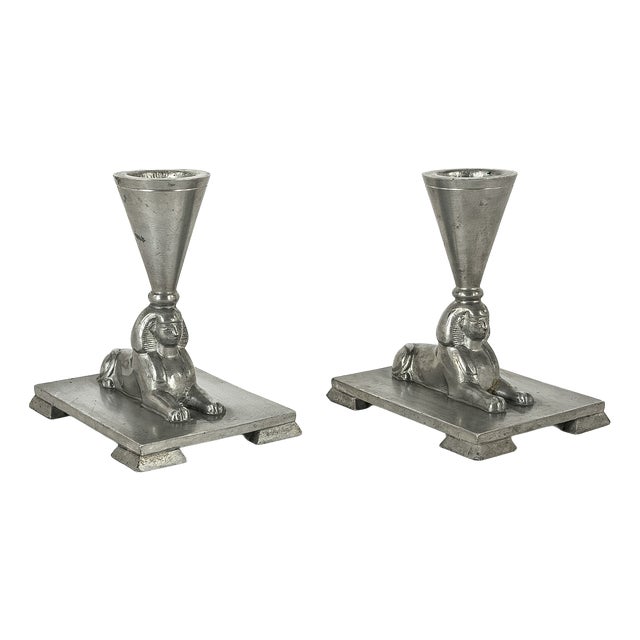
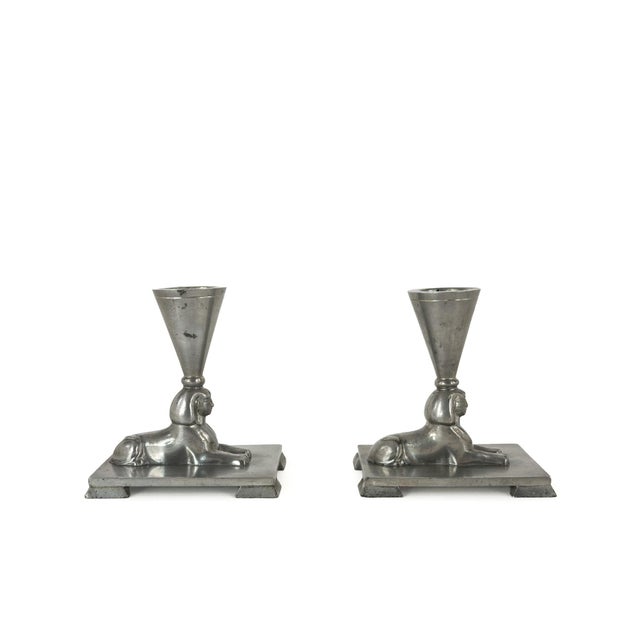
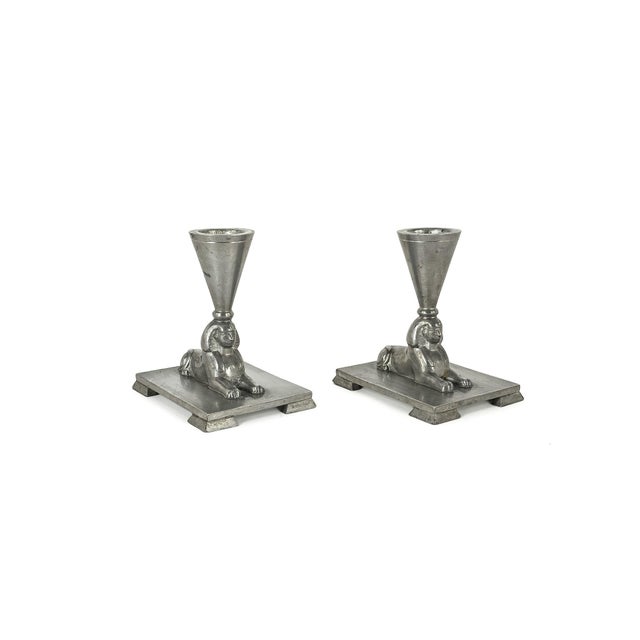
the pair of candlesticks presented here captures that remarkable collision of worlds.
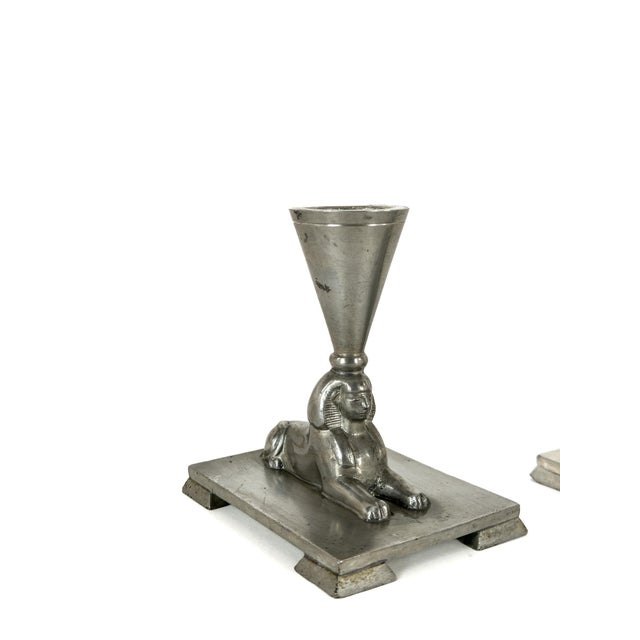
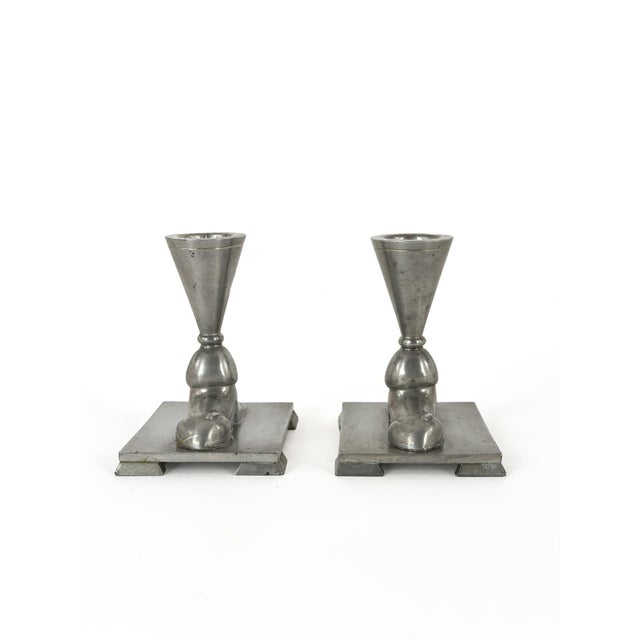
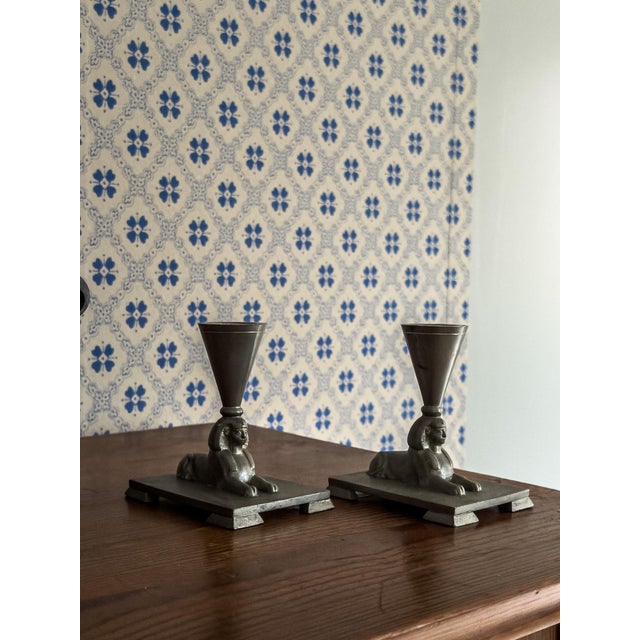
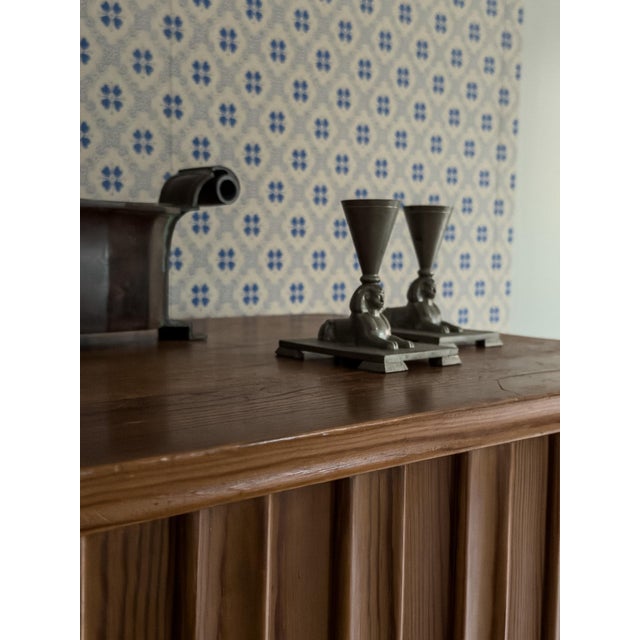
each sphinx lies silently beneath a rising candleholder, its body stretched across the base in cool swedish pewter.
run a hand across the metal and the material feels dense and cold.
almost stone-like.
look closer and nearly a century of age begins to reveal itself. The pewter has softened in tone. Small variations have developed across the surface. Light settles on the backs of the figures before disappearing into the shadows beneath them.
then place candles above the sphinxes.
everything changes.
a flame flickers.
warm light moves across cold metal.
the faces emerge and disappear again in shadow.
for a moment, these strange creatures made in a workshop in småland almost seem to wake.
but there is another detail underneath them.
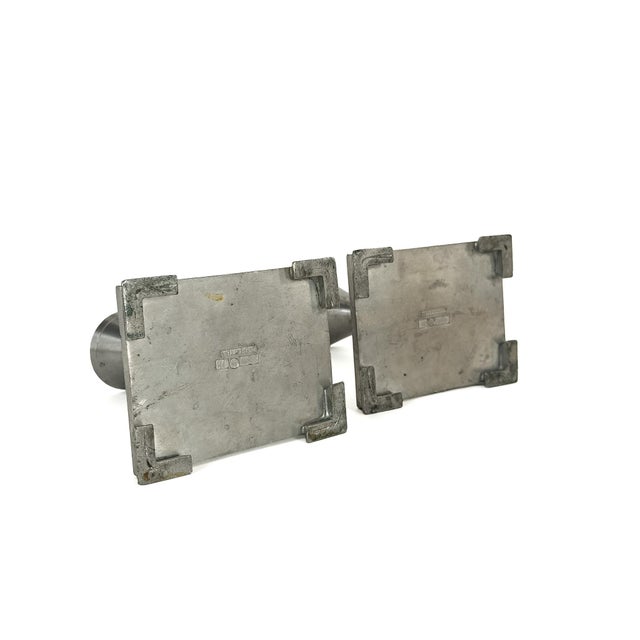
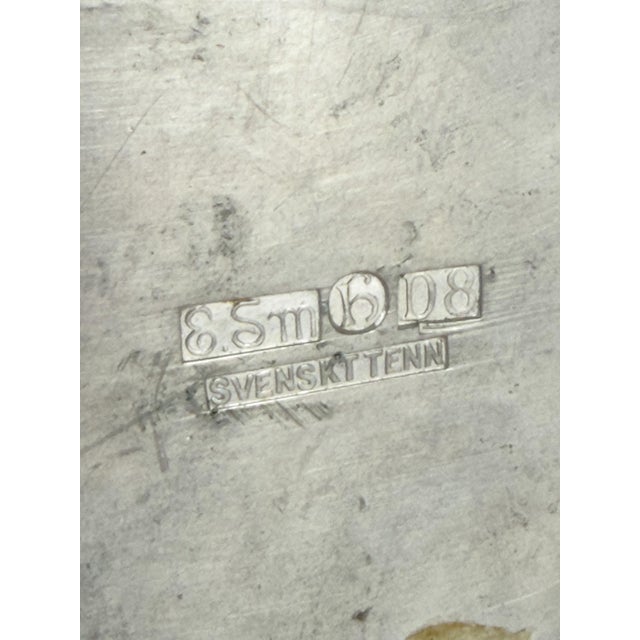
turn one of the candlesticks over and the story suddenly becomes precise.
stamped into the metal are the marks e.sm and svenskt tenn.
and beside them is d8.
the swedish date code for 1930.
that year matters.
because sweden in 1930 was standing between two worlds.
the elegance and classicism of swedish grace still lingered in interiors and decorative objects, but something radically different was approaching. At the stockholm exhibition that summer, functionalism announced a new vision of swedish life.
cleaner.
lighter.
more rational.
the future of scandinavian design was beginning to take shape.
yet while sweden was looking forward, ernst svedbom was looking thousands of years backward.
to egypt.
eight years earlier, in 1922, the discovery of tutankhamun’s tomb had ignited an extraordinary fascination with ancient egypt. Across europe and america, egyptian imagery entered jewellery, fashion, architecture, cinema and the decorative arts.
sphinxes, scarabs, pyramids and pharaohs suddenly belonged to the visual language of the modern age.
and somehow that fascination travelled all the way to småland.
that is where the story becomes particularly intriguing.
because the sphinxes were not an isolated experiment.
look through svedbom’s surviving work and a pattern begins to appear.
lions.
dragons.
egyptian inspired forms.
again and again, creatures from distant places, history and mythology entered his metalwork.
it suggests a craftsman whose imagination travelled considerably further than the walls of his vetlanda workshop.
svedbom himself had built an impressive life there.
born in 1878, he established himself as a jeweller and manufacturer and became the proprietor of guld & silvervarufabriken amicus, with operations in vetlanda and eksjö.
his success left a physical mark on the town.
in 1914, he commissioned architect j. Nikl. Norman to design a substantial villa for his family. Completed the following year, it contained an art collection and interiors befitting a successful jeweller and entrepreneur.
there is something compelling about imagining those two worlds together.
outside, småland.
dark forests. Cold winters. Quiet streets.
inside, art, metalwork and an imagination populated by lions, dragons and sphinxes.
perhaps that is what makes these candlesticks so much more interesting than their function suggests.
they are evidence of how ideas travelled before the digital world made distance almost meaningless.
an archaeological discovery in egypt becomes an international obsession.
that obsession enters european art deco.
those ideas travel north.
and eventually, in 1930, a craftsman in vetlanda casts two sphinxes in swedish pewter.
cairo to paris.
paris to stockholm.
stockholm to småland.
and then, almost a century later, the journey continues.
this is also why swedish design history becomes much richer when we look beyond the names everyone already knows.
the story is not only stockholm.
it is not only the great exhibitions, the famous architects or the designers who later became synonymous with scandinavian modern.
sometimes the more interesting story is hiding underneath an object.
in a stamp.
e.sm.
svenskt tenn.
d8.
vetlanda, 1930.
three small marks that lead back to a swedish craftsman working among the forests of småland while looking far beyond them.
the smålander who looked out into the world and brought a piece of it home.
in this case, he brought home the sphinx. I have official proof of authenticity such as vintage catalogs,
designer records,
or other literature sources and take full responsibility for any authenticity issues arising
from
misattribution
See less
- Dimensions
- 2.76ʺW × 3.54ʺD × 4.33ʺH
- Period
- 1930s
- Country of Origin
- Sweden
- Item Type
- Vintage, Antique or Pre-owned
- Materials
- Pewter
- Condition
- Good Condition, Unknown, Some Imperfections
- Color
- Gray
- Condition Notes
- Good — This vintage item remains fully functional, but it shows sign of age through scuffs, dings, faded finishes, minimal … moreGood — This vintage item remains fully functional, but it shows sign of age through scuffs, dings, faded finishes, minimal upholstery defects, or visible repairs\. Age-related wear and minor impact marks less
Returns & Cancellations
Return Policy - All sales are final 48 hours after delivery, unless otherwise specified in the description of the product.
Cancellation Policy - Prior to shipping or local pickup, buyers may cancel an order for up to 48 hours, unless otherwise specified.