






Details
Description
A finely detailed Chinese reverse-glass painting depicting the traditional story of statesman Baili Xi’s reunion with his long-separated wife through …
Read more
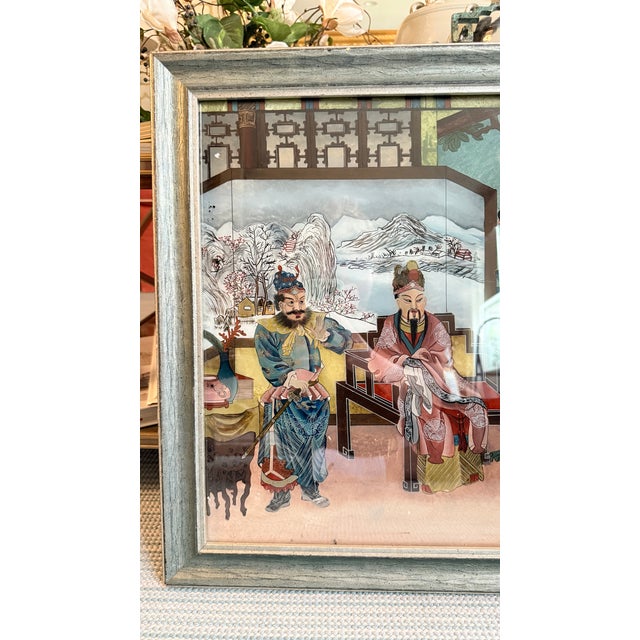
A finely detailed Chinese reverse-glass painting depicting the traditional story of statesman Baili Xi’s reunion with his long-separated wife through music. Five richly dressed figures gather within an elaborate architectural and garden setting, surrounded by intricate latticework, flowering trees, ornamental railings and distant mountains.
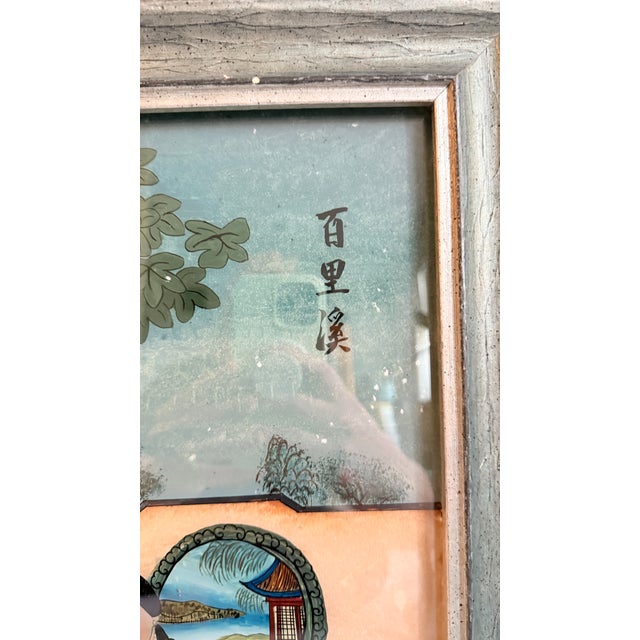
The inscription 百里奚 identifies Baili Xi, while the seated woman playing a guqin connects the scene to the reunion narrative. According to the story, her song recalled their earlier life together, allowing him to recognize his wife after years apart—a touching theme of loyalty and enduring devotion.
Hand-painted on the reverse of the glass, the composition required fine details to be applied before the broader colors and background. Celadon blue, dusty rose, ivory and deep blue create a luminous palette, complemented by patterned robes and expressive faces.
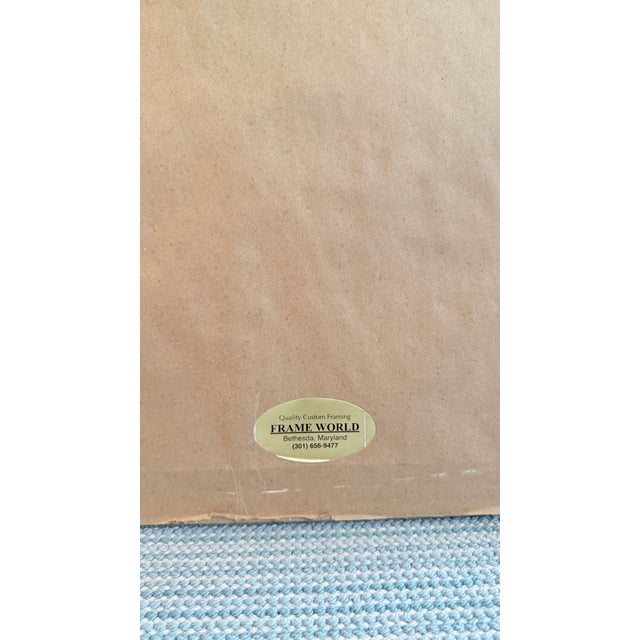
Presented in a later silvered blue-gray wood frame with a decorative Asian-style brass hanger, the painting retains a Frame World label from Bethesda, Maryland, documenting its later American framing history. Estimated circa 1930s–1950s; artist unknown.
A compelling focal point above a console or chest, this narrative work pairs beautifully with blue-and-white porcelain, lacquerware and collected antiques in chinoiserie, traditional or grandmillennial interiors.
Good vintage condition with scattered spotting, localized pigment wear and small paint losses. The glass remains intact, with no chips or cracks observed. The later frame shows age-related finish wear and slight movement when handled; professional tightening is recommended before transport. Please review all photographs as part of the condition description.
Dimensions: 27.5″ W × 1″ D × 21.75″ H, including frame.
See less
- Dimensions
- 27.5ʺW × 1ʺD × 21.75ʺH
- Art Subjects
- Architecture
- Figure
- Landscape
- Other
- Frame Type
- Framed
- Period
- Mid 20th Century
- Country of Origin
- China
- Item Type
- Vintage, Antique or Pre-owned
- Materials
- Enamel
- Glass
- Metal
- Ornamental & Decorative Materials
- Paper
- Wood
- Condition
- Good Condition, Unknown, Some Imperfections
- Color
- Blue
- Condition Notes
- Good vintage condition. The reverse-painted glass panel remains intact, with no chips, cracks or other structural issues observed. The painted … moreGood vintage condition. The reverse-painted glass panel remains intact, with no chips, cracks or other structural issues observed. The painted composition displays scattered spotting, tonal variation, localized pigment wear and small areas of loss consistent with age and the inherently fragile nature of reverse-glass decoration. These imperfections are visible in the photographs and contribute to the work’s authentic vintage character without compromising the overall composition. The later silvered blue-gray wood frame is in good overall condition with age-appropriate rubbing, marks and finish wear, particularly along the sides. The frame exhibits slight looseness or movement when handled but remains assembled and suitable for display. A buyer may wish to have it tightened by a professional framer, particularly before long-distance transport. The decorative Asian-style brass hanger at the top remains intact and in good condition. Naturally developed oxidation, darkened areas and mellow patina have been retained rather than polished away. The Frame World paper backing and hanging wire remain present. Please review all photographs closely, particularly the detailed images of the painted surface, inscription, frame sides, brass hanger and reverse. less
Questions about the item?
Returns & Cancellations
Return Policy - All sales are final 48 hours after delivery, unless otherwise specified in the description of the product.
Cancellation Policy - Prior to shipping or local pickup, buyers may cancel an order for up to 48 hours, unless otherwise specified.
Related Collections
- Photorealism Canvas Paintings
- Ed Ruscha Paintings
- Photorealism Paintings in New York
- Richard Serra Paintings
- Louise Nevelson Paintings
- Silk Velvet Paintings
- Herman Miller Paintings
- BDDW Paintings
- Karl-Erik Ekselius Paintings
- Carl-Axel Acking Paintings
- Joseph Stella Paintings
- James McCray Paintings
- Milton Avery Paintings
- Photorealism Paintings in Los Angeles
- Leroy Neiman Paintings
- Jaanika Peerna Paintings
- Jo Baskerville Paintings
- Nicola Simbari Paintings
- Soicher Marin Paintings
- Cassina Paintings
- Black Photorealism Paintings
- Lawson-Fenning Paintings
- White Abstract Paintings
- Jean-Paul Barray Paintings
- Hans Andersen Paintings