

Details
Description
One of the most atmospheric plates in the early volumes of The North American Indian, this photogravure depicts an Akimel …
Read more
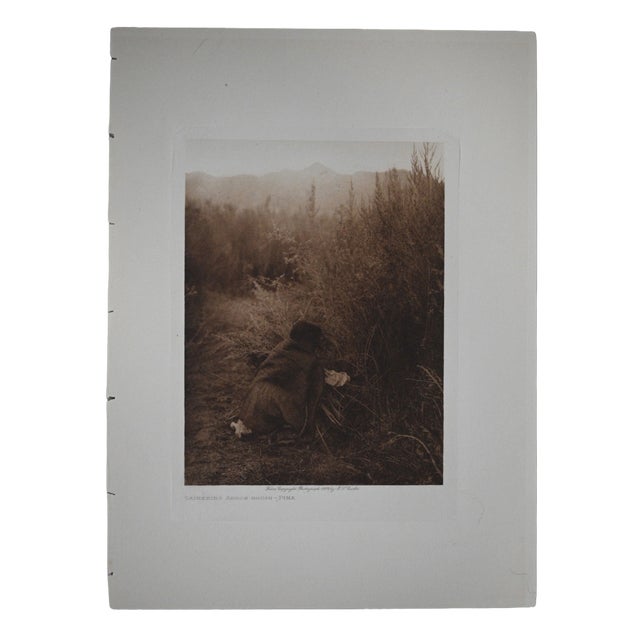
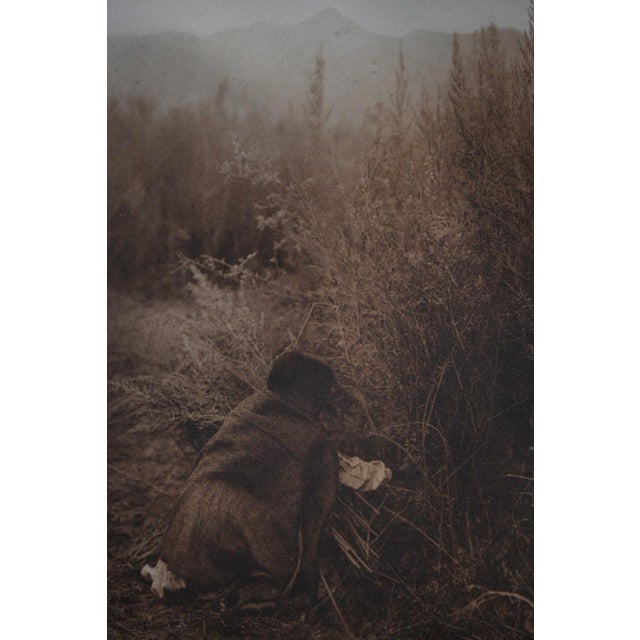
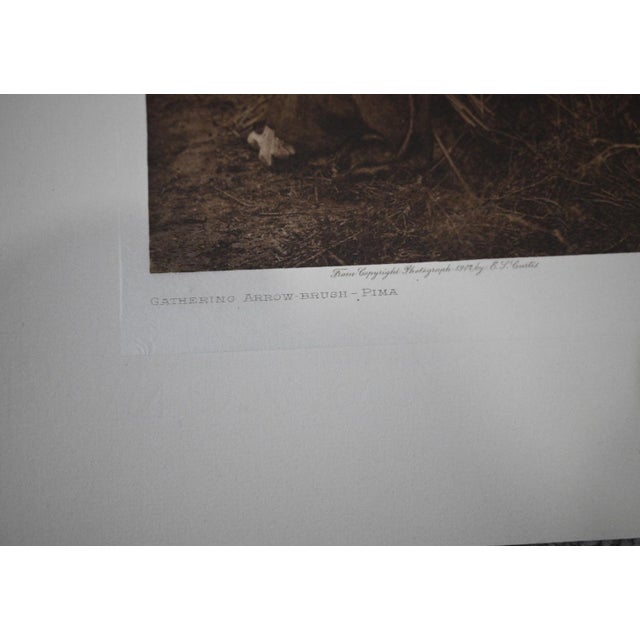
One of the most atmospheric plates in the early volumes of The North American Indian, this photogravure depicts an Akimel O'odham (Pima) woman cutting arrowweed at the edge of a desert thicket, photographed in 1907 during Curtis's Gila River fieldwork and published in Volume II, the installment devoted to the Pima, Mohave, Yuma, and neighboring peoples of the desert Southwest.
The scene is Curtis pictorialism at its purest. The woman kneels in a wool blanket at the base of a tall stand of brush, her cut bundle beside her, while the thicket dissolves into mist and a mountain ridge floats at the horizon. It reads as much like a tonalist painting as an ethnographic document, and the velvety continuous tone of hand-pulled gravure is exactly what the image asks for. Arrowweed was a staple material of life along the Gila: straight stalks for arrow shafts, walls and thatch for the traditional round house, material for granaries and shade structures. The Akimel O'odham, the River People, farmed these bottomlands for centuries, and their descendants continue today in the Gila River and Salt River communities.
This impression is from the deluxe tissue edition of the original 1907-1930 publication: printed on translucent Japanese gampi tissue and mounted, as issued, to its Holland Van Gelder support leaf (chine-collé), per Cardozo Collection cataloging. The tissue issue was the most expensive format offered to original subscribers, priced at $3,750 per set against $3,000 for the standard papers. This is not a 1970s-era restrike; restrikes were printed on modern papers such as Arches and Rives BFK.
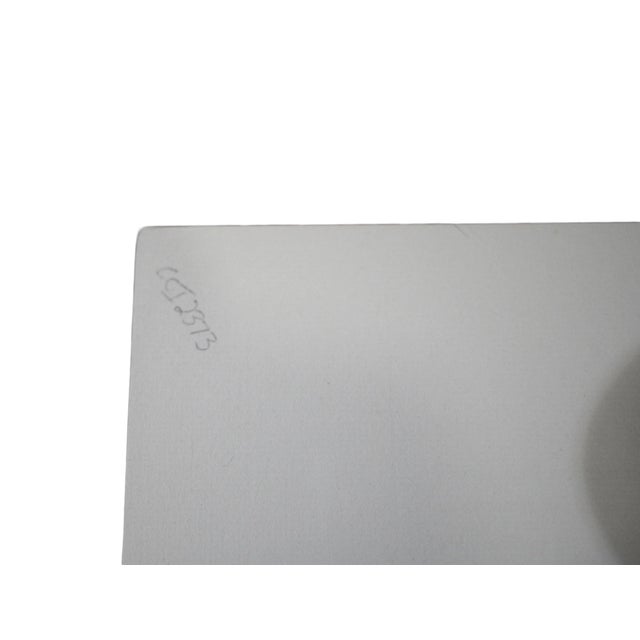
Provenance is the strongest available in the Curtis market: the Christopher G. Cardozo Collection. Cardozo (1948-2021) was the foremost Curtis collector, dealer, and scholar of his generation, author of Sacred Legacy and numerous standard references. This leaf retains its Cardozo inventory number in pencil on the verso.
A painterly, softly luminous example of early Curtis in the rarest issue of the publication. Pairs naturally with An Old Mohave from the same volume, listed separately in our shop. Ready to mat and frame.
See less
- Dimensions
- 9.5ʺW × 0.01ʺD × 12.5ʺH
- Frame Type
- Unframed
- Period
- 1900 - 1909
- Country of Origin
- United States
- Item Type
- Vintage, Antique or Pre-owned
- Materials
- Paper
- Condition
- Good Condition, Original Condition Unaltered, Some Imperfections
- Color
- Tan
- Condition Notes
- Good vintage condition for a volume leaf. A luminous, delicately toned impression with a clear plate mark. The gampi tissue … moreGood vintage condition for a volume leaf. A luminous, delicately toned impression with a clear plate mark. The gampi tissue is well adhered to its Van Gelder support leaf as issued, with the light surface undulation inherent to mounted tissue. A row of small binding holes runs along the left sheet edge from the leaf's removal from a bound deluxe volume; these sit well away from the image and disappear under a standard mat. A short diagonal handling crease at the right margin edge near the title line, approximately one inch, not affecting the image. Light, even age tone with a few scattered pinpoint paper flecks in the margins. No foxing, no repairs noted. Verso bears the Cardozo Collection inventory number in pencil at one corner, disclosed for completeness. Housed in an archival sleeve. less
Questions about the item?
Returns & Cancellations
Return Policy - All sales are final 48 hours after delivery, unless otherwise specified in the description of the product.
Cancellation Policy - Prior to shipping or local pickup, buyers may cancel an order for up to 48 hours, unless otherwise specified.
Related Collections
- Photography in Salt Lake City
- Color Pencil Photography
- Edward S. Curtis Photography
- Scarlet Photography
- Raymond Loewy Photography
- Soicher Marin Photography
- Renaissance Photography
- Cubism Photography
- Nick Mele Photography
- Black and White Photos
- Edwardian Photography
- Gustavian (Swedish) Photography
- Photography in Cleveland
- Photography in Minneapolis