







Details
Description
EMPIRE MAHOGANY AND GILT BRONZE MOUNTED BED BY FRANÇOIS HONORÉ GEORGES JACOB DESMALTER
Paris, France circa 1805 to 1817
62" …
Read more
EMPIRE MAHOGANY AND GILT BRONZE MOUNTED BED BY FRANÇOIS HONORÉ GEORGES JACOB DESMALTER
Paris, France circa 1805 to 1817
62" H x 58 1/2" D x approximately 81" W
74 1/8" L x 52" W approximately (interior)
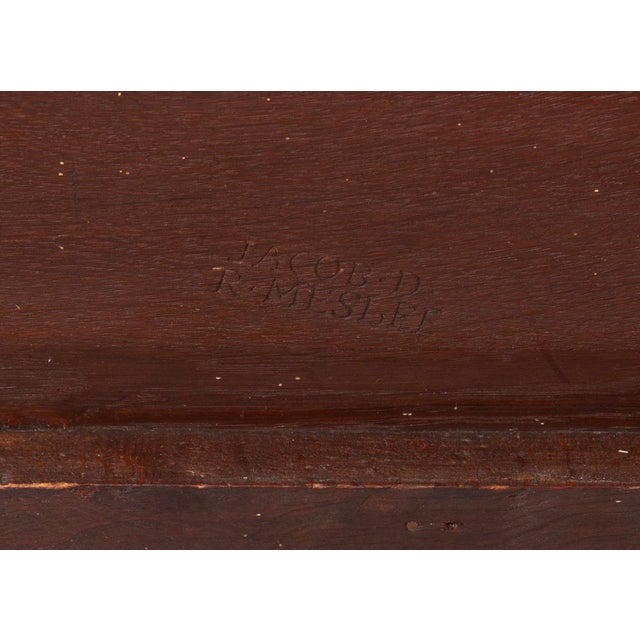
Stamped JACOB D.R. MESLEE on the footboard
Gilt busts attributed to the workshop of Pierre Philippe Thomire
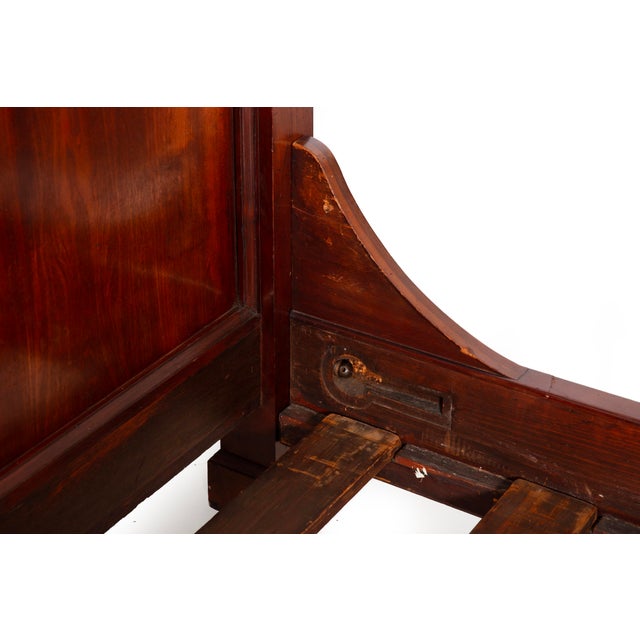
Foot-board and rails adapted into a more modern form
Mahogany and mahogany veneers, oak secondary woods, pine slats
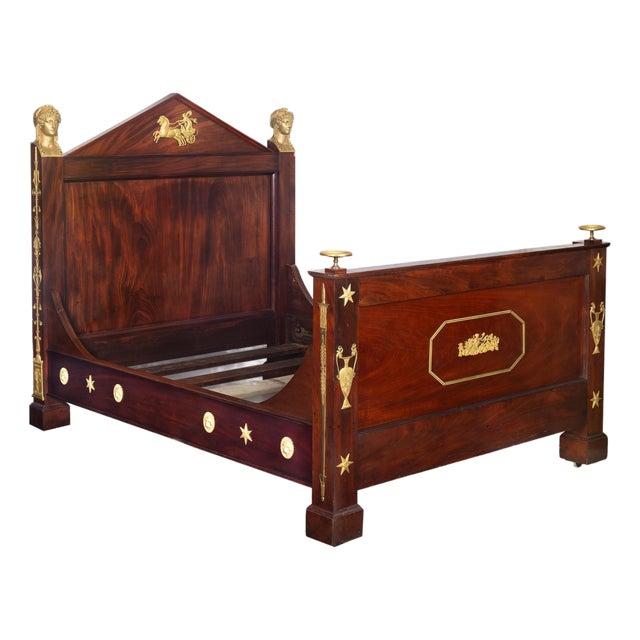
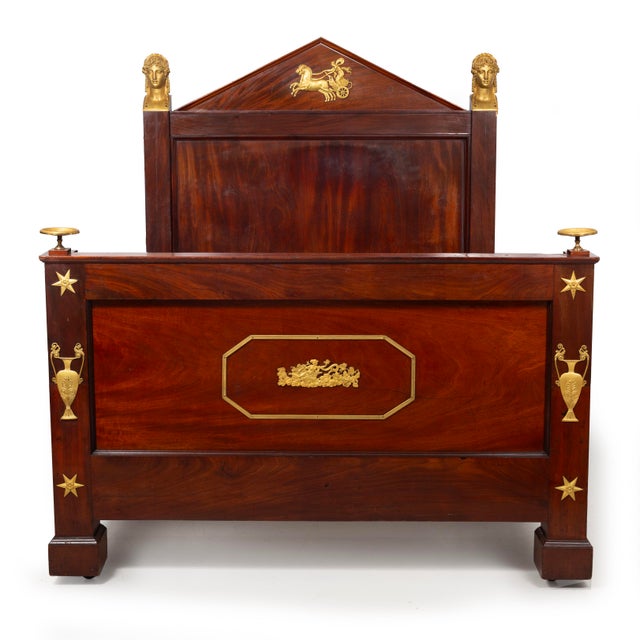
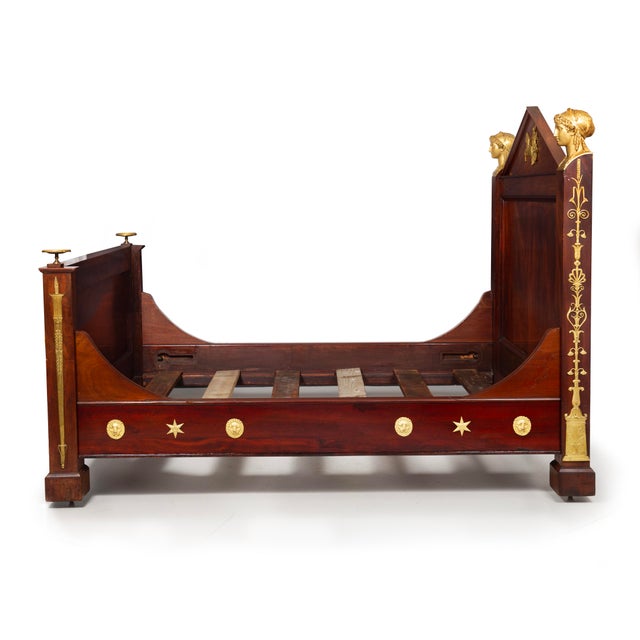
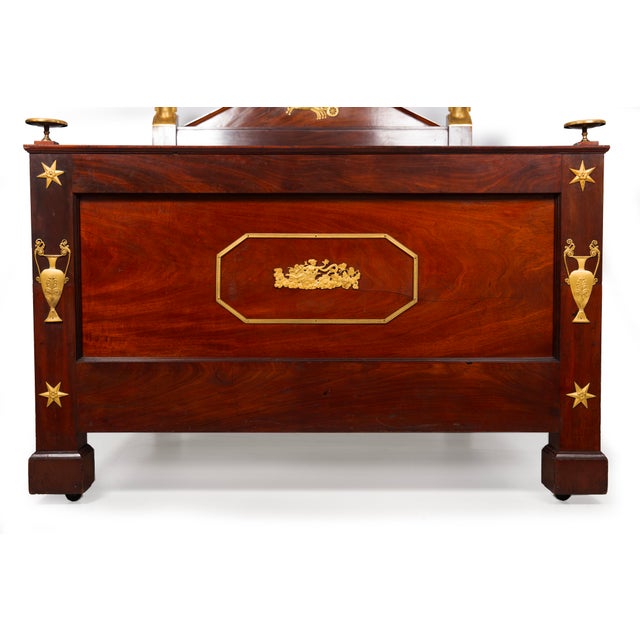
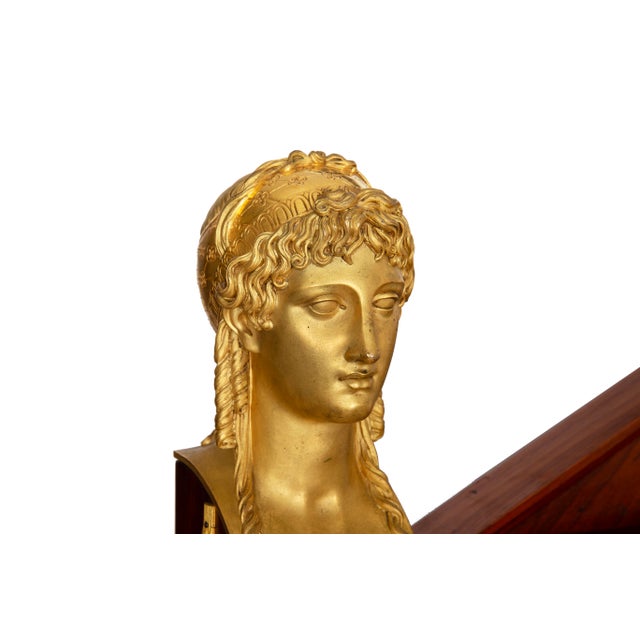
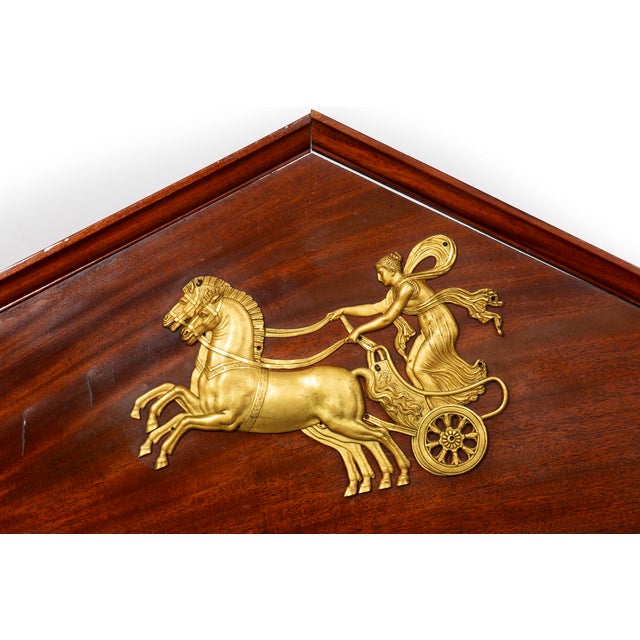
A fine French Empire mahogany bed by the Jacob dynasty in Paris, the form is conceived as an architectural object with a high paneled headboard, triangular pediment, broad foot-board and square post supports with marlborough molded feet; every major point frames or highlights finely chased gilt bronze mounts. Idealized classical female busts of the most extraordinary quality mount the headboard posts; these flank the gilt bronze group centered within the triangular pediment of a female charioteer driving a pair of horses while her diaphanous shawl furls around her body. The motifs of stars, flambeaux, anthemion-decorated vases, medallions, lion-masks and tazzas are balanced across the surfaces. The bed was adapted to more modern tastes at some point (see condition report for discussion). It presents not simply as a stunningly beautiful object to be collected but rather as a fully functional bed ready for regular use in today's home.
The stamp refers to the Jacob firm working at the time from rue Meslée, the Paris workshop operated by François Honoré Georges Jacob Desmalter. The mark JACOB D.R. MESLEE is the mark used by Jacob Desmalter et Cie, formed in 1803 by François Honoré Georges Jacob Desmalter and his father Georges Jacob after the death of Georges II Jacob. While the partnership is generally described as active from 1803 to 1813 and that ten year period is most commonly associated with the JACOB D.R. MESLEE mark, that date range should not be applied too rigidly to stamped furniture from the father and son duo. A documented bed made by Jacob Desmalter in 1817 for the royal prince D. Pedro de Braganza, now in the National Palace of Queluz, is recorded as stamped seven times JACOB D.R. MESLEE.
There are distinct echoes between the present bed and beds Jacob Desmalter made for the Bonaparte family and contemporaries. A bed by Jacob Desmalter of 1806, now in Napoleon’s bedroom at Malmaison, was originally Eugène de Beauharnais’s bed at the Tuileries. Its use of patinated and gilt bust mounts provides a direct point of comparison for the present example. The same bust type also appears on the bed in the suite designed for Prince Felice Baciocchi, husband of Elisa Bonaparte, at the Villa Reale di Marlia. These parallels do not establish a shared commission, but they place the present bed within a small and recognizable group of Empire beds made for the most important families in France.
Another important comparison is the Lit de Napoléon Ier in the Musée Marmottan Monet, dated circa 1807 to 1808. That bed is recorded as mahogany with bronze and gilt bronze, by or associated with Jacob Desmalter, with the bronze work attributed to Pierre Philippe Thomire. Its front uprights are surmounted by female heads in patinated and gilt bronze, while its gilt bronze mounts include stars and poppy flowers, imagery connected with sleep and night. The Marmottan bed is not stamped and the museum notes that it may have been locally made for the imperial residence at Bordeaux, but the richness of its bronzes indicates the status of the intended occupant.
The Jacob firm at rue Meslée in Paris was one of the principal furniture making houses of the Empire and Restoration periods. Its foundation lay with Georges Jacob, 1739 to 1814, one of the leading menuisiers of the Louis XVI period. After his retirement in 1796, the business passed to his sons Georges II Jacob, 1768 to 1803, and François Honoré Georges Jacob, 1770 to 1841, who worked under the name Jacob Frères.
Following the premature death of Georges II in 1803, François Honoré Georges Jacob adopted the name Jacob Desmalter, taken from one of his father’s properties in Burgundy, and resumed business with his father under the name Jacob Desmalter et Cie. During the Empire, he was described as menuisier ébéniste and maker of furniture and bronzes for Their Imperial and Royal Majesties, which gives at least some indication of the sheer breadth of production the firm engaged in while servicing the imperial households.
The firm expanded substantially after Jacob Desmalter’s appointment as ébéniste de l’Empereur. Important commissions came through the Garde Meuble Impérial for Bonaparte residences, particularly those connected with Empress Joséphine. The firm also supplied major private patrons, wealthy Parisian clients, and foreign courts, including commissions from Tsar Alexander I of Russia and Charles IV of Spain.
Among the firm’s important surviving works are the imperial throne at Fontainebleau, the jewel cabinet made for Empress Marie Louise and the display cases for the Cabinet des Antiques at the Bibliothèque Nationale in Paris. Jacob Desmalter’s work is represented in major French palace and museum collections, including Compiègne, Fontainebleau, Malmaison, Versailles, Sceaux, the Louvre, the Musée Marmottan, the Mobilier National, the Grand Trianon, and the Bibliothèque Marmottan, as well as institutional and royal collections outside France, including the Palais d’Aranjuez in Spain.
Despite its exceptional reputation, the firm was affected by the broader crisis in the luxury trades following the Peninsular War and the Russian campaign. Georges Jacob retired in 1813, the same year the firm declared bankruptcy. The setback was brief. Business revived after the Restoration of Louis XVIII in 1814, and the firm continued until 1847, when it was sold to Charles Joseph Marie Jeanselme.
Literature:
For an extensive discussion of the Jacob family, specifically the Jacob-Desmalter period, along with a larger collection of their documented work (showing many echoes to the bronze mounts chosen for the present example), see Ledoux-Lebard, "Le Mobilier Français du XIXe Siècle: Dictionnaire des ébénistes et menuisiers", 2000, p. 267-367
See Nicolay, "L'Art et la Maniere des Maitres Ebenistes Français au XVIIIe Siecle", 1976, p.246, fig. G for identical amphora mounts
Public Collections:
https://collection.mobilier-national.fr/objet/GME-8937-000
https://www.marmottan.fr/notice/770/
Condition: Footboard is reconfigured (note the horizontal splice line behind the amphora, added oak secondary to the upper, absence of molding along the top edge within the recessed panel of footboard) as well as the bedrails (strips added to underside of bedrails to enlarge their profile and probably also to provide greater stability/torque strength). This appears to be an early adaption and competently executed, the mounts then repositioned to maintain symmetry. The bedrails were refinished at some point in a higher gloss than the other elements; bottom strip of molding on bedrails replaced. Returns for the bedrails show filled holes where mounts would have hung; returns are missing a few of the dowels that plug into the head/footboard uprights; all returns show some degree of restoration/repair. Most bed support boards are old, two are 20th century replacements. Some spliced repairs to mahogany. The shellac surface would benefit from being French polished again throughout. Old chips by the mounted busts along with other wear/chips/cloudiness throughout from gentle historical wear, rubbing and wear to the feet (along with a spliced patch). Busts are missing a few screws and present with very minor rubbing to nose and raised elements. Gilding throughout is vibrant and well preserved on the mounts. Very sturdy structure and ready for regular active use.
ref. 512BPP16S
See less
- Dimensions
- 81ʺW × 58.5ʺL × 62ʺH
- Styles
- Empire
- Bed Size
- Custom
- Period
- 19th Century
- Country of Origin
- France
- Item Type
- Vintage, Antique or Pre-owned
- Materials
- Bronze
- Mahogany
- Oak
- Pine
- Condition
- Good Condition, Restored, Some Imperfections
- Color
- Brown
- Condition Notes
- Footboard is reconfigured (note the horizontal splice line behind the amphora, added oak secondary to the upper, absence of molding … moreFootboard is reconfigured (note the horizontal splice line behind the amphora, added oak secondary to the upper, absence of molding along the top edge within the recessed panel of footboard) as well as the bedrails (strips added to underside of bedrails to enlarge their profile and probably also to provide greater stability/torque strength). This appears to be an early adaption and competently executed, the mounts then repositioned to maintain symmetry. The bedrails were refinished at some point in a higher gloss than the other elements; bottom strip of molding on bedrails replaced. Returns for the bedrails show filled holes where mounts would have hung; returns are missing a few of the dowels that plug into the head/footboard uprights; all returns show some degree of restoration/repair. Most bed support boards are old, two are 20th century replacements. Some spliced repairs to mahogany. The shellac surface would benefit from being French polished again throughout. Old chips by the mounted busts along with other wear/chips/cloudiness throughout from gentle historical wear, rubbing and wear to the feet (along with a spliced patch). Busts are missing a few screws and present with very minor rubbing to nose and raised elements. Gilding throughout is vibrant and well preserved on the mounts. Very sturdy structure and ready for regular active use. less
Questions about the item?
Returns & Cancellations
Return Policy - All sales are final 48 hours after delivery, unless otherwise specified in the description of the product.
Cancellation Policy - Prior to shipping or local pickup, buyers may cancel an order for up to 48 hours, unless otherwise specified.
Related Collections
- Eldred Wheeler Bedframes
- Marble Bedframes
- Berkey and Gay Bedframes
- Poltronova Bedframes
- Leighton Hall Furniture Bedframes
- Sleigh Bed Frames
- 1980s Bed Frames
- Bauhaus Bedframes
- Cane Beds
- Storage Bed Frames
- Kindel Furniture Bedframes
- Barbara Barry Bedframes
- Pennsylvania House Bedframes
- Hot Pink Bedframes
- Danish Modern Teak Bedframes
- Bedframes in Sacramento