

Details
Description
Why This Work Matters
Confetti Nature captures the exuberance of the natural world as if growth itself has become a …
Read more
Why This Work Matters
Confetti Nature captures the exuberance of the natural world as if growth itself has become a celebration. Bouzard-Hui turns nature into something spontaneous and joyful—a burst of color, movement, and life that refuses to remain contained.
Artwork Description
Confetti Nature
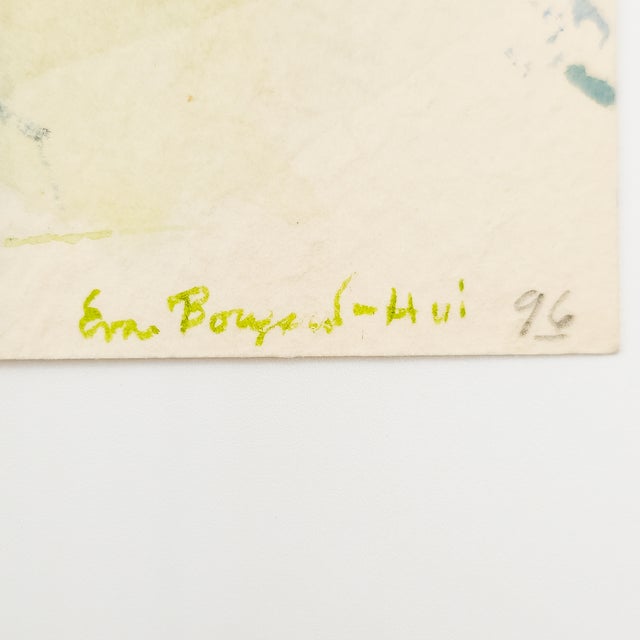
Eva Bouzard-Hui, c. 1996
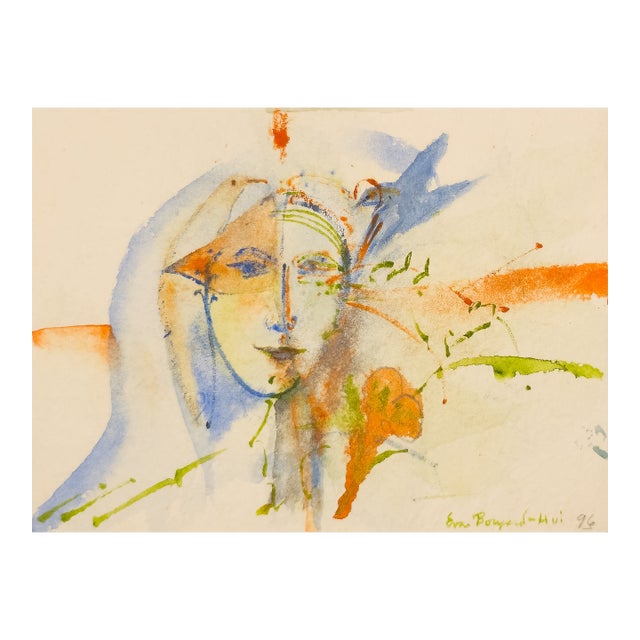
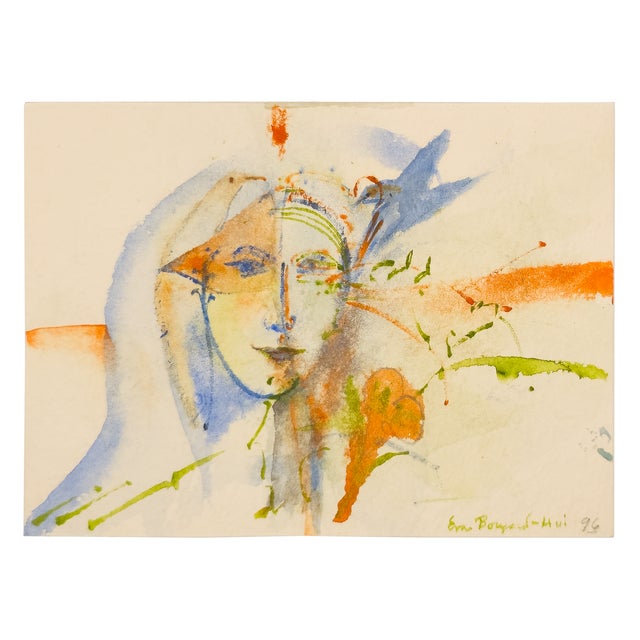
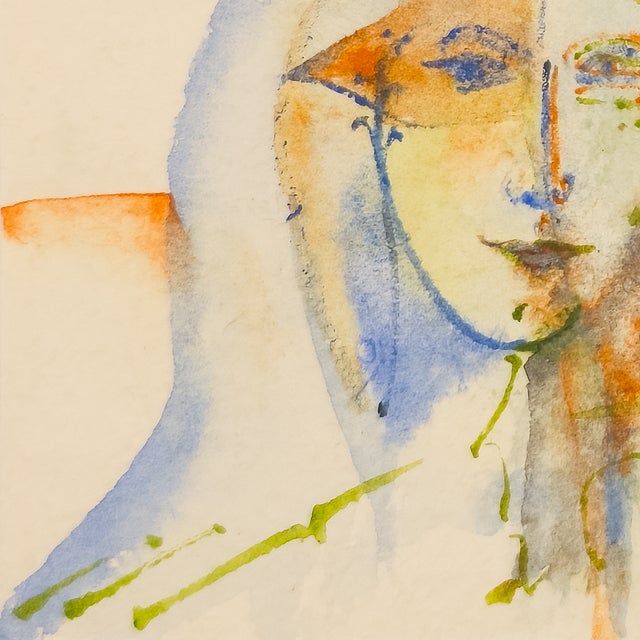
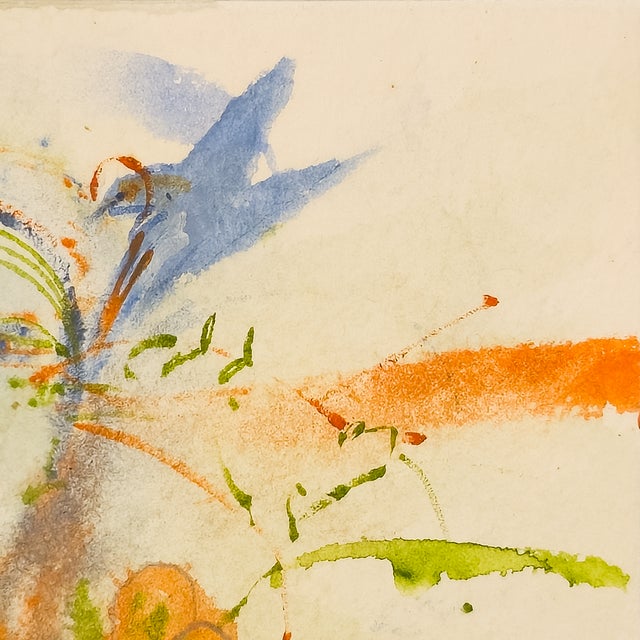
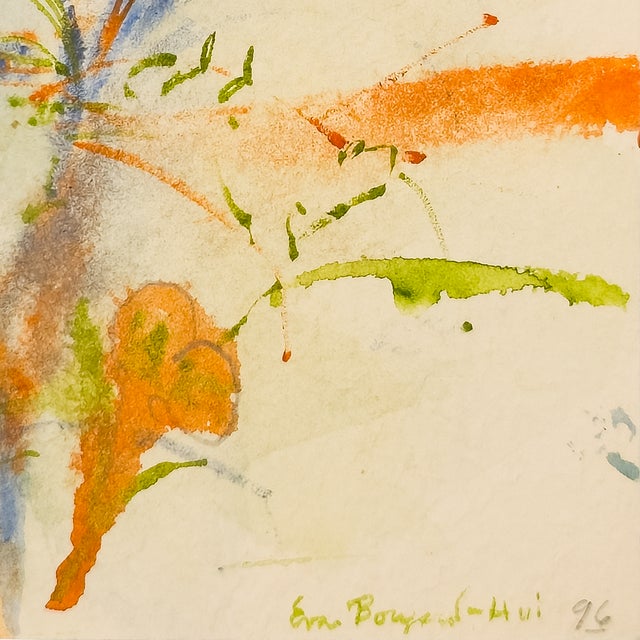
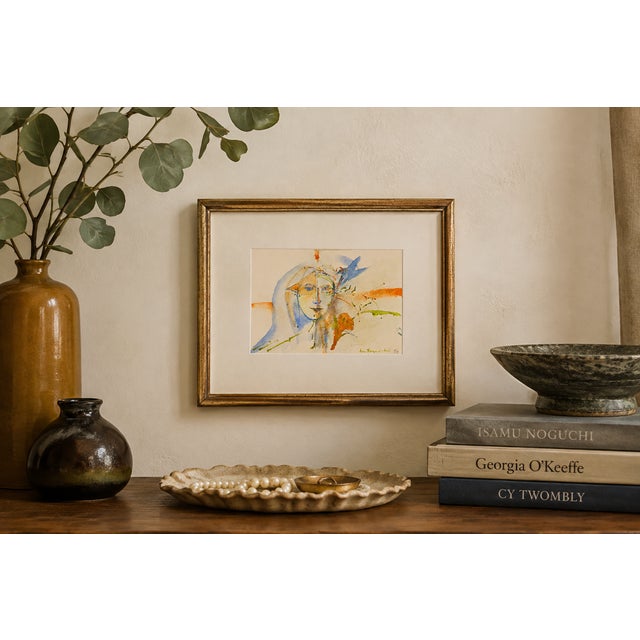
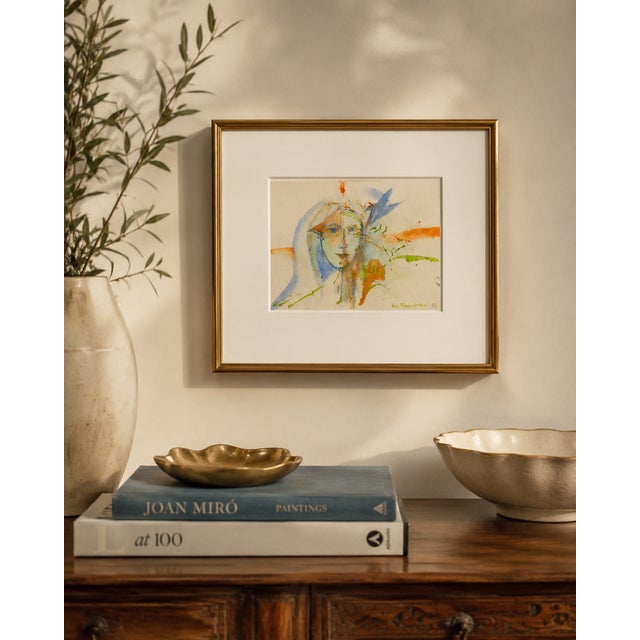
Eva Bouzard-Hui constructs Confetti Nature through overlapping watercolor washes, broken contours, and isolated bursts of saturated color. The central face is the composition’s primary anchor, but it never becomes fully separate from the surrounding imagery. Pale blue shadow gathers around the head and neck, orange pigment moves across the cheek and lower center, and green lines travel through the figure like stems, veins, or traces of landscape. The portrait is therefore less a fixed likeness than a point where bodily, emotional, and natural forms converge.
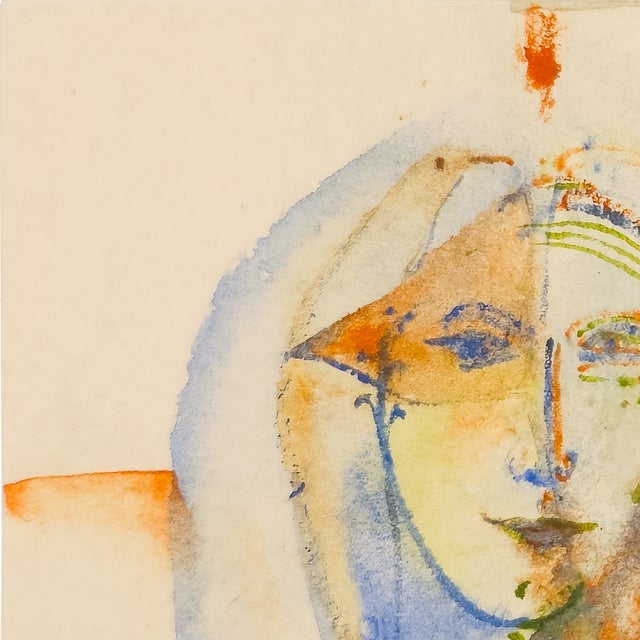
The face itself is asymmetrical and partially doubled. Its central eye, long nose, and restrained mouth create a contemplative expression, while a second profile seems to press inward from the left. That profile possesses an elongated, almost beaklike nose and a sharply defined eye. It may be another person, a bird-human hybrid, or an alternate aspect of the central figure. Bouzard-Hui frequently permits human and animal identities to overlap, allowing the natural world to become a visual extension of consciousness.
Near the upper right, a blue-gray shape rises behind the faces like a wing, mountain, shadow, or crest of hair. Its angular silhouette contrasts with the softer central washes. The form can be read as protective, intrusive, or simply atmospheric, but its ambiguity strengthens the sense that the central figure exists within a shifting field rather than a stable setting.
The title’s “confetti” appears through scattered orange, green, blue, and red accents. These marks do not fall evenly across the page. Instead, they gather around the face, throat, and right side, where color becomes most concentrated. Confetti traditionally signifies public celebration, but Bouzard-Hui’s marks are too irregular and emotionally weighted to remain purely festive. They resemble sparks, petals, fragments, stains, or small pieces of experience distributed through memory.
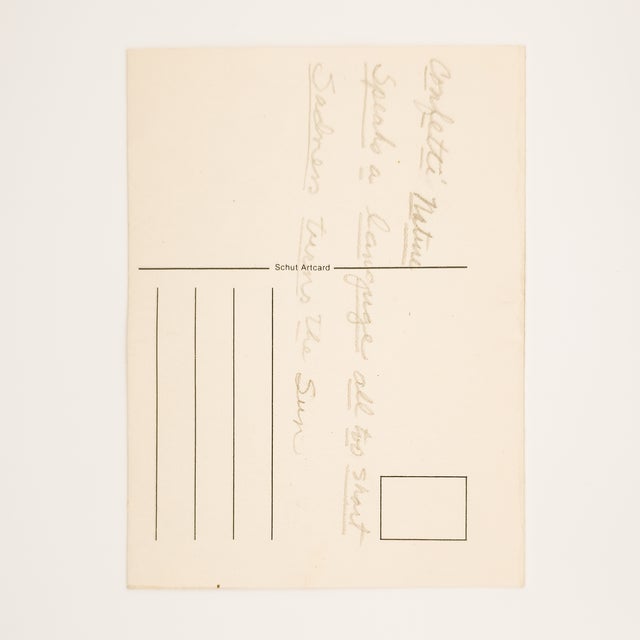
This contradiction between celebration and melancholy is articulated by the verso poem:
“Confetti nature
Spreads a language all too short
Sadness turns the Sun.”
The first line joins the artificial festivity of confetti with the organic abundance of nature. Flowers, leaves, birds, sunlight, and seasonal color can appear as scattered gifts, each offering a momentary sign of beauty. Bouzard-Hui’s phrasing suggests that nature itself throws these fragments into the world.
Yet the second line immediately limits their communicative power. Nature “spreads a language,” but that language is “all too short.” The phrase may describe the brevity of flowering, daylight, spring, or life itself. It can also suggest that visual beauty cannot adequately express prolonged grief. Nature speaks through color and form, but its vocabulary may be insufficient when sadness exceeds what can be named.
The wording “all too short” also introduces time. Confetti falls quickly; blossoms fade; sunlight passes; seasons change. The natural signs that promise renewal are temporary. Their brevity may intensify rather than relieve melancholy because beauty becomes inseparable from its disappearance.
The final line, “Sadness turns the Sun,” is especially powerful because it leaves the transformation incomplete. Bouzard-Hui does not specify what sadness turns the sun into. The sun might become dim, cold, red, distant, or emotionally unrecognizable. By withholding the conclusion, she invites the image to complete the thought.
The painting’s orange passages may represent that altered sun. Orange appears near the top, across the faces, and in a concentrated organic form near the lower center-right. It retains warmth, yet it is mixed with gray, blue, and green, preventing it from dominating the composition as a stable source of light. Sadness has not extinguished color; it has changed its emotional temperature.
This treatment connects Confetti Nature to Bouzard-Hui’s broader exploration of seasonal renewal complicated by inward resistance. In A Doubtful Spring, luminous color and a bird announce spring while the fragmented face remains apprehensive. In Oh So What / Springtime, sweeping creatures and bright washes suggest seasonal awakening, but the alternate title responds with indifference. In So What!, a flower-like growth emerges from a withdrawn figure’s head, yet the person appears unwilling or unable to acknowledge nature’s promise.
Across these works, Bouzard-Hui repeatedly questions the assumption that the natural world automatically heals human sorrow. Spring may arrive, birds may return, and flowers may bloom, but psychological renewal follows no predictable seasonal schedule. Nature continues its cycles independently of whether the individual is prepared to receive them.
The poem also reflects Bouzard-Hui’s larger practice of pairing images with short, fractured texts. Her language often operates like her drawing: associative, compressed, and resistant to conventional syntax. Rather than explaining the image, the poem creates another layer of ambiguity. “Sadness turns the Sun” behaves much like an unfinished contour in the painting. It directs interpretation without closing it.
The multiple faces further place the work within her recurring interest in divided or relational identity. In Questioned Love, two figures overlap within an embrace whose tenderness is complicated by emotional uncertainty. In Pain, bodies become inseparable within a structure of suffering. Here, the overlapping profiles may represent separate beings, but they can also be understood as multiple emotional positions within one consciousness—the self observing nature, the self altered by sadness, and the more instinctive or birdlike self still responsive to the world.
Formally, the large unpainted areas are as important as the colored passages. The open paper prevents the imagery from becoming visually heavy, while also giving the faces an unfinished, vulnerable quality. Bouzard-Hui allows the image to breathe, but this openness can also feel like silence surrounding the inadequate “language” described in the poem.
Confetti Nature is not a rejection of beauty. Bouzard-Hui preserves the pleasure of color, the delicacy of watercolor, and the vitality of natural forms. What she rejects is the idea that beauty alone can resolve emotional pain. Nature scatters its brief messages generously, but sadness changes how they are understood. The sun continues to shine, yet the grieving or introspective mind transforms its meaning
-Jonathan Flike
About the Artist
Eva Bouzard-Hui (1936–2023) was an American artist, ceramicist, poet, educator, and community advocate whose career spanned more than six decades. Working across painting, drawing, ceramics, collage, photography, handmade paper, book arts, and poetry, she developed an intimate visual language centered on relationships, memory, vulnerability, spirituality, and emotional transformation.
Born in Columbia, South Carolina, and raised in the small town of North, Bouzard-Hui earned a B.A. in Art Education from the University of South Carolina in 1957. She later moved to New York, receiving an M.A. in Art Education from Teachers College, Columbia University, in 1961 and an Ed.D. in College Teaching from its Arts and Art Education Department in 1993. Her continuing studies included ceramics at Greenwich House Pottery, book arts in New York, Chinese brush painting, and traditional Chinese mounting.
In 1961, Bouzard-Hui began a more than thirty-year career in the Caldwell–West Caldwell public schools of New Jersey. She taught at the middle- and high-school levels and eventually chaired the Art Department and ceramics program at James Caldwell High School. She also held teaching appointments at Middlesex County College, Essex County College, Teachers College, and Georgian Court College. For Bouzard-Hui, education was not separate from studio practice; teaching, experimentation, and encouraging others to discover their own creative language remained central to her life.
Bouzard-Hui met and later married the Chinese-born American ceramicist Ka Kwong Hui, whose work and knowledge of Chinese ceramic traditions contributed to their shared artistic environment. Her own engagement with China expanded through a Geraldine R. Dodge Foundation grant to study at the ceramic factories of Jingdezhen. She later lectured and demonstrated at schools and ceramic institutions in China and Hong Kong while also exhibiting as a visiting artist.
Her exhibition career began with a solo presentation at Columbia University in 1961 and continued into the 2010s. Her work was shown at the New Jersey State Museum, Teachers College, the Paterson Museum, Georgian Court College, Phoenix Gallery and the Interchurch Center in New York, Agora Gallery, Studio Montclair, and numerous regional galleries and cultural institutions. Works by Bouzard-Hui are documented in institutional, educational, presidential, and private collections.
Although ceramics remained foundational to her practice, Bouzard-Hui resisted identification with a single medium. Her works on paper combine ink, watercolor, graphite, colored pencil, collage, handmade paper, and handwritten language. Figures, hearts, animals, flowers, vessels, chairs, and domestic objects frequently become carriers of emotion. Titles and inscriptions function as extensions of the imagery, transforming individual works into visual poems, questions, private jokes, prayers, or fragments of correspondence.
This relationship between art and communication is especially evident in her artist-designated “Sealed Art” series. These works were enclosed, folded, wrapped, or sealed so that opening them became part of the artistic experience. The revealed image and handwritten message often resemble a personal greeting card, turning the artwork into an exchange between artist and recipient.
Bouzard-Hui also used art as a form of service. She taught through CARE in Biafra, facilitated race-relations programs, worked with shelter residents, led poetry groups at the Essex County Jail Annex, and provided art instruction to incarcerated individuals at East Jersey State Prison. Her career reflects a sustained belief that creative work could provide dignity, connection, humor, and emotional freedom.
Across her many media, Bouzard-Hui treated the handmade object as a vessel for human experience. Her work asks how tenderness and imagination might endure pain, separation, and uncertainty—and how an artwork might carry those feelings from one person to another.
Underrepresented Artist Information
Despite a career spanning more than six decades, Eva Bouzard-Hui remains largely absent from broader accounts of postwar American art. Her relative obscurity does not reflect a lack of training, exhibition history, or sustained artistic production. Rather, it illustrates how artists working outside dominant commercial centers—and especially women whose careers combined studio practice, teaching, craft, and community service—have often been overlooked by the market and art-historical record.
Bouzard-Hui worked across ceramics, painting, drawing, collage, photography, poetry, handmade paper, and book arts. This movement between media enriched her practice but also placed her outside the easily defined categories through which artists are frequently promoted and collected. Ceramics and art education, both central to her career, have historically received less institutional attention than painting and sculpture produced for the commercial gallery system. Her extensive work in schools, shelters, prisons, and community programs further positioned art as a social and educational practice rather than solely as a market commodity.
Although Bouzard-Hui exhibited regularly in New York, New Jersey, and institutional settings, much of her career developed through cooperative galleries, colleges, libraries, community organizations, and regional cultural networks. These venues allowed her to maintain an independent and experimental practice, but they rarely produced the sustained critical documentation or secondary-market visibility that establishes long-term recognition.
Her surviving work reveals an artist of remarkable emotional and material range. Bouzard-Hui addressed love, grief, faith, confinement, humor, memory, and human connection through imagery that could be whimsical, unsettling, tender, or deeply introspective. Her intimate works on paper and artist-designated “Sealed Art” also challenge conventional assumptions about artistic importance by locating meaning in small scale, handwritten language, private exchange, and personal discovery.
Recovering Bouzard-Hui’s work contributes to a broader reassessment of women artists, artist-educators, ceramicists, and regionally active creators whose achievements have remained fragmented across archives, private collections, and personal histories. Her practice demonstrates that significance is not determined solely by market recognition, but by the originality, persistence, and humanity of the work itself.
See less
- Dimensions
- 6ʺW × 0.1ʺD × 4ʺH
- Frame Type
- Unframed
- Period
- 1990s
- Country of Origin
- United States
- Item Type
- Vintage, Antique or Pre-owned
- Materials
- Watercolor
- Condition
- Good Condition, Original Condition Unaltered, Some Imperfections
- Color
- Blue
- Condition Notes
- Please note that this item is vintage and shows wear consistent with age, use, and history. Signs of wear may … morePlease note that this item is vintage and shows wear consistent with age, use, and history. Signs of wear may include, but are not limited to, minor surface marks, patina, fading, or imperfections typical of older items. All items is standard with vintage and pre-owned goods and cannot be returned on the basis of condition. Measurements are approximate. We do our best to describe items accurately; however, condition assessments are subjective. If you would like additional details, images, or clarification before purchasing, please contact us. less
Questions about the item?
Returns & Cancellations
Return Policy - All sales are final 48 hours after delivery, unless otherwise specified in the description of the product.
Cancellation Policy - Prior to shipping or local pickup, buyers may cancel an order for up to 48 hours, unless otherwise specified.
Related Collections
- Ed Ruscha Paintings
- Photorealism Canvas Paintings
- Ralph Lauren Paintings
- Photorealism Paintings in New York
- Louise Nevelson Paintings
- Richard Serra Paintings
- Silk Velvet Paintings
- Herman Miller Paintings
- BDDW Paintings
- Jo Baskerville Paintings
- Jean-Paul Barray Paintings
- Johannes Andersen Paintings
- Peter Behrens Paintings
- Carl-Axel Acking Paintings
- Joseph Stella Paintings
- Karl-Erik Ekselius Paintings
- Pedro Friedeberg Paintings
- Piet Hein Eek Paintings
- Black Photorealism Paintings
- James McCray Paintings
- Lawson-Fenning Paintings
- Milton Avery Paintings
- Raphael Paintings
- Hans Andersen Paintings
- Cassina Paintings