

Details
Description
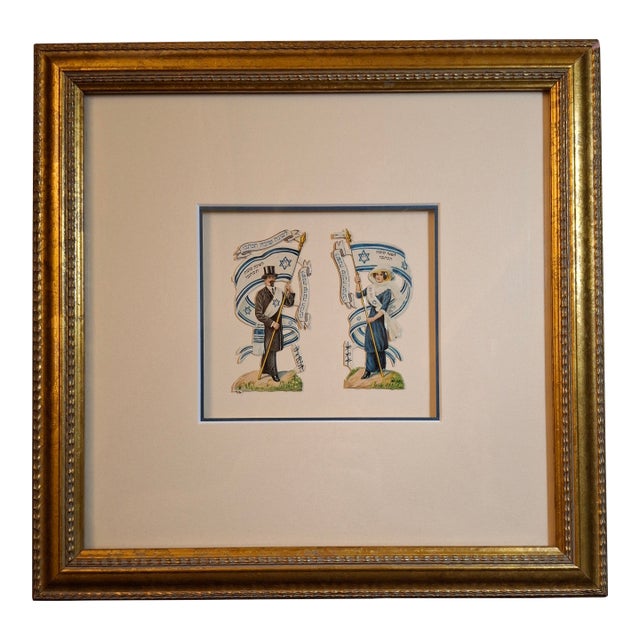
A beautifully preserved and professionally framed pair of early 20th-century Jewish New Year (Rosh Hashanah) die-cut greeting cards, originally produced …
Read more
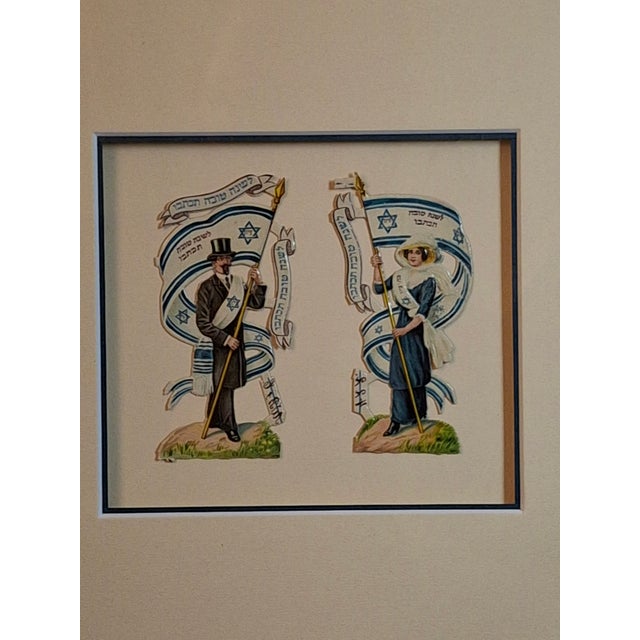
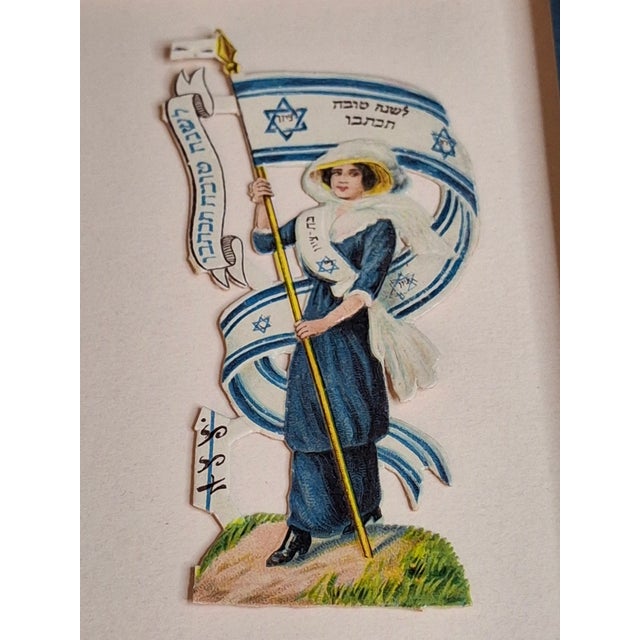
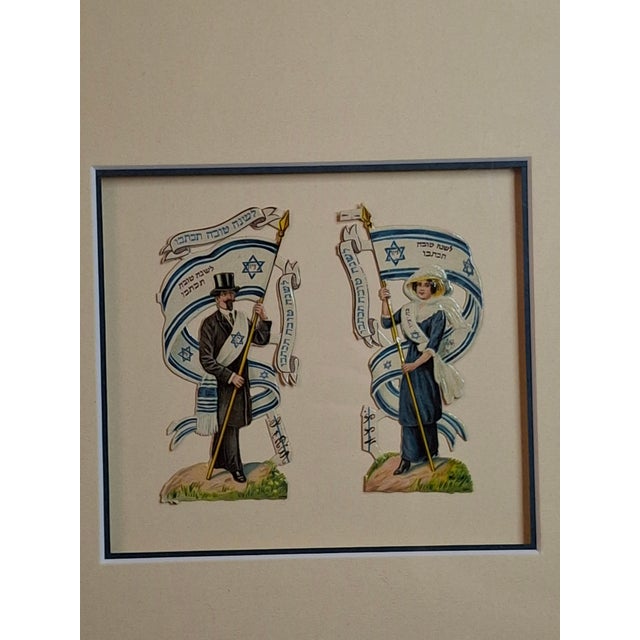
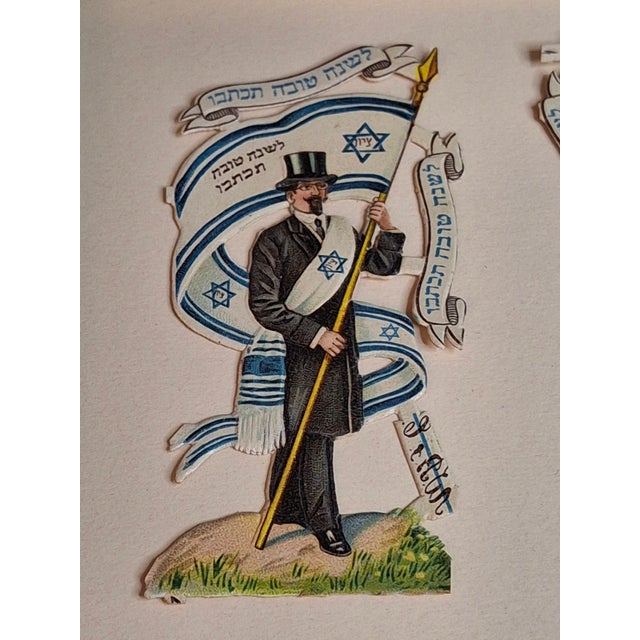
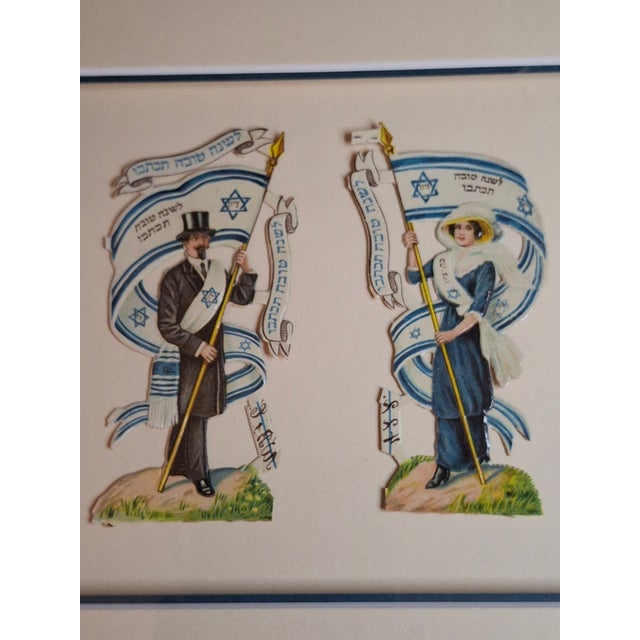
A beautifully preserved and professionally framed pair of early 20th-century Jewish New Year (Rosh Hashanah) die-cut greeting cards, originally produced by the renowned Hebrew Publishing Company of New York.
This historic pair features highly detailed, embossed chromolithograph die-cuts reflecting the early American Zionist movement:
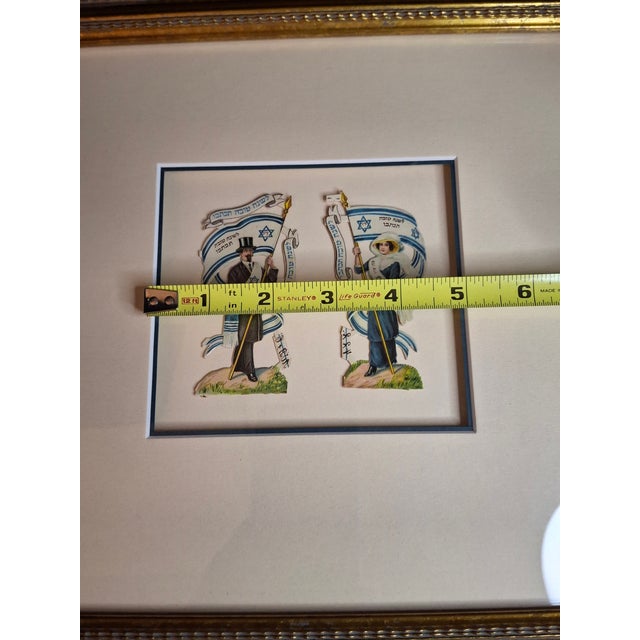
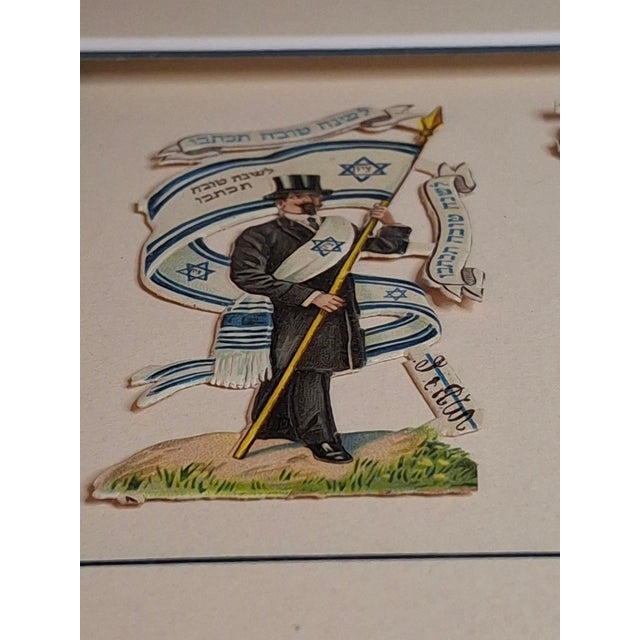
Left Figure: A gentleman in a formal top hat, frock coat, and traditional tallit (prayer shawl) proudly holding a large blue-and-white flag adorned with the Star of David (Magen David) and the word "Zion" (Zion / ציון).
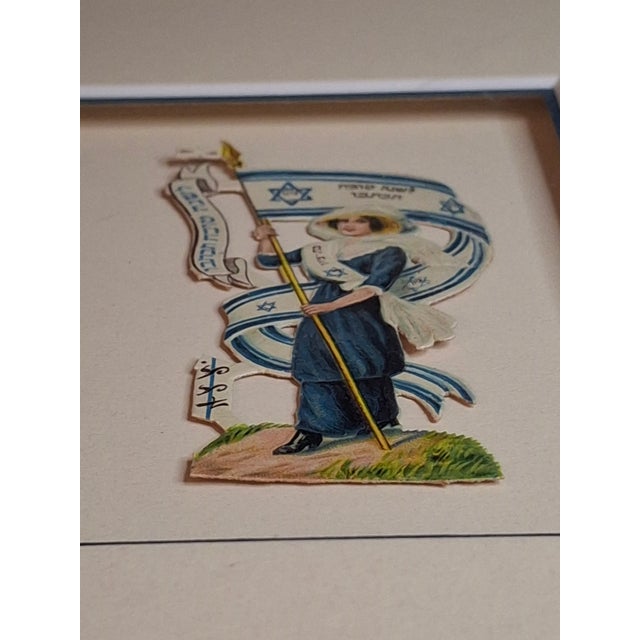
Right Figure: A stylishly dressed Edwardian woman wearing a fashionable wide-brimmed yellow hat, white fur muff/stole, and a decorative sash bearing the Hebrew phrase Bat Tzion (Daughter of Zion). She holds a matching blue-and-white Zionist banner.
Both pieces display the traditional Hebrew holiday greeting banner: לשנה טובה תכתבו (L'Shanah Tovah Tikatevu – "May you be inscribed for a good year"). The die-cuts have been beautifully preserved and expertly presented in a double-matted display within a high-quality, gilded wood gallery frame under protective glass. This is an exceptional, investment-grade piece of American Judaica folk art.
Origin
Publisher: Hebrew Publishing Company (77-79 Delancey St, New York, NY)
Country of Origin: United States (printed with German chromolithographic technology typical of the period)
Age
Circa: 1905–1915 (Edwardian / Early Progressive Era)
Material
Medium: Embossed chromolithograph on die-cut cardstock
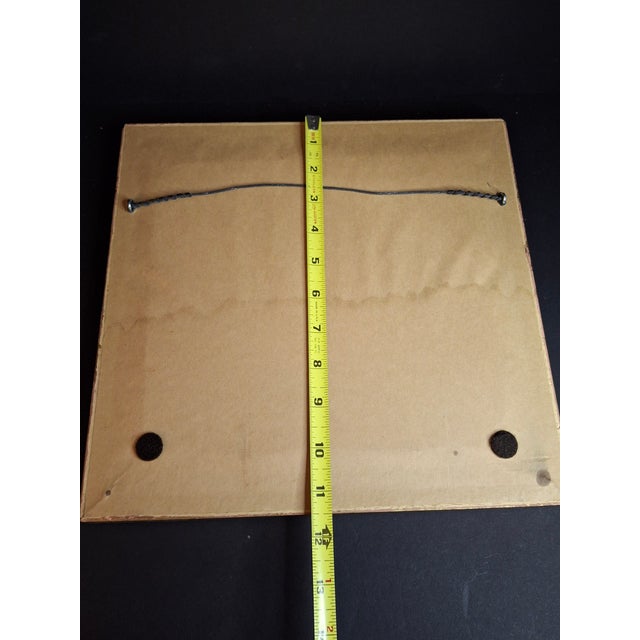
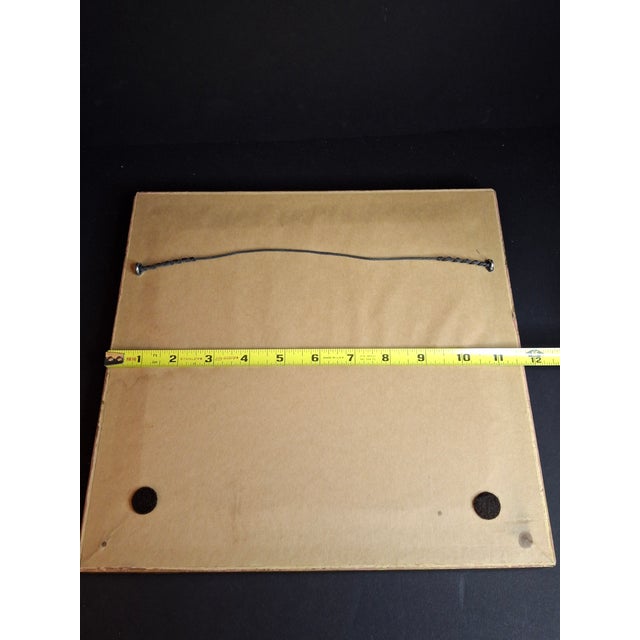
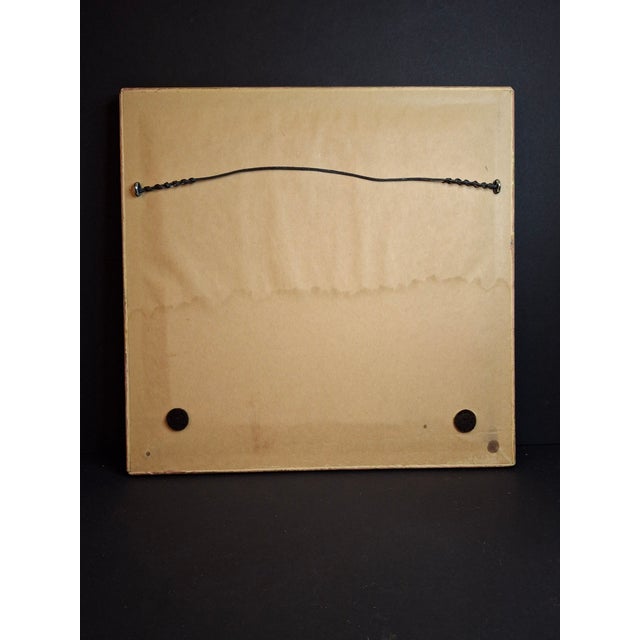
Framing: Gilded wood profile, acid-free double matting, glass cover, paper dust cover backing with heavy-duty hanging wire
Authenticity Assessment
These pieces display all the definitive hallmarks of authentic early 20th-century production by the Hebrew Publishing Company. The printing utilizes multi-layered chromolithography rather than modern dot-matrix or digital reproduction, which is evident under magnification by the smooth, rich saturation of the ink layers and distinct ink boundaries. The crisp, mechanical embossing gives the figures three-dimensional depth, an attribute highly characteristic of German-made dies imported by New York publishers during the Edwardian era. The typography matches known holiday catalog lines from the 1910 era, and the natural, gradual reverse-side silvering/toning of the paper matrix confirms its century-old age.
Reference
This specific style of American immigrant-era holiday stationery is well-documented in standard references on Jewish ephemera:
Book Title: Shanah Tovah: The Rosh Hashanah Greeting Card in Israel and the Diaspora
Author: Shalom Sabar
Page Reference: Page 42 (Discussing the thematic shift to early American Zionist iconography and the die-cut imports of the Hebrew Publishing Co.)
Historical Provenance & Design Significance
This framed pair represents a crucial historical nexus in American Jewish material culture. Produced on the Lower East Side of New York by the iconic Hebrew Publishing Company, these die-cuts highlight how Jewish immigrants blended traditional religious practice with rising national aspirations. The inclusion of the blue-and-white Zionist flags alongside classical religious elements like the tallit demonstrates the visual language used to build a modern identity at the turn of the century. The use of high-relief German embossing techniques elevates these pieces from simple holiday stationery to significant works of early American folk art.
Curator's Note
A stunning testament to early 20th-century history and graphic art, this framed pair offers an exquisite pop of color, narrative depth, and graphic interest. The rich lapis blues of the banners contrast beautifully against the warm, aged tone of the antique paper matrix, while the modern gilded frame makes it ready to hang immediately. Perfect for an eclectic gallery wall, a scholar's library, or an entryway vignette, this piece bridges the gap between historical artifact and sophisticated interior accent.
See less
- Dimensions
- 11.5ʺW × 0.25ʺD × 11.5ʺH
- Styles
- Early American
- Religious
- Frame Type
- Framed
- Period
- 1910s
- Country of Origin
- United States
- Item Type
- Vintage, Antique or Pre-owned
- Materials
- Cardboard
- Glass
- Wood
- Condition
- Good Condition, Original Condition Unaltered, Some Imperfections
- Color
- White
- Condition Notes
- Excellent Antique Condition: The die-cut graphics remain vibrant with deep blues, crisp whites, and excellent registration. Minimal age-related toning is … moreExcellent Antique Condition: The die-cut graphics remain vibrant with deep blues, crisp whites, and excellent registration. Minimal age-related toning is present on the paper edges, which adds authentic historical character. The figures are entirely intact with no major tears or bends. The frame and matting are modern, clean, and structurally sound, showing only micro-scuffs on the outer gilt border from gentle handling. The original patina and finish of the antique cardstock have been left completely unaltered to maintain full collector value. less
Questions about the item?
Returns & Cancellations
Return Policy - All sales are final 48 hours after delivery, unless otherwise specified in the description of the product.
Cancellation Policy - Prior to shipping or local pickup, buyers may cancel an order for up to 48 hours, unless otherwise specified.
Related Collections
- Felt Ephemera and Advertisements
- Ephemera and Advertisements in Seattle
- Ephemera and Advertisements in Cincinnati
- Ephemera and Advertisements in Providence
- Fabric Ephemera and Advertisements
- Belle Epoque Ephemera and Advertisements
- Burnt Orange Ephemera and Advertisements
- Ephemera and Advertisements in Saint Louis
- Mustard Ephemera and Advertisements
- Giltwood Ephemera and Advertisements
- Early American Ephemera and Advertisements
- Canvas Ephemera and Advertisements
- Olive Ephemera and Advertisements
- Arts and Crafts Ephemera and Advertisements