

Details
Description
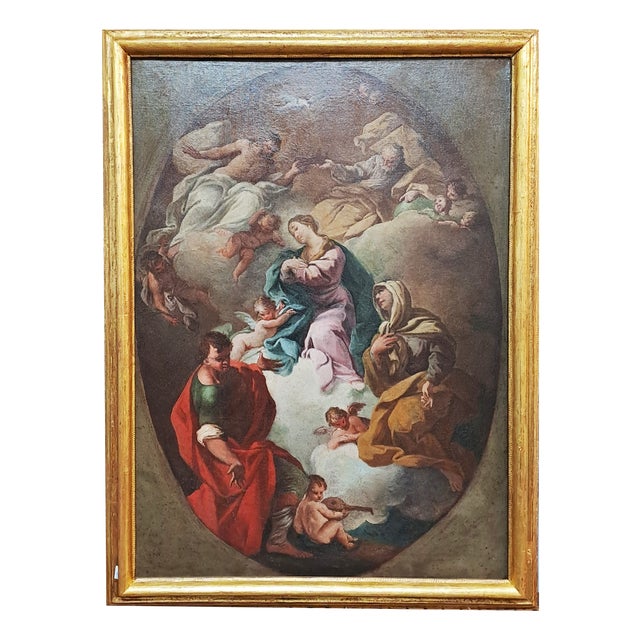
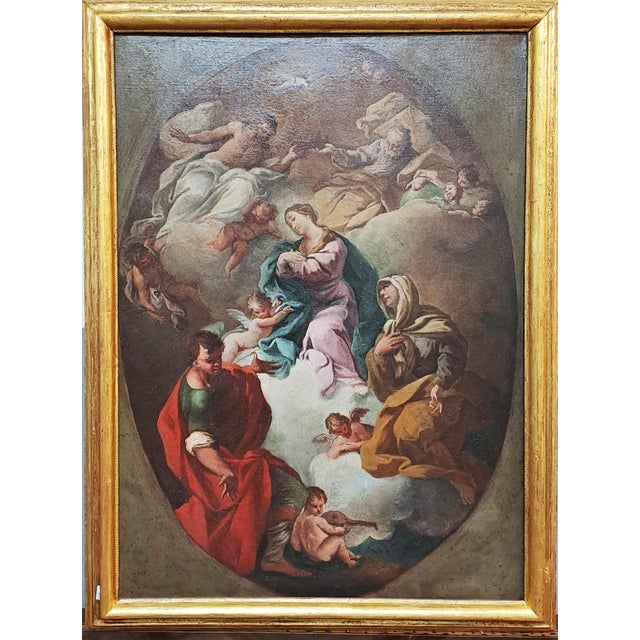
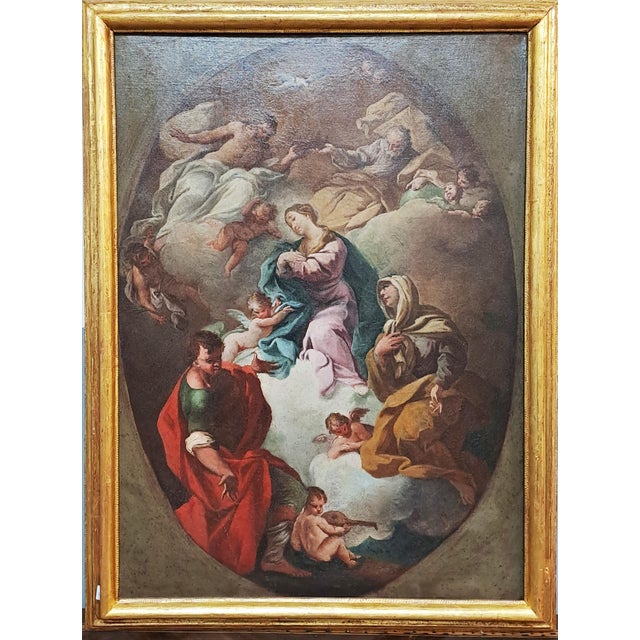
The painting features a complex, late-Baroque academic structure centered on the theme of the Coronation of the Virgin. The scene …
Read more
The painting features a complex, late-Baroque academic structure centered on the theme of the Coronation of the Virgin. The scene is organized across multiple celestial and earthly registers within a fictional oval frame:
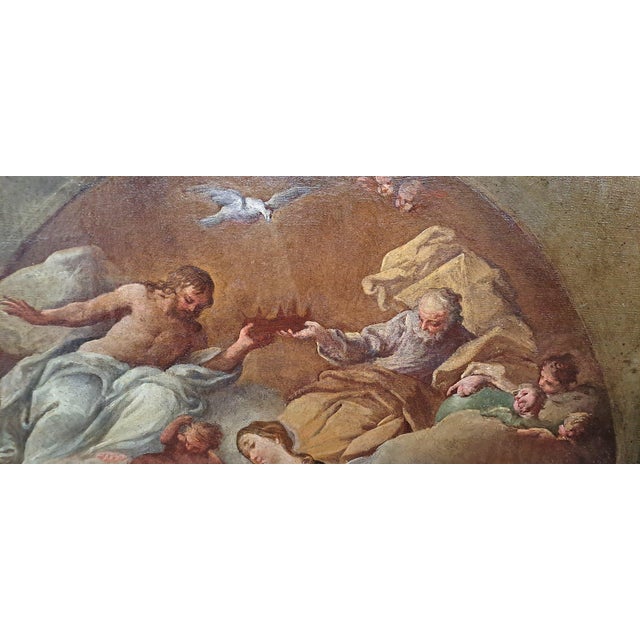
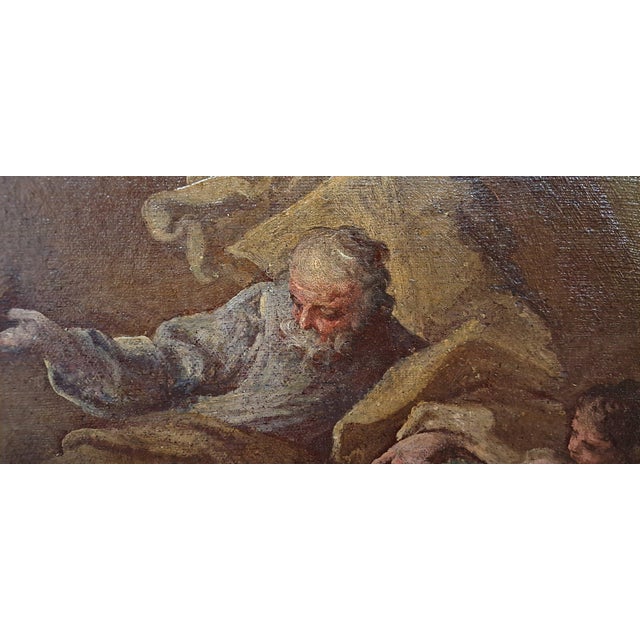
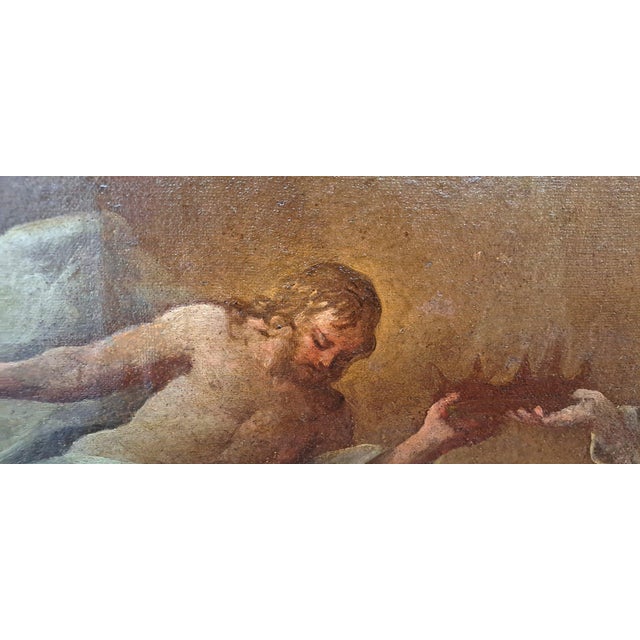
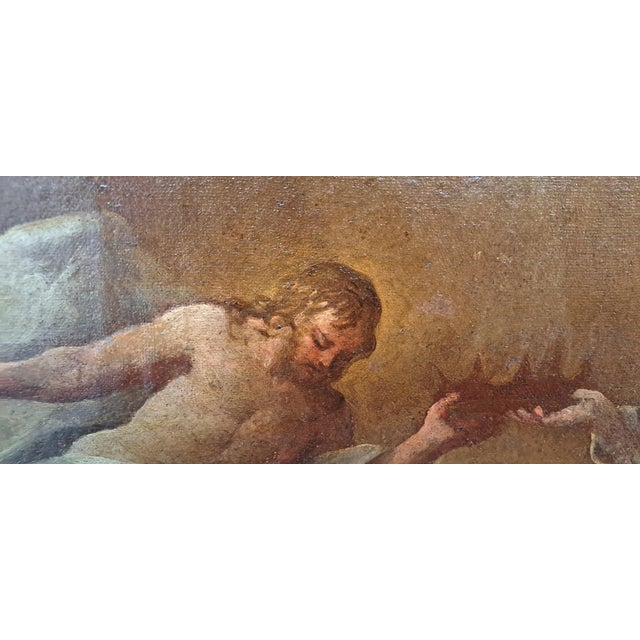
The Upper Register (The Trinity): In the highest part of the composition, bathed in golden light and surrounded by clouds, are the figures of Jesus Christ (on the left, depicted bare-chested with a pale cloak) and God the Father (on the right, the bearded elder wrapped in a golden robe). Together, they hold and lower the royal crown. Above them, in the exact center, flies the dove of the Holy Spirit, completing the Trinity.
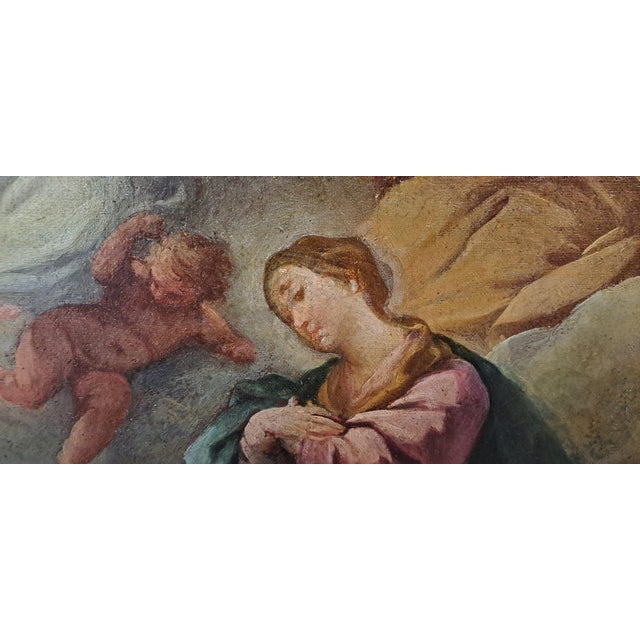
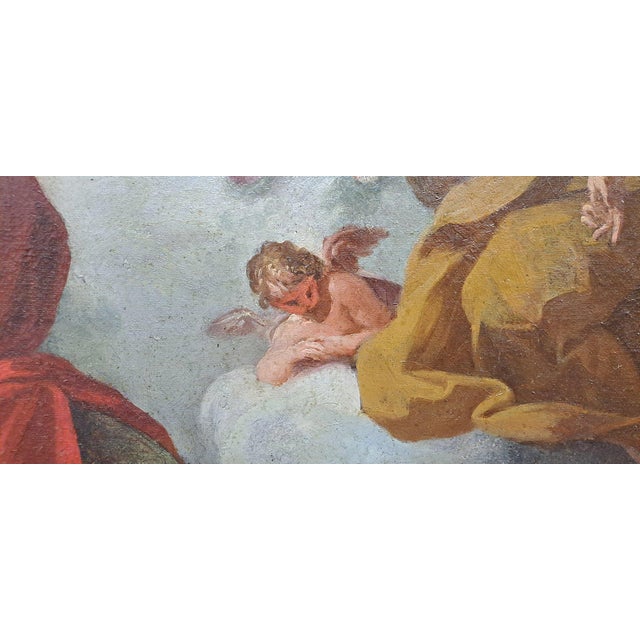
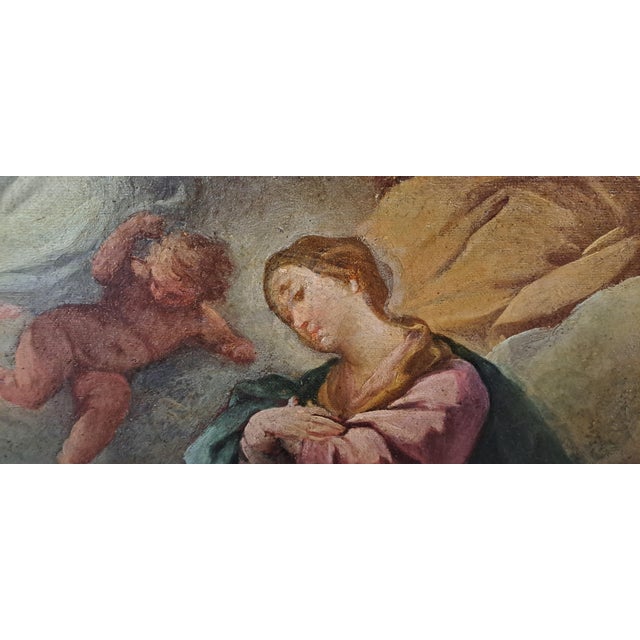
The Middle Register (The Virgin Mary): Seated on the clouds, in a position of humble submission yet the emotional fulcrum of the canvas, the Virgin Mary awaits her coronation with her hands clasped on her chest. She wears the classic pink tunic and blue-green cloak.
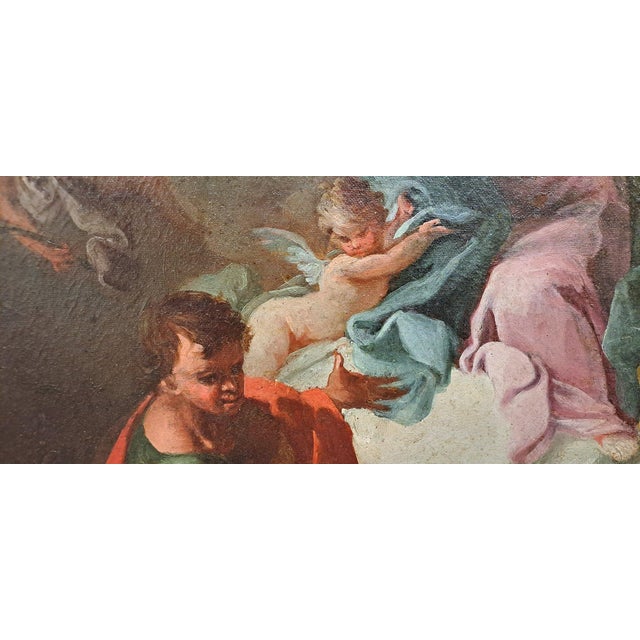
The Lower Register (The Intercessory Saints): * On the left, in the foreground, stands a vigorous male figure (likely a holy apostle or martyr, perhaps Saint Joseph or Saint Peter given the setting, but the lack of specific attributes is typical of the preliminary stage of the sketch) wrapped in bright red drapery, which acts as a visual "wing" introducing the viewer to the scene.
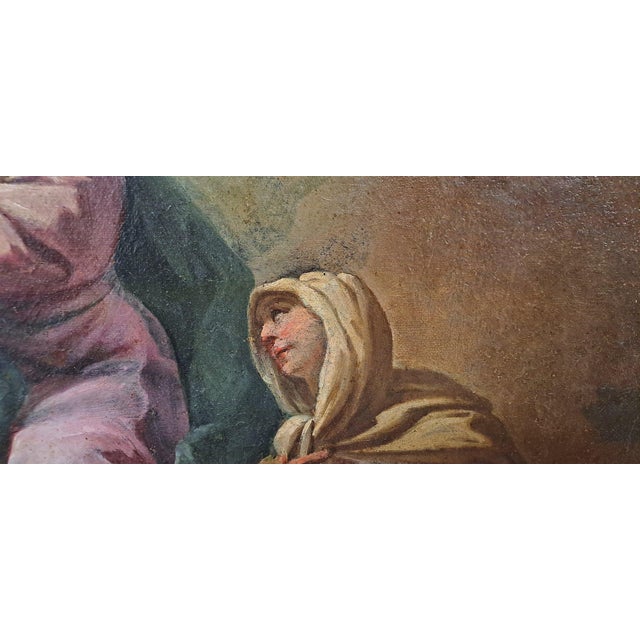
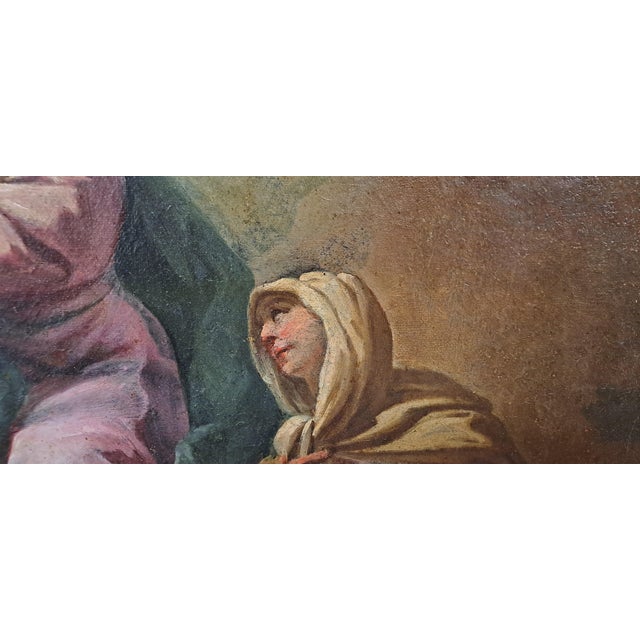
On the right, a kneeling, veiled female figure in prayer, likely Saint Anne or another widowed/matron saint.
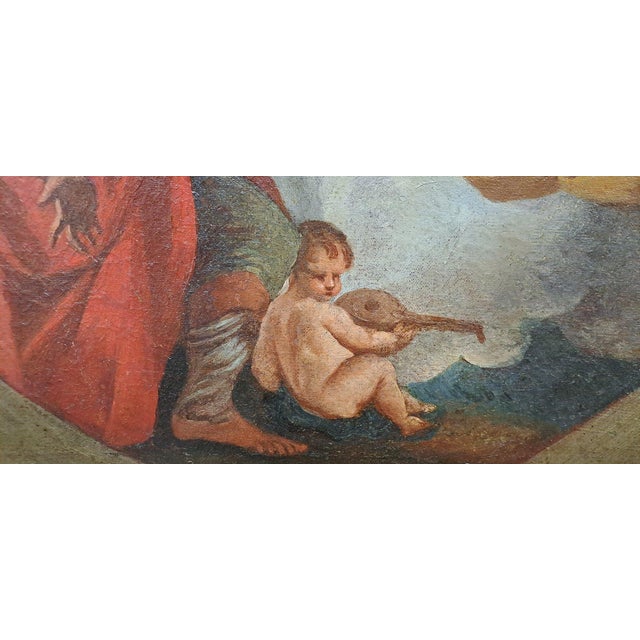
A dense crowd of cherubs, angels, and cherubs moves around; one of them, at the bottom center, is seated on the ground and playing a stringed instrument (a lute).
2. Elements that confirm its status as a "Bozzetto"
The nature of this work as a model or preparatory study for a large-scale work (such as the decoration of a dome, an apse, or a large altarpiece) is supported by several technical and formal elements clearly visible in the photographic details:
The rapid, concise, and "jettisoned" brushstroke: In the details of the faces of God the Father, Christ, and the cherubs, one can see how the paint is applied in rapid, stringy strokes (so-called "macchia" painting). The artist does not linger on calligraphic detail or the finish of the skin, but defines the volumes, shadows, and highlights with strokes of white and ochre. This helps the painter study the overall effect and the impact of light (chiaroscuro) before translating it to a large scale.
The oval frame painted on a rectangular canvas: The dark background that defines the oval-shaped composition serves precisely as an architectural guideline. It indicates that the final work would have been inserted into a specific oval space (e.g., a vaulted ceiling or a monumental stucco frame inside a church).
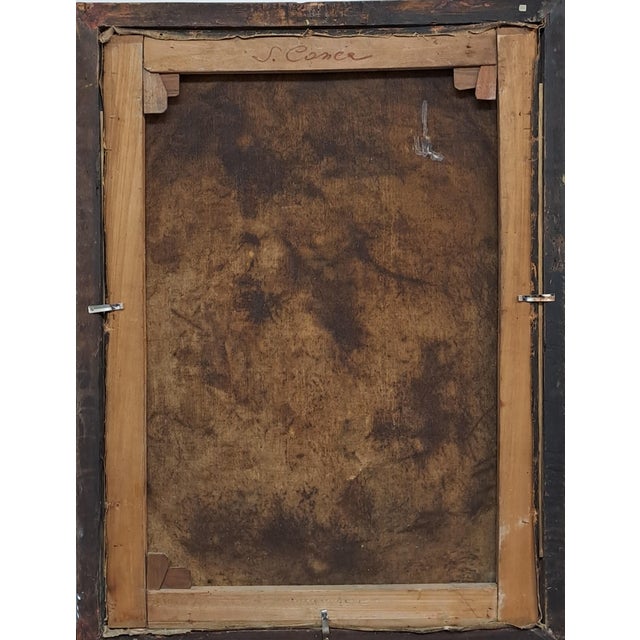
The inscription on the back of the frame: The ancient signature or inscription "S. Conca" on the wooden frame shaft on the back attests to the historical and collectors' attribution to the master or his very active workshop.
3. Style and Scope: Sebastiano Conca
The work perfectly reflects the dictates of the 18th-century Neapolitan school, of which Conca was one of the leading international exponents.
The Chromatic Palette: The use of contrasts between the bright reds of the foreground, the delicate pastels of the Virgin's robes (pink and blue), and the golden fields of the Paradise background is typical of Roman Baroque classicism, softened by early Rococo influences.
The movement of the figures: The darting putti, the vaporous clouds creating an ascending spiral, and the graceful faces (particularly the Madonna's soft profile and the saints' subtle expressiveness) directly recall the compositional models of Conca's great Roman and Neapolitan commissions (such as the frescoes for the church of Santa Maria della Scala in Siena or for San Giovanni in Laterano in Rome).
Conclusions
We are faced with an artifact of considerable interest for the antiques and art history markets: a "living" work, documenting the creative idea in its making. The freshness of the application, combined with the accurate traceability on the back and the quality of the light passages, make this oval an excellent and typical example of an eighteenth-century atelier model from the circle of Sebastiano Conca.
Conservation status: The work is still in its original canvas on a 19th-century stretcher. The frame is antique but not contemporary.
Dimensions: 64 x 87 cm including the canvas, 55 x 76 the painting.
See less
- Dimensions
- 21.65ʺW × 1.97ʺD × 29.92ʺH
- Art Subjects
- Figure
- Period
- 19th Century
- Country of Origin
- Italy
- Item Type
- Vintage, Antique or Pre-owned
- Condition
- Good Condition, Original Condition Unaltered, Some Imperfections
- Color
Returns & Cancellations
Return Policy - All sales are final 48 hours after delivery, unless otherwise specified in the description of the product.
Cancellation Policy - Prior to shipping or local pickup, buyers may cancel an order for up to 48 hours, unless otherwise specified.
Related Collections
- Photorealism Canvas Paintings
- Ed Ruscha Paintings
- Photorealism Paintings in New York
- Richard Serra Paintings
- Louise Nevelson Paintings
- Herman Miller Paintings
- BDDW Paintings
- Carl-Axel Acking Paintings
- Joseph Stella Paintings
- Karl-Erik Ekselius Paintings
- James McCray Paintings
- Milton Avery Paintings
- Jaanika Peerna Paintings
- Photorealism Paintings in Los Angeles
- Leroy Neiman Paintings
- Jo Baskerville Paintings
- Nicola Simbari Paintings
- Soicher Marin Paintings
- Cassina Paintings
- Black Photorealism Paintings
- Lawson-Fenning Paintings
- Vienna Secession Paintings
- Jean-Paul Barray Paintings
- Hans Andersen Paintings
- Johannes Andersen Paintings