

Details
Description
Why This Work Matters
Morrell transforms the male nude into an image of vulnerability, strength, and restless aspiration. With its …
Read more
Why This Work Matters
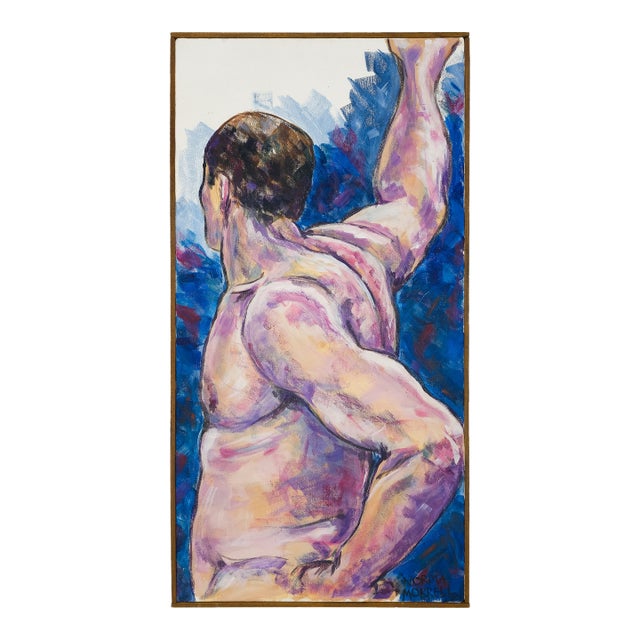
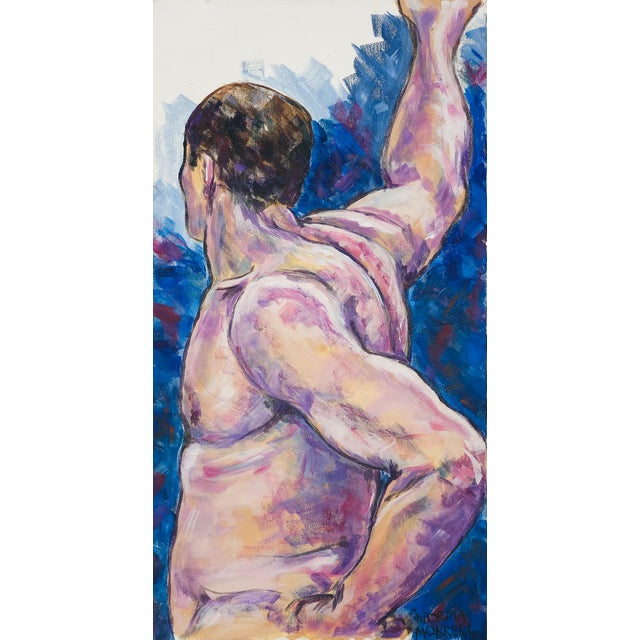
Morrell transforms the male nude into an image of vulnerability, strength, and restless aspiration. With its cropped upward gesture and vivid color, the painting captures the universal urge to reach beyond the limits placed around us.
Artwork Description
Male Nude Figure Reaching Beyond
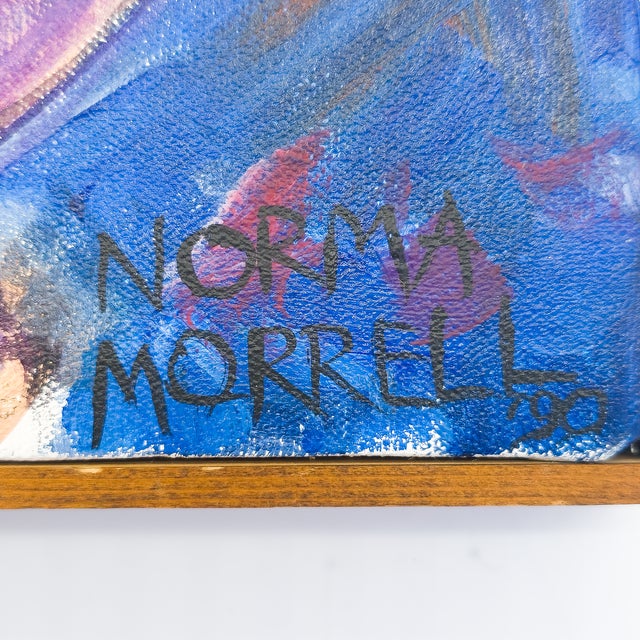
Norma Ann Morrell, c. 1990
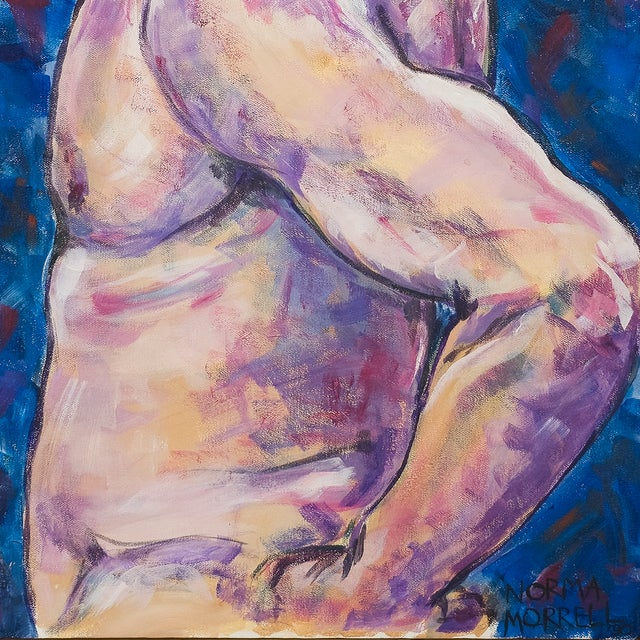
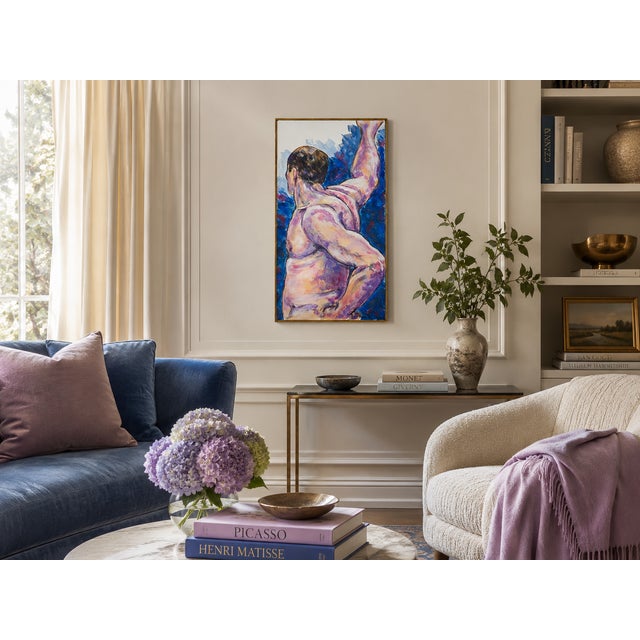
Created in 1990, Male Nude Figure Reaching Beyond occupies an intriguing place within Norma Ann Morrell’s figurative practice. The painting begins with a familiar art-historical subject—the nude studio model, but it quickly abandons the conventions of detached observation, anatomical idealization, and balanced classical proportion. Morrell instead treats the body as an expressive structure: compressed, twisting, cropped, and saturated with color.
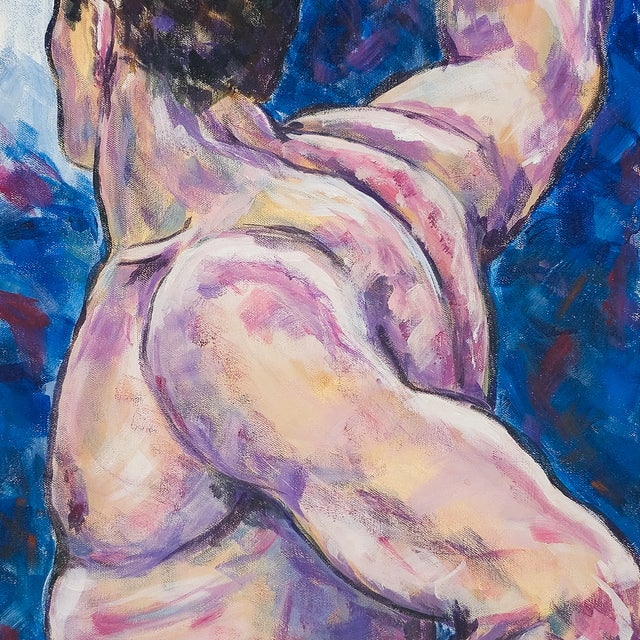
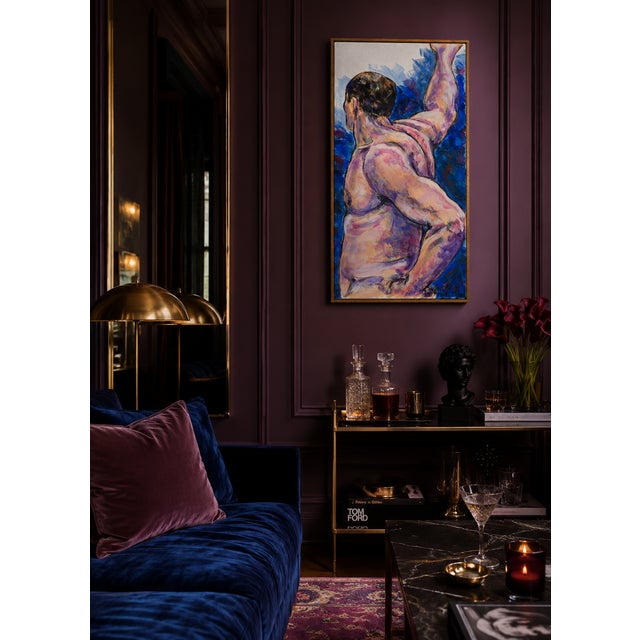
The figure’s pose supplies the composition with its fundamental tension. His back faces the viewer, but his body does not remain passive or closed. The shoulders rotate, the lower arm folds inward, and the opposite arm extends almost vertically before disappearing beyond the canvas. This raised limb functions as both a physical gesture and a compositional device. It pulls the eye upward through an otherwise densely packed body, while its abrupt cropping suggests that the action continues outside the limits of the picture.
That cropping is essential to the work’s meaning. Morrell does not show the hand or reveal what the man might be reaching toward. The gesture therefore remains open: it may communicate aspiration, effort, longing, resistance, searching, or simply the strain of a held pose. The title encourages the more expansive interpretation. “Beyond” becomes not only a location outside the frame but also a metaphor for something unavailable within the figure’s present condition.
The narrow canvas reinforces this psychological pressure. The man’s body occupies nearly every available inch, leaving little room for conventional background space. His broad back and bent arm create a succession of overlapping curves that move downward through the composition, while the extended arm counters that downward weight with a single forceful ascent. The resulting structure is almost architectural: mass gathers at the center and base, while the raised limb behaves like a column or vertical support.
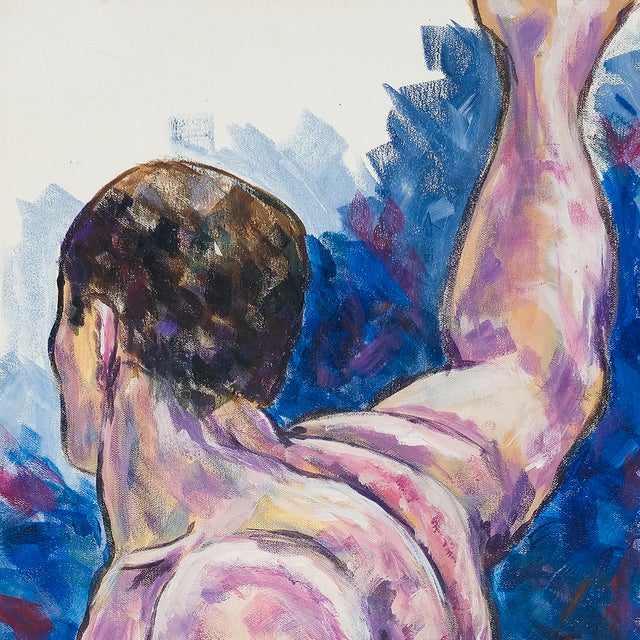
Morrell’s color pushes the painting away from naturalism and toward figurative expressionism. The flesh is assembled from pink, peach, violet, lavender, yellow, and white rather than modeled through conventional brown shadows and beige highlights. These colors do not merely describe reflected light. They animate the body from within, allowing emotional temperature to replace anatomical exactitude. Deep blue surrounds the figure, interrupted by touches of purple and burgundy, creating a saturated field against which the pale body appears to glow.
This use of non-naturalistic color places the painting in conversation with Fauvism and later expressionist approaches to the figure. Like those traditions, Morrell employs color as an independent emotional language rather than as a tool of literal description. Yet her treatment remains personal and tactile. Individual brushstrokes stay visible, particularly across the back, shoulders, and arm, preserving the physical process of painting. The body appears accumulated through repeated acts of looking and revision.
The contrast between the figure and the ground is also psychologically suggestive. The blue does not recede gently into atmospheric space; it presses against the body in active patches. At the upper left, however, Morrell leaves a substantial area of pale, comparatively open canvas. That lighter zone introduces a sense of release. The figure’s head turns toward it, while the arm rises beside it, making the emptier area feel like a possible destination beyond the darker enclosure.
Morrell’s choice to paint a male nude is particularly notable within the longer history of Western art. For centuries, the nude was overwhelmingly constructed around male artists looking at female bodies. Here, a woman artist directs sustained attention toward male flesh, subtly reversing that inherited structure. Morrell does not replace one form of idealization with another. The model is muscular but not perfected; his body carries softness, weight, and palpable vulnerability. His face is withheld, denying the viewer an easy psychological narrative and focusing attention instead on posture, effort, and corporeal presence.
This withholding also complicates the erotic dimension of the work. The figure is physically exposed, yet he is not displayed frontally for the viewer. His turned body and hidden face create distance, while the sweeping curves of his back and arm retain sensuality. The result is neither an impersonal academic study nor an explicitly erotic image. It occupies a more nuanced territory in which bodily admiration, empathy, and psychological projection coexist.
Seen in relation to Morrell’s later-life commitment to art, the title acquires further resonance. A figure extending beyond the limits imposed upon him can be read as an image of creative persistence and the refusal to remain contained. That interpretation cannot be established as the artist’s documented intention, but it is supported by the painting’s formal language: a body pressed tightly into its boundaries nevertheless continues reaching outside them.
Male Nude Figure Reaching Beyond succeeds because its expressive meaning is inseparable from its physical construction. The cropped gesture, compressed scale, vivid blue field, and fractured passages of color all contribute to an image of embodied striving. Morrell takes a private studio encounter and turns it into something broader—a meditation on strength, vulnerability, desire, and the persistent human instinct to reach beyond the space one has been given.
-Jonathan Flike
About the Artist
Norma Ann Morrell is a Portland, Oregon–based painter, printmaker, and ceramic artist whose documented career spans more than three decades. Working across oil painting, monotype, and hand-modeled ceramics, Morrell repeatedly returned to subjects possessing a strong sense of individual character: relatives, studio models, imagined personalities, animals, flowers, fruit, and birds’ nests. Whether monumental or only a few inches tall, her figures are distinguished by expressive color, visible handling, and an empathetic curiosity about the lives concealed beneath outward appearances.
Morrell’s path to becoming a professional artist was unusually delayed. As a student at a Catholic high school, she painted a ballerina in a traditional tutu for an art class. Although her teacher praised and displayed the work, Morrell returned the following day to find it crumpled in the garbage after being judged inappropriate for the school. Her young teacher resigned following the incident, while Morrell internalized the controversy and withdrew from art for many years. This formative act of censorship would cast a long shadow over her creative life.
Under her maiden name, Norma A. Hague, she earned a Bachelor of Science in Nursing from the University of Portland in 1958. Morrell pursued a long nursing career, married dentist Gerry Morrell, and raised three children. During the mid-1980s, she joined four other nurses in helping establish a health center at Reynolds High School. Yet art remained an unresolved ambition. Around the end of that decade, an art-history class prompted her to return seriously to the subject. She subsequently studied at Mt. Hood Community College and Portland State University and participated in a summer program at Haystack in Cannon Beach. Around 1992, approaching her sixtieth birthday, she relinquished her nursing license and committed herself to a full-time studio practice.
Morrell had already begun producing hand-modeled ceramic ornaments in 1980. By the mid-1990s, she had created approximately sixty individualized characters—including doctors, farmers, brides, skiers, seamstresses, and other figures—each painted and glazed with its own personality. Alongside these intimate sculptures, she developed a broader practice in monotype and oil painting. Her paintings moved between portraiture, the nude figure, animals, and still life, unified by her interest in character, emotional presence, and the expressive possibilities of color.
Her work appeared at Graystone Gallery, Attic Gallery, Lakewood Center Gallery, the Buckman Art Show and Sell, and the long-running Local 14 Art Show and Sale. Local 14 was founded in 1967 partly because few women artists were receiving gallery opportunities, and the organization established a professional exhibition platform dedicated to women’s art. Morrell’s recurring participation placed her within an important female-led network in the history of Portland’s regional arts community. In 2007, Local 14 honored her among fourteen notable past and present members and scholarship recipients, identifying her as both a ceramic artist and painter.
Morrell continued exhibiting into the twenty-first century, including presentations of paintings and ceramics at Graystone Gallery in 2000 and 2002. In 2014, her work was selected for Oregon Impressions, a juried Portland exhibition and charitable sale benefiting Bradley Angle’s services for survivors of domestic violence.
Her influence also extended beyond her own body of work. In 2026, painter Maureen O’Hara credited Morrell, her sister-in-law, with encouraging her to begin painting. Morrell’s legacy is therefore not simply that of an artist who returned late to a suppressed ambition, but of one who transformed that return into a sustained practice—and helped give others permission to create as well.
Underrepresented Artist Information
Norma Ann Morrell’s delayed artistic career reflects the social constraints placed on many women of her generation. As a Catholic high school student, she painted a ballerina for an art assignment. Although her teacher praised and displayed the work, Morrell returned to find it crumpled in the garbage after school authorities deemed the image inappropriate. Her young art teacher resigned following the incident. For Morrell, the episode communicated that artistic expression—particularly art involving the body—could carry serious personal and professional consequences for a woman.
Rather than pursue art professionally, Morrell entered nursing, a respected and socially sanctioned career then widely considered appropriate for women. She earned a Bachelor of Science in Nursing from the University of Portland in 1958 and spent much of her adult life working as a nurse, raising a family, and contributing to community health programs. Art remained an ambition, but one she had learned to regard as impractical or unacceptable.
Only later in life did Morrell return seriously to painting, printmaking, and ceramics. Around 1992, near the age of sixty, she relinquished her nursing license and committed herself fully to the studio. Her subsequent career—including exhibitions with Local 14, an organization created to provide opportunities for women excluded from conventional gallery systems—represents not simply a late artistic awakening, but the recovery of a vocation interrupted by gendered expectations. Morrell’s work matters because it preserves the creative voice of a woman who was discouraged from becoming an artist, yet ultimately refused to let that early silencing define the rest of her life.
See less
- Dimensions
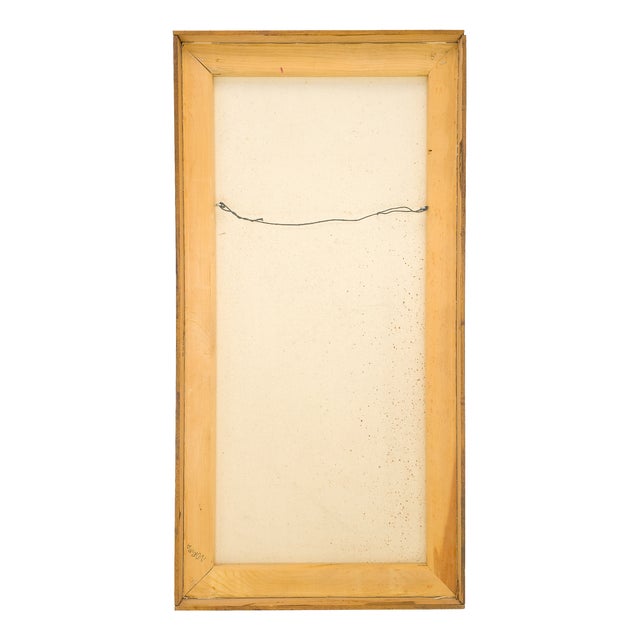
- 15.5ʺW × 1ʺD × 30.5ʺH
- Styles
- Expressionism
- Figurative
- Frame Type
- Framed
- Period
- 1990s
- Country of Origin
- United States
- Item Type
- Vintage, Antique or Pre-owned
- Materials
- Oil Paint
- Condition
- Good Condition, Original Condition Unaltered, Some Imperfections
- Color
- Pink
- Condition Notes
- Please note that this item is vintage and shows wear consistent with age, use, and history. Signs of wear may … morePlease note that this item is vintage and shows wear consistent with age, use, and history. Signs of wear may include, but are not limited to, minor surface marks, patina, fading, or imperfections typical of older items. All items are sold as-is, which is standard with vintage and pre-owned goods and cannot be returned on the basis of condition. Measurements are approximate. We do our best to describe items accurately; however, condition assessments are subjective. If you would like additional details, images, or clarification before purchasing, please contact us. less
Questions about the item?
Returns & Cancellations
Return Policy - All sales are final 48 hours after delivery, unless otherwise specified in the description of the product.
Cancellation Policy - Prior to shipping or local pickup, buyers may cancel an order for up to 48 hours, unless otherwise specified.
Related Collections
- Photorealism Canvas Paintings
- Ed Ruscha Paintings
- Photorealism Paintings in New York
- Richard Serra Paintings
- Jo Baskerville Paintings
- Louise Nevelson Paintings
- Karen Offutt Paintings
- Nicola Simbari Paintings
- Herman Miller Paintings
- BDDW Paintings
- James McCray Paintings
- Jaanika Peerna Paintings
- Leroy Neiman Paintings
- Jeff Slemmons Paintings
- Vienna Secession Paintings
- Johannes Andersen Paintings
- Pedro Friedeberg Paintings
- Peter Behrens Paintings
- Piet Hein Eek Paintings
- Raphael Paintings
- Photorealism Paintings in Los Angeles
- Carl-Axel Acking Paintings
- Karl-Erik Ekselius Paintings
- Hans Andersen Paintings
- Jean-Paul Barray Paintings