

Details
Description
Object: secessionist relief plaque
design & execution: elena luksch-makowsky (vienna, 1903)
dimensions in cm (h x w x d): 41 …
Read more
Object: secessionist relief plaque
design & execution: elena luksch-makowsky (vienna, 1903)
dimensions in cm (h x w x d): 41 x 20 x 2
material: zinc sheet, colored glass
condition: good, with age-related wear
provenance: estate of teddy podgorski and mag. Margit podgorski-hummer
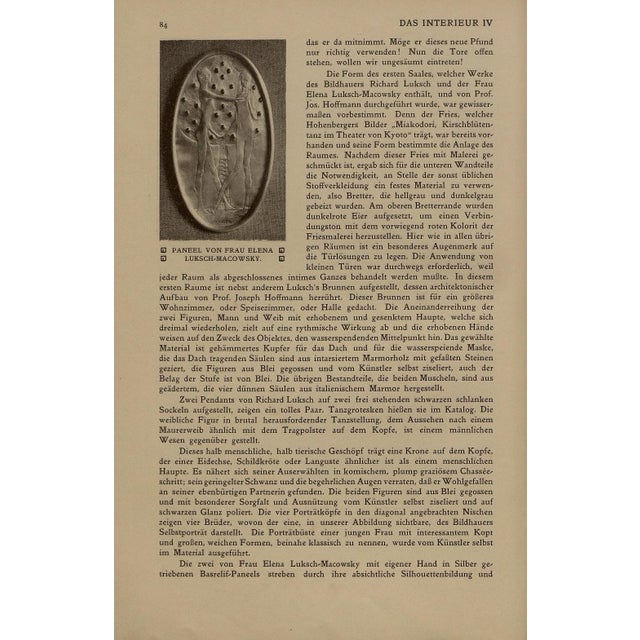
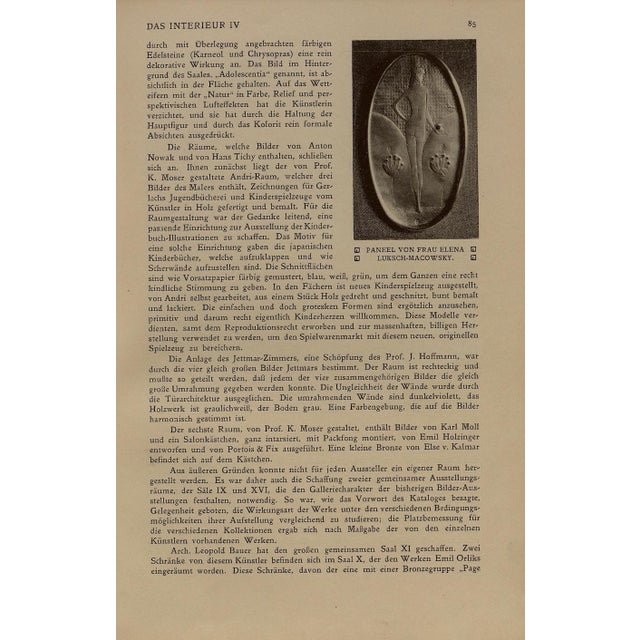
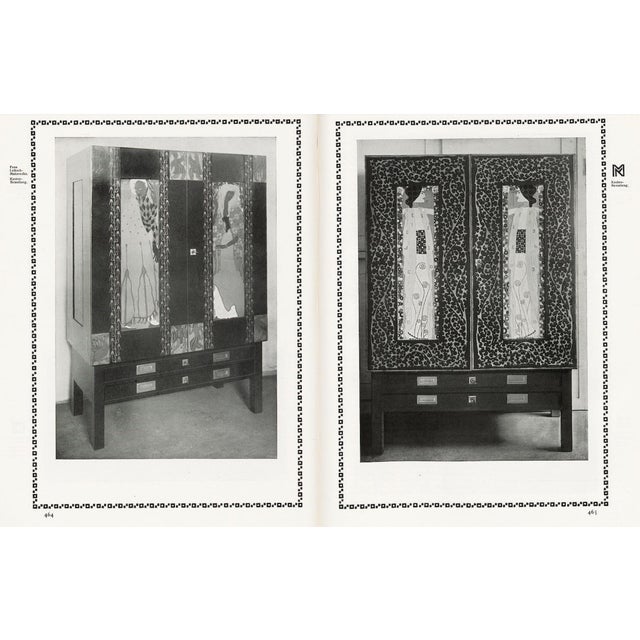
literature: catalogue of the 8th exhibition of the association of visual artists of austria, secession, nov-dec 1900, pp. 27, 31 / catalogue of the 10th exhibition of the association of visual artists of austria, secession, mar-may 1901 / catalogue of the 13th exhibition of the association of visual artists of austria, secession, feb-mar 1902, p. 20 / ver sacrum, 1902, issue vi, p. 106 / catalogue of the 14th exhibition of the association of visual artists of austria, secession, apr-jun 1902, pp. 56, 68, 75 / catalogue of the 15th exhibition of the association of visual artists of austria, secession, nov-dec 1902, p. 24 / ver sacrum, 1902, issue xii, pp. 187, 189 / catalogue of the 17th exhibition of the association of visual artists of austria, secession, march-may 1903, p. 19 / the interior, 4th year, 1903, pp. 82, 84, 85, 96 / decorative art - illustrated journal for applied art, volume 11, 1903, p. 38 / german art and decoration, volume 19, 1906-1907, alexander koch, darmstadt. Pp. 464-465 / magnasok lakberendezöje (1858-1918), rostas, peter, 1972, p. 176 /
additional information:
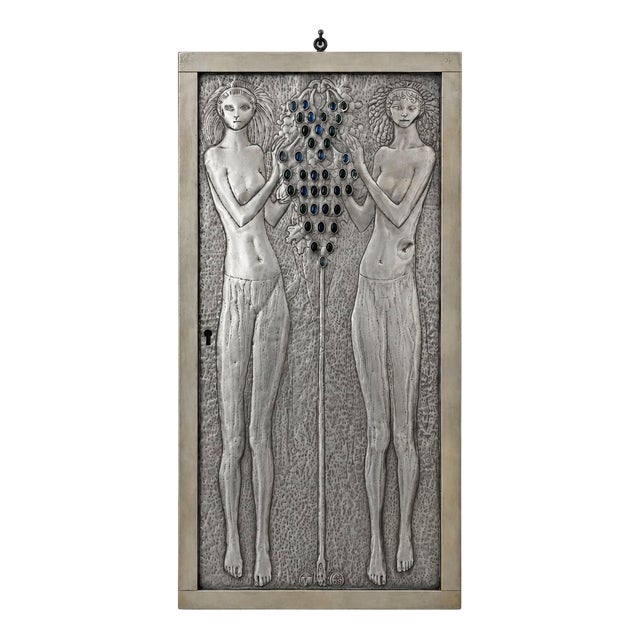
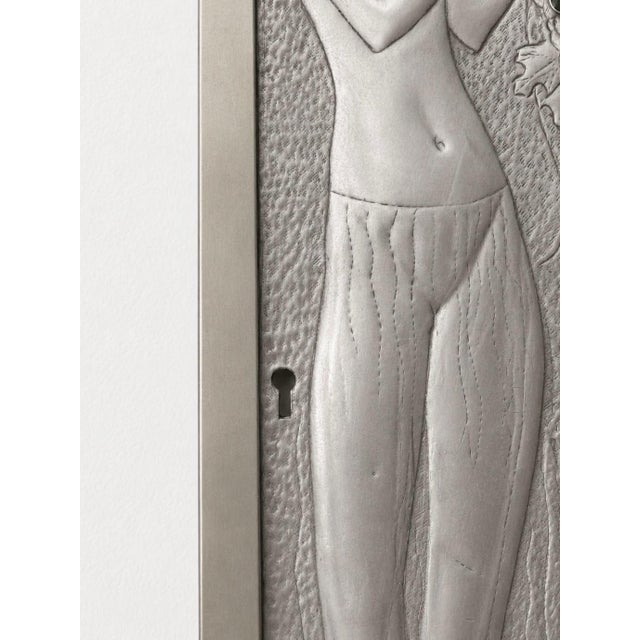
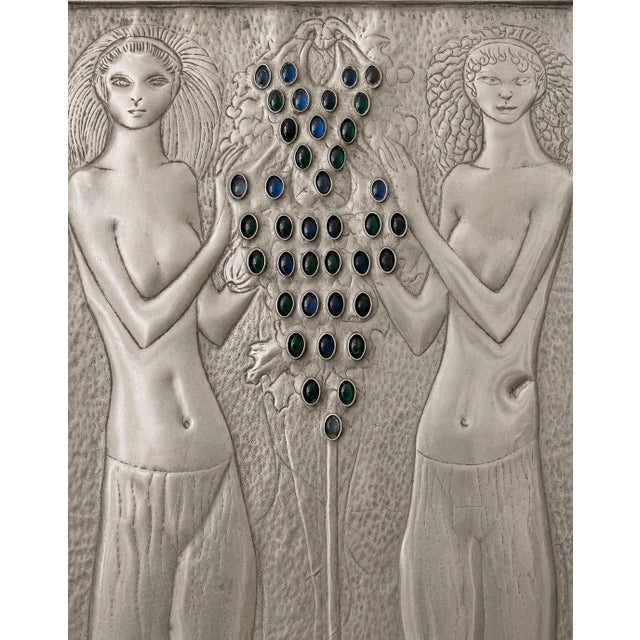
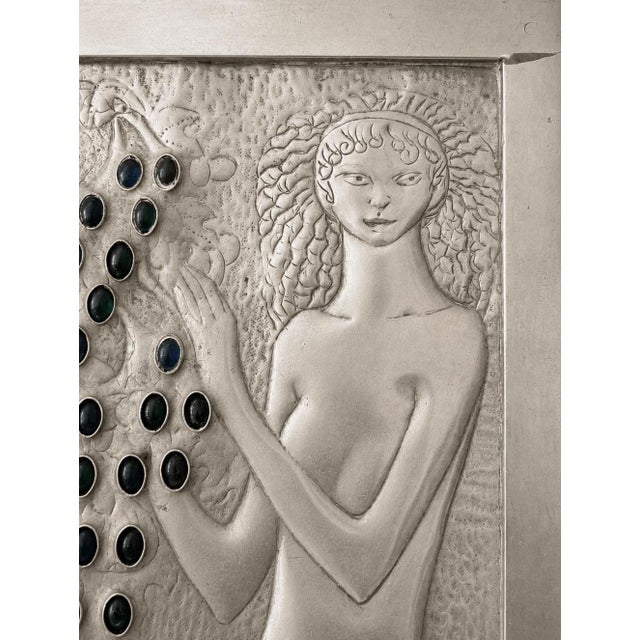
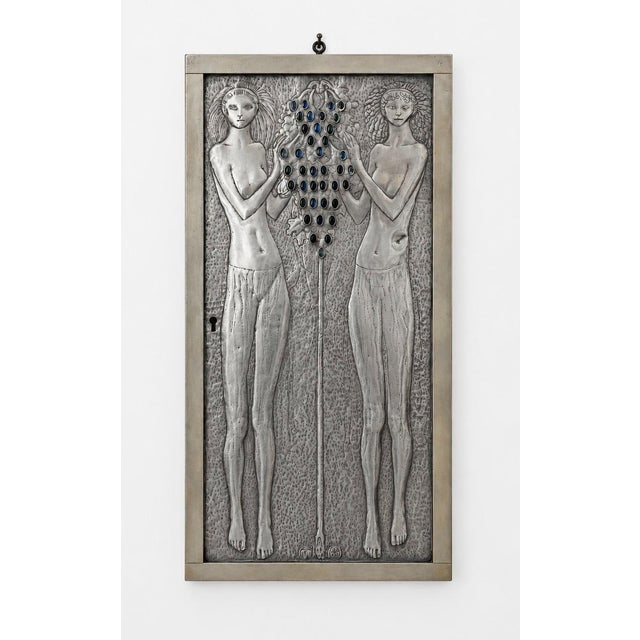
this relief plaque made of zinc sheet with colored glass inlays was created in 1903 and is very likely one of the rare surviving works by elena luksch-makowsky. (1878–1967), one of the most important artists of viennese modernism. Originally conceived as a door panel for a piece of furniture, it documents the close connection between fine art, applied arts, and architecture, which was one of the central concerns of the vienna secession. The surviving keyhole recess points to its original function as part of a high-quality gesamtkunstwerk (total work of art).
the artist, who trained in st. Petersburg, was one of the most influential figures of the viennese avant-garde from 1900 onward. Her first participation in a vienna secession exhibition was at the 8th exhibition with the works "dachauerin" (woman from dachau), "jahrmarkt" (fairground), and a "bronze table bell." as early as march 1901, she was first mentioned in contemporary press reports in connection with the 10th exhibition. This was followed by the presentation of the work "heiliger frühling" (sacred spring) at the 13th exhibition in february 1902 and her participation in the 14th exhibition in april of the same year. There, she became the first and only woman in the association to receive her own secession ornament, thus occupying an exceptional position within the circle around gustav klimt, josef hoffmann, and koloman moser.
in the same year, elena luksch-makowsky was already involved in significant international exhibition projects. For the tea room designed by leopold bauer at the 1902 düsseldorf industrial, trade, and art exhibition, she created a published repoussé metal plate, which is among the earliest documented examples of her applied arts work. A few months later, at the 15th vienna secession exhibition, she contributed to another piece of furniture designed by leopold bauer, whose decorative panel she designed and executed. The piece was manufactured by the renowned viennese furniture firm friedrich otto schmidt.
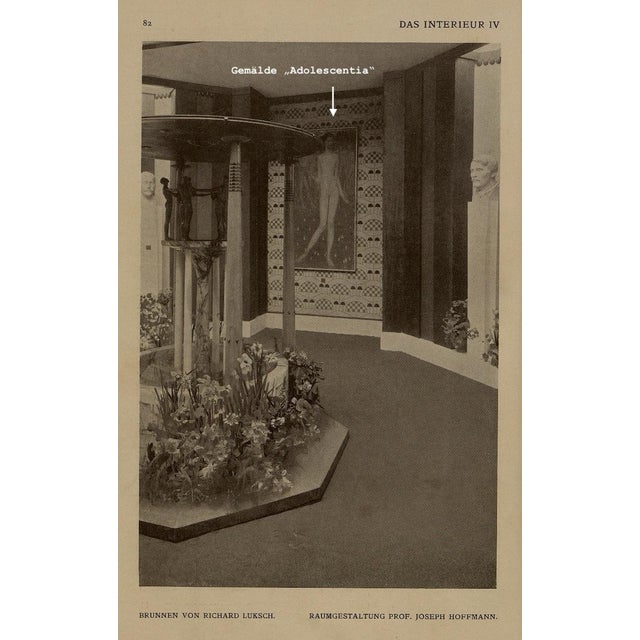
the 17th vienna secession exhibition marked a high point in her career. Exhibition of the vienna secession in march 1903. In a room designed by josef hoffmann, elena luksch-makowsky presented her major work, "adolescentia," as well as two hand-crafted silver relief panels inlaid with carnelian and chrysoprase. Contemporary publications highlighted these works, emphasizing their deliberately flat, decorative design, which, through silhouettes, ornamentation, and colored accents, developed a distinctive formal language. In the same room was a fountain by her husband, richard luksch, whose ornamental base was designed by elena luksch-makowsky. The merging of painting, sculpture, metalwork, architecture, and interior design exemplifies the concept of the gesamtkunstwerk (total work of art) of viennese modernism.
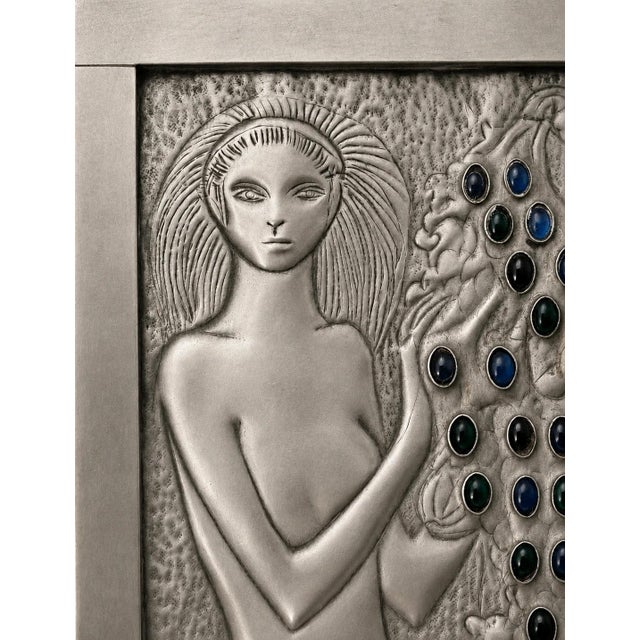
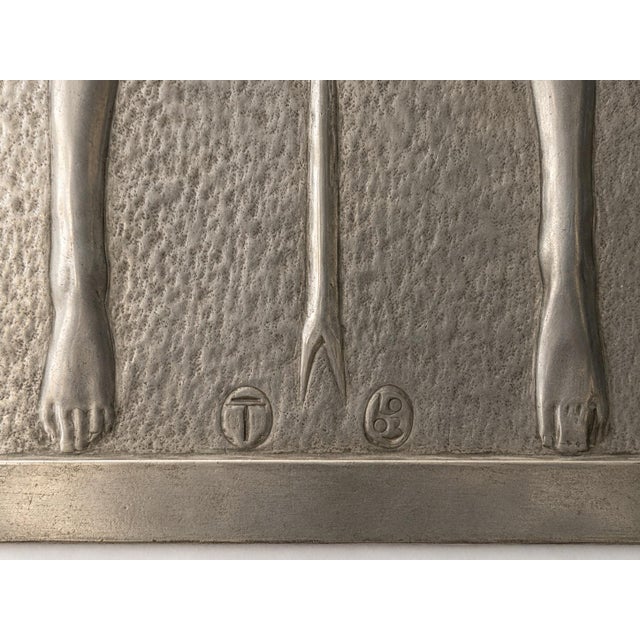
the present relief panel was created precisely during this pivotal creative period. The motif of two female nudes with a large-scale grapevine unites characteristic features of her work: stylized figurative representation, linear ornamentation, and a deliberately decorative composition. The stamps "t" and "1903" within a circle document the object's date of origin.
among her last exhibitions within the vienna secession were a portrait of a woman and another portrait at the 23rd exhibition in march 1905. After the klimt group left the secession, elena luksch-makowsky and richard luksch joined the group of artists around gustav klimt. At the same time, the artist intensified her collaboration with the wiener werkstätte (vienna workshop). In 1906–1907, she created furniture designs, metalwork, and other decorative art objects. Particularly noteworthy are two cabinets from the wiener werkstätte published in "deutsche kunst und dekoration" (german art and decoration), one painted by koloman moser and the other by elena luksch-makowsky. This publication documents her active participation in the decorative arts reform efforts of viennese modernism.
\. Original metalwork by elena luksch-makowsky is among the rarest surviving groups of works from her oeuvre. This is especially true for pieces from her viennese period, during which she, along with gustav klimt, josef hoffmann, koloman moser, leopold bauer, and richard luksch, was one of the leading figures of viennese modernism.
the present relief panel is therefore not only a rare example of her applied arts work, but also an important testament to women's participation in the reform movements of the european avant-garde around 1900.
viewing possible: hintzerstraße 6, 1030 vienna
the images have been digitally altered, which may result in slight variations. This piece is attributed to the mentioned designer/maker. It has no attribution mark and no
official proof of authenticity,
however it is well documented in design history. I take full responsibility for any authenticity
issues arising from misattribution
See less
- Dimensions
- 7.87ʺW × 0.79ʺD × 16.14ʺH
- Period
- Early 20th Century
- Country of Origin
- Austria
- Item Type
- Vintage, Antique or Pre-owned
- Materials
- Glass
- Zinc
- Condition
- Good Condition, Unknown, Some Imperfections
- Color
- Blue
- Condition Notes
- Good — This vintage item remains fully functional, but it shows sign of age through scuffs, dings, faded finishes, minimal … moreGood — This vintage item remains fully functional, but it shows sign of age through scuffs, dings, faded finishes, minimal upholstery defects, or visible repairs\. Zustand: gut, mit altersbedingten Gebrauchsspuren less
Returns & Cancellations
Return Policy - All sales are final 48 hours after delivery, unless otherwise specified in the description of the product.
Cancellation Policy - Prior to shipping or local pickup, buyers may cancel an order for up to 48 hours, unless otherwise specified.
Related Collections
- Parchment Sculptural Wall Objects
- Ralph Lauren Sculptural Wall Objects
- Andy Warhol Sculptural Wall Objects
- Helmut Friedrich Schäffenacker Sculptural Wall Objects
- Medium-Density Fibreboard Sculptural Wall Objects
- Pastel Sculptural Wall Objects
- Antique Copper Finish Sculptural Wall Objects
- Dada Sculptural Wall Objects
- Maison Jansen Sculptural Wall Objects
- Asian Sculptural Wall Objects
- Greg Copeland Sculptural Wall Objects
- Curtis Jere Sculptural Wall Objects
- Mid-Century Modern Sculptural Wall Objects
- Plaster Sculptural Wall Objects
- Brutalist Sculptural Wall Objects
- Japanese Sculptural Wall Objects
- Sarreid Ltd. Sculptural Wall Objects
- Wenge Sculptural Wall Objects
- Arteriors Home Sculptural Wall Objects
- Silverplate Sculptural Wall Objects
- Platinum Sculptural Wall Objects
- Stainless Steel Sculptural Wall Objects