


Details
Description
Space Odyssey: Wheel of Time *
Fran Bull, c. 1990s
Space Odyssey: Wheel of Time by Fran Bull is a …
Read more
Space Odyssey: Wheel of Time *
Fran Bull, c. 1990s
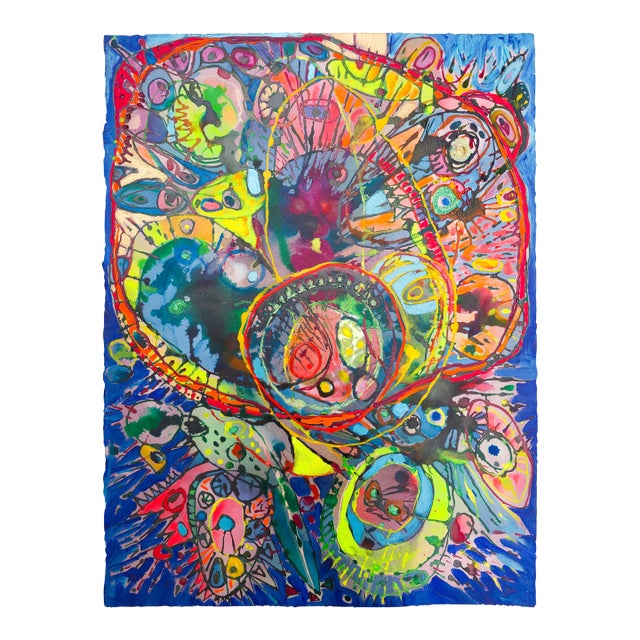
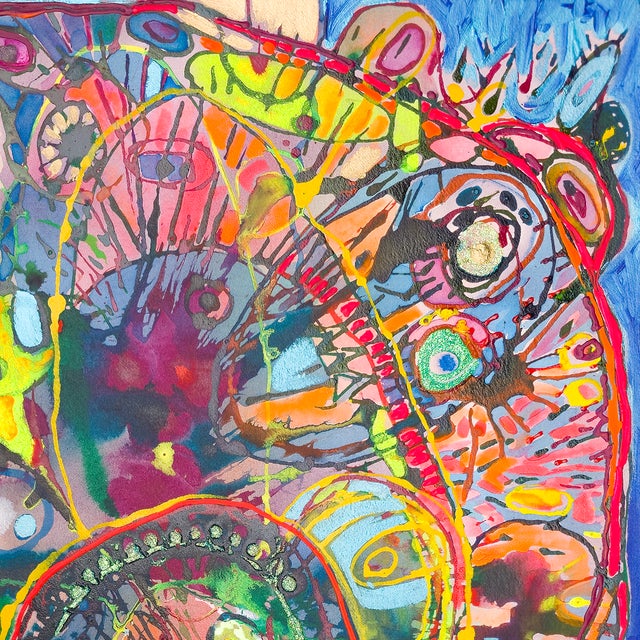
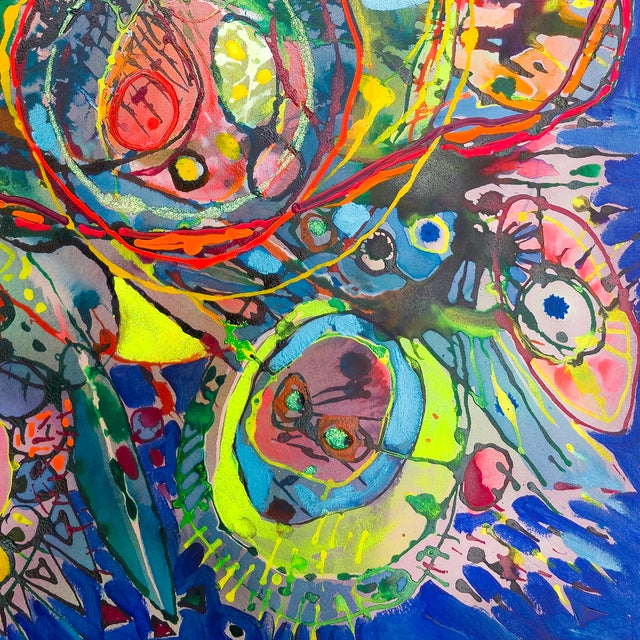
Space Odyssey: Wheel of Time by Fran Bull is a richly saturated abstract work that brings together the cosmic, biological, and symbolic languages that recur throughout her later practice. The piece belongs to the larger imaginative world in which Bull transforms cells, bodies, landscapes, planets, and inner states into a private visual system. Her stated desire to invent motifs that could stand for things in the world while remaining entirely strange feels especially relevant here. Wheel of Time is not a literal map of space, biology, or memory, yet it seems to contain traces of all three.
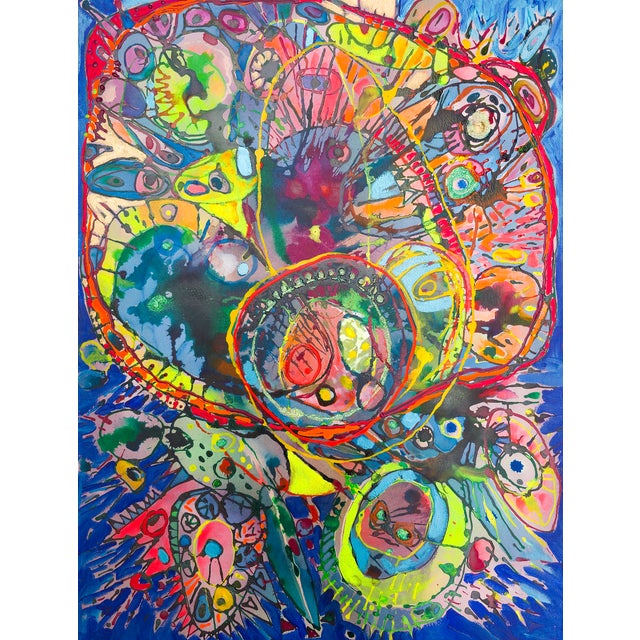
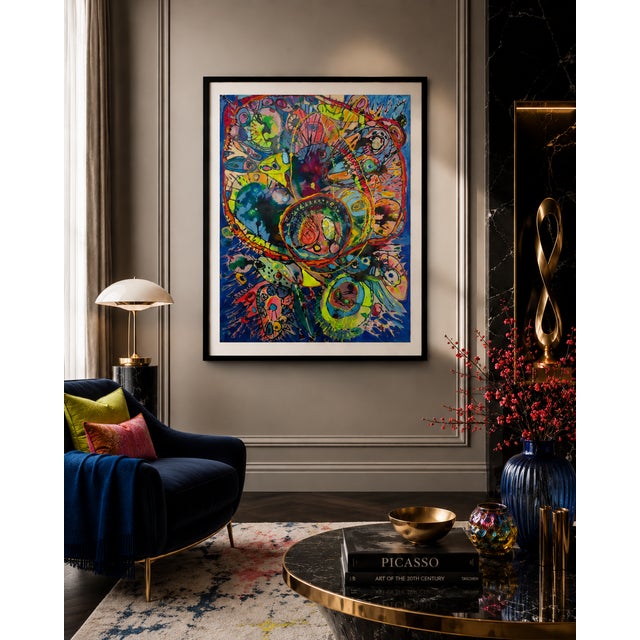
“Space Odyssey” suggests a journey through the unknown, while “Wheel of Time” introduces the idea of recurrence, rotation, and return. Time in this painting does not appear as a straight line. It moves in arcs, loops, and spirals. Bull makes this visible through the large circular structures that dominate the composition. Red, yellow, and orange lines curve across the surface like orbital paths, binding the image into a rotating system. The work feels less like a single scene than a living mechanism.
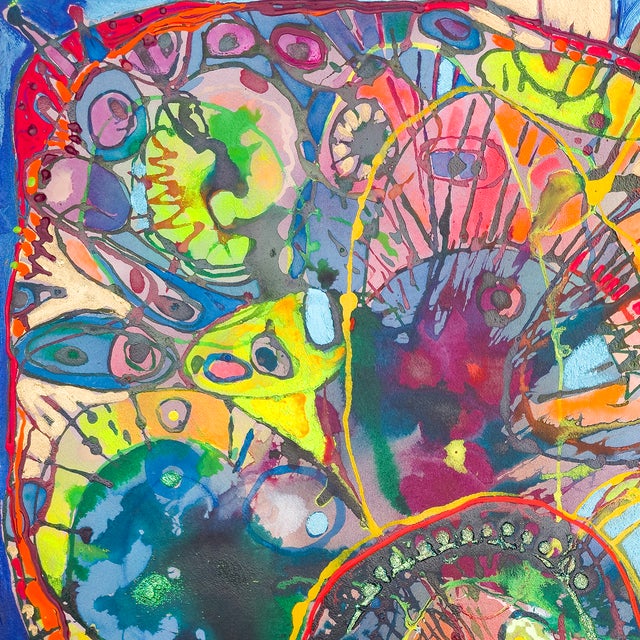
Bull’s circular forms carry multiple associations at once. They may be read as planets, cells, eyes, eggs, membranes, or microscopic vessels. This ambiguity is central to the work’s strength. The painting collapses scale until the viewer can no longer easily distinguish the cosmic from the cellular. A small body inside a membrane may also be a planet inside an orbit. A cluster of organelle-like forms may also be a constellation. Bull presents life as something that repeats across scales, from the smallest biological structures to the vastness of space.
The central circular form becomes the visual and symbolic anchor of the composition. It sits within a larger network of curved lines and surrounding forms, suggesting a nucleus, portal, clock face, or wheel hub. Around it, smaller structures gather and radiate outward, each one seeming to contain its own internal life. The eye moves from one form to the next, pulled through the painting as if traveling along a path of energy or memory. This movement gives the work its odyssey-like quality. The viewer is not simply looking at the image; the viewer is moving through it.
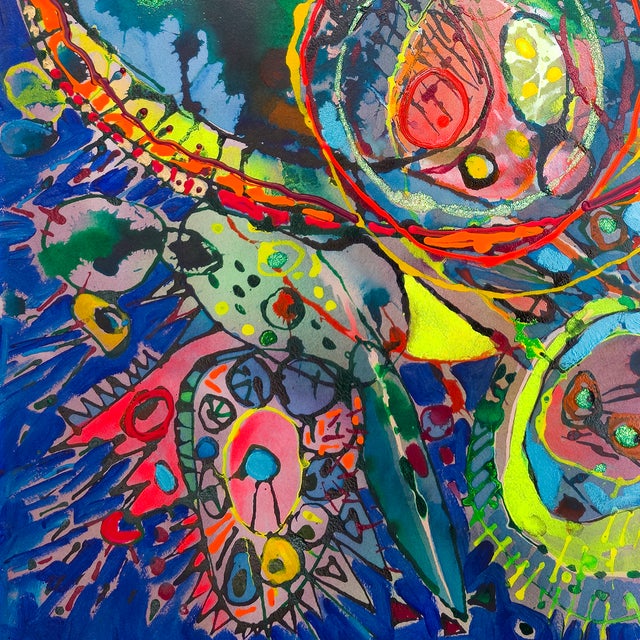
Color is essential to the work’s vitality. Bull uses saturated blues, hot pinks, red-orange passages, electric green, yellow, teal, and black to create a surface that feels charged and unstable. The palette is exuberant, but it does not become merely decorative. The colors push against one another, sometimes blending and sometimes resisting. Cool blues and greens create depth, while reds and oranges generate heat and urgency. The yellow line work acts almost like a current running through the piece, connecting forms and giving the composition a sense of nervous energy.
The dense layering of the painting also matters. Wheel of Time is visually abundant, but not chaotic. Bull fills the surface with lines, circles, dots, membranes, and cellular interiors, yet the larger circular arcs provide structure. These arcs hold the composition together and prevent the image from dissolving into pure excess. The title helps clarify this visual abundance. What may first appear as accumulation begins to read as recurrence. The forms do not merely crowd the surface; they cycle through it.
This cyclical reading connects the work to broader themes in Bull’s abstraction. Across her Sophia, zygote-like, Lux Aeterna: 9, and cosmic works, Bull often returns to ideas of formation, connection, transformation, and aftermath. Forms meet, divide, mutate, and generate new possibilities. In Wheel of Time, that process becomes cosmic in scale. The painting suggests that life is not a single event but an ongoing system of return and alteration. The wheel turns, but it never returns everything exactly as it was.
The work also carries a sense of communication. Many of the forms appear linked by pathways, membranes, or energetic lines. They seem to be signaling to one another, exchanging information, or moving through a shared field. This makes the painting feel alive in a networked sense. It is not just a collection of isolated bodies, but a system of contact. Bull’s universe is built through relation: cells to cells, planets to planets, body to cosmos, past to future.
The phrase “Wheel of Time” also introduces a philosophical dimension. Wheels imply motion, fate, recurrence, and cycles larger than the individual. In Bull’s hands, however, the wheel is not cold or mechanical. It is organic, messy, colorful, and alive. Time is not a clean clock. It is a biological and cosmic force, full of accidents, ruptures, repetitions, and bright moments of emergence. Bull gives time a body, and that body is crowded, luminous, unstable, and generative.
Space Odyssey: Wheel of Time is a work about life in motion across scales. Bull imagines time as something biological and cosmic at once, a turning system in which forms return, transform, and continue. The painting’s power lies in its ability to feel both microscopic and universal. It suggests that the same forces that shape cells may also shape stars, memory, identity, and creation itself. In Bull’s hands, the wheel of time does not simply spin. It blooms, mutates, connects, and begins again.
-Jonathan Flike
*The title of this work was assigned by Visard Gallery.
About the Artist
Fran Bull is an American artist whose career moves restlessly across painting, drawing, printmaking, sculpture, performance, and installation. Originally associated with the Photorealist movement of the 1970s and 1980s, Bull gradually pushed beyond realism toward a more personal and psychologically charged visual language. Her work often exists between figuration and abstraction, using the body, myth, theatricality, and distortion as tools for exploring consciousness, memory, fear, beauty, and transformation.
Bull studied Music and Art at Bennington College and later earned a master’s degree in Art and Art Education from New York University. Her early Photorealist work was shown through Louis K. Meisel Gallery, placing her within one of the central gallery contexts for American Photorealism. Over time, however, Bull’s practice became increasingly experimental. Her ink drawings, prints, sculptural forms, and mixed-media works reveal an artist less interested in reproducing the visible world than in exposing the unstable forces beneath it.
This evolution is central to Bull’s importance. In her later work, faces fracture, bodies become theatrical vessels, and forms seem to emerge from dream, satire, ritual, and unconscious thought. Her imagery can be grotesque, humorous, spiritual, and deeply human all at once. Whether working in ink, etching, paint, or sculpture, Bull treats art as a means of passage between worlds: the seen and unseen, the ordinary and mythic, the personal and collective.
Bull has exhibited in the United States and Europe, with works connected to major phases of American Photorealism, expressionist abstraction, printmaking, and installation. For Visard, her work represents the power of artistic reinvention: a career not defined by a single style, but by an ongoing search for a freer, stranger, and more expansive visual truth.
Underrepresented Artist Information
Like many women artists of her generation, Fran Bull’s career reflects both achievement and uneven recognition within the larger art historical record. Although Bull was connected to significant artistic movements and exhibited widely across multiple decades, her work remains less visible than that of many male contemporaries who moved through similar circles of realism, abstraction, and experimental image-making.
This underrepresentation is especially important because Bull’s career resists easy categorization. She was not simply a Photorealist, nor solely an expressionist, printmaker, sculptor, or performance-based artist. Her practice evolved across mediums with intellectual restlessness and emotional force, making her body of work harder to flatten into a single market-friendly label. Visard recognizes Bull as an artist whose breadth, reinvention, and psychological depth deserve fuller documentation and continued attention.
See less
- Dimensions
- 22.75ʺW × 0.1ʺD × 30ʺH
- Art Subjects
- Abstract
- Frame Type
- Unframed
- Period
- 1990s
- Country of Origin
- United States
- Item Type
- Vintage, Antique or Pre-owned
- Materials
- Acrylic Paint
- Condition
- Good Condition, Original Condition Unaltered, Some Imperfections
- Color
- Blue
- Condition Notes
- Please note that this item is vintage and shows wear consistent with age, use, and history. Signs of wear may … morePlease note that this item is vintage and shows wear consistent with age, use, and history. Signs of wear may include, but are not limited to, minor surface marks, patina, fading, or imperfections typical of older items. Measurements are approximate. We do our best to describe items accurately; however, condition assessments are subjective. If you would like additional details, images, or clarification before purchasing, please contact us. less
Questions about the item?
Returns & Cancellations
Return Policy - All sales are final 48 hours after delivery, unless otherwise specified in the description of the product.
Cancellation Policy - Prior to shipping or local pickup, buyers may cancel an order for up to 48 hours, unless otherwise specified.
Related Collections
- Ralph Lauren Paintings
- Photorealism Canvas Paintings
- Ed Ruscha Paintings
- Photorealism Paintings in New York
- Silk Velvet Paintings
- Louise Nevelson Paintings
- Herman Miller Paintings
- Richard Serra Paintings
- Jaanika Peerna Paintings
- Jo Baskerville Paintings
- Jean-Paul Barray Paintings
- Hans Andersen Paintings
- Johannes Andersen Paintings
- Peter Behrens Paintings
- Raphael Paintings
- Photorealism Paintings in Los Angeles
- Black Photorealism Paintings
- BDDW Paintings
- Cassina Paintings
- Carl-Axel Acking Paintings
- Joseph Stella Paintings
- Karl-Erik Ekselius Paintings
- Pedro Friedeberg Paintings
- Piet Hein Eek Paintings
- Lee Reynolds Paintings