


Details
Description
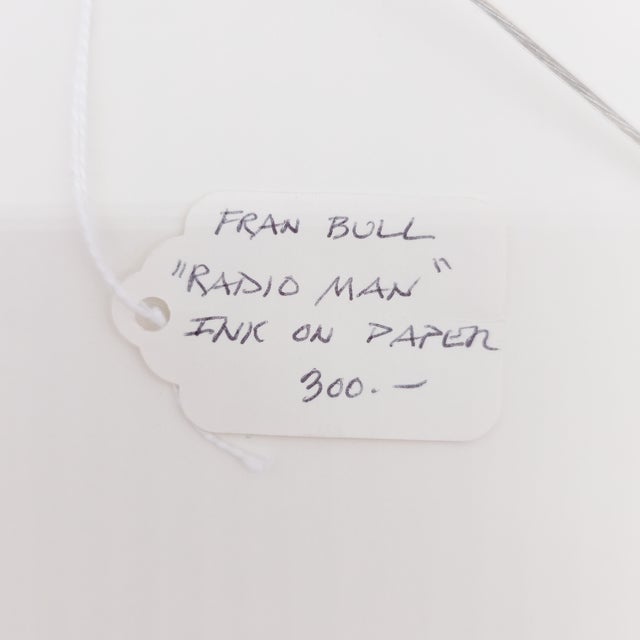
Radio Man
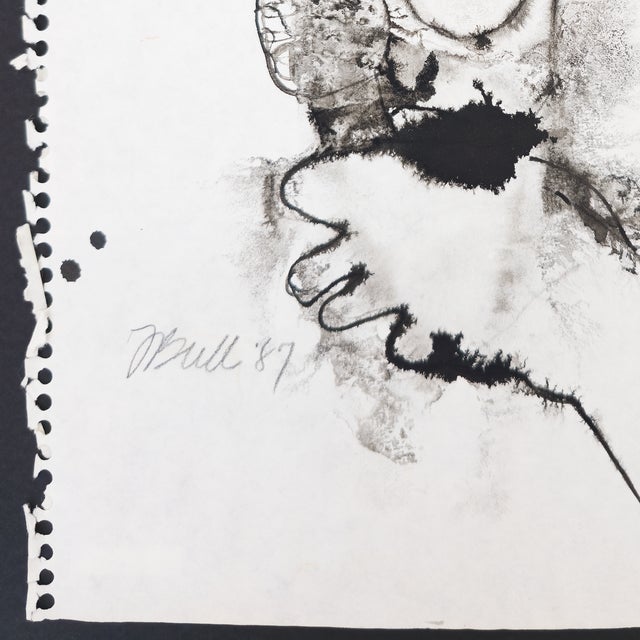
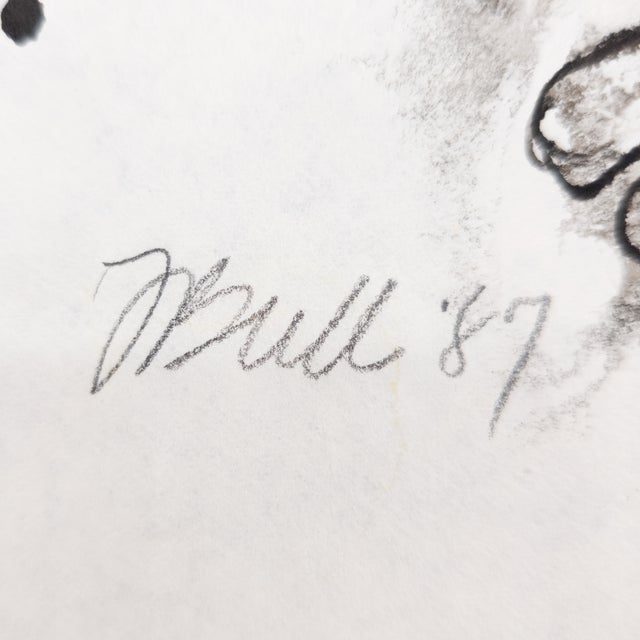
Fran Bull, c. 1987
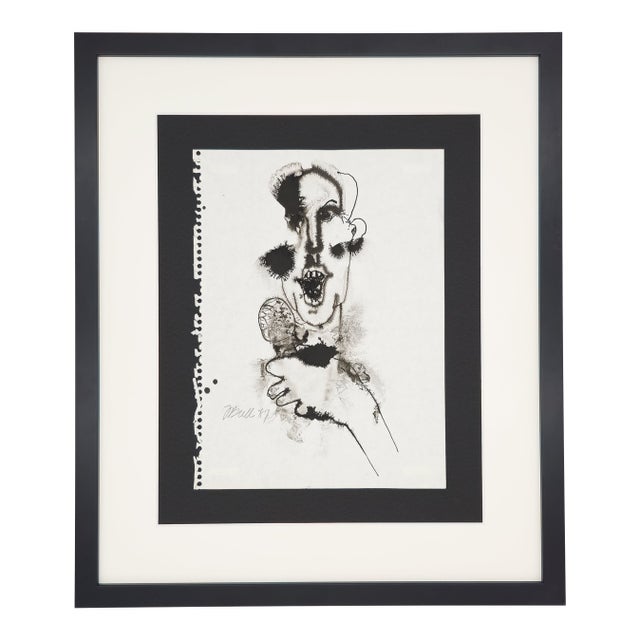
Radio Man by Fran Bull is an early original ink drawing that appears to …
Read more
Radio Man
Fran Bull, c. 1987
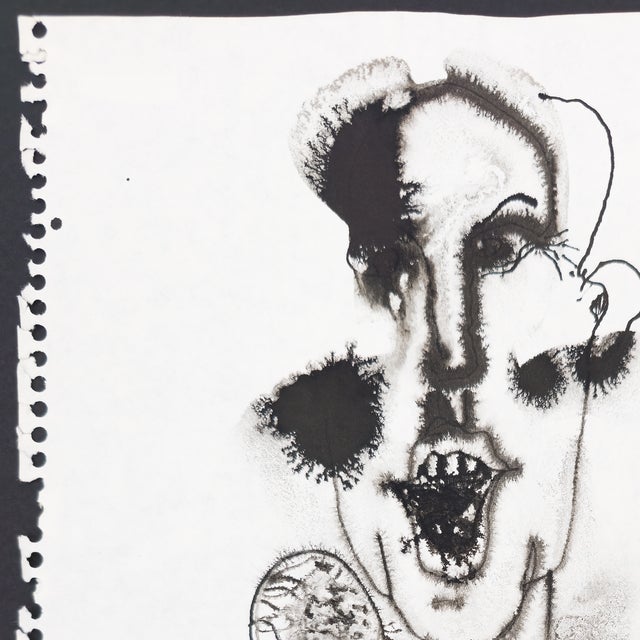
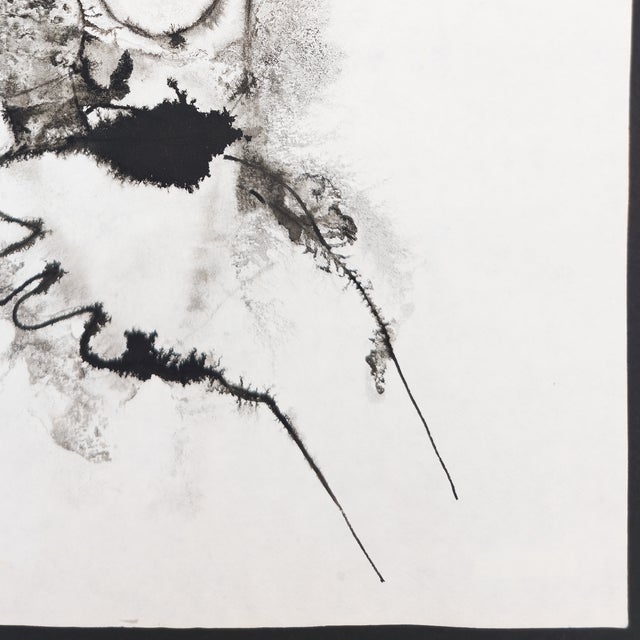
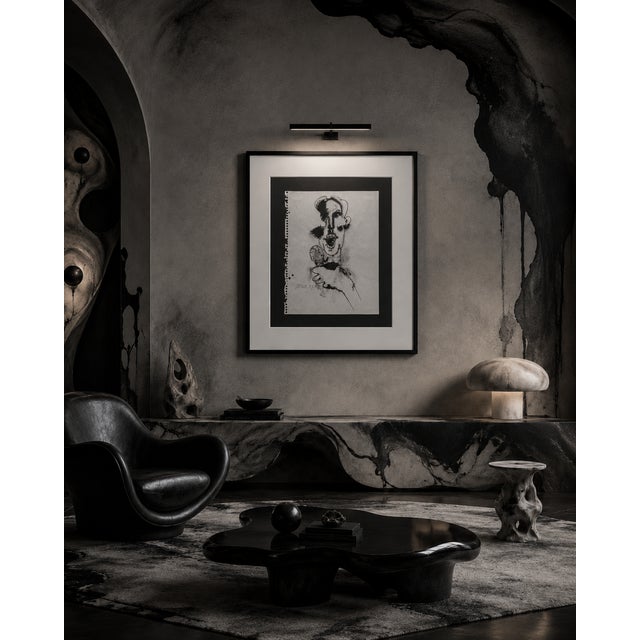
Radio Man by Fran Bull is an early original ink drawing that appears to catch its figure in the act of broadcast. The man’s mouth is stretched open, teeth exposed, as though he has been frozen mid-announcement, mid-performance, or mid-declaration. A microphone rises beside him not as a simple accessory in the image, but a part of the figure’s anatomy, an external organ of amplification. Bull presents a body built for transmission, but not necessarily for thought.
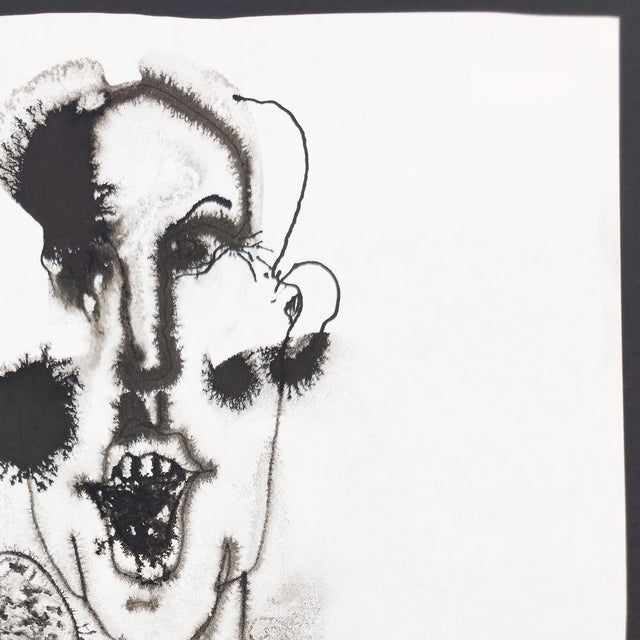
The head is the most psychologically charged area of the drawing. Bull forms the figure through hard, searching lines, then aggressively interrupts that structure with ink washes that eat away at the face. The left side of the head is especially unstable. There, the portrait nearly collapses into blackened vapor, leaving behind an absence Bull does not attempt to repair. This gap gives the figure an unsettling emptiness. In the context of a man at a microphone, the effect is pointed: the loudest voice in the room may also be the least inhabited. The figure becomes, quite literally, empty-headed, a vessel of noise more than understanding.
Bull’s distortion is not merely grotesque for its own sake. The open mouth, the hollowed head, and the darkened eye sockets suggest the violence of unchecked speech. The figure is not quietly communicating; he is projecting. His mouth becomes a black pit at the center of the composition, a place where language seems to disappear rather than clarify. The teeth create a flash of comic ugliness, but the humor quickly turns sour. Bull gives us the spectacle of speech stripped of wisdom, an announcement delivered by a fractured and partially erased man.
The microphone complicates the analysis further. Its rounded head is rendered with interior texture, almost like a cellular structure, a honeycomb, or a diseased organ. It looks less like a clean technological tool and more like something organic and contaminated. It's a visual echo of thought, signal, and static. Rather than liberating the voice, the microphone seems to entangle him. The figure is both speaker and captive, empowered by the apparatus that also distorts him.
Bull’s use of ink is central to the work’s force. The restricted black-and-white palette strips the image down to pressure, stain, and rupture. Every mark matters because there is nowhere for the eye to hide. The washes soften and dissolve the figure, while the hard lines insist on the remains of a body underneath. That tension between construction and collapse gives Radio Man its eerie vitality. The man is present, but he is also coming apart. He is defined by the very medium that is destroying him.
The torn sketchbook edge on the left side also adds to the immediacy of the piece. It keeps the drawing from feeling precious or overly composed. Instead, it feels pulled from a moment of experimentation, as if Bull caught an image arriving quickly and refused to over-polish it. That rawness matters. Radio Man feels like a document of transition, not only in subject but in artistic method. It shows Bull moving away from the controlled discipline of photorealism and toward a more expressive, psychologically loaded visual language.
In this sense, Radio Man can be read as more than a portrait of a broadcaster. It becomes a declaration of artistic change. Photorealism can reproduce the visible world with remarkable precision, but Bull’s ink work digs into something less stable: distortion, anxiety, absurdity, and the grotesque theater of human behavior. A realistic image of a man at a microphone might show us a speaker. Bull’s version shows us the emptiness, performance, and menace that can live inside the act of speaking.
Radio Man becomes a fitting emblem of Bull’s broader artistic transition. The figure may be announcing something to the world, but the announcement is also Bull’s own. Here is an artist loosening herself from the strictures of realism, allowing ink to misbehave. Radio Man is not just a man with a microphone. He is a herald of rupture, noise, reinvention, and the arrival of a more liberated Fran Bull.
-Jonathan Flike
About the Artist
Fran Bull is an American artist whose career moves restlessly across painting, drawing, printmaking, sculpture, performance, and installation. Originally associated with the Photorealist movement of the 1970s and 1980s, Bull gradually pushed beyond realism toward a more personal and psychologically charged visual language. Her work often exists between figuration and abstraction, using the body, myth, theatricality, and distortion as tools for exploring consciousness, memory, fear, beauty, and transformation.
Bull studied Music and Art at Bennington College and later earned a master’s degree in Art and Art Education from New York University. Her early Photorealist work was shown through Louis K. Meisel Gallery, placing her within one of the central gallery contexts for American Photorealism. Over time, however, Bull’s practice became increasingly experimental. Her ink drawings, prints, sculptural forms, and mixed-media works reveal an artist less interested in reproducing the visible world than in exposing the unstable forces beneath it.
This evolution is central to Bull’s importance. In her later work, faces fracture, bodies become theatrical vessels, and forms seem to emerge from dream, satire, ritual, and unconscious thought. Her imagery can be grotesque, humorous, spiritual, and deeply human all at once. Whether working in ink, etching, paint, or sculpture, Bull treats art as a means of passage between worlds: the seen and unseen, the ordinary and mythic, the personal and collective.
Bull has exhibited in the United States and Europe, with works connected to major phases of American Photorealism, expressionist abstraction, printmaking, and installation. For Visard, her work represents the power of artistic reinvention: a career not defined by a single style, but by an ongoing search for a freer, stranger, and more expansive visual truth.
Underrepresented Artist Information
Like many women artists of her generation, Fran Bull’s career reflects both achievement and uneven recognition within the larger art historical record. Although Bull was connected to significant artistic movements and exhibited widely across multiple decades, her work remains less visible than that of many male contemporaries who moved through similar circles of realism, abstraction, and experimental image-making.
This underrepresentation is especially important because Bull’s career resists easy categorization. She was not simply a Photorealist, nor solely an expressionist, printmaker, sculptor, or performance-based artist. Her practice evolved across mediums with intellectual restlessness and emotional force, making her body of work harder to flatten into a single market-friendly label. Visard recognizes Bull as an artist whose breadth, reinvention, and psychological depth deserve fuller documentation and continued attention.
See less
- Dimensions
- 17.25ʺW × 1.5ʺD × 20.25ʺH
- Frame Type
- Framed
- Art Subjects
- Portrait
- Period
- 1980s
- Country of Origin
- United States
- Item Type
- Vintage, Antique or Pre-owned
- Materials
- Pen and Ink
- Condition
- Good Condition, Original Condition Unaltered, Some Imperfections
- Color
- Black
- Condition Notes
- Please note that this item is vintage and shows wear consistent with age, use, and history. Signs of wear may … morePlease note that this item is vintage and shows wear consistent with age, use, and history. Signs of wear may include, but are not limited to, minor surface marks, patina, fading, or imperfections typical of older items. Measurements are approximate. We do our best to describe items accurately; however, condition assessments are subjective. If you would like additional details, images, or clarification before purchasing, please contact us. less
Questions about the item?
Returns & Cancellations
Return Policy - All sales are final 48 hours after delivery, unless otherwise specified in the description of the product.
Cancellation Policy - Prior to shipping or local pickup, buyers may cancel an order for up to 48 hours, unless otherwise specified.
Related Collections
- Ralph Lauren Paintings
- Photorealism Canvas Paintings
- Ed Ruscha Paintings
- Photorealism Paintings in New York
- Silk Velvet Paintings
- Louise Nevelson Paintings
- Herman Miller Paintings
- Richard Serra Paintings
- Jaanika Peerna Paintings
- Jo Baskerville Paintings
- Jean-Paul Barray Paintings
- Hans Andersen Paintings
- Johannes Andersen Paintings
- Peter Behrens Paintings
- Raphael Paintings
- Photorealism Paintings in Los Angeles
- Black Photorealism Paintings
- BDDW Paintings
- Cassina Paintings
- James McCray Paintings
- Lawson-Fenning Paintings
- Milton Avery Paintings
- Carl-Axel Acking Paintings
- Joseph Stella Paintings
- Karl-Erik Ekselius Paintings