

Details
Description
Jack Be Nimble
Fran Bull, c. 1990
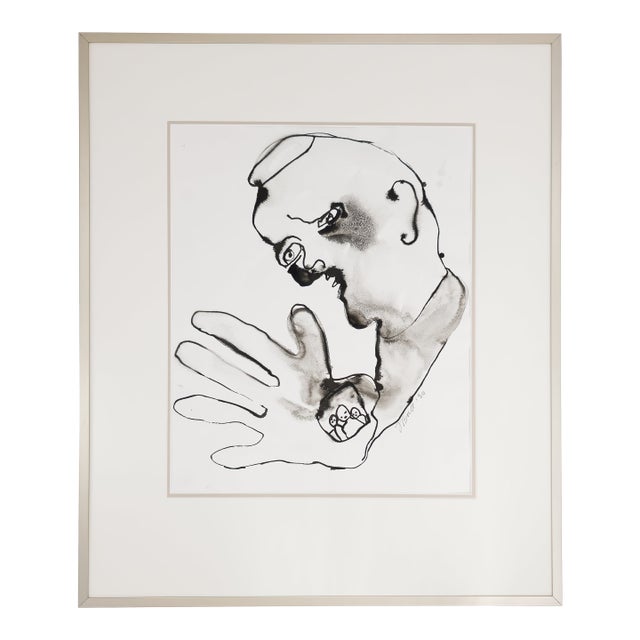
Jack Be Nimble by Fran Bull presents an original ink painting featuring a …
Read more
Jack Be Nimble
Fran Bull, c. 1990
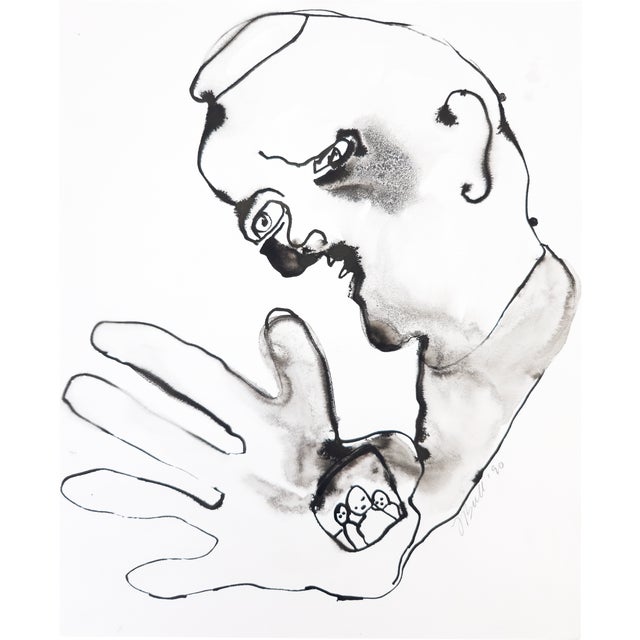
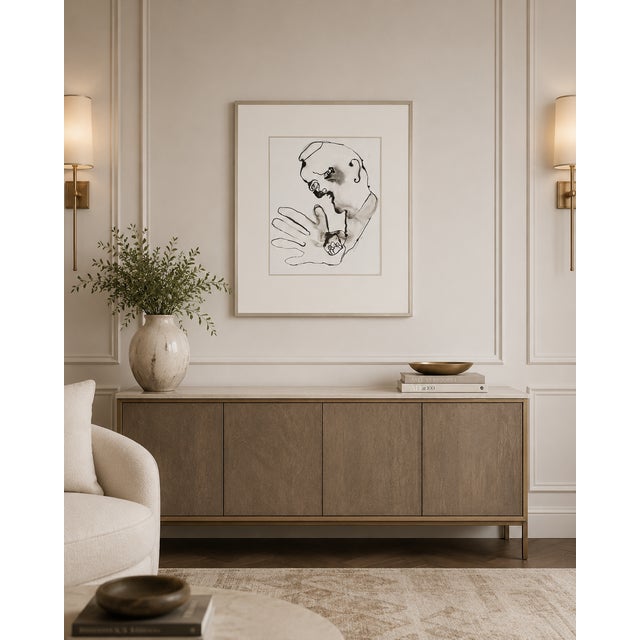
Jack Be Nimble by Fran Bull presents an original ink painting featuring a figure we can reasonably assume to be Jack from the classic Mother Goose nursery rhyme:
Jack be nimble,
Jack be quick,
Jack jump over
The candlestick.
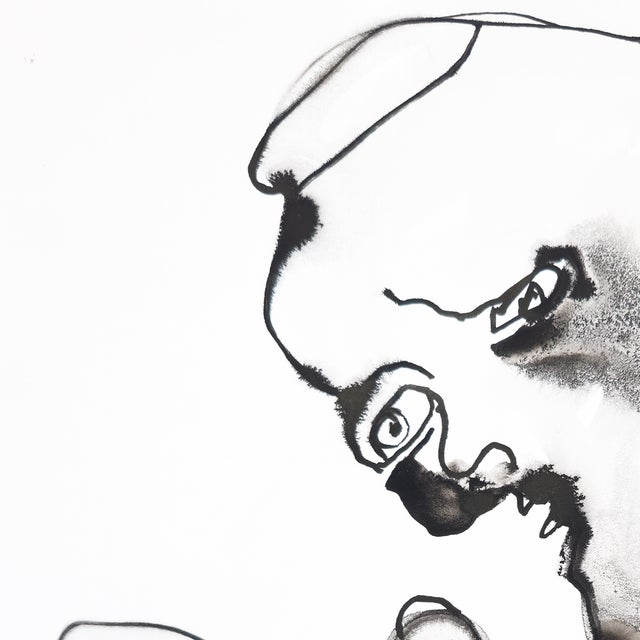
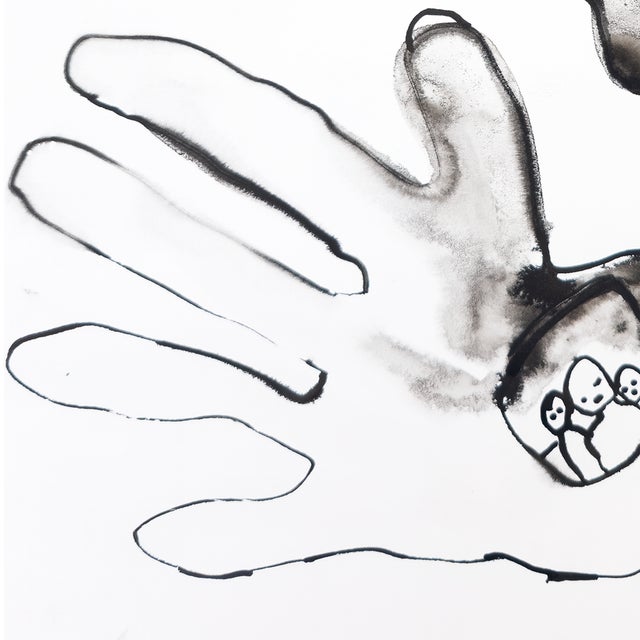
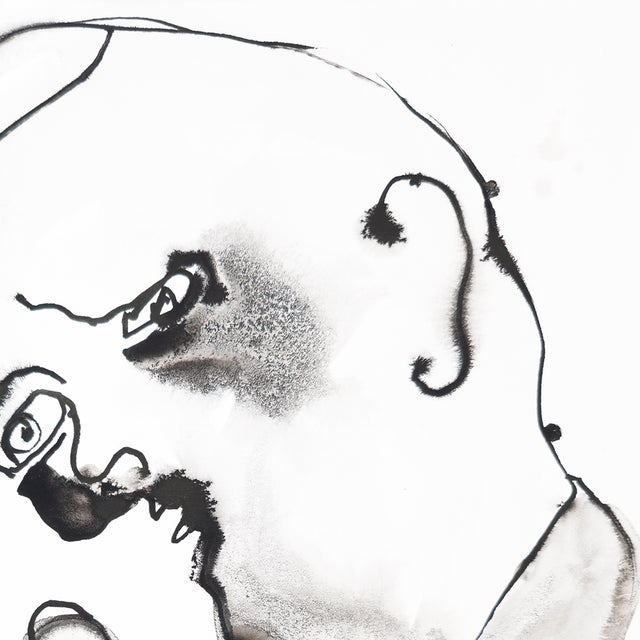
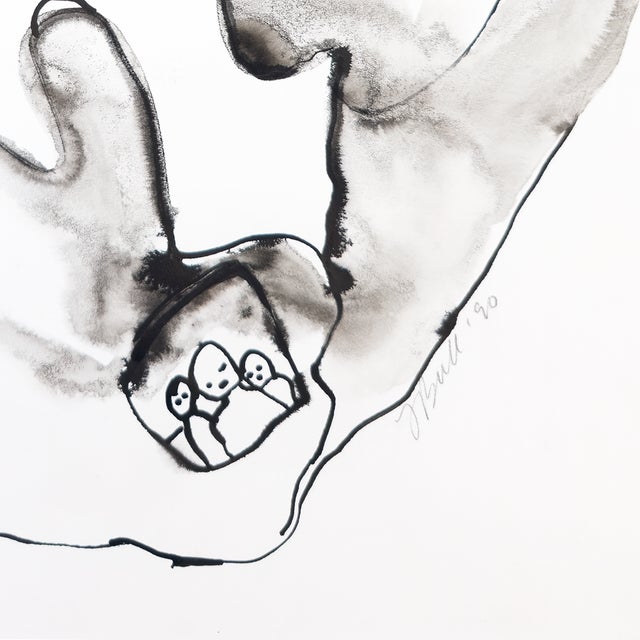
However, the Jack in Bull’s painting does not seem especially nimble or quick, and there is no candlestick in sight. Instead of showing the figure in motion, Bull gives us a moment of pause. Jack bends forward, looking downward at his enlarged hand, where three small figures appear. This shifts the work away from action and into reflection. Rather than depicting the famous leap, Bull seems more interested in what remains after the leap has passed into memory.
The absence of the candlestick is important. It removes the expected symbol of the rhyme and forces the viewer to look elsewhere for meaning. Jack is not jumping, performing, or proving his agility. He is examining his own hand, a gesture that suggests memory, possession, regret, or self-assessment. The tiny figures gathered within the palm complicate the image further. They may represent children, memories, former selves, or small lives held within the larger weight of experience. Jack appears to be looking not at an object, but at time itself.
The practice of jumping over a candlestick has been associated with the English folk tradition of “candle leaping.” If one could jump over a lit candle without extinguishing it, good luck and prosperity were said to follow. If the flame went out, bad luck was implied. Through this lens, the rhyme becomes more than a simple test of speed. It becomes a ritual of risk, fortune, and bodily capability. Bull’s image seems to ask what happens when the body is no longer organized around proving itself through quickness.
There is an underlying suggestion that good fortune often appears to belong to the young: those nimble enough, quick enough, and reactive enough to clear the hazards placed before them. Youth jumps. Youth risks. Youth believes the flame can be cleared without consequence. Bull’s Jack, by contrast, appears older, larger, and more still. His attention is not directed toward the next leap, but toward what has already been gathered, lost, or remembered.
Yet the work also allows for a counter-reading. Perhaps with age, one no longer needs to be nimble or rely so heavily on luck. Experience reshapes the way a person responds to uncertainty, misfortune, and the slings and arrows of life. The figure’s large hand may not represent weakness, but accumulation. It is the hand of someone who has held things, endured things, and come to understand that survival is not always a matter of speed.
Bull’s use of ink gives the figure an unsettled but expressive presence. The head tilts downward with scrutiny, while the large hand opens like a stage, altar, or memory chamber. The body is only partially articulated, leaving the viewer to focus on the relationship between face and hand, thought and recollection. As in many of Bull’s ink works, distortion is not merely grotesque. It becomes a way of making interior experience visible.
The humor of the title remains, but it is no longer innocent. Bull takes a light nursery rhyme and turns it into a meditation on aging, luck, and self-recognition. The joke is that Jack is not nimble. The deeper truth is that perhaps nimbleness is no longer the point. Though there may be far less candle leaping as one ages, there may be far more candle kicking: a chest-out antagonism toward fate and whatever it chooses to throw forward.
Jack Be Nimble ultimately becomes a work about the strange dignity of looking back. Jack may be reminiscing about an earlier time when life seemed simpler, when luck felt like something one could win with a quick jump over fire. But he is not necessarily weaker in the present. He may, in fact, be better prepared for it. Bull gives us not the leap, but the aftermath: a figure who has survived long enough to know that fate is not always cleared gracefully. Sometimes it is studied in the hand, remembered through small figures, and met with something sturdier than luck.
-Jonathan Flike
About the Artist
Fran Bull is an American artist whose career moves restlessly across painting, drawing, printmaking, sculpture, performance, and installation. Originally associated with the Photorealist movement of the 1970s and 1980s, Bull gradually pushed beyond realism toward a more personal and psychologically charged visual language. Her work often exists between figuration and abstraction, using the body, myth, theatricality, and distortion as tools for exploring consciousness, memory, fear, beauty, and transformation.
Bull studied Music and Art at Bennington College and later earned a master’s degree in Art and Art Education from New York University. Her early Photorealist work was shown through Louis K. Meisel Gallery, placing her within one of the central gallery contexts for American Photorealism. Over time, however, Bull’s practice became increasingly experimental. Her ink drawings, prints, sculptural forms, and mixed-media works reveal an artist less interested in reproducing the visible world than in exposing the unstable forces beneath it.
This evolution is central to Bull’s importance. In her later work, faces fracture, bodies become theatrical vessels, and forms seem to emerge from dream, satire, ritual, and unconscious thought. Her imagery can be grotesque, humorous, spiritual, and deeply human all at once. Whether working in ink, etching, paint, or sculpture, Bull treats art as a means of passage between worlds: the seen and unseen, the ordinary and mythic, the personal and collective.
Bull has exhibited in the United States and Europe, with works connected to major phases of American Photorealism, expressionist abstraction, printmaking, and installation. For Visard, her work represents the power of artistic reinvention: a career not defined by a single style, but by an ongoing search for a freer, stranger, and more expansive visual truth.
Underrepresented Artist Information
Like many women artists of her generation, Fran Bull’s career reflects both achievement and uneven recognition within the larger art historical record. Although Bull was connected to significant artistic movements and exhibited widely across multiple decades, her work remains less visible than that of many male contemporaries who moved through similar circles of realism, abstraction, and experimental image-making.
This underrepresentation is especially important because Bull’s career resists easy categorization. She was not simply a Photorealist, nor solely an expressionist, printmaker, sculptor, or performance-based artist. Her practice evolved across mediums with intellectual restlessness and emotional force, making her body of work harder to flatten into a single market-friendly label. Visard recognizes Bull as an artist whose breadth, reinvention, and psychological depth deserve fuller documentation and continued attention.
See less
- Dimensions
- 21.25ʺW × 1ʺD × 25.25ʺH
- Frame Type
- Framed
- Period
- 1990s
- Country of Origin
- United States
- Item Type
- Vintage, Antique or Pre-owned
- Materials
- Pen and Ink
- Condition
- Good Condition, Original Condition Unaltered, Some Imperfections
- Color
- Black
- Condition Notes
- Please note that this item is vintage and shows wear consistent with age, use, and history. Signs of wear may … morePlease note that this item is vintage and shows wear consistent with age, use, and history. Signs of wear may include, but are not limited to, minor surface marks, patina, fading, or imperfections typical of older items. Measurements are approximate. We do our best to describe items accurately; however, condition assessments are subjective. If you would like additional details, images, or clarification before purchasing, please contact us. Special Condition Notes Historical frame and matting directly from the artist's estate. less
Questions about the item?
Returns & Cancellations
Return Policy - All sales are final 48 hours after delivery, unless otherwise specified in the description of the product.
Cancellation Policy - Prior to shipping or local pickup, buyers may cancel an order for up to 48 hours, unless otherwise specified.
Related Collections
- Photorealism Canvas Paintings
- Ed Ruscha Paintings
- Photorealism Paintings in New York
- Richard Serra Paintings
- Jo Baskerville Paintings
- Louise Nevelson Paintings
- Karen Offutt Paintings
- Nicola Simbari Paintings
- Herman Miller Paintings
- BDDW Paintings
- James McCray Paintings
- Jaanika Peerna Paintings
- Leroy Neiman Paintings
- Jeff Slemmons Paintings
- Vienna Secession Paintings
- Johannes Andersen Paintings
- Pedro Friedeberg Paintings
- Peter Behrens Paintings
- Piet Hein Eek Paintings
- Raphael Paintings
- Photorealism Paintings in Los Angeles
- Carl-Axel Acking Paintings
- Karl-Erik Ekselius Paintings
- Hans Andersen Paintings
- Jean-Paul Barray Paintings