


Details
Description
Here Comes the Airplane*
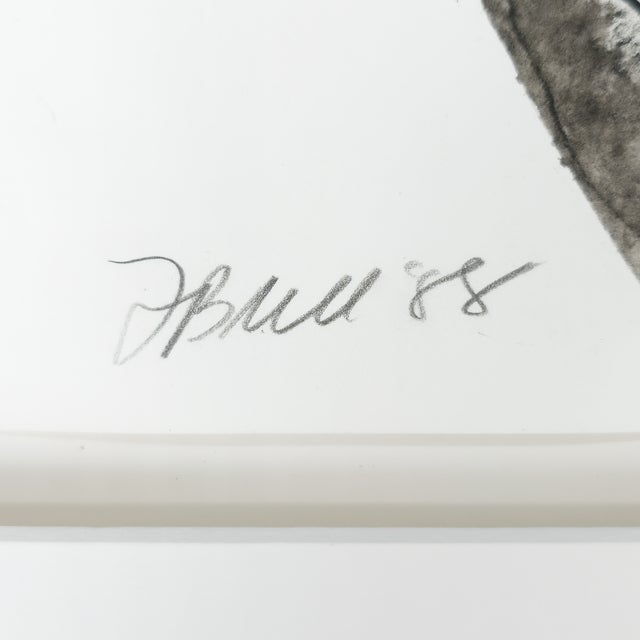
Fran Bull, c. 1988
Here Comes the Airplane by Fran Bull taps into the strange, macabre …
Read more
Here Comes the Airplane*
Fran Bull, c. 1988
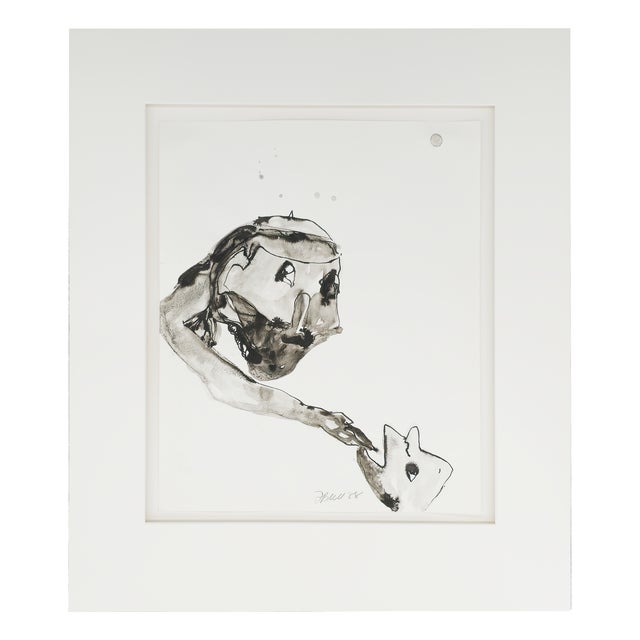
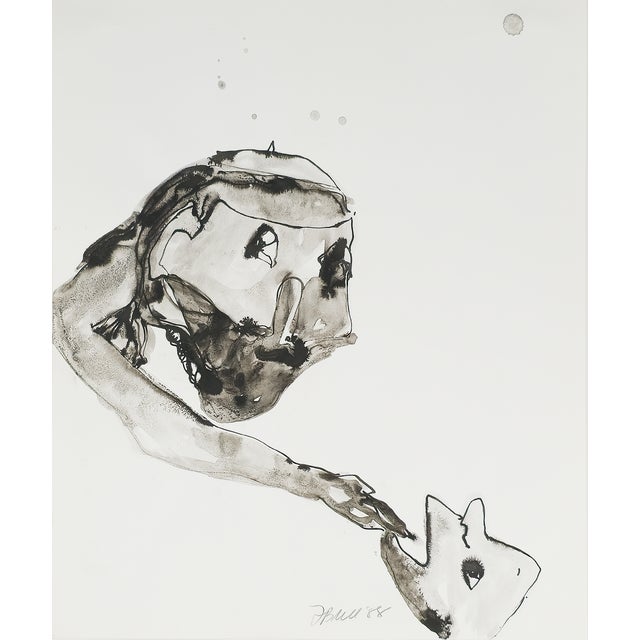
Here Comes the Airplane by Fran Bull taps into the strange, macabre humor that appears frequently throughout her original ink series. The title refers to the familiar game adults often use when feeding children, turning a spoonful of food into an approaching airplane. It is a small domestic ritual, playful and ordinary, yet Bull transforms it into something surreal, tender, and slightly unsettling.
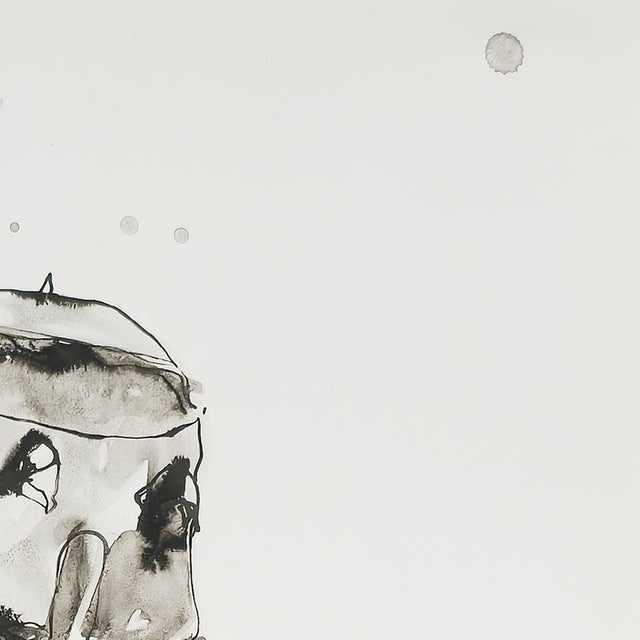
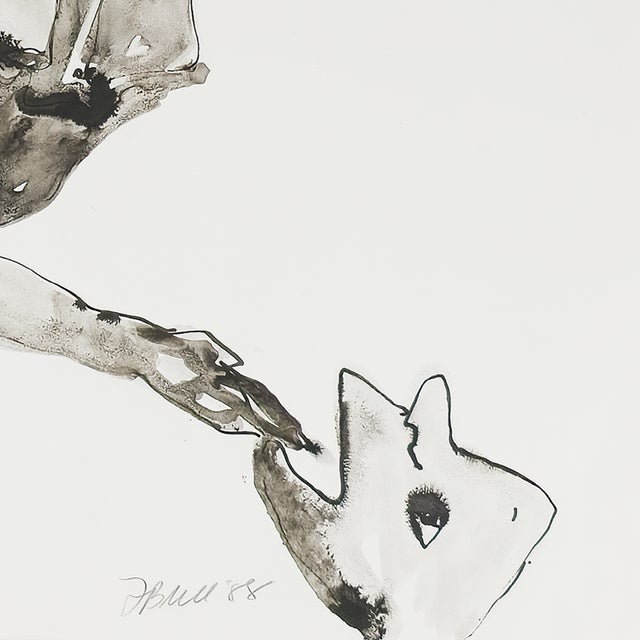
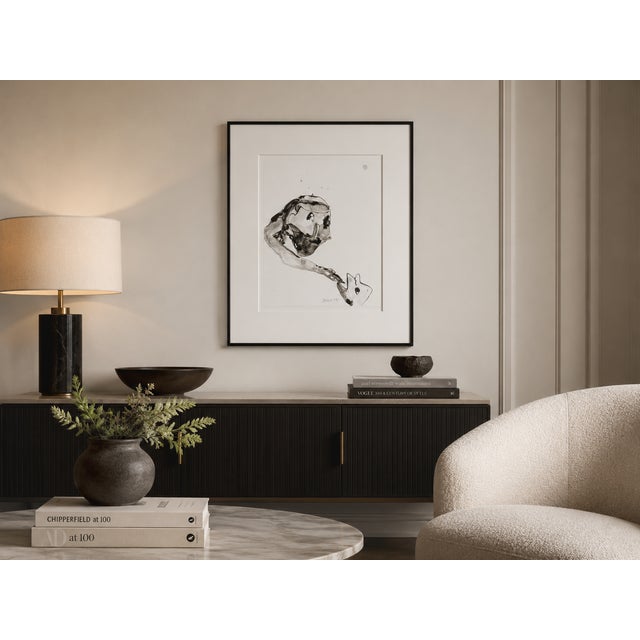
The piece features two figures: one hovering above to offer a morsel, and a smaller figure seated at the bottom of the image with an open mouth, ready to receive. The smaller figure behaves almost birdlike, head tilted upward in anticipation, waiting to be fed from above. Bull gives the scene the structure of an intimate exchange, but she strips it of sentimentality. The moment is funny because it is so recognizable, yet it becomes strange because the figures have been reduced almost entirely to head, mouth, and hand.
Bull makes light of the human experience of feeding by placing the lower figure in a position more animal-like than the typical image of a child being fed. The child becomes fledgling, dependent creature, open vessel. This transformation is humorous, but it also reveals something truthful. Feeding another person is one of the earliest and most primal forms of care. It places the receiver in a state of vulnerability and the giver in a position of responsibility.
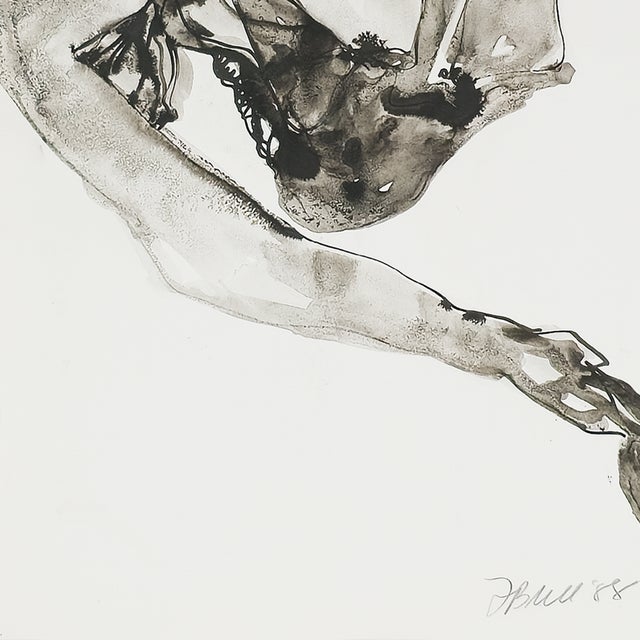
The composition is remarkably economical. Bull isolates the figures within the moment of offer and reception, removing nearly everything not necessary to the action. The adult figure’s arm extends toward the child as the only visible limb, emphasizing Bull’s use of reduction as a tool for focused viewing. The offering hand becomes the emotional hinge of the work. It connects the two beings and gives the image its entire narrative.
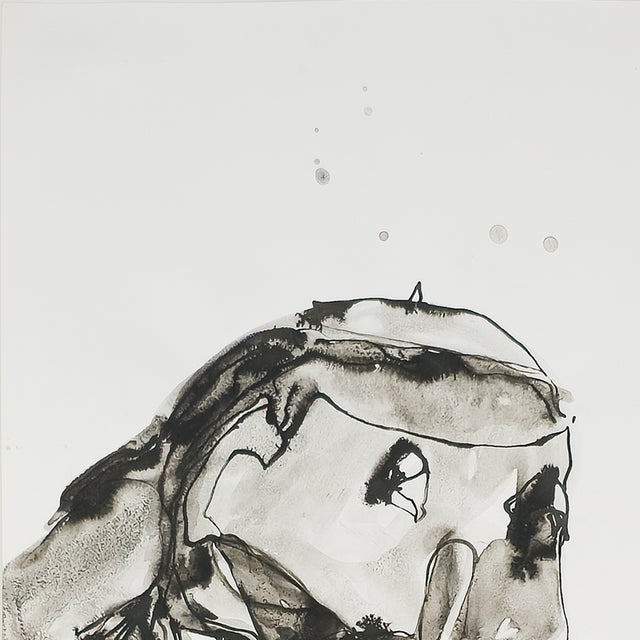
The adult figure looks on with large, joy-filled eyes at the child’s acceptance of food, while the child looks directly upward, unable to see the full presence of the one providing sustenance. This imbalance matters. The child receives without full understanding. The adult gives with awareness, pleasure, and responsibility. Bull captures the asymmetry of care: one figure knows the meaning of the gesture, while the other simply trusts it.
What makes Here Comes the Airplane touching, despite its inky distortions, is the vulnerability it portrays. The act of feeding another person requires grace, patience, and self-sacrifice. It is intimate without being grand. It asks the giver to attend to the needs of another body, and it asks the receiver to accept that care without fear. The giver must ensure the food is healthful and will not cause harm, while the receiver must open themselves to nourishment. Their relationship is intertwined through duty, empathy, trust, and necessity.
Bull’s India ink deepens the emotional strangeness of the scene. The washes and darkened passages prevent the work from becoming merely sweet. The figures feel partially dissolved, as though they belong to memory, dream, or some private emotional register. The work remembers what it means to be small, hungry, trusting, and held within the care of another.
There is also a subtle reversal in the work’s humor. The phrase “here comes the airplane” is normally used to make the child comply, to persuade the mouth to open. In Bull’s image, the mouth is already open. The child is ready. The ritual has become less about persuasion and more about exchange. The joke remains, but beneath it is a recognition of need.
Here Comes the Airplane shows that the simple act of feeding another is a powerful form of connection. Bull turns a familiar domestic game into a scene of dependence, responsibility, and trust. Beneath the humor and distortion is a tender recognition of care: the offering hand, the open mouth, and the quiet agreement that allows one being to nourish another.
-Jonathan Flike
*The title of this work was assigned by Visard Gallery.
About the Artist
Fran Bull is an American artist whose career moves restlessly across painting, drawing, printmaking, sculpture, performance, and installation. Originally associated with the Photorealist movement of the 1970s and 1980s, Bull gradually pushed beyond realism toward a more personal and psychologically charged visual language. Her work often exists between figuration and abstraction, using the body, myth, theatricality, and distortion as tools for exploring consciousness, memory, fear, beauty, and transformation.
Bull studied Music and Art at Bennington College and later earned a master’s degree in Art and Art Education from New York University. Her early Photorealist work was shown through Louis K. Meisel Gallery, placing her within one of the central gallery contexts for American Photorealism. Over time, however, Bull’s practice became increasingly experimental. Her ink drawings, prints, sculptural forms, and mixed-media works reveal an artist less interested in reproducing the visible world than in exposing the unstable forces beneath it.
This evolution is central to Bull’s importance. In her later work, faces fracture, bodies become theatrical vessels, and forms seem to emerge from dream, satire, ritual, and unconscious thought. Her imagery can be grotesque, humorous, spiritual, and deeply human all at once. Whether working in ink, etching, paint, or sculpture, Bull treats art as a means of passage between worlds: the seen and unseen, the ordinary and mythic, the personal and collective.
Bull has exhibited in the United States and Europe, with works connected to major phases of American Photorealism, expressionist abstraction, printmaking, and installation. For Visard, her work represents the power of artistic reinvention: a career not defined by a single style, but by an ongoing search for a freer, stranger, and more expansive visual truth.
Underrepresented Artist Information
Like many women artists of her generation, Fran Bull’s career reflects both achievement and uneven recognition within the larger art historical record. Although Bull was connected to significant artistic movements and exhibited widely across multiple decades, her work remains less visible than that of many male contemporaries who moved through similar circles of realism, abstraction, and experimental image-making.
This underrepresentation is especially important because Bull’s career resists easy categorization. She was not simply a Photorealist, nor solely an expressionist, printmaker, sculptor, or performance-based artist. Her practice evolved across mediums with intellectual restlessness and emotional force, making her body of work harder to flatten into a single market-friendly label. Visard recognizes Bull as an artist whose breadth, reinvention, and psychological depth deserve fuller documentation and continued attention.
See less
- Dimensions
- 21.5ʺW × 0.1ʺD × 25ʺH
- Frame Type
- Unframed
- Art Subjects
- Figure
- Period
- 1980s
- Country of Origin
- United States
- Item Type
- Vintage, Antique or Pre-owned
- Materials
- Pen and Ink
- Condition
- Good Condition, Original Condition Unaltered, Some Imperfections
- Color
- Black
- Condition Notes
- Please note that this item is vintage and shows wear consistent with age, use, and history. Signs of wear may … morePlease note that this item is vintage and shows wear consistent with age, use, and history. Signs of wear may include, but are not limited to, minor surface marks, patina, fading, or imperfections typical of older items. Measurements are approximate. We do our best to describe items accurately; however, condition assessments are subjective. If you would like additional details, images, or clarification before purchasing, please contact us. less
Questions about the item?
Returns & Cancellations
Return Policy - All sales are final 48 hours after delivery, unless otherwise specified in the description of the product.
Cancellation Policy - Prior to shipping or local pickup, buyers may cancel an order for up to 48 hours, unless otherwise specified.
Related Collections
- Ed Ruscha Paintings
- Ralph Lauren Paintings
- Photorealism Canvas Paintings
- Photorealism Paintings in New York
- Louise Nevelson Paintings
- Richard Serra Paintings
- Silk Velvet Paintings
- Herman Miller Paintings
- BDDW Paintings
- Jo Baskerville Paintings
- Jean-Paul Barray Paintings
- Johannes Andersen Paintings
- Peter Behrens Paintings
- Carl-Axel Acking Paintings
- Joseph Stella Paintings
- Karl-Erik Ekselius Paintings
- Pedro Friedeberg Paintings
- Piet Hein Eek Paintings
- James McCray Paintings
- Lawson-Fenning Paintings
- Milton Avery Paintings
- Raphael Paintings
- Jaanika Peerna Paintings
- Hans Andersen Paintings
- Cassina Paintings