


Details
Description
Deer Tree
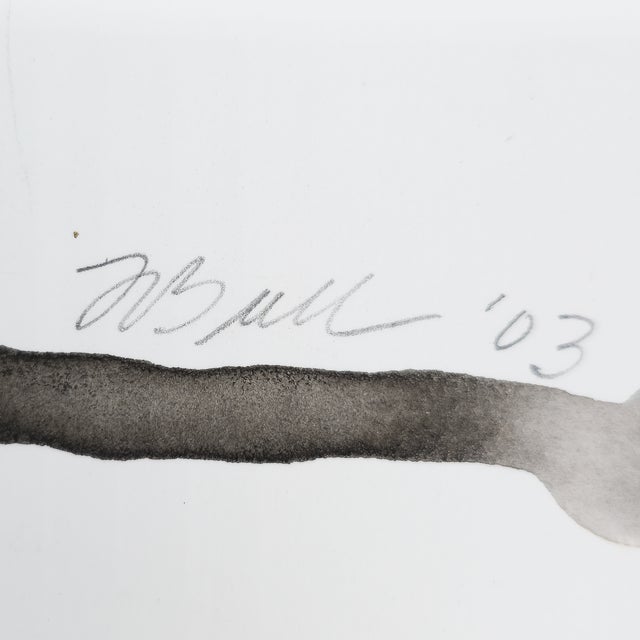
Fran Bull, c. 2003
Deer Tree by Fran Bull is an abstract work that fuses the structure of …
Read more
Deer Tree
Fran Bull, c. 2003
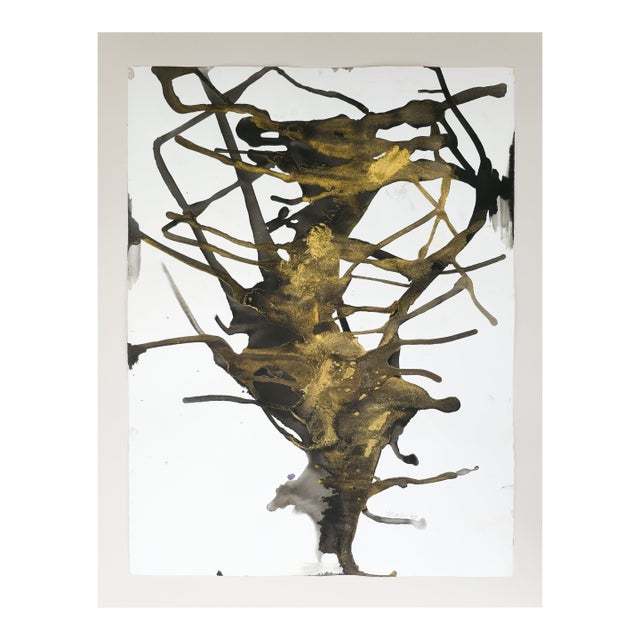
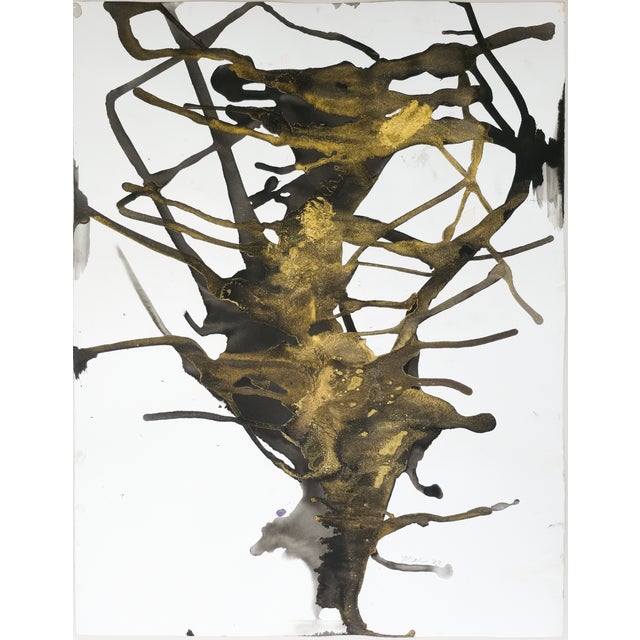
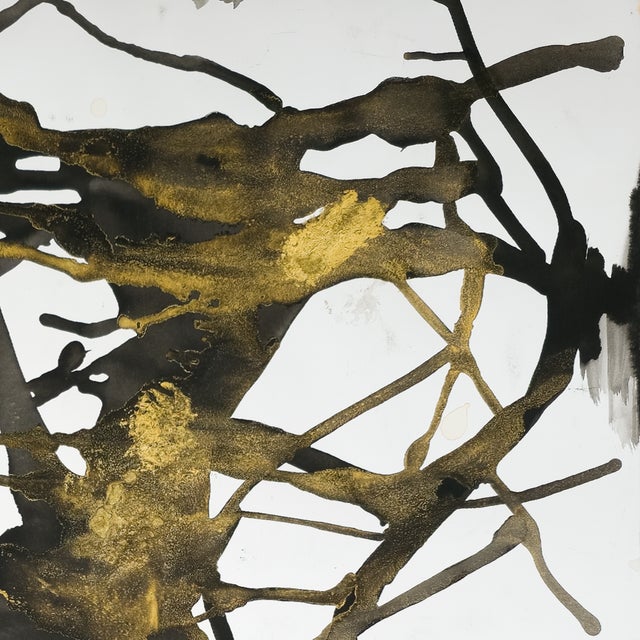
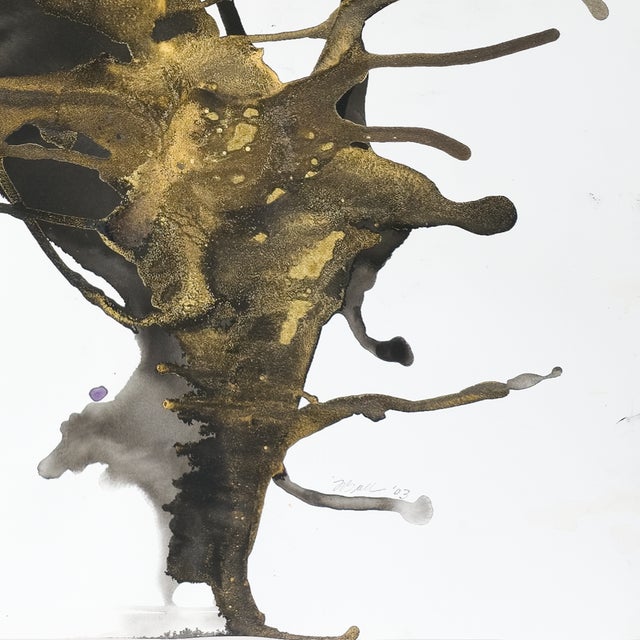
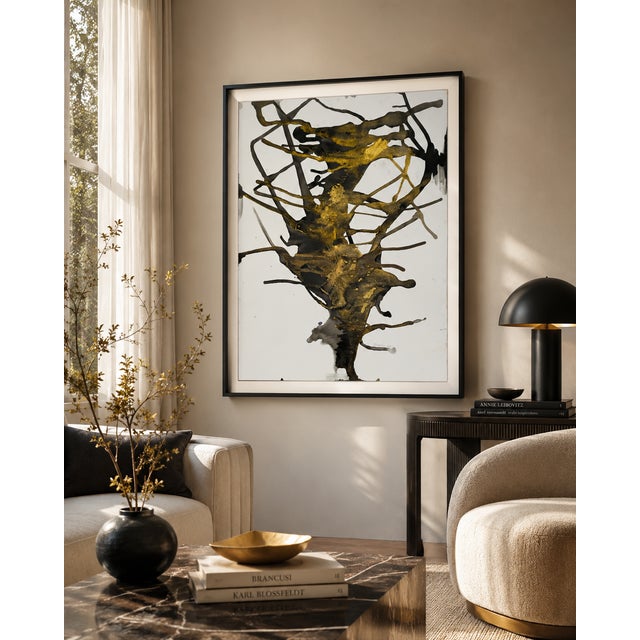
Deer Tree by Fran Bull is an abstract work that fuses the structure of a tree and a deer into a single hybridized form. As with many of Bull’s works, the title carries significant interpretive weight. Without it, the image would remain far more elusive, its forms hovering between organic suggestion and pure abstraction. Bull deliberately complicates that reading by orienting the work upright, even though the deer’s form becomes more recognizable when the painting is rotated 90 degrees counterclockwise.
When reoriented, the image begins to reveal the profile of a deer with its back legs kicked upward in motion. A solitary rounded oval reads as the nostril, the muzzle extends directly to the right, and the antlers rise from the head in branching projections. What appears in the upright orientation as an abstract lattice of limbs and extensions becomes, in this alternate view, a far more animated and bodily presence. Two front legs align along the left side of the composition, which becomes the ground once the work is turned. This rotational ambiguity gives the painting an important instability, as if Bull is asking the viewer to participate in the act of recognition itself.
In its intended orientation, however, Deer Tree reads more like a distorted tree. A dense central trunk anchors the image while branches or branch-like extensions thrust outward in every direction. There is no foliage to soften the form, no naturalistic detail to ground it in landscape. Instead, Bull presents a stripped and skeletal structure, something more analytical than descriptive. The protrusions from the central form operate as a visual overlap of branches and antlers, allowing the two identities named in the title to remain inseparable. Rather than showing a deer beside a tree, Bull collapses them into one hybrid body.
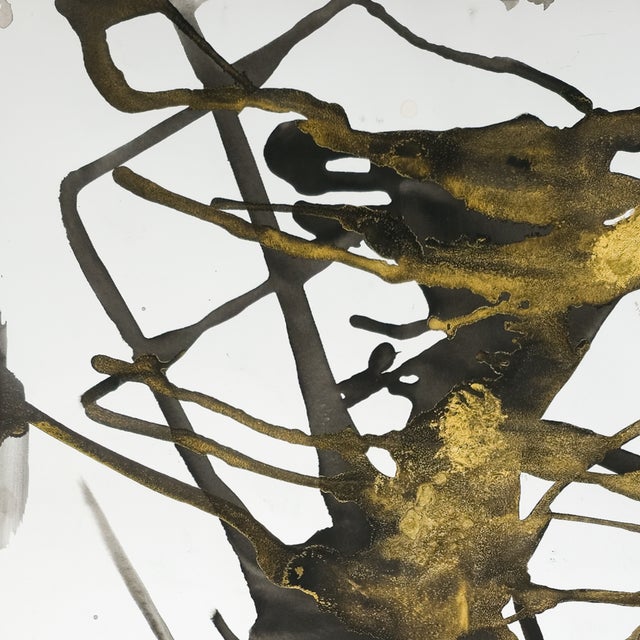
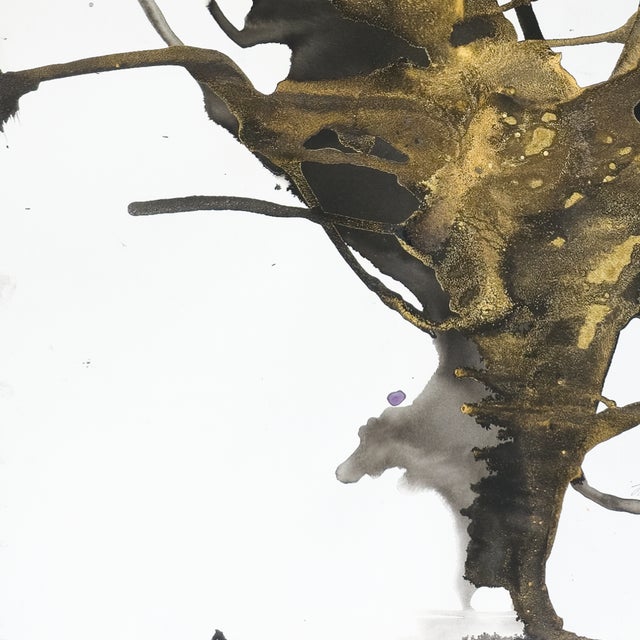
This fusion gives the work an uncanny presence. Twisted and almost alien, the form feels ancient and unstable, as though it belongs equally to the natural world and to some invented symbolic system. Bull pushes that ambiguity further through her restricted palette. The painting relies almost entirely on black ink and flashes of glimmering gold paint. Unlike some of her more color-saturated works, color here carries very little descriptive or emotional instruction. Instead, the gold seems to activate select portions of the form, catching the eye like illuminated residue. The black provides structure, mass, and fluidity, while the gold introduces a strange, almost alchemical light.
Bull’s handling of material is especially important in this piece. The ink bleeds, pools, and extends with a kind of organic force, while the gold sits on the surface with a distinct shimmer and density. This interplay between matte darkness and reflective brightness heightens the painting’s tension between concealment and revelation. The form seems to emerge and dissolve at once. Certain passages feel decisive and trunk-like, while others appear to slip away into gestural fragments. The work is therefore not only about hybrid imagery, but also about transformation through process.
Deer Tree also marks an evolution in Bull’s practice. It draws upon motifs and methods visible in earlier bodies of work, especially the fluidity of her ink works and the strange organic invention of the Sophia series, yet it does not fully belong to either. Instead, Bull uses those artistic throwbacks alongside continued experimentation to create something distinct. The work feels both retrospective and exploratory, as though it is gathering older visual languages and pressing them toward a new possibility.
That sense of newness also carries a quiet feeling of finality. As motifs from prior periods unite in Deer Tree, only a small number of works appear to carry this language further. Because of that, the piece feels especially elusive within Bull’s larger practice. It stands as a hybrid not only in image, but in chronology: part culmination, part departure, and part isolated experiment. Tree becomes deer, deer becomes tree, and abstraction becomes the mechanism through which the two can coexist. The result is a work that is visually restrained yet conceptually rich, mysterious in its form and powerful in its refusal to settle into a single meaning.
-Jonathan Flike
About the Artist
Fran Bull is an American artist whose career moves restlessly across painting, drawing, printmaking, sculpture, performance, and installation. Originally associated with the Photorealist movement of the 1970s and 1980s, Bull gradually pushed beyond realism toward a more personal and psychologically charged visual language. Her work often exists between figuration and abstraction, using the body, myth, theatricality, and distortion as tools for exploring consciousness, memory, fear, beauty, and transformation.
Bull studied Music and Art at Bennington College and later earned a master’s degree in Art and Art Education from New York University. Her early Photorealist work was shown through Louis K. Meisel Gallery, placing her within one of the central gallery contexts for American Photorealism. Over time, however, Bull’s practice became increasingly experimental. Her ink drawings, prints, sculptural forms, and mixed-media works reveal an artist less interested in reproducing the visible world than in exposing the unstable forces beneath it.
This evolution is central to Bull’s importance. In her later work, faces fracture, bodies become theatrical vessels, and forms seem to emerge from dream, satire, ritual, and unconscious thought. Her imagery can be grotesque, humorous, spiritual, and deeply human all at once. Whether working in ink, etching, paint, or sculpture, Bull treats art as a means of passage between worlds: the seen and unseen, the ordinary and mythic, the personal and collective.
Bull has exhibited in the United States and Europe, with works connected to major phases of American Photorealism, expressionist abstraction, printmaking, and installation. For Visard, her work represents the power of artistic reinvention: a career not defined by a single style, but by an ongoing search for a freer, stranger, and more expansive visual truth.
Underrepresented Artist Information
Like many women artists of her generation, Fran Bull’s career reflects both achievement and uneven recognition within the larger art historical record. Although Bull was connected to significant artistic movements and exhibited widely across multiple decades, her work remains less visible than that of many male contemporaries who moved through similar circles of realism, abstraction, and experimental image-making.
This underrepresentation is especially important because Bull’s career resists easy categorization. She was not simply a Photorealist, nor solely an expressionist, printmaker, sculptor, or performance-based artist. Her practice evolved across mediums with intellectual restlessness and emotional force, making her body of work harder to flatten into a single market-friendly label. Visard recognizes Bull as an artist whose breadth, reinvention, and psychological depth deserve fuller documentation and continued attention.
See less
- Dimensions
- 22ʺW × 0.1ʺD × 30ʺH
- Art Subjects
- Abstract
- Frame Type
- Unframed
- Period
- 2000 - 2009
- Country of Origin
- United States
- Item Type
- Vintage, Antique or Pre-owned
- Materials
- Acrylic Paint
- Pen and Ink
- Condition
- Good Condition, Original Condition Unaltered, Some Imperfections
- Color
- Black
- Condition Notes
- Please note that this item is vintage and shows wear consistent with age, use, and history. Signs of wear may … morePlease note that this item is vintage and shows wear consistent with age, use, and history. Signs of wear may include, but are not limited to, minor surface marks, patina, fading, or imperfections typical of older items. All items are sold as-is, which is standard with vintage and pre-owned goods and cannot be returned on the basis of condition. Measurements are approximate. We do our best to describe items accurately; however, condition assessments are subjective. If you would like additional details, images, or clarification before purchasing, please contact us. less
Questions about the item?
Returns & Cancellations
Return Policy - All sales are final 48 hours after delivery, unless otherwise specified in the description of the product.
Cancellation Policy - Prior to shipping or local pickup, buyers may cancel an order for up to 48 hours, unless otherwise specified.
Related Collections
- Ed Ruscha Paintings
- Photorealism Canvas Paintings
- Ralph Lauren Paintings
- Photorealism Paintings in New York
- Richard Serra Paintings
- Silk Velvet Paintings
- Louise Nevelson Paintings
- Black Photorealism Paintings
- Herman Miller Paintings
- Cassina Paintings
- Jaanika Peerna Paintings
- BDDW Paintings
- Jo Baskerville Paintings
- Jean-Paul Barray Paintings
- Hans Andersen Paintings
- Johannes Andersen Paintings
- Peter Behrens Paintings
- Raphael Paintings
- Photorealism Paintings in Los Angeles
- Pedro Friedeberg Paintings
- Piet Hein Eek Paintings
- Lee Reynolds Paintings
- Mid-Century Modern Paintings
- Abstract Paintings
- Nautical Paintings