


Details
Description
Soul, Clap Hands, and Sing: Pulcinella
Fran Bull, c. 2016
Soul, Clap Hands, and Sing: Pulcinella by Fran Bull contains …
Read more
Soul, Clap Hands, and Sing: Pulcinella
Fran Bull, c. 2016
Soul, Clap Hands, and Sing: Pulcinella by Fran Bull contains a rich intertextual allusion. The “Soul, Clap Hands, and Sing” portion of the title refers to William Butler Yeats’s poem Sailing to Byzantium, while “Pulcinella” refers to the stock character from commedia dell’arte, often associated with Naples, the lower social classes, appetite, cunning, foolishness, and survival. Pulcinella is not a noble or refined figure. He is closer to the common man pushed through theatrical exaggeration: comic, instinctive, self-aware, and socially marginal. In Yeats’s poem, old age becomes an opportunity to turn away from sensual life, which is destined to fade, and toward a more permanent form of being through the cultivation of the soul. Bull’s work places that elevated spiritual aspiration into dialogue with one of theater’s most earthy and unruly figures.
This tension feels deeply aligned with Bull’s exhibition We’re All at A Party Called Life on Earth, a larger-than-life body of work that celebrated an almost Dadaist existence through caricatures drawn from circuses, amusement parks, and commedia dell’arte. Rather than treating life as a solemn march toward transcendence, Bull frames it as performance, absurdity, disguise, and spectacle. The soul may clap its hands and sing, but in Bull’s world, it does so while wearing a mask.
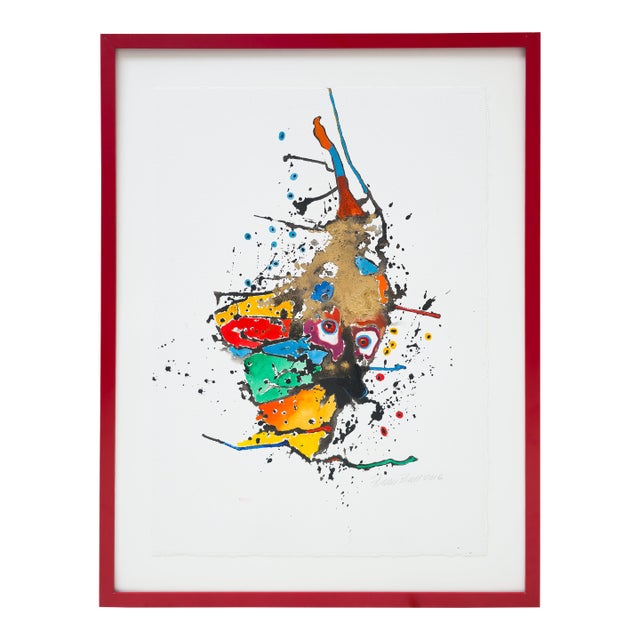
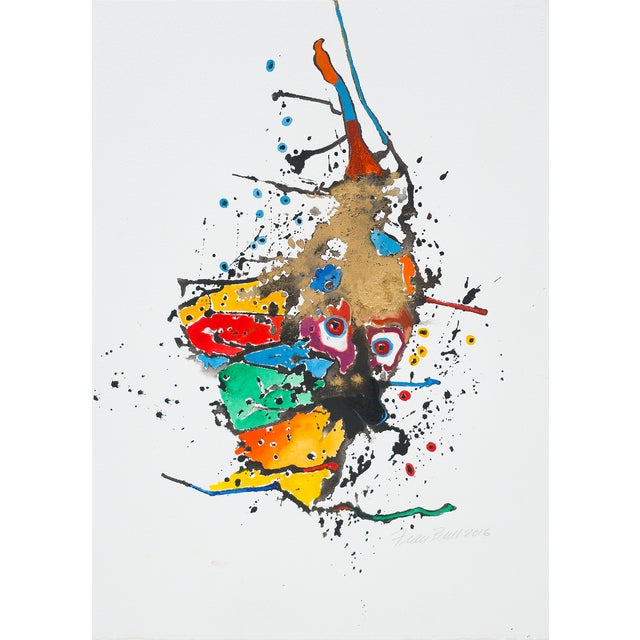
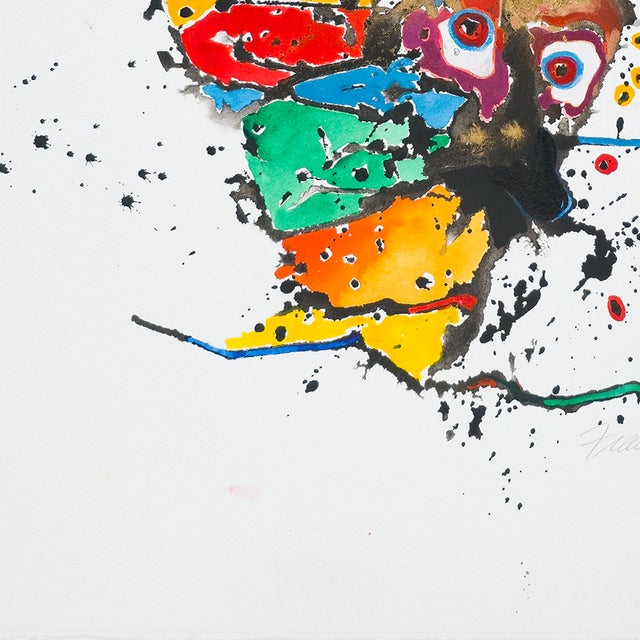
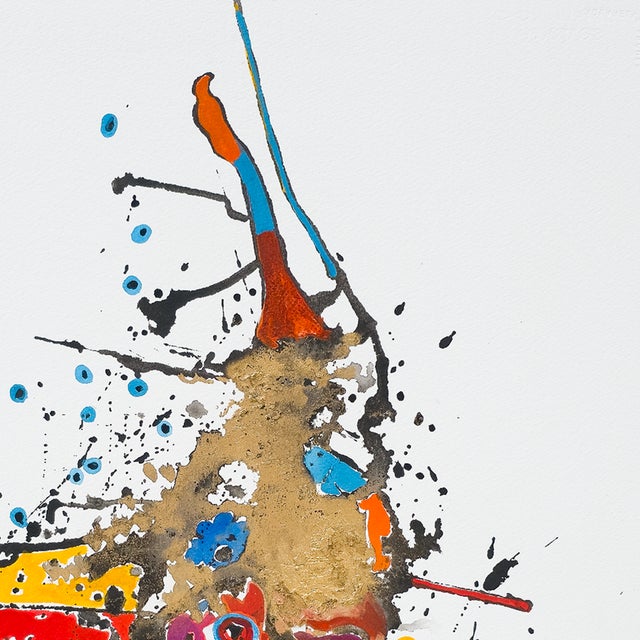
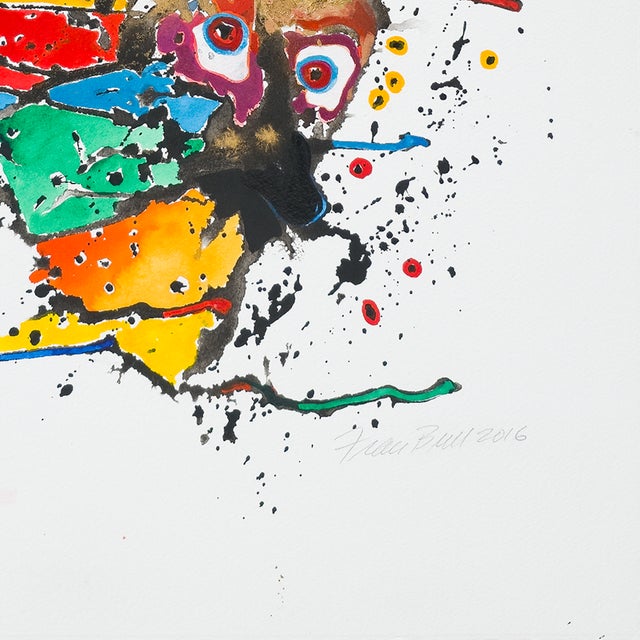
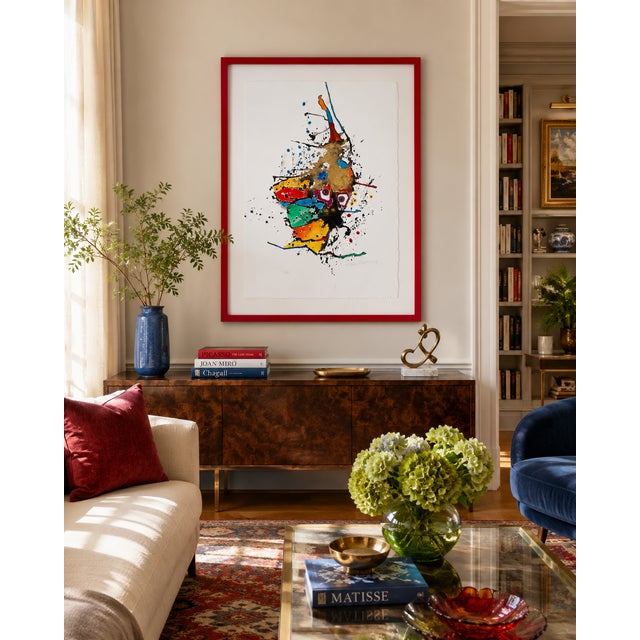
The piece features an abstracted face of Pulcinella, anchored by the character’s traditional black mask. The mask cuts through the composition with force, creating a dark center around which the surrounding colors gather, rupture, and rearrange themselves. Red and blue eyes stare outward at the viewer, giving the figure a strange psychological charge. These eyes are comical in their exaggeration, yet they are also alert and knowing. Pulcinella does not merely perform for us; he watches us watching him.
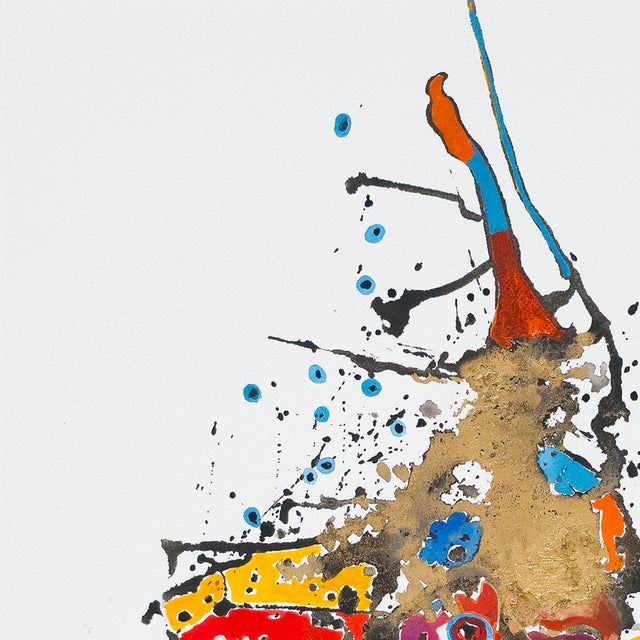
Bull constructs the face through bold, color-blocked sections of yellow, red, turquoise, green, orange, brown, and blue. These forms do not create a smooth or naturalistic portrait. Instead, they operate like fragments of costume, mask, and personality pressed into one unstable being. The elongated vertical passage rising from the top of the head suggests the character’s traditional hat, while the surrounding splatters and drawn lines give the figure a sense of sudden motion, as though he has been thrown into existence by the force of performance itself.
The white space surrounding the figure is essential to the work’s impact. Against this open field, Pulcinella appears suspended and theatrically lit. The paper becomes a stage, and every mark becomes part of the performance. Black splatters radiate outward like comic violence, while small colored dots in blue, red, yellow, and green add a playful visual rhythm. These dots give the composition a sense of celebration, but also instability, as if the character is surrounded by confetti, debris, or the residue of some explosive entrance.
Bull’s handling of abstraction allows Pulcinella to remain recognizable without becoming literal. The image gives us enough to locate the mask, the eyes, the hat, and the profile-like structure of the face, but it never settles into illustration. Instead, the figure stays in flux. He is part clown, part mask, part soul, and part painted eruption. This instability mirrors the nature of Pulcinella himself, a character who often shifts between fool and survivor, servant and manipulator, victim and trickster.
The Yeats reference deepens this reading. In Sailing to Byzantium, the soul seeks a form that might outlast the body’s decay. Bull’s Pulcinella complicates that ambition. He is bodily, ridiculous, and socially grounded, yet he is also transformed through art into something enduring. The mask becomes a vessel for survival. The comic figure becomes a site of spiritual animation. The lowly character is elevated, not by being purified of his absurdity, but by having that absurdity made radiant.
What makes the Soul, Clap Hands, and Sing series unique is how sharply it diverges from the series that came before and after it. It sits like the middle layer of a three-tiered abstract birthday cake, pressed between the Sophia and Tar Pits series, which share more recognizable motifs with one another. Here, Bull gives us something distinct, vibrant, and refreshingly theatrical: an abstract expressionist work filtered through humor, performance, literary reference, and symbolic disguise.
Soul, Clap Hands, and Sing: Pulcinella is ultimately a work about the strange dignity of performance. Bull takes a comic figure from the bottom of the social order and gives him visual intensity, spiritual resonance, and theatrical authority. Pulcinella stares back with full awareness, as if he knows the joke, the tragedy, and the audience all at once. In Bull’s hands, he becomes both fool and philosopher, mask and soul, a fractured performer clapping his hands and singing from the middle of life’s absurd party.
-Jonathan Flike
About the Artist
Fran Bull is an American artist whose career moves restlessly across painting, drawing, printmaking, sculpture, performance, and installation. Originally associated with the Photorealist movement of the 1970s and 1980s, Bull gradually pushed beyond realism toward a more personal and psychologically charged visual language. Her work often exists between figuration and abstraction, using the body, myth, theatricality, and distortion as tools for exploring consciousness, memory, fear, beauty, and transformation.
Bull studied Music and Art at Bennington College and later earned a master’s degree in Art and Art Education from New York University. Her early Photorealist work was shown through Louis K. Meisel Gallery, placing her within one of the central gallery contexts for American Photorealism. Over time, however, Bull’s practice became increasingly experimental. Her ink drawings, prints, sculptural forms, and mixed-media works reveal an artist less interested in reproducing the visible world than in exposing the unstable forces beneath it.
This evolution is central to Bull’s importance. In her later work, faces fracture, bodies become theatrical vessels, and forms seem to emerge from dream, satire, ritual, and unconscious thought. Her imagery can be grotesque, humorous, spiritual, and deeply human all at once. Whether working in ink, etching, paint, or sculpture, Bull treats art as a means of passage between worlds: the seen and unseen, the ordinary and mythic, the personal and collective.
Bull has exhibited in the United States and Europe, with works connected to major phases of American Photorealism, expressionist abstraction, printmaking, and installation. For Visard, her work represents the power of artistic reinvention: a career not defined by a single style, but by an ongoing search for a freer, stranger, and more expansive visual truth.
Underrepresented Artist Information
Like many women artists of her generation, Fran Bull’s career reflects both achievement and uneven recognition within the larger art historical record. Although Bull was connected to significant artistic movements and exhibited widely across multiple decades, her work remains less visible than that of many male contemporaries who moved through similar circles of realism, abstraction, and experimental image-making.
This underrepresentation is especially important because Bull’s career resists easy categorization. She was not simply a Photorealist, nor solely an expressionist, printmaker, sculptor, or performance-based artist. Her practice evolved across mediums with intellectual restlessness and emotional force, making her body of work harder to flatten into a single market-friendly label. Visard recognizes Bull as an artist whose breadth, reinvention, and psychological depth deserve fuller documentation and continued attention.
See less
- Dimensions
- 27.5ʺW × 1ʺD × 36.25ʺH
- Frame Type
- Framed
- Period
- 2010s
- Country of Origin
- United States
- Item Type
- Vintage, Antique or Pre-owned
- Materials
- Acrylic Paint
- Condition
- Good Condition, Original Condition Unaltered, Some Imperfections
- Color
- Red
- Condition Notes
- Please note that this item is vintage and shows wear consistent with age, use, and history. Signs of wear may … morePlease note that this item is vintage and shows wear consistent with age, use, and history. Signs of wear may include, but are not limited to, minor surface marks, patina, fading, or imperfections typical of older items. Measurements are approximate. We do our best to describe items accurately; however, condition assessments are subjective. If you would like additional details, images, or clarification before purchasing, please contact us. less
Questions about the item?
Returns & Cancellations
Return Policy - All sales are final 48 hours after delivery, unless otherwise specified in the description of the product.
Cancellation Policy - Prior to shipping or local pickup, buyers may cancel an order for up to 48 hours, unless otherwise specified.
Related Collections
- Photorealism Canvas Paintings
- Photorealism Paintings in New York
- Ed Ruscha Paintings
- Richard Serra Paintings
- Herman Miller Paintings
- Jo Baskerville Paintings
- Louise Nevelson Paintings
- Karen Offutt Paintings
- Nicola Simbari Paintings
- BDDW Paintings
- James McCray Paintings
- Leroy Neiman Paintings
- Jaanika Peerna Paintings
- Black Photorealism Paintings
- Johannes Andersen Paintings
- Pedro Friedeberg Paintings
- Peter Behrens Paintings
- Piet Hein Eek Paintings
- Raphael Paintings
- Vienna Secession Paintings
- Jeff Slemmons Paintings
- Gold-filled Paintings
- Photorealism Paintings in Los Angeles
- Carl-Axel Acking Paintings
- Karl-Erik Ekselius Paintings