


Details
Description
Profile of an Abstracted Adonis*
Robert Lohman, c. 1969
Robert Lohman’s Profile of an Abstracted Adonis, dated 1969, is a …
Read more
Profile of an Abstracted Adonis*
Robert Lohman, c. 1969
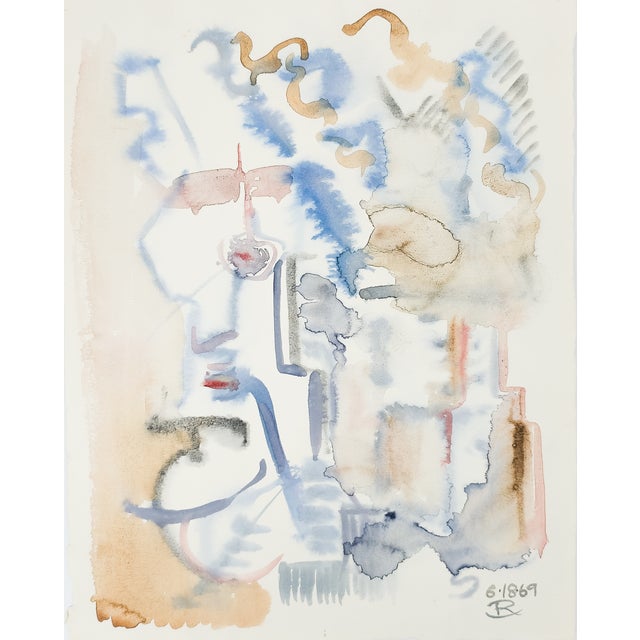
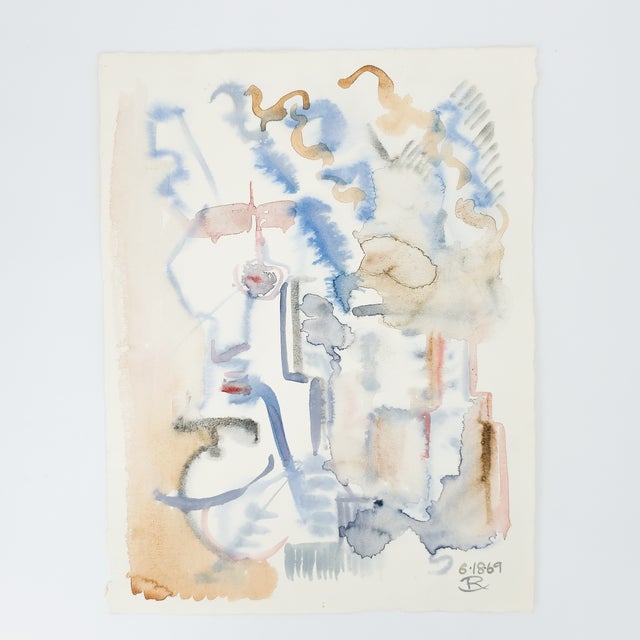
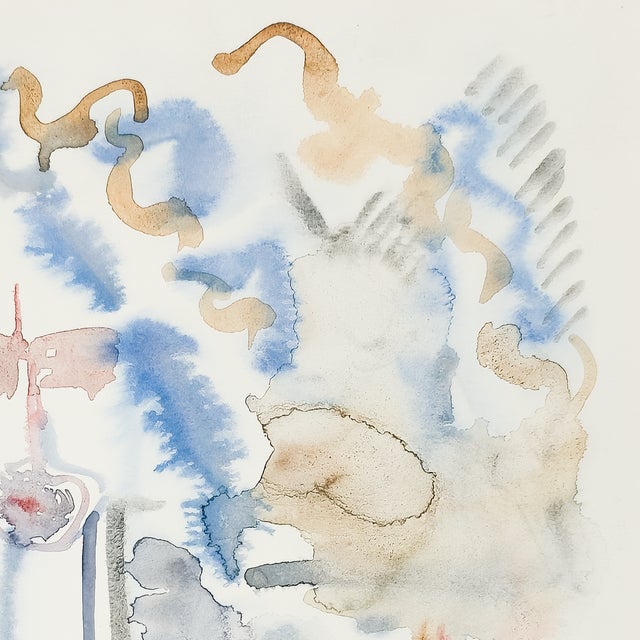
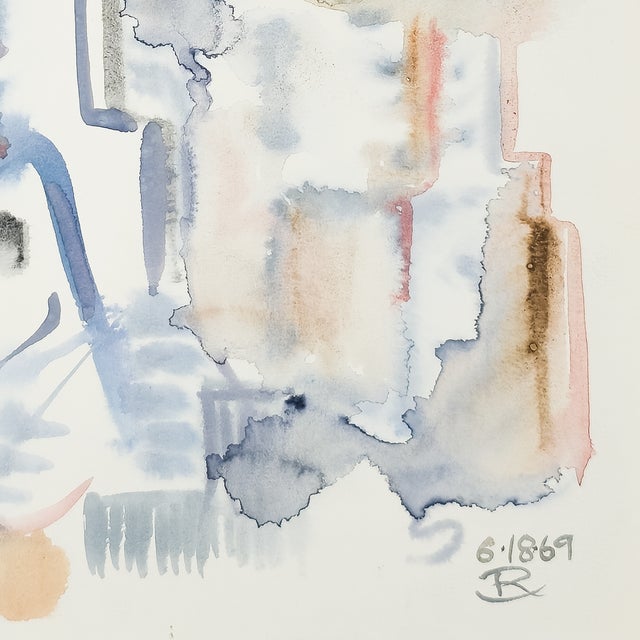
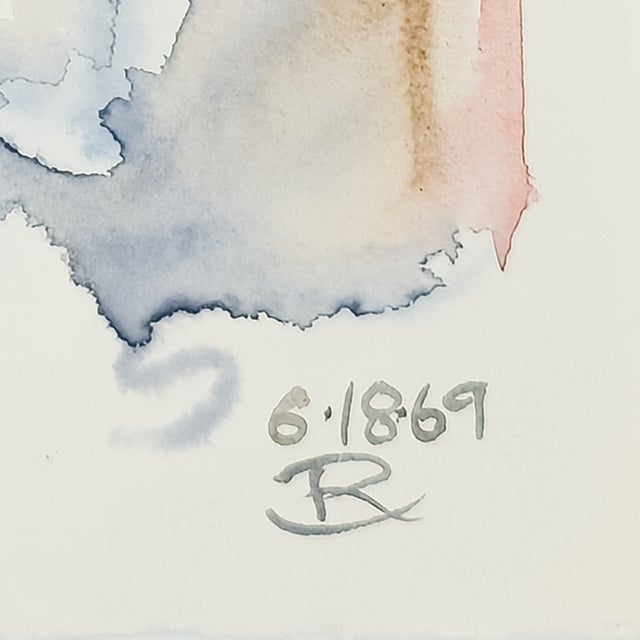
Robert Lohman’s Profile of an Abstracted Adonis, dated 1969, is a watercolor that asks the viewer to assemble the figure gradually from scattered signs of face, hair, ornament, and contour. At first, the work appears almost entirely abstract: a field of blue, tan, gray, and red washes arranged in vertical passages and soft-edged forms. With closer looking, however, a male profile begins to emerge. Lohman has not painted the figure through direct portraiture, but through a system of visual clues that gather into the image of a head turned to the left.
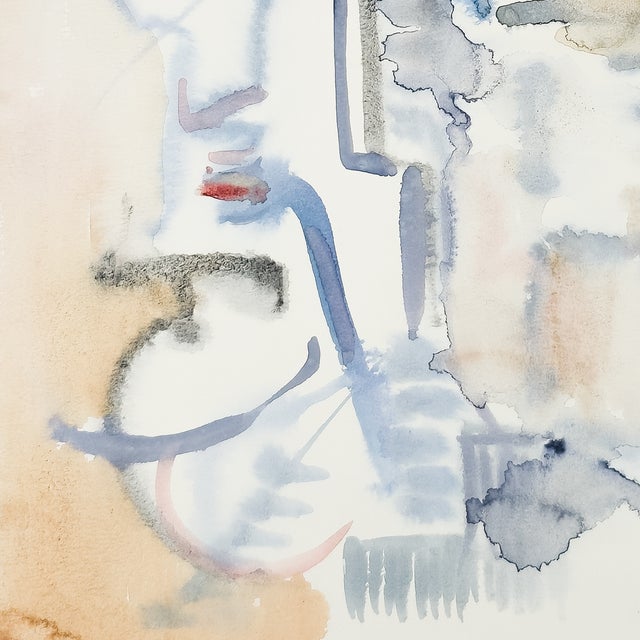
The left side of the composition is key to understanding the work. The pale blue wash along the left edge forms the forward portion of the head, especially the hairline and forehead. The face itself is suggested in profile rather than fully described. A pale open area becomes the facial plane, while the darker linear elements near the lower left help establish the nose, mouth, and the larger rounded chin toward the bottom. That rounded heroic chin is one of the most important anchors of the image. It gives the otherwise fluid figure a bodily presence and helps the viewer understand the orientation of the profile.
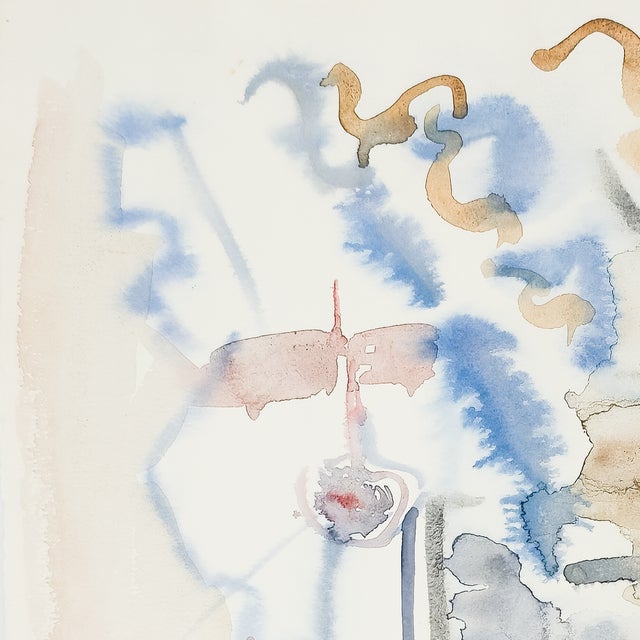
The red horizontal streak near the center reads as a headband, cutting across the head and giving the figure a classical or mythic suggestion. Rather than presenting an academic male beauty, Lohman gives us a fragmented modernist version of the idealized male profile: handsome, but only partially visible; classical in implication, but fully abstract in execution. The headband functions almost like a costume remnant, a small sign of heroic or decorative identity within the looseness of the watercolor.
The hair is distributed across the upper portion of the sheet in a particularly inventive way. The blue forms on the left establish the forehead and frontal hair mass, while the curling blue and orange passages across the top and upper right read as more expansive hair. These curling forms give the figure movement and elegance. They also prevent the profile from feeling flat. The head seems to extend into the surrounding space, with hair becoming both anatomy and ornament.
Color carries much of the work’s structure. The blues create the head, shadow, and surrounding atmosphere. The warm tan and ochre washes provide counterbalance, especially along the left and right edges, where they frame the cooler blue passages. The small red accents are used sparingly but decisively. The red headband and vertical red marks give the composition a sharper human reference, allowing the viewer to locate the body within what might otherwise read as a purely atmospheric abstraction.
Lohman’s handling of watercolor is loose but purposeful. Pigment is allowed to bloom, feather, and spread across the paper, creating forms that feel discovered rather than tightly engineered. The marks are not polished into conventional likeness. Instead, Lohman lets the profile hover between portrait and abstraction. This gives the work its particular charm: the face is there, but it must be found.
There is also a quiet sculptural quality in the way the head is built. Lohman was trained as both a painter and sculptor, and that sensibility appears here in the way forms are stacked, curved, and balanced. The profile is not drawn as a continuous outline. It is assembled through masses: blue for the forehead and hair, pale wash for the facial plane, darker marks for the lower profile, red for the headband, and curling ochre-blue forms for the hair at the top. The image functions almost like a sculptural relief made from watercolor.
Profile of an Abstracted Adonis is a refined example of Lohman’s ability to keep figuration alive inside abstraction. The work does not hand the image to the viewer immediately. It reveals itself through recognition. Once the male profile becomes visible, the surrounding marks begin to feel intentional. Lohman turns the act of looking into part of the subject. The viewer does not simply see Adonis; the viewer pieces him together.
-Jonathan Flike
*The title of this work was assigned by Visard Gallery.
About the Artist
Robert Lohman was an American artist associated with Indiana modernism, recognized as both a sculptor and painter. The National Gallery of Art identifies Lohman as an American artist, 1919–2001, and holds examples of his 1966 bronze medallic work created with the Medallic Art Company in its collection.
Lohman worked across a wide range of media, including watercolor, oil, wood, plaster, ceramics, and bronze. Biographical sources identify him as a portrait and figure sculptor as well as a painter, with formal study at the John Herron Art Institute, Cranbrook, and Yale. He assisted the noted sculptor Carl Milles at Cranbrook Academy and later served as Director of Fine Arts at Cranbrook from 1947 to 1949. Lohman also taught at Washington University in St. Louis and the Indianapolis Art League, where he remained connected to art education and regional modernist practice.
His work often moves between figuration and abstraction, reflecting the eye of a sculptor and the freedom of a modernist draftsman.
Underrepresented Artist Information
Robert Lohman may also be understood within the broader history of underrepresented LGBT artists in the American Midwest. Documentary records connect him closely with Jerrol T. Davis of Indianapolis, who served as Secretary-Treasurer of Robert Lohman, Inc.; Davis’s obituary confirms his role in Lohman’s company, and later memorial sources identify him as Lohman’s spouse. While historical records from this period often leave same-sex relationships only partially documented, the available evidence points to a significant personal and professional partnership that adds important context to Lohman’s life and legacy.
See less
- Dimensions
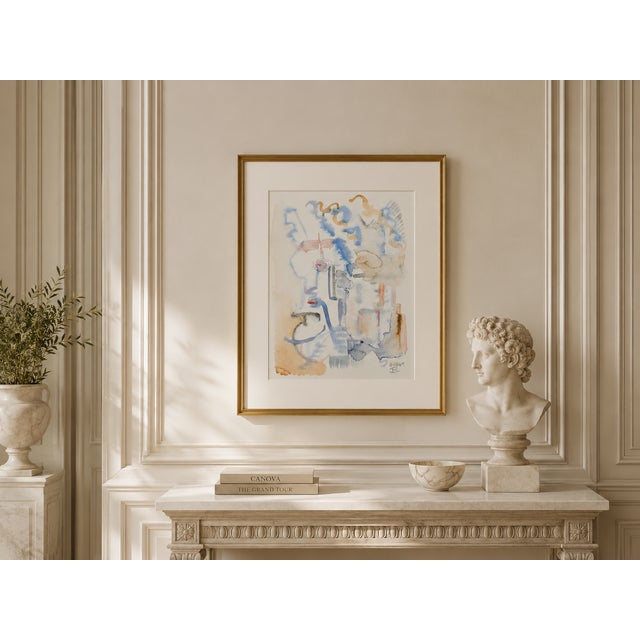
- 9.5ʺW × 0.1ʺD × 12.5ʺH
- Frame Type
- Unframed
- Period
- 1960s
- Country of Origin
- United States
- Item Type
- Vintage, Antique or Pre-owned
- Materials
- Watercolor
- Condition
- Good Condition, Original Condition Unaltered, Some Imperfections
- Color
- Blue
- Condition Notes
- Please note that this item is vintage and shows wear consistent with age, use, and history. Signs of wear may … morePlease note that this item is vintage and shows wear consistent with age, use, and history. Signs of wear may include, but are not limited to, minor surface marks, patina, fading, or imperfections typical of older items. All items are sold as-is, which is standard with vintage and pre-owned goods and cannot be returned on the basis of condition. Measurements are approximate. We do our best to describe items accurately; however, condition assessments are subjective. If you would like additional details, images, or clarification before purchasing, please contact us. less
Questions about the item?
Returns & Cancellations
Return Policy - All sales are final 48 hours after delivery, unless otherwise specified in the description of the product.
Cancellation Policy - Prior to shipping or local pickup, buyers may cancel an order for up to 48 hours, unless otherwise specified.
Related Collections
- Ralph Lauren Paintings
- Ed Ruscha Paintings
- Photorealism Canvas Paintings
- Photorealism Paintings in New York
- Silk Velvet Paintings
- Herman Miller Paintings
- Louise Nevelson Paintings
- Richard Serra Paintings
- Jaanika Peerna Paintings
- Jo Baskerville Paintings
- Jean-Paul Barray Paintings
- Hans Andersen Paintings
- Johannes Andersen Paintings
- Peter Behrens Paintings
- Raphael Paintings
- Photorealism Paintings in Los Angeles
- Carl-Axel Acking Paintings
- Joseph Stella Paintings
- Karl-Erik Ekselius Paintings
- Pedro Friedeberg Paintings
- Piet Hein Eek Paintings
- Black Photorealism Paintings
- Cassina Paintings
- BDDW Paintings
- Lee Reynolds Paintings