

Details
Description
Abstract Musician*
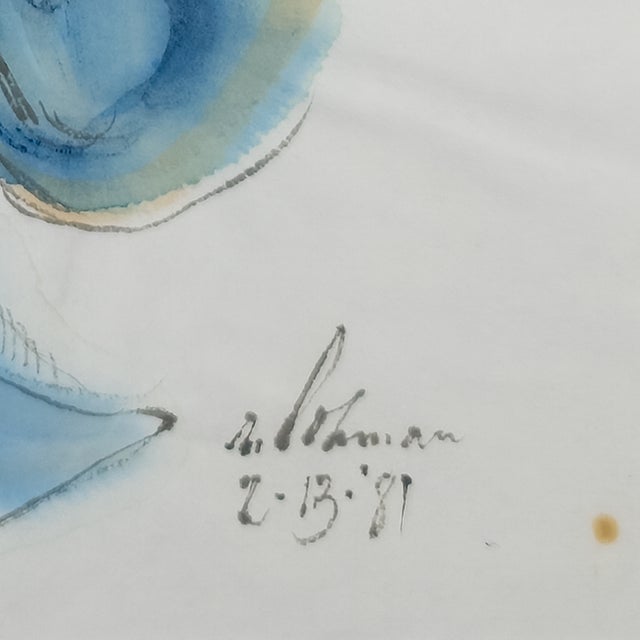
Robert Lohman, c. 1981
Robert Lohman’s Abstract Musician, presents the figure not as a stable anatomical subject, but …
Read more
Abstract Musician*
Robert Lohman, c. 1981
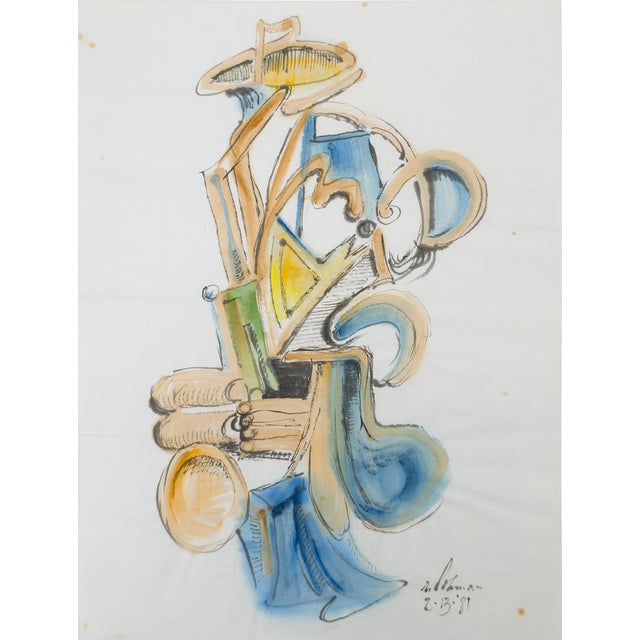
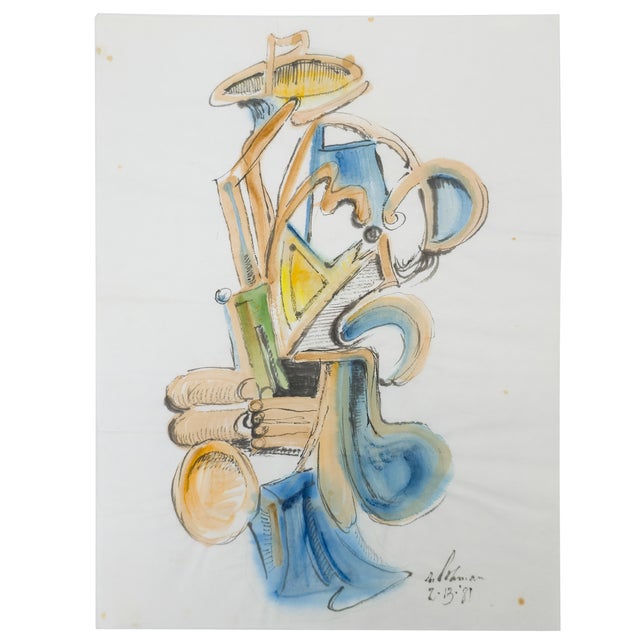
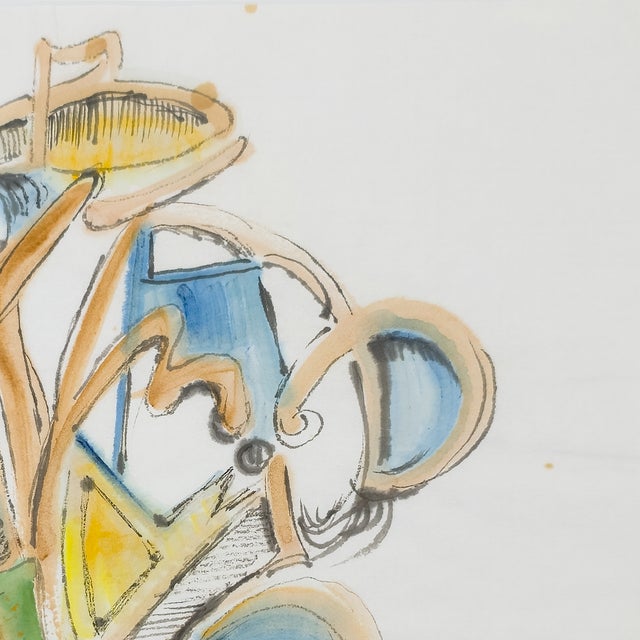
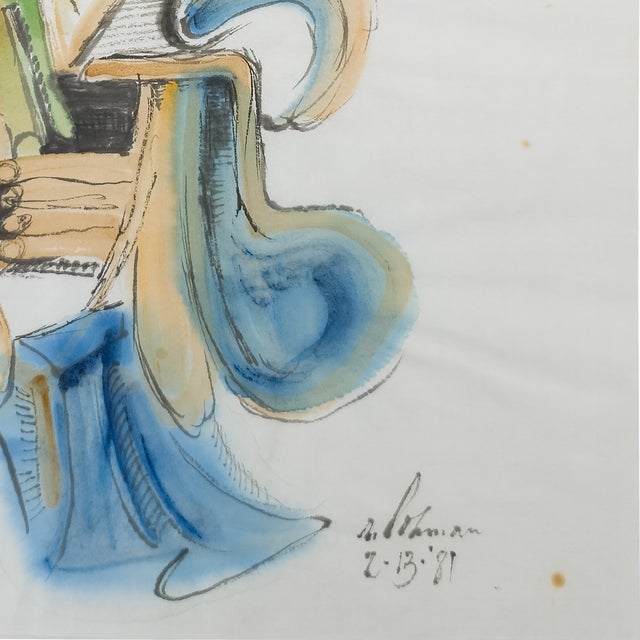
Robert Lohman’s Abstract Musician, presents the figure not as a stable anatomical subject, but as a dynamic assemblage of rhythm, instrument, gesture, and bodily implication. The work is executed in watercolor with drawn media, allowing Lohman to move between fluid chromatic washes and incisive linear articulation. The musician is not described through conventional portraiture. Instead, the body is reconstructed through signs of performance: curved limbs, horn-like forms, striated passages suggesting strings or vibration, and blue tonal fields that read alternately as clothing, instrument, shadow, or sonic atmosphere.
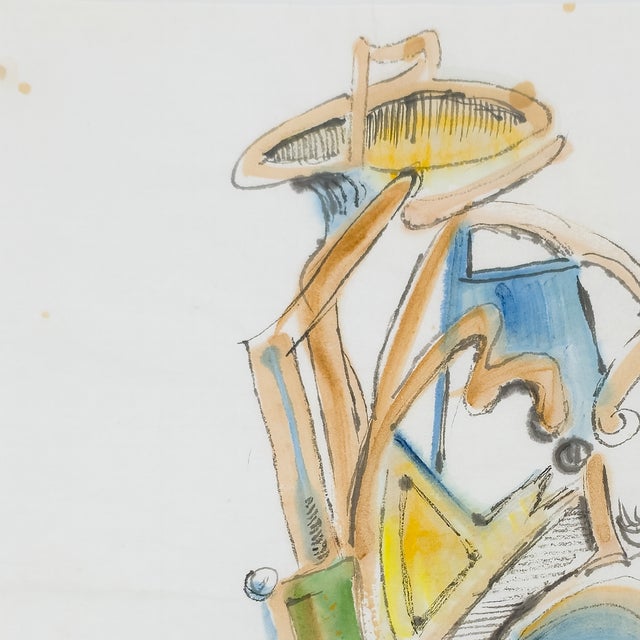
The composition is vertically organized, almost totemic in its rise from the lower blue forms to the tilted hat at the top. This upward movement gives the image a sculptural presence, as though the figure has been stacked, bent, and assembled from fragments of music itself. The musician’s anatomy is deliberately unstable. Arms become diagonals; hands become rhythmic clusters; instruments become bodily extensions. This instability is not casual distortion, but the central intelligence of the work. Lohman treats music as a physical event: something that bends posture, reorganizes space, and temporarily dissolves the boundary between performer and instrument.
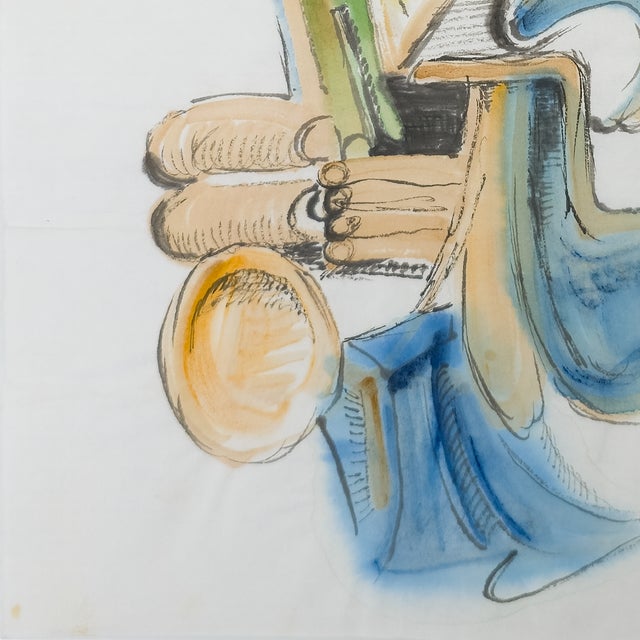
Color operates with a carefully limited but expressive vocabulary. Ochres, yellows, pale greens, and saturated blues are set against an open white ground. The white space is not empty; it creates an acoustic space, allowing the figure’s fragmented forms to resonate. The blues give the work its deepest emotional register. They pool in the lower right and central passages, providing weight and coolness against the warmer ochre linear structure. Yellow accents, especially near the central triangular form, introduce flashes of syncopation, almost like visual notes struck within the composition.
Lohman’s line is searching and highly constructive. Rather than enclosing forms neatly, it probes them. The graphite or ink marks scratch, hatch, curve, and double back, creating a sense of immediacy while also revealing a disciplined command of structure. The drawing has the quality of improvisation, but not randomness. It feels closer to jazz: a composition built from variation, interruption, repetition, and return. The lines around the hands, horn-like forms, and hat produce a kind of visual percussion, while the broader watercolor washes sustain the slower tonal atmosphere.
The work also reflects Lohman’s broader sculptural sensibility. Lohman was known as a portrait and figure sculptor as well as a painter, working across media including wood, plaster, oil, watercolor, ceramics, and bronze. His training included the John Herron Art Institute, Cranbrook, and Yale, and he assisted Carl Milles at Cranbrook before later serving as Director of Fine Arts there from 1947 to 1949. That background matters here because Abstract Musician does not behave like a purely pictorial abstraction. It feels modeled, bent, and constructed. The forms have mass even when they are only suggested by transparent washes. The figure reads almost like a sculptural armature translated into watercolor.
The date of 1981 is significant. By the late 1970s, artists working outside the dominant commercial centers often developed highly personal forms of modernism, absorbing abstraction, surrealism, figural distortion, and expressive drawing without submitting entirely to any single movement. Lohman’s work here feels aligned with that independent modernist space. It is playful, but not slight. It uses humor and exaggeration, but the formal intelligence is serious. The musician appears almost comic at first glance, yet the longer one looks, the more the image reveals a sophisticated understanding of balance, displacement, and compositional tension.
As a whole, Abstract Musician is a compelling example of Lohman’s ability to fuse figural subject matter with abstract structure. Its strength lies in its refusal to separate performer from performance. The musician is not simply holding an instrument; he is becoming one. The work’s vitality comes from that transformation. Line becomes sound, color becomes atmosphere, and the figure becomes a living construction of rhythm.
-Jonathan Flike
*The title of this work was assigned by Visard Gallery.
About the Artist
Robert Lohman was an American artist associated with Indiana modernism, recognized as both a sculptor and painter. The National Gallery of Art identifies Lohman as an American artist, 1919–2001, and holds examples of his 1966 bronze medallic work created with the Medallic Art Company in its collection.
Lohman worked across a wide range of media, including watercolor, oil, wood, plaster, ceramics, and bronze. Biographical sources identify him as a portrait and figure sculptor as well as a painter, with formal study at the John Herron Art Institute, Cranbrook, and Yale. He assisted the noted sculptor Carl Milles at Cranbrook Academy and later served as Director of Fine Arts at Cranbrook from 1947 to 1949. Lohman also taught at Washington University in St. Louis and the Indianapolis Art League, where he remained connected to art education and regional modernist practice.
His work often moves between figuration and abstraction, reflecting the eye of a sculptor and the freedom of a modernist draftsman.
Underrepresented Artist Information
Robert Lohman may also be understood within the broader history of underrepresented LGBT artists in the American Midwest. Documentary records connect him closely with Jerrol T. Davis of Indianapolis, who served as Secretary-Treasurer of Robert Lohman, Inc.; Davis’s obituary confirms his role in Lohman’s company, and later memorial sources identify him as Lohman’s spouse. While historical records from this period often leave same-sex relationships only partially documented, the available evidence points to a significant personal and professional partnership that adds important context to Lohman’s life and legacy.
See less
- Dimensions
- 9ʺW × 0.1ʺD × 12ʺH
- Frame Type
- Unframed
- Period
- 1980s
- Country of Origin
- United States
- Item Type
- Vintage, Antique or Pre-owned
- Materials
- Watercolor
- Condition
- Good Condition, Original Condition Unaltered, Some Imperfections
- Color
- Blue
- Condition Notes
- Please note that this item is vintage and shows wear consistent with age, use, and history. Signs of wear may … morePlease note that this item is vintage and shows wear consistent with age, use, and history. Signs of wear may include, but are not limited to, minor surface marks, patina, fading, or imperfections typical of older items. All items are sold as-is, which is standard with vintage and pre-owned goods and cannot be returned on the basis of condition. Measurements are approximate. We do our best to describe items accurately; however, condition assessments are subjective. If you would like additional details, images, or clarification before purchasing, please contact us. less
Questions about the item?
Returns & Cancellations
Return Policy - All sales are final 48 hours after delivery, unless otherwise specified in the description of the product.
Cancellation Policy - Prior to shipping or local pickup, buyers may cancel an order for up to 48 hours, unless otherwise specified.
Related Collections
- Ed Ruscha Paintings
- Ralph Lauren Paintings
- Photorealism Canvas Paintings
- Photorealism Paintings in New York
- Louise Nevelson Paintings
- Silk Velvet Paintings
- Richard Serra Paintings
- Herman Miller Paintings
- BDDW Paintings
- Jo Baskerville Paintings
- Jean-Paul Barray Paintings
- Johannes Andersen Paintings
- Peter Behrens Paintings
- Karl-Erik Ekselius Paintings
- Carl-Axel Acking Paintings
- Joseph Stella Paintings
- Raphael Paintings
- Pedro Friedeberg Paintings
- Piet Hein Eek Paintings
- James McCray Paintings
- Lawson-Fenning Paintings
- Milton Avery Paintings
- Hans Andersen Paintings
- Cassina Paintings
- Photorealism Paintings in Los Angeles