

Details
Description
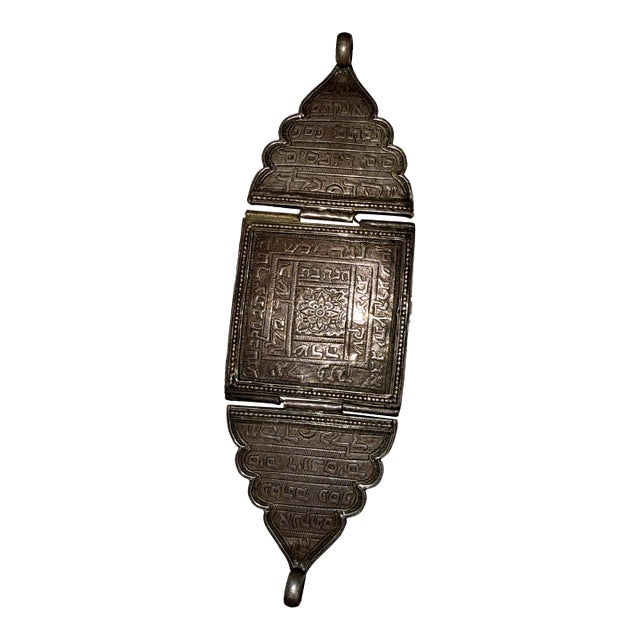
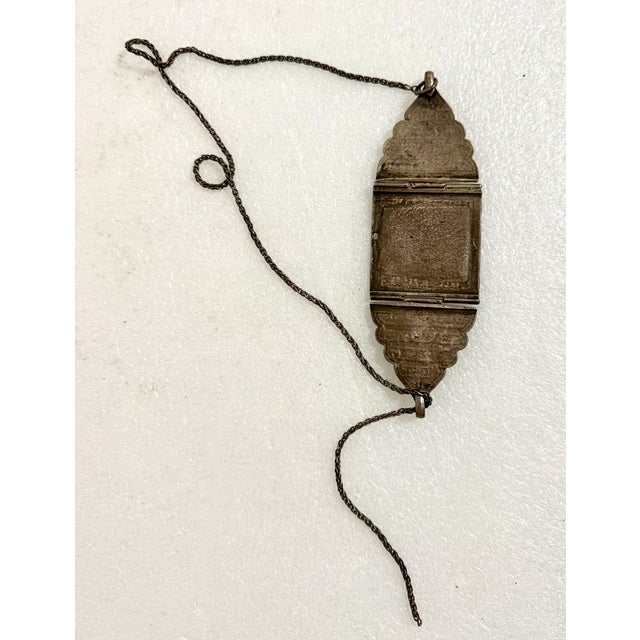
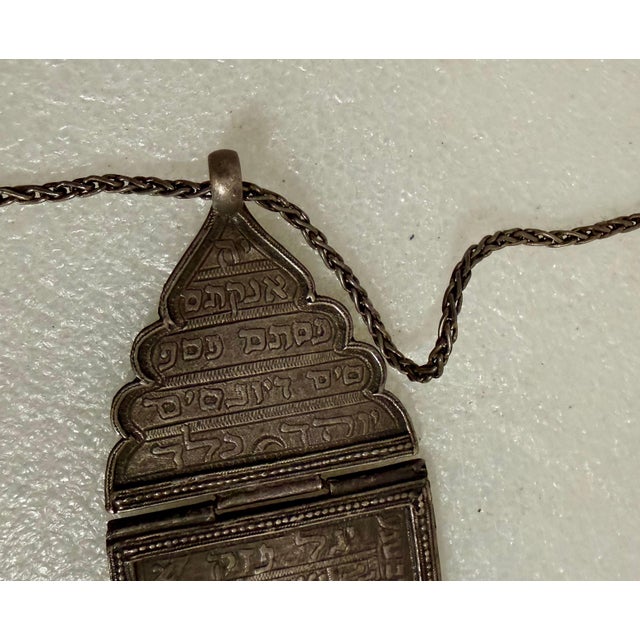
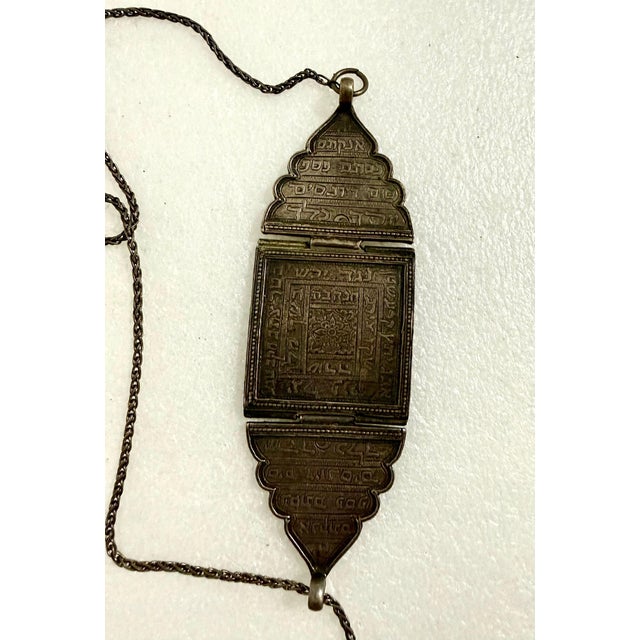
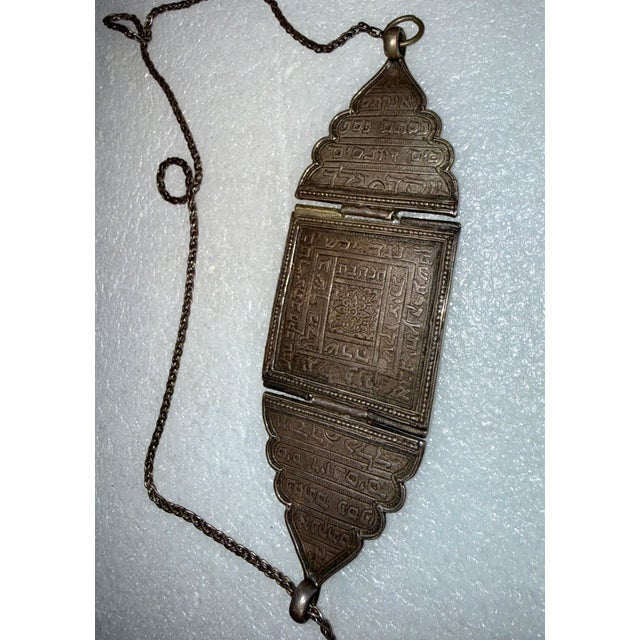
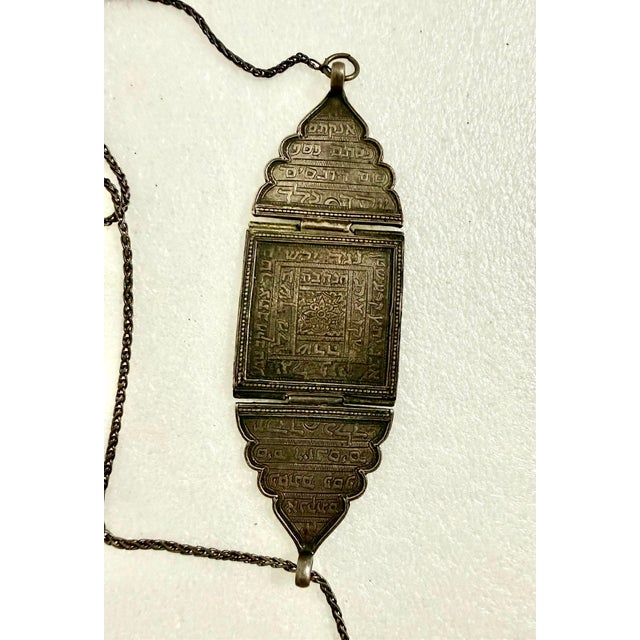
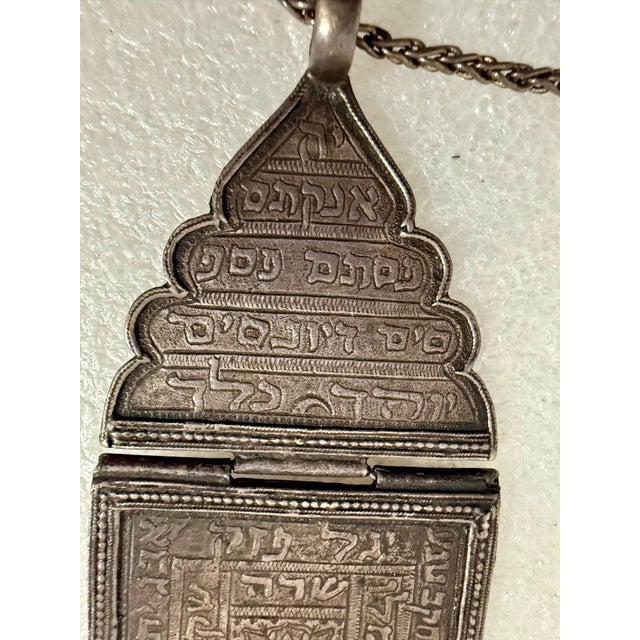
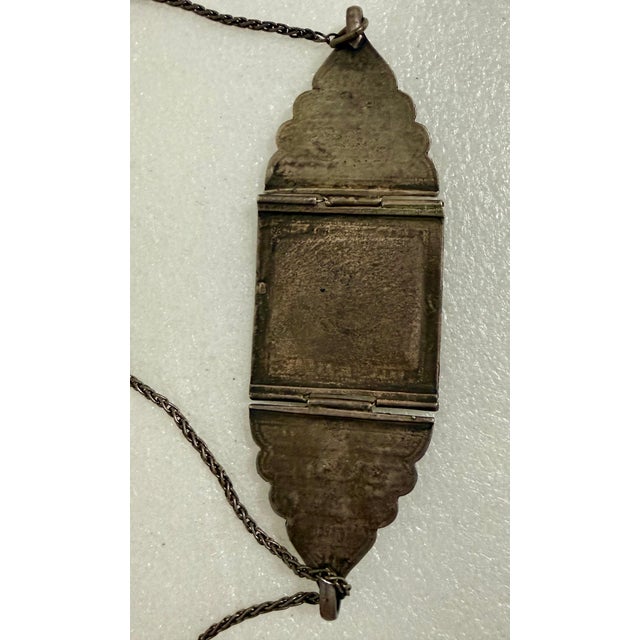
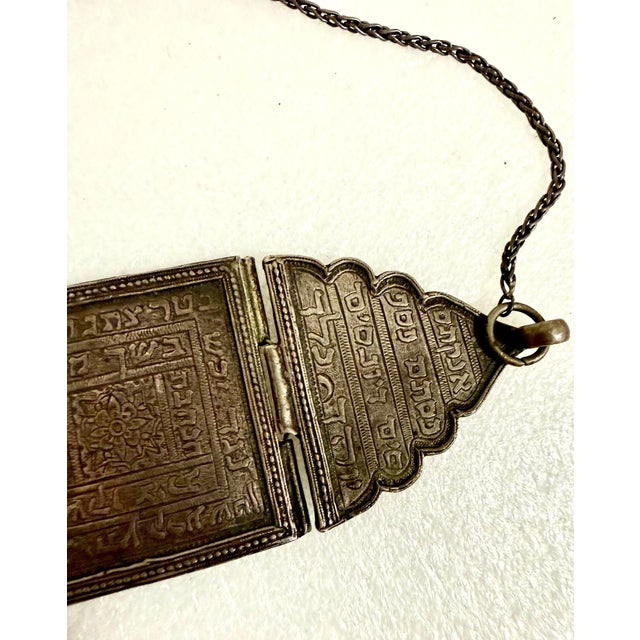
Antique Middle Eastern Judaic Birth Amulet Buckle with Kabbalistic Inscription. On woven silver chain.
Most likely from Iran, Persia, (possibly …
Read more
Antique Middle Eastern Judaic Birth Amulet Buckle with Kabbalistic Inscription. On woven silver chain.
Most likely from Iran, Persia, (possibly from Afghanistan or Bukharian Jews)
Circa l19th Century - early 20th Century.
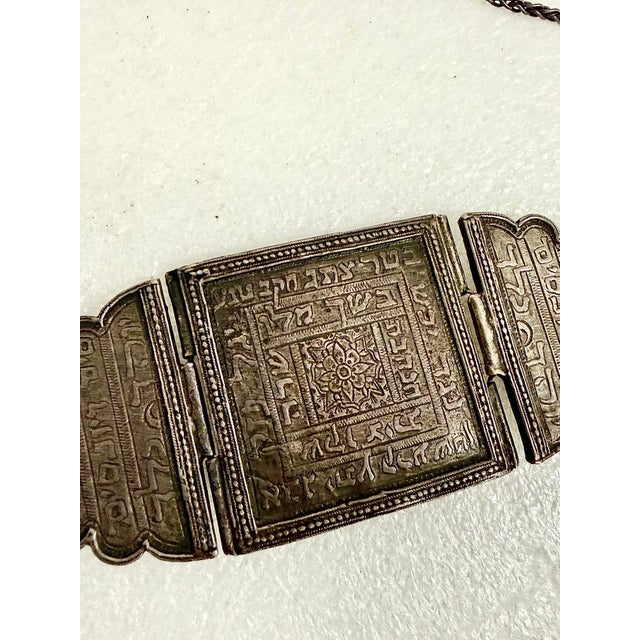
Three-part buckle amulet, protection for the mother and baby, Persia, 19th century.
Repousse engraved and welded silver.
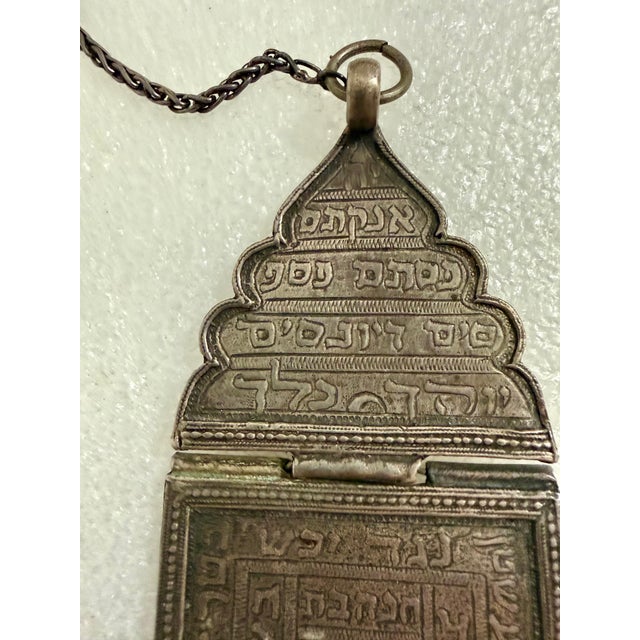
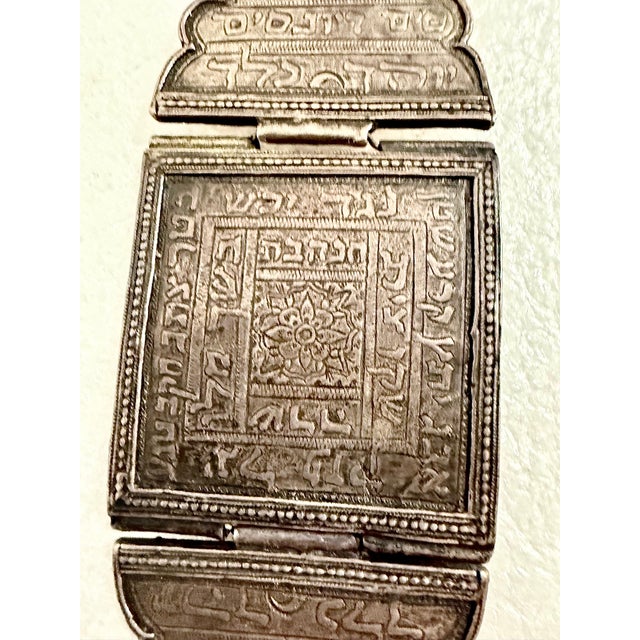
The buckle has three hinged parts: the middle section is square; the sides are designed as Persian gates. In the center: engraving of a flower. Around it is inscribed the name of the owner of the amulet: "Chana Bat Sara"{ (Hannah bas Sarah). Kabbalistic phrases and the names of protective angels are engraved around the flower.
For a similar object see: "Jewish Tradition in Art, the Feuchtwanger Collection of Judaica", by Dr. Isaiah Shachar. Item 931.
The inscriptions were generally those of multi letter “names” from the Kabbalistic library of inscriptions. The 42-letter name of God, derived from the first letters of the 42 words of the hymn “Anah Ba-Koach” are engraved on the amulets.
This is an antique Jewish silver amulet, likely from Persia or the Middle East, dating around the 19th century. These were folk art items and there are also Islamic ones of the same form with Arabic or Persian calligraphy inscriptions. These amulets were traditionally used for protection from an evil eye, blessing, or healing.
The design frequently includes hinged parts forming a house or gate shape, often engraved with Kabbalistic phrases, protective angels, or sacred texts. Jewish ceremonial art, also known as Judaica refers to an array of objects used by Jews for ritual purposes. Both for synagogue and for home, because enhancing a mitzvah by performing it with an especially beautiful object is considered a praiseworthy way of honoring God's commandments, Judaism has a long tradition of commissioning ritual objects from craftsmen and artists.
Judaism has a set of classical early rabbinic commentaries on the Hebrew Bible; these commentary collections are known as the midrash literature (Heb: midrashim). Midrash Mechilta has this teaching on a biblical verse:
"This is my God and I will glorify Him" (Exodus 15:2)
Is it possible for a human being to add glory to his Creator? What this really means is: I shall glorify God in the way that I perform commandments. I shall prepare a beautiful lulav, beautiful sukkah, beautiful fringes (tzitzit), and beautiful tefilin."
Other Midrash teachings (e.g. Song of Songs Rabbah 1.15) offer the same idea. This idea is expanded upon in the Babylonian Talmud (e.g. Tractate Bava Kama 9b). This teaching was understood by succeeding generations as a duty, when possible, to make beautiful items used in Jewish life and worship, both physical and textual
Kiddush cup: Kiddush, literally, "sanctification," is a blessing recited over wine or grape juice to sanctify the Shabbat and Jewish holidays. Kiddush cups are highly decorated, and are generally made of china, porcelain, silver, pewter and nickel. The close of the Jewish Shabbat is marked by the brief prayer ceremony of Havdalah, which usually takes place in the home. Part of the ceremony requires sniffing a sweet-smelling spice or plant. In Jewish communities around the Mediterranean, a sprig of a sweet-smelling shrub was customarily used, in Northern Europe by the twelfth century there are literary references of the use of a specially designed spice box or or spice tower container. The oldest surviving spice boxes for Havdalah date to the mid-sixteenth century. The Jewish Museum (New York) has a German example c. 1550 thought to originate in Frankfurt am Main. The menorah (or hanukkiah) used on the Jewish holiday of Hanukkah is perhaps the most widely produced article of Judaic ceremonial art. The Lindo lamp is a particularly fine example by an 18th-century silversmith. Contemporary Israel artists often design menorahs, such as the gold-plated brass menorah with 35 moveable branches designed by Israeli artist Yaacov Agam. A silver Chanukah menorah by Ze'ev Raban from the 1930s is in the Judaica Collection of the North Carolina Museum of Art.
To protect the ethrog during the Sukkot holiday, it is traditionally wrapped in silky flax fibers and stored in a special box, often made from silver. In modern times, the etrog is also commonly wrapped in synthetic netting, and placed in cardboard boxes. Wooden boxes are increasingly popular as well.
The tradition of artistically embellished haggadah, the Jewish Hebrew text that sets forth the order of the Passover Seder, dates back to the Middle Ages. The Sarajevo Haggadah of 1350 is a celebrated example. Major contemporary artists have produced notable haggadahs, such as the Arthur Szyk Hagadah. See also the facsimile edition of the even earlier Barcelona Haggadah of 1340.
Museums with notable collections of Jewish ceremonial art include the British Library, the Israel Museum, Jerusalem, as well as the Tel Aviv museum of art, the Jewish Museum (London), the Musée d'Art et d'Histoire du Judaïsme in Paris, the Jewish Museum in Prague, the North Carolina Museum of Art, the Jewish Museum (New York), the Musée Lorraine in Nancy, the Musée alsacien in Strasbourg and the Contemporary Jewish Museum of San Francisco. The Museum of Jewish Heritage in Battery City Park, New York City also holds a sizable collection. Another way to see good antique, rare, Judaica is through the art marketplace, There are many examples of Russian, German Polish, Austro Hungarian and Sephardic works available as well as contemporary Israeli and American. The leading auction houses. Sotheby's, Bonhams-New York, J. Greenstein, Skinner's and Kestenbaum's routinely hold regular auctions each year.
See less
Questions about the item?
Returns & Cancellations
Return Policy - All sales are final 48 hours after delivery, unless otherwise specified in the description of the product.
Cancellation Policy - Prior to shipping or local pickup, buyers may cancel an order for up to 48 hours, unless otherwise specified.
Related Collections
- Wenge Sculptural Wall Objects
- Ralph Lauren Sculptural Wall Objects
- Helmut Friedrich Schäffenacker Sculptural Wall Objects
- Byzantine Sculptural Wall Objects
- Stainless Steel Sculptural Wall Objects
- Medium-Density Fibreboard Sculptural Wall Objects
- Mid-Century Modern Sculptural Wall Objects
- Curtis Jere Sculptural Wall Objects
- Plaster Sculptural Wall Objects
- Brutalist Sculptural Wall Objects
- Asian Sculptural Wall Objects
- Greg Copeland Sculptural Wall Objects
- Japanese Sculptural Wall Objects
- Sarreid Ltd. Sculptural Wall Objects
- Silverplate Sculptural Wall Objects