

Details
Description
David Gerstein (Israeli, b. 1944)
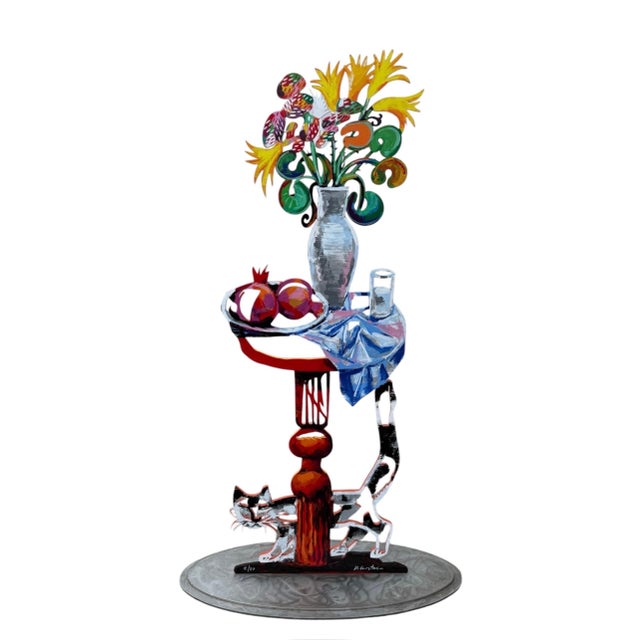
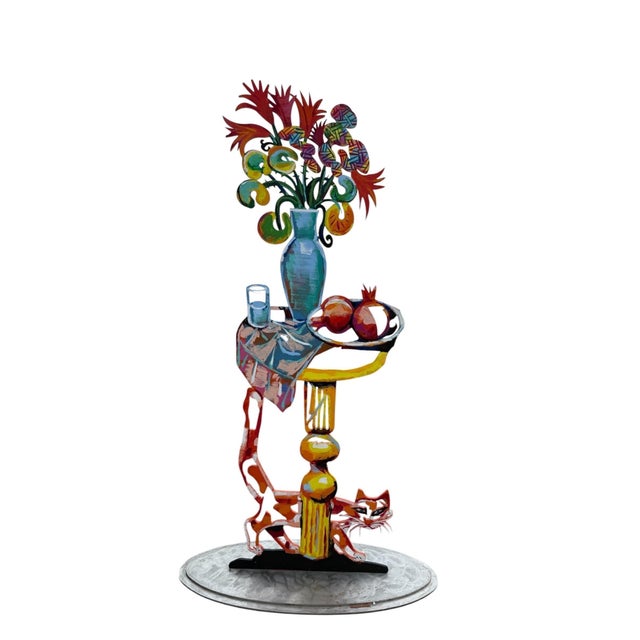
Large, heavy, painted sculpture.
From small edition of 20.
Not sure the exact weight
Painted …
Read more
David Gerstein (Israeli, b. 1944)
Large, heavy, painted sculpture.
From small edition of 20.
Not sure the exact weight
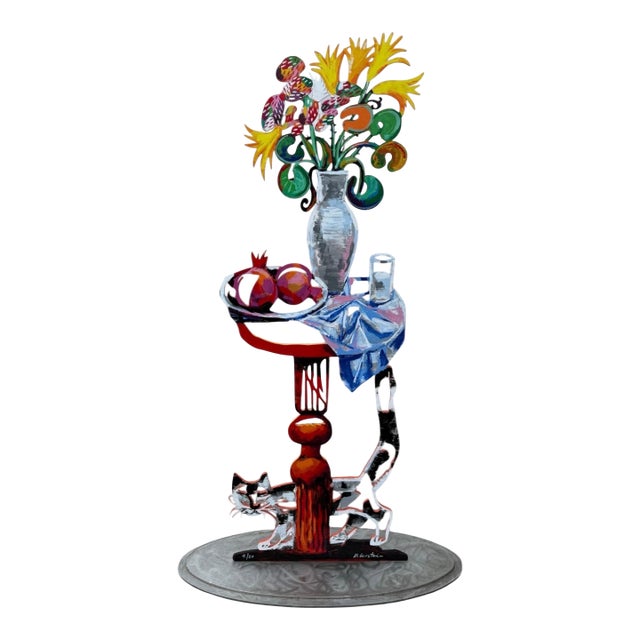
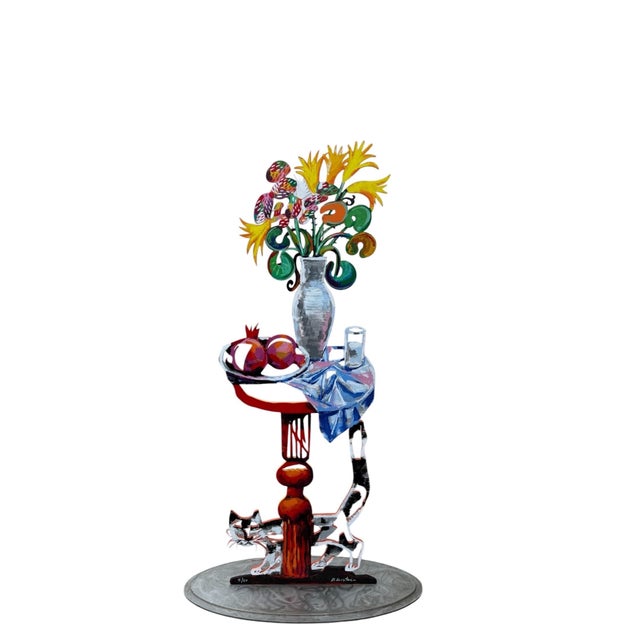
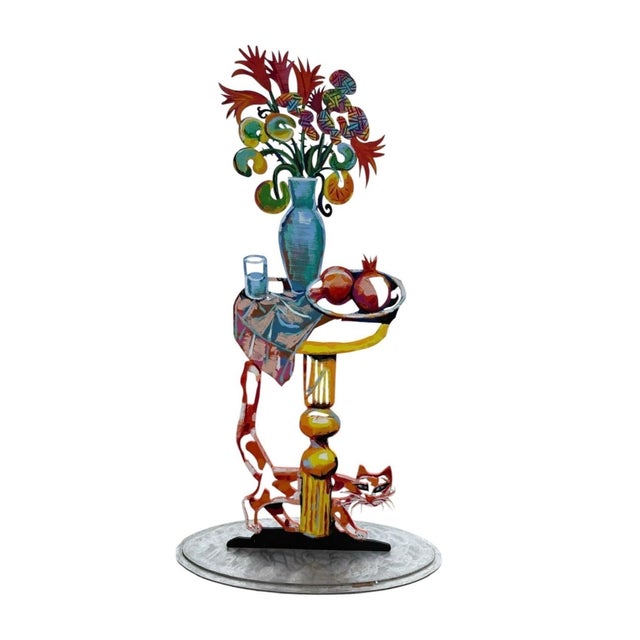
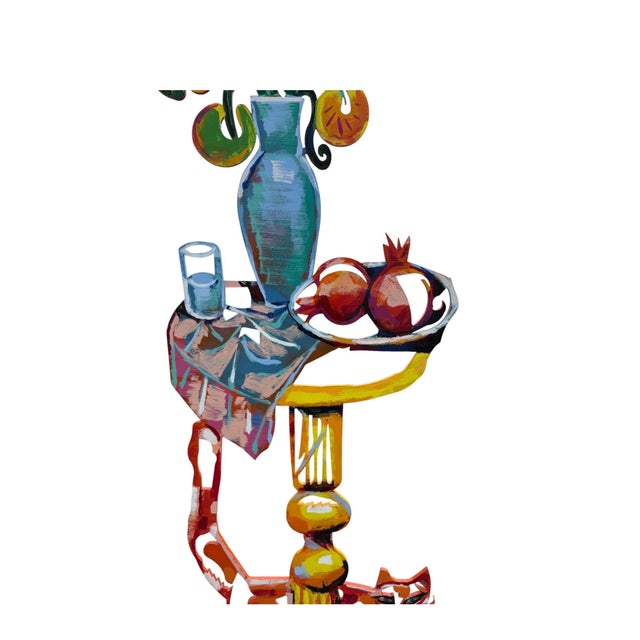
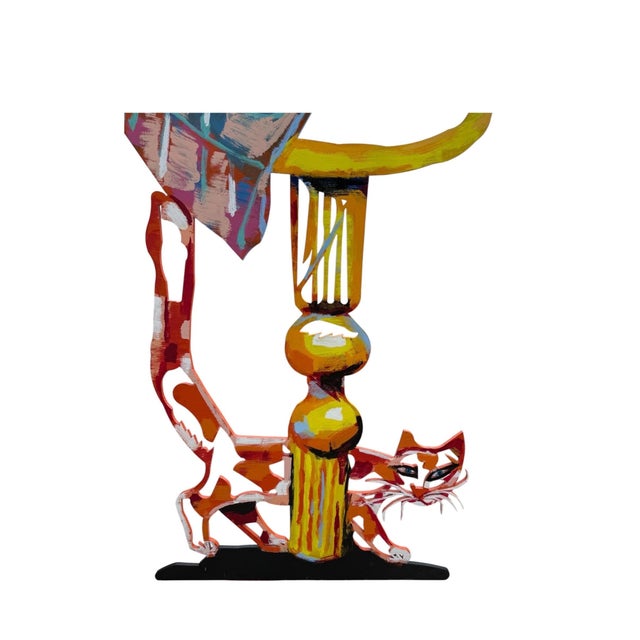
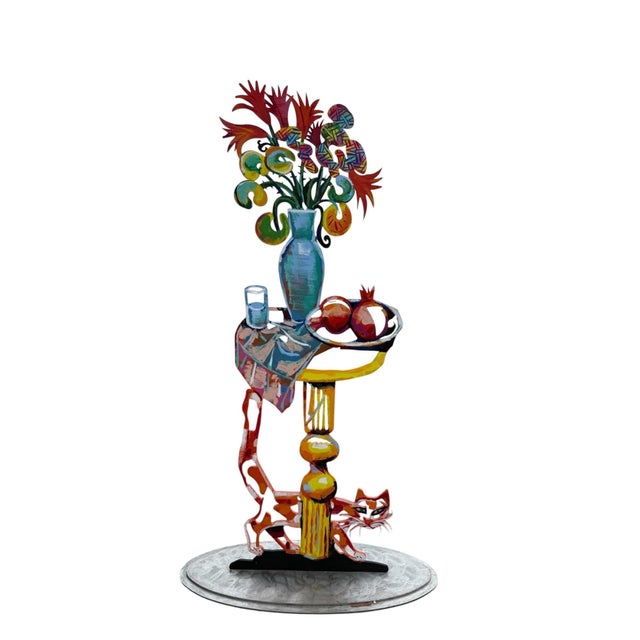
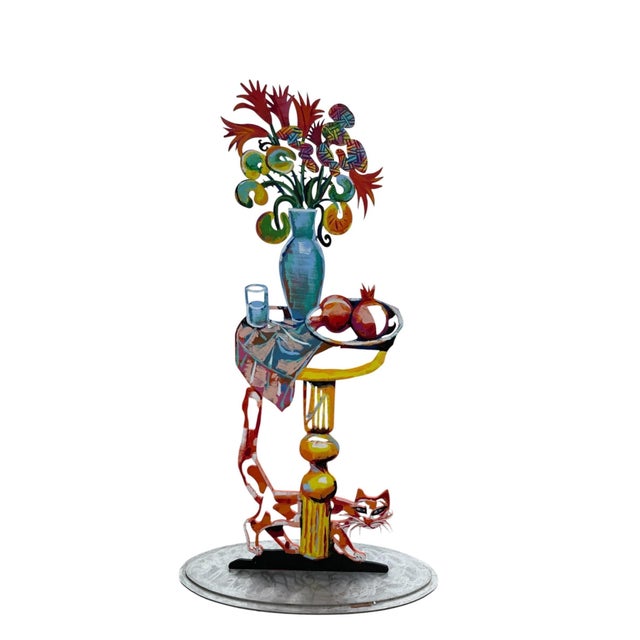
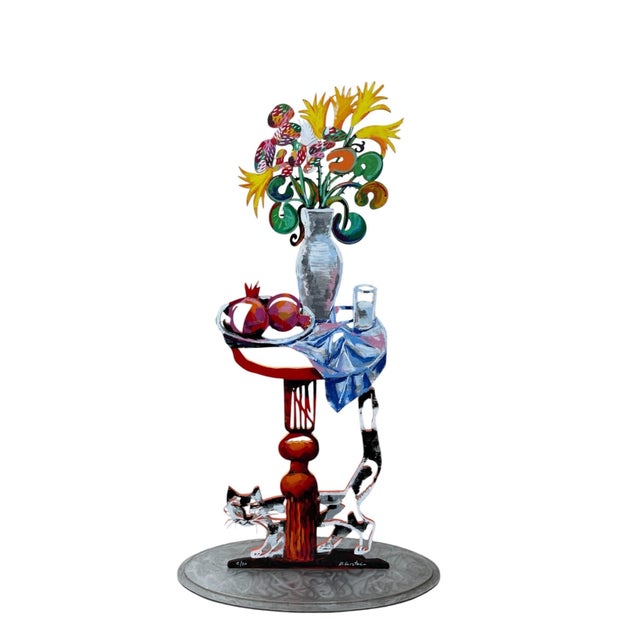
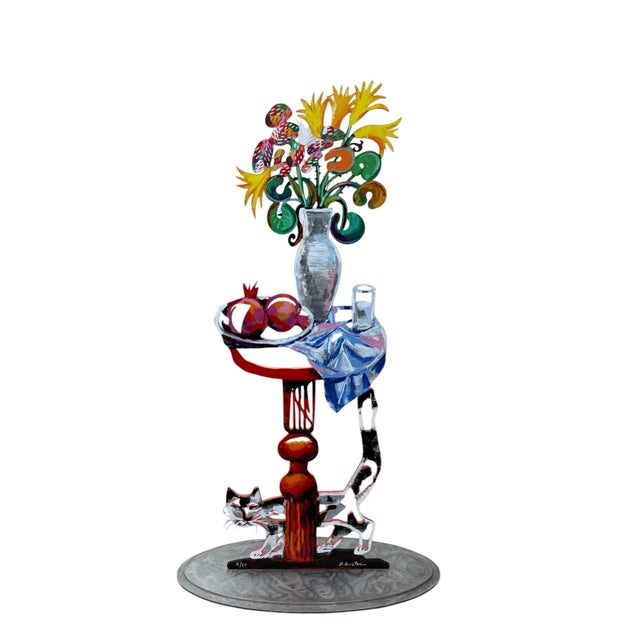
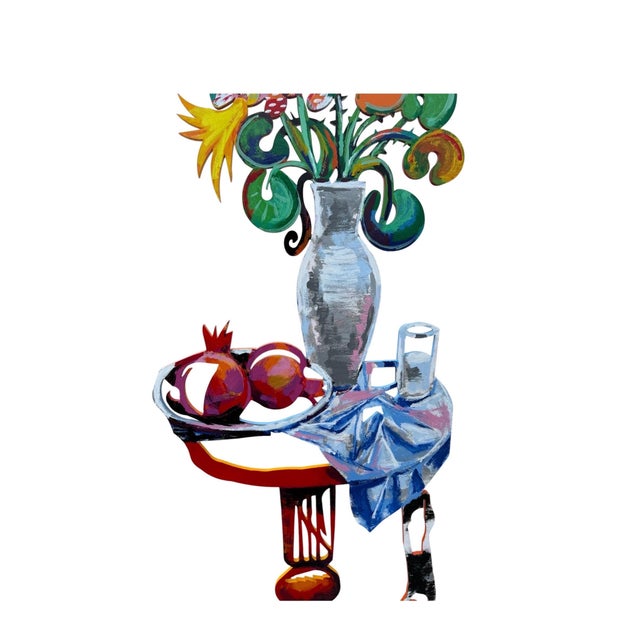
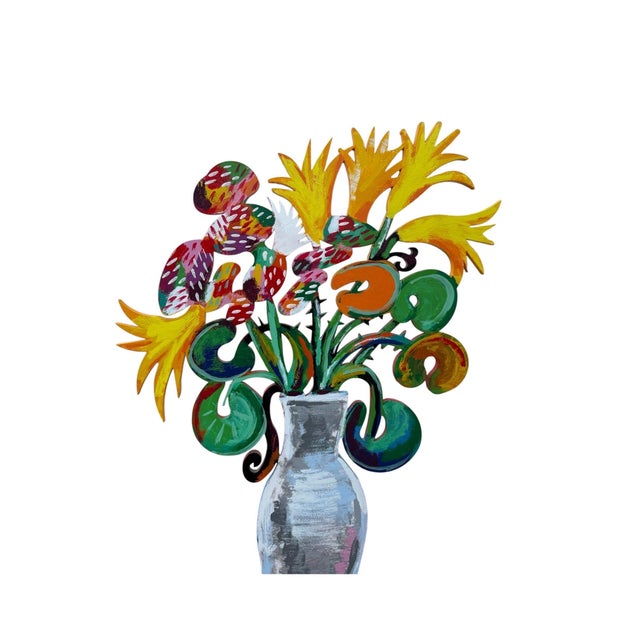
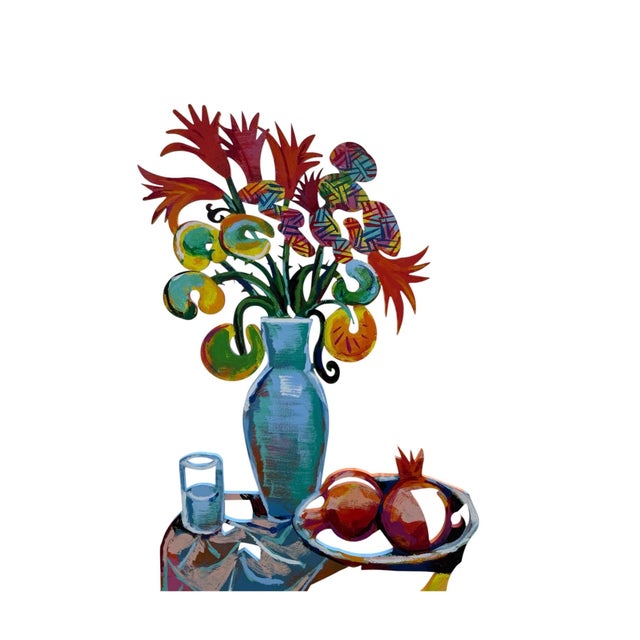
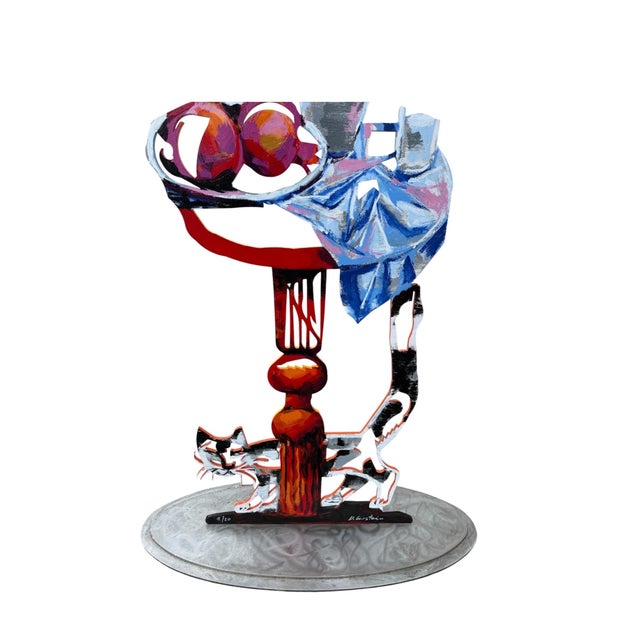
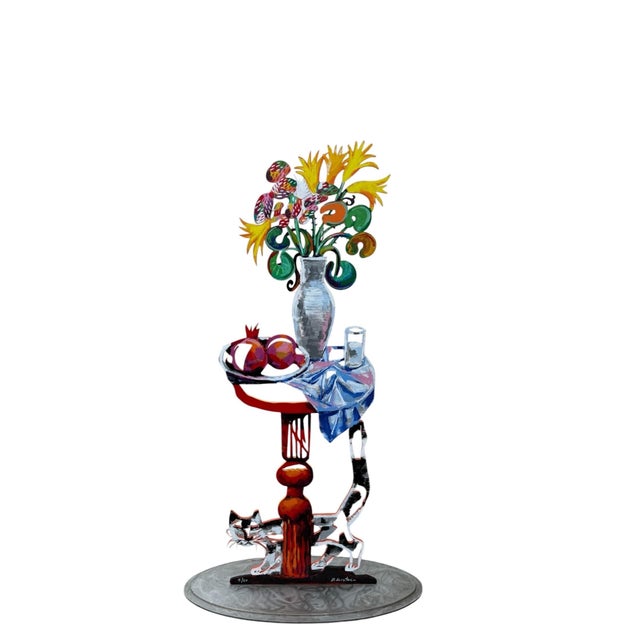
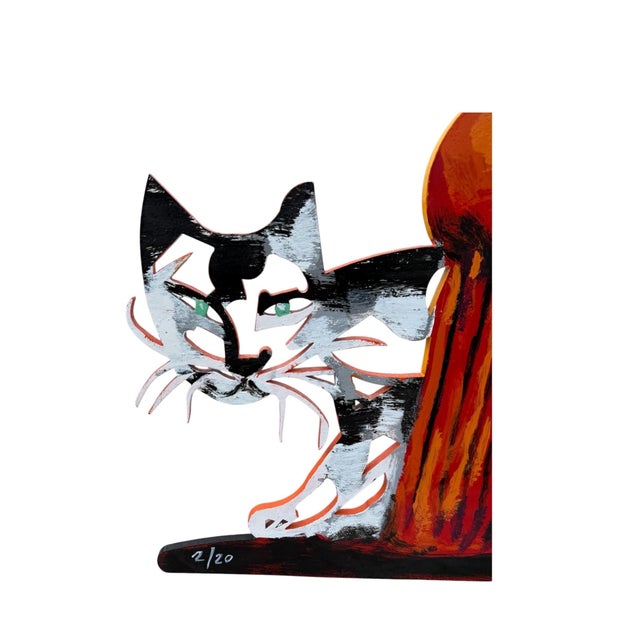
Painted steel sculpture depicting a cat, with raised tail, below a round table with floral vase. 2 sided, Painted differently on each side.
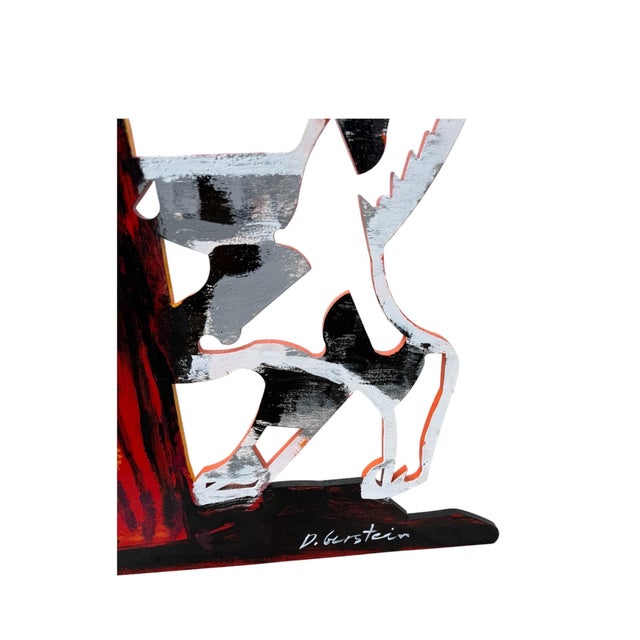
Hand signed and numbered 2/20
Measures 72 1/2" x 41 1/2" x 16"
This is a colorful wall hanging sculpture by Israeli Pop Artist Dudu Gerstein
David (Dudu) Gerstein (Hebrew: דוד (דודו) גרשטיין; born November 14, 1944) is an Israeli painter, sculptor, draftsman, and printmaker. He began as a figurative painter and was recipient of the Israel Museum Prize for illustration. At the end of the 1970s, he wished to expand the limits of two-dimensional painting, into painting in three dimensions. He began cutting out the main subjects of each painting and, to cancel the background, creating unique and iconic cutout images, free-standing in space, without the standard and traditional square frame.
That led him to work in sculpture, mostly in wood and using industrial paint as coating. Through the use of primary colors and subject matters from our day-to-day life, he created a variation of personal pop-art style, which he defined as second-generation pop-art. Following the path of Roy Lichtenstein, Tom Wesselmann, and David Hockney, Gerstein similarly aimed at creating his personal post-pop art style, and left behind the monochromatic palette of oil and watercolors and used instead vibrant, design-oriented colors.
Gerstein pays homage to the past: the multiple perspectives of cubism; the bright energy of expressionism and the simplicity of primitivism, all allowing her to show the true integrity of painting. His every-day world and that of fantasy collide to create bright and joyful images based on the clarity and simplicity of abstract forms. From 1980 to 1995, he created mostly free-standing wooden sculptures, which he later abandoned when he found laser-cutting technology. By that, he pioneered the use of laser cutting in art and was the first artist to use multi-layered cutout steel wall-sculptures.
Simultaneously to his wall-sculptures, Gerstein had a great interest in sculpture in public spaces. He created more than 40 sculptures in public squares and plazas in Israel alone. This led him to create many more large-scale outdoor sculptures in England, France, Sweden, Italy, China, South Korea, and other countries.
His art was shown in museums around the world, beginning in Israel Museum in 1987. In 2016 he won Taiwan's Artistic Creation Award. His sculptures of bicycle riders were purchased by Lance Armstrong, and were mentioned in Stephen King's writings. His outdoor sculpture "Momentum" is Singapore's tallest public sculpture.
David (Dudu) Gerstein was born in 1944 in Jerusalem to parents who immigrated from Poland. Both he and his twin brother, Jonathan (Yoni) Gerstein, showed artistic talent from an early age. At the age of thirteen, he was sent to a camp for the arts in Jerusalem, which he attended for several summers in a row. Later he took classes at the Beit Zvi Art Center in Ramat Gan.
As a child, he was moved by the works of the impressionists and earlier art movements in history. He frequented a gallery near his home and was always eager to find the new paintings on display there, "deeply emotionally moved" by the art there.[
In 1955, at age 11, David was introduced to modern art when he saw, in a newspaper, a reproduction of Picasso's Guernica. The reproduction ignited his interest in modern art movements such as cubism and expressionism. He continued to frequent museums and galleries as a teenager.
During his mandatory military service he painted a series of oils of fishing docks, boats and kibbutz landscape. Upon completion of his military service, David applied to the Bezalel Academy of Arts and Design, Jerusalem, where he met teacher Avraham Ofek, who had a marked influence on Gerstein's style.
In 1965, Gerstein enrolled in Israel's leading art academy Bezalel at the graphic design department, as there was no art department at the time. After two years he realized that graphic design did not interest him. Having had a dream to visit Paris from an early age, he sailed to France and in 1966, enrolled at the École nationale supérieure des Beaux-Arts in Paris, where he studied under Chapelain-Midy.
After the 1968 revolution in France two years in Paris, he moved to New York and attended classes of the Art Students League, where he learned portrait painting under William F. Draper, and oil painting under Jacob Lawrence.
Gerstein returned to Israel at the age of twenty-six and began teaching at Bezalel. At first, he taught drawing and then became a faculty member of the Department of Jewelry Design, which was then undergoing a process of renewal; evolving from the outmoded, traditional style of "Bezalel" to introducing innovative concepts influenced by modern art. Due to his background in the fine arts, Gerstein was responsible for closing the gap between jewelry design and the world of modern art. He introduced his students to contemporary movements, such as Danish design, expressionism, conceptual art, minimalism, and other contemporary movements. He wanted jewelry design to be considered in the same light as contemporary art, no less inferior for being decorative, equal to other forms of art. Years later, Gerstein remarked that his involvement in teaching in the department influenced his transition from painting to sculpture.
Being interested in printmaking, and wishing to expand in the art form, Gerstein enrolled in Saint Martin's School of Art in London, where he focused on printmaking and earned his Masters of Art. Having learned lithograph and silkscreen printing, he sought to combine the two media, which had not as yet been integrated. Upon completing his studies he was awarded first prize and two awards for excellence in an end-of-year competition at St. Martin's.
Gerstein returned to Bezalel and applied printmaking to enamel technique. Already then, his tendency to integrate different mediums and advanced technologies in creating art was discernible; a tendency that was reflected more strongly in his use of laser in the 1990s. He continued in his position as senior lecturer at Bezalel until 1985.
Gerstein's first exhibition in Israel was held in 1971 at the Engel Gallery in Jerusalem, comprising figurative drawings and watercolors. Thereafter, he exhibited at Jerusalem's Artist's House in 1972 with large oil paintings dealing with interiors and the seaside, work that received enthusiastic reviews. Among others, Gerstein was compared to David Hockney due to the fact that "like Hockney, he, too, had been first and foremost a master drawer with an excellent color sense".
During those years, Gerstein led a struggle to legitimize figurative art, unacceptable in the mainly conceptual Israeli art scene. The conceptual art trend was irrelevant for him and he chose the less accepted orientation at the time, figurative painting. Gerstein numbered among the few artists, such as Avraham Ofek, Uri Lifschitz, and others, who focused on narrative-figurative painting.
At the same period, parallel to conceptualism, an opposite trend developed: hyper-realism. Gerstein, however, aspired to create figurative paintings informed by a personal and free style, striving to find his personal handwriting. Gerstein sought to make statements about the world and life, using the narrative and experiences of his personal life.
Gerstein painted memories from his past such as his mother riding a bicycle, or a painting depicting the childhood of twins, referencing the childhood of his twin brother and him, childhood vacations at the Dead Sea, etc. Among his main inspirations was the work of Hanoch Levin who presented life's vanities in a vein of comic irony. Gerstein aspired to do the same in painting: "I tried to express in painting what Levin wrote: relationships between men and women, within families…a sort of grotesque style of painting".
Another inspiration at the time was the painter George Gross, to whom he felt an affinity and who also dealt with what Gerstein termed "the human comedy". In addition, he was influenced by David Hockney, Fernando Botero and José Luis Cuevas, who all dealt with the human experience and people' interactions.
In the 1970s, Gerstein explored the integration of personal themes alongside figurative painting, particularly in his watercolors and gouache on paper. His works stemmed not from the political realm, nature or science, but rather from early personal memories of family and growing up. At first, these works were intended as sketches for large canvas oil paintings. With time, though, he found interest in working in watercolors on paper only, and they became his main medium. Gerstein created a series of paintings concerning his childhood based on photographs and memories. Another series dealt with the memory of freedom: his mother riding a bicycle in the streets, a motif that developed into a series of bicycle riders in the 1990s and afterward. Another series of paintings focused on interior settings of personal living spaces such as living rooms, in French tradition. A repetitive motif in these works was that a cat, as well as a vase, which, for the artist, expressed, "the serenity of daily home life."
While wishing to express the interior, intimate life of individuals and families, Gerstein was also interested in the public realm, and, more specifically, in the tension between the private and public. It was then that he was attracted to the theme of balconies, as they successfully captured that tension; on the one hand, they were extensions of the personal home, and, on the other hand, they were like an exhibition displayed to the public in the street below. These were works stemming from nostalgia and longing to his childhood memories of Tel Aviv balconies with peeling plaster, and the day-to-day modest life of working-class middle-aged couples, as he recalled from his parents' friends.
Both the cat and the flower vase continued to accompany his work decades later. While involved with these motifs Gerstein wanted "to escape the Israeli political reality to an Olympian turbulent-free, tranquility". In the mid-'70s, he made a series of paintings of people at the beach, influenced both by the artist's childhood memories as well as from observation. Another series of paintings included the landscape of the Ein Kerem neighborhood, where the artist lived at the time, used as a backdrop for compositions abundant with interacting figures in groups and couples.
Gerstein's aim to portray the daily experience of Israeli life came to fruition in the 1980s. Gerstein figuratively describes chapters from the Israeli experience, derived, among others, from childhood memories in Tel Aviv. The first series depicts Tel Aviv with its Bauhaus style balconies, with a humoristic irony. This series was based on Gerstein's memories of his parents' generation of "little Tel Aviv"; people whom he regarded with wonder and humor. These paintings express the tension between the sabra generation of the children and the relatively "exilic" generation of the parents.
The series contains elderly people, the "old world" reflected in their faces, as seen from the eyes of a sabra child looking at the "generation of the desert"; the generation that founded the country, having had immigrated at a young age, yet still marked by the heritage of "diaspora". The origins of this series can be found in Gerstein's watercolors and gouache on paper from the '70s, parts of which were adapted to canvas oil paintings. In the '80s, Gerstein developed this into another series of paintings, those of bathers in the Dead Sea, about which Avraham Eilat wrote,"the residents of the balconies have gone down to the Dead Sea where they lie about on the shore, covered in mud, exposing their pinkish bodies to the mercy of the sun's rays and the salt and get slowly fried".
Despite the positive response his paintings evoked, both from the critics and the art world, Gerstein felt the need to renew, find new directions and expand his artistic boundaries. During 1980–1987, while continuing to paint, Gerstein experimented with wood sculptures, which were "three-dimensional while preserving a two-dimensional quality". Gerstein sought to "expand the borders of painting" to the domain of the third-dimension. Dissatisfied with his few sculpting experiments, the artist discovered that he could cut and assemble the elements into a type of sculpture in space. The idea came to him during reserve duty while dismantling cardboard boxes containing cartridges. He painted on the inner partition of a box and then reassembled it. From this evolved the idea of painting on large-scale cardboard constructed into sculpture. Following a number of sculptures from cardboard, Gerstein used wood and thin aluminum. Gerstein defines those years as a "struggle" between painting and sculpture, comparing his relationship to painting as that to a wife, as opposed to his relationship to sculpture: a seductive lover.
Gerstein first showed these sculptures at the Horace Richter in Tel Aviv in 1981. This was a bold step for the 36-year-old painter who had not been known for sculpture previously. The works were of aluminum and wood, and the subject matter was a continuation of that of the 1970s: his mother riding a bicycle, cats, flower vases and various still-life elements.
In the following years, Gerstein showed at two main galleries, Sara Gilat and Ruth Debel, with work reflecting the artist's continued "search" for a new language integrating painting and three-dimensionality.
In 1984 Gerstein traveled to New York, the first time since the conclusion of his studies there fifteen years earlier, and began working with the art dealer Marilyn Goldberg, who ordered the production of six limited edition aluminum prints titled "Art Cats". The series included cutouts of cats inspired by those of twelve known artists, from van Gogh to Picasso and Lichtenstein. In the wake of these works, Gerstein was invited to show at the Israel Museum in Jerusalem. The exhibit in 1987 was presented under the heading, "From Dudu to 3-D", comprising sculptures that were "colorful, cheerful, amusing and reminiscent of toys or paper cutouts". The exhibit was a summary of Gerstein's three-dimensional work of the previous seven years and was a breakthrough for the artist. Most of the exhibited work was purchased by international collectors and Gerstein was subsequently invited to exhibit in the United States and Canada.
While continuing to develop his sculpture in the '90s, Gerstein returned to painting in the style that constituted a direct link to the balconies and the Dead Sea series, depicted in the '70s and '80s. The series of automobiles created during this period presents people traveling in a car from the perspective of the spectator "peeping" in at the passengers through the front windshield. Similar to the motif of peeping into Tel Aviv balconies, here too, Gerstein chose the perspective of the outsider looking at the driver through the windshield, while at the same time reflecting the surroundings in the reflections on the windshield. The series was created in Paris during Gerstein's residency at the Cité internationale des arts, 1990–1991.
In 1995, after years of working with wood, Gerstein discovered the technology of laser cutting and began cutting metals and painting them in glossy paint taken from the car industry. On this he collaborated with Rosenfeld Gallery in Tel Aviv.
At first, he began working with one-layer cutout steel. Due to the fact that the metal required industrial paint, mostly based on primary colors, Gerstein was attracted to bright primary colors.
Shortly after beginning to work with one layer laser cutout, he began experimenting with adding one additional metal cutout layer. Using screws, he secured the second layer to the first and was immediately "taken" by the technique: "From early on I tried to create three dimensional paintings, which is what led me to wood sculptures in the early 1980s. Suddenly, fifteen years later, I finally found the perfect way to create a three dimensional painting, floating above the wall, breathing, living. It was, for me, an eureka moment. I knew from that moment on that I'd like to further develop this medium."
Soon after, Gerstein began creating these multi-layered cutout wall sculptures in limited editions. These limited editions were nonetheless hand painted, and by that were each uniquely original.
Gerstein is known for his outdoor sculptures, many of which are installed in city squares or next to public buildings. His sculptures can be found throughout Israel: ten sculptures in Netanya, twelve sculptures in Herzliya, large-scale sculptures in the campus of the Hebrew University of Jerusalem and the Tel Aviv University, Avdat, the Yoav Dagon Sculpture Garden in Ramat Hasharon, Memorial sculpture in Yahud and a memorial sculpture in Beit Hashanti in Mitzpe Ramon, Faculty of Agriculture of the Hebrew University in Rehovot, Raanana, Ramat Alon in Haifa, Holon, Kiryat Yam, Ramat Gan, Ashkelon, Mevaseret, Modi'in, and others.
Outside of Israel, Gerstein is known for his large-scale colorful sculptures, including Roman Warrior is in Bromford, London. In Singapore's Raffles Place. The athletic stadium and shopping mall in Hsinchu, Taiwan, Museum of Contemporary Art in Tainan City, Taiwan; eleven sculptures in the Science Park in Taichung, Taiwan, six outdoor sculptures in the Morgan Stanley building in Seoul, Korea; Star City in Seoul. Five sculptures in a park in Guizhou, China; sculptures in a hospital of Taikang, Beijing, China; and "Tea for Two" in Fuliang Province, China.
Select Israeli Exhibitions:
There Are No Bad Animals: Animals as Motif in Works of Art, Man and the Living World Museum,
1986. Artists: Ofek, Avraham Ben Shaul, David (Dedi) Pichhadze, Meir Kerman, Dani Rauchwerger, Jan Reuven Rubin, David Reeb, Cohen Levy, Maya Yosl Bergner, Audrey Gerstein, David (Dudu) Hendler, David Weil, Shraga Navon, Arieh Salomon, Edwin Pins, Jacob Kimche, Rina Schwebel, Ivan Lifschitz, Uri Grossman Lehmann, Hedwig Danziger, Itzhak Messag, Aharon Eshet, Pinchas Feingersh, Oded Paldi, Israel Menashe Kadishman, Chana Orloff, Zvi Aldouby, Geva, Tsibi Moreh, Mordecai Fenichel, Abba Nishri, Miri Constant, Joseph Schwerin, Ludwig Tadmor, Zvi Lehmann, Rudolph (Rudi) Michal Naaman.
Teddy Kollek - The Lion That Became Silent:
Municipal Art Gallery, Jerusalem
Artists: Agam, Yaacov Arikha, Avigdor Blum, Motke (Mordechai) Gerstein, David (Dudu) Kollek Sachs, Osnat Litvinovsky, Pinchas Lakicevic, Yochanan Stern, Yossi Enkaoua, Daniel
Eat with the Eyes
Zaritsky Artists House, Tel Aviv
8 February, 2024 - 2 March, 2024
Artists: Azoulay, Shai, Arnovitz, Andi, Gerstein, David (Dudu), Zourabova, Natalia, Tevet, Eyal, Yarden, Nurit, Lukashevsky, Anna
Bear your Banner to Zion,
Engel Gallery, Shlomzion Hamalka, Jerusalem 2025
Artists: Yaacov Agam, Bokobza, Eliahou Eric, Gerstein, David (Dudu), Jano, Jacques
See less
- Dimensions
- 41.5ʺW × 16.5ʺD × 72.5ʺH
- Styles
- Pop Art
- Art Subjects
- Other
- Frame Type
- Unframed
- Period
- 1990s
- Country of Origin
- United States
- Item Type
- Vintage, Antique or Pre-owned
- Materials
- Metal
- Paint
- Condition
- Good Condition, Original Condition Unaltered, Some Imperfections
- Color
- Red
- Condition Notes
- Good minor wear. Good minor wear. less
Questions about the item?
Returns & Cancellations
Return Policy - All sales are final 48 hours after delivery, unless otherwise specified in the description of the product.
Cancellation Policy - Prior to shipping or local pickup, buyers may cancel an order for up to 48 hours, unless otherwise specified.
Related Collections
- Photorealism Paintings in New York
- Photorealism Canvas Paintings
- Joseph Solman Paintings
- Donald Judd Paintings
- George Coggeshall Paintings
- Karen Offutt Paintings
- Richard Serra Paintings
- Margaret Kennedy Paintings
- William IV Paintings
- Jacobean Paintings
- Lowell Nesbitt Paintings
- Francine Tint Paintings
- Louis Wolchonok Paintings
- Jean Calogero Paintings
- Vienna Secession Paintings
- René Magritte Paintings
- Jeff Slemmons Paintings
- Paintings in Panama City, FL
- BandB Italia Paintings
- Laddie John Dill Paintings
- Michelle Arnold Paine Paintings
- Camille Pissarro Paintings
- Etruscan Revival Paintings
- Photorealism Paintings in Los Angeles
- Black Photorealism Paintings