

Details
Description
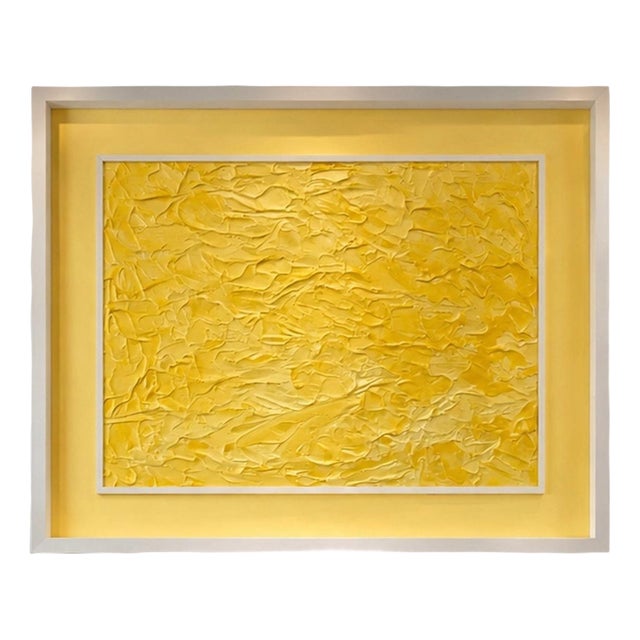
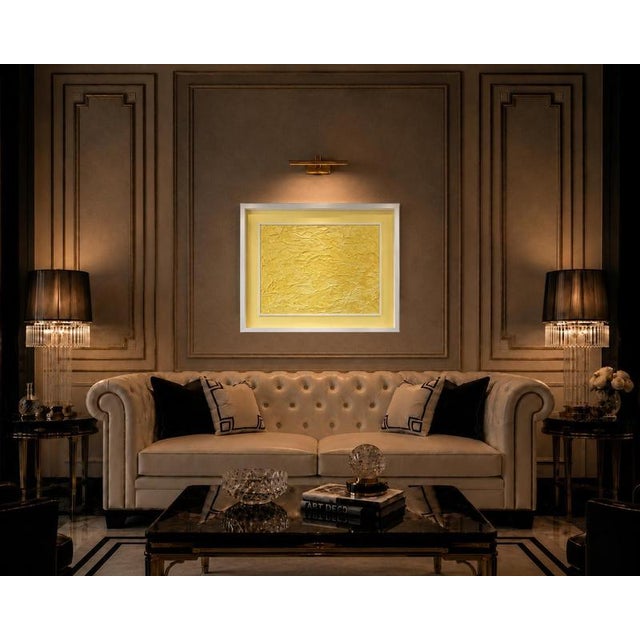
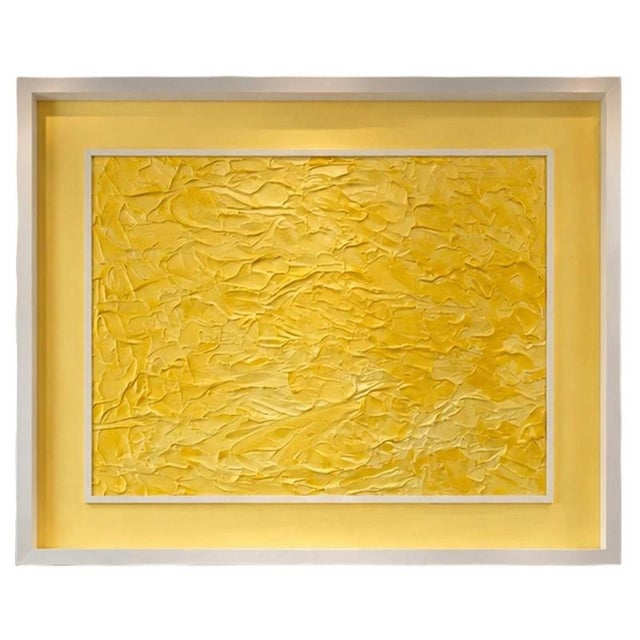
Silvy Favero Deserto Arabico / Arabian Desert, 2022 Acrylic on canvas 70 × 50 cm Visual narrative In “Arabian Desert,” … Read more Silvy Favero Deserto Arabico / Arabian Desert, 2022 Acrylic on canvas 70 × 50 cm Visual narrative In “Arabian Desert,” Silvy Favero does not simply depict a landscape: she evokes it as a primordial presence, almost as a surface of memory. The pictorial matter seems to become sand, rock, compressed light. Yellow is not merely a colour, but heat, reflection, silence. It is the absolute tone of a place where the gaze, at first, believes it finds nothing, and then slowly begins to perceive life. The work tells of the immensity of the desert not through the horizon, but through its skin. The canvas becomes a living expanse, crossed by reliefs, ripples, marks and stratifications that recall the movement of the wind over the sand, the fractures of rock, the invisible trace of time. There is no figure, no human presence, and precisely for this reason the space appears larger, more mysterious, more absolute. According to the artist’s vision, painting the desert means revealing the grandeur of nature in its most essential form: a place where apparent emptiness becomes revelation. Where there seems to be nothing, there is instead a hidden, minimal, resistant, almost secret life. It is a life that does not reveal itself immediately, but asks for silence, attention and reconnection. “Arabian Desert” thus becomes an invitation to look beyond the obvious. Sand and rock are not only natural elements, but metaphors for an inner condition: the search for an absolute essence, for a truth stripped of the superfluous. In this golden, material and luminous surface, the desert does not appear as absence, but as an extreme form of presence. Silvy Favero Artistic Profile The painting of Silvy Favero begins with an apparently simple and, precisely for this reason, radical choice: to reduce the palette to its essence. Green, red, yellow, white. Primary or basic colours, used not as pure fields, but as living matter — mixed, crossed, rippled, raised. It is within this apparent limitation that the artist finds her space of freedom. Favero does not seek complexity through accumulation, but through the depth of the surface. Each painting seems to begin with a dominant colour, almost with an absolute decision: the yellow of the desert, the green of vegetation, the red of an inner energy. But that colour is then immediately set in motion. It is mixed with white, opened, scratched, lifted, transformed into a material geography. Her works do not describe recognisable places. Rather, they suggest them. They are mental territories, inner landscapes, emotional maps. The pictorial matter becomes sand, leaf, wave, flesh, light, rock, wind. There is no explicit narrative, but a continuous evocation. The viewer does not look at a scene: they enter a surface. The strength of her work lies precisely in this tension between chromatic simplicity and tactile complexity. Colour is never flat, never merely colour. It is body. It is relief. It is contained movement. The canvas seems to breathe through its ripples, as if the painting were a skin crossed by something trying to emerge. One might imagine, with caution and without forcing the comparison, a distant ideal kinship with the lesson of Rothko: not in formal language, but in the idea that colour can become a spiritual space. As if a red, green or yellow field suddenly opened up, rippled, took on matter, and became landscape. Favero seems to begin from an essential chromatic field and then wound it, animate it, make it sensitive. Her pictorial gesture is not decorative, even when the work possesses a strong aesthetic presence. It is a gesture of research: an inquiry into the evocative power of matter, into the possibility of giving birth to a world from just a few elements — a colour, white, light, the pressure of the hand, the density of acrylic. In this sense, her painting lives in a border zone: between abstraction and nature, between surface and depth, between silence and movement. It does not represent the world, but retains its echo. And each canvas becomes a threshold: a place where colour, on its own, begins to speak. See less
- Dimensions
- 31.5ʺW × 3.94ʺD × 23.62ʺH
- Styles
- Contemporary
- Art Subjects
- Abstract
- Period
- 2000 - 2009
- Country of Origin
- Italy
- Item Type
- Vintage, Antique or Pre-owned
- Materials
- Acrylic
- Canvas
- Condition
- Good Condition, Original Condition Unaltered, Some Imperfections
- Color
- Gold
- Condition Notes
- Excellent — This vintage piece is in near original condition. It may show minimal traces of use and/or have slight … moreExcellent — This vintage piece is in near original condition. It may show minimal traces of use and/or have slight restorations\. Wear consistent with age and use. less
Returns & Cancellations
Return Policy - All sales are final 48 hours after delivery, unless otherwise specified in the description of the product.
Cancellation Policy - Prior to shipping or local pickup, buyers may cancel an order for up to 48 hours, unless otherwise specified.
Related Collections
- Ralph Lauren Paintings
- Photorealism Canvas Paintings
- Ed Ruscha Paintings
- Photorealism Paintings in New York
- Louise Nevelson Paintings
- Silk Velvet Paintings
- Richard Serra Paintings
- Herman Miller Paintings
- BDDW Paintings
- Jaanika Peerna Paintings
- Jo Baskerville Paintings
- Jean-Paul Barray Paintings
- Johannes Andersen Paintings
- Peter Behrens Paintings
- Photorealism Paintings in Los Angeles
- Karl-Erik Ekselius Paintings
- Carl-Axel Acking Paintings
- Joseph Stella Paintings
- Raphael Paintings
- Black Photorealism Paintings
- Pedro Friedeberg Paintings
- Piet Hein Eek Paintings
- James McCray Paintings
- Lawson-Fenning Paintings
- Milton Avery Paintings