



Details
Description
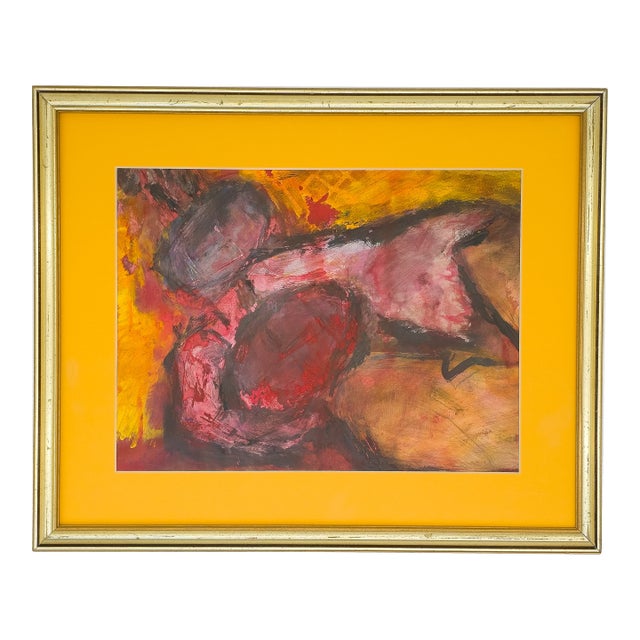
Samurai Love
Virginia Cohn Parkum, c. 1980s
In Samurai Love, Virginia Cohn Parkum presents the human body as a site …
Read more
Samurai Love
Virginia Cohn Parkum, c. 1980s
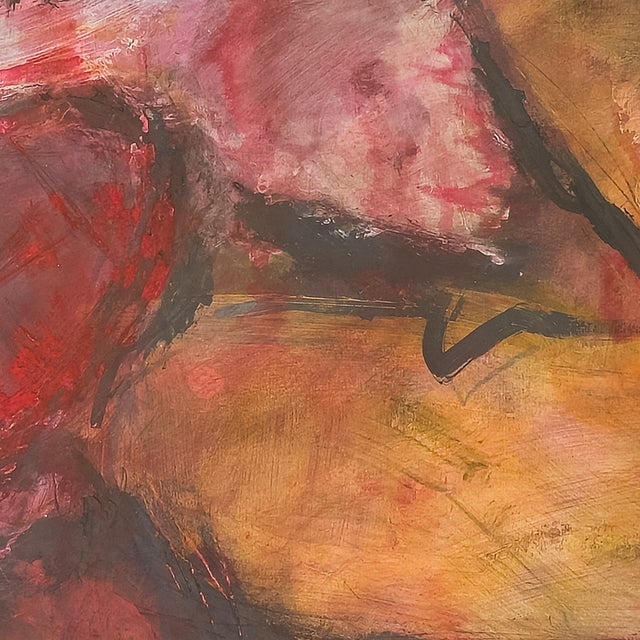
In Samurai Love, Virginia Cohn Parkum presents the human body as a site of intimacy, vulnerability, and shared presence. Two figures occupy the composition, their forms intertwined and partially fused through sweeping gestures of paint. The bodies are rendered in layered reds, ochres, and deep maroons, emerging from a field of warm yellow that radiates across the upper portion of the canvas. Rather than delineating clear anatomical boundaries, Parkum allows the figures to merge through overlapping brushwork, producing a visual language in which connection supersedes separation.
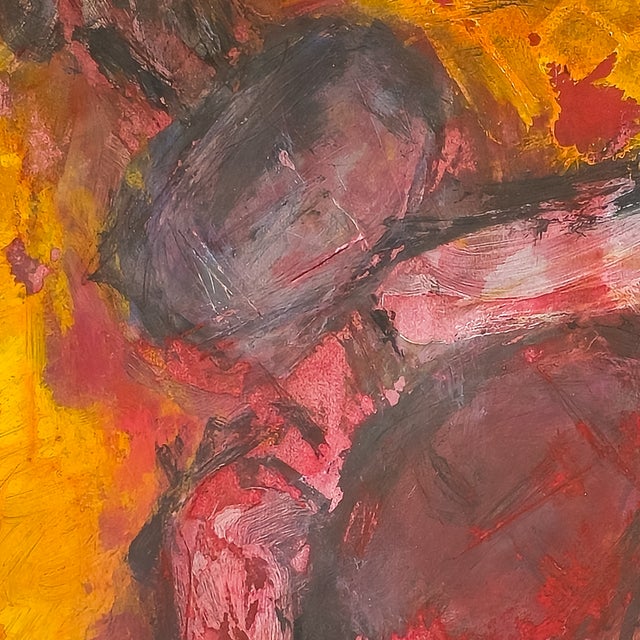
The composition unfolds diagonally, with one figure reclining while the other leans inward, their heads positioned in close proximity. The doubling of heads becomes legible through subtle shifts in contour and tonal variation: one face is angled downward in repose, while the other tilts toward it, suggesting watchfulness, devotion, or tender proximity. This quiet doubling is central to the work’s meaning. The figures are not posed for spectacle; they exist within a private moment of closeness that resists theatrical display.
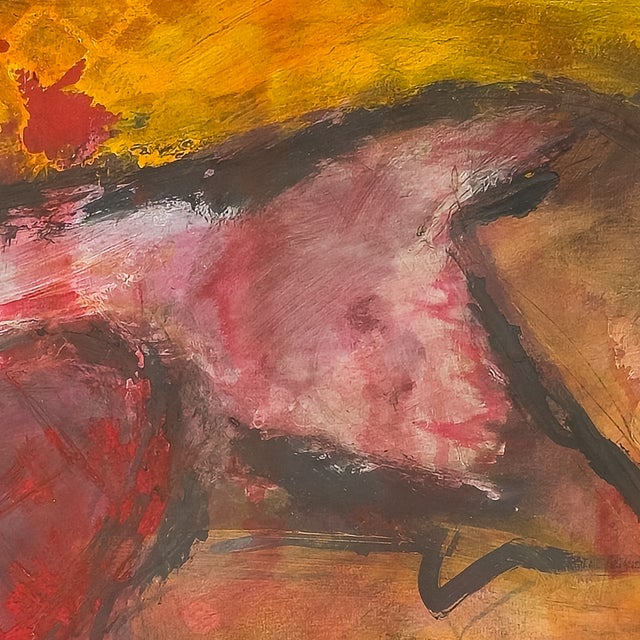
Parkum’s handling of paint emphasizes corporeality and immediacy. Broad strokes and dragged passages create a sense of physical weight, while darker lines trace the contours of shoulders, torsos, and limbs without enclosing them fully. The pigment accumulates and thins across the surface, revealing the artist’s revisions and reinforcing the sense that the image is formed through touch as much as observation. Reds appear layered and reworked, at times reading as flesh, at others as the heat of contact or the residual trace of movement.
The title introduces an interpretive framework that extends beyond the visible forms. The term “samurai” evokes the disciplined warrior class of feudal Japan, associated with codes of honor, loyalty, and ritualized conduct. Historical scholarship has also documented the practice of wakashudō, a tradition of same-sex love between samurai and younger male companions, in which emotional devotion, mentorship, and physical intimacy coexisted within a codified social framework. Parkum’s painting resonates with this history not through literal costume or setting, but through its emphasis on closeness, trust, and shared vulnerability within a disciplined, restrained space.
The figures’ fusion suggests a relationship grounded in mutual reliance rather than dominance. There is no gesture of conquest or spectacle; instead, the bodies rest within one another’s proximity, emphasizing protection and communion. The reclining figure’s openness contrasts with the attentive lean of the second, creating a dynamic of care and guardianship. This interplay echoes the ethical dimensions of samurai bonds, where loyalty and emotional attachment were integral to martial identity.
Color reinforces the work’s thematic tension between strength and tenderness. The saturated reds convey bodily warmth and vitality, while the luminous yellow field above introduces a halo-like radiance that frames the figures without sanctifying them. Dark linear accents and earthen undertones anchor the composition, preventing the palette from becoming decorative and maintaining the gravity of the encounter.
Samurai Love resists clear narrative resolution. Instead, it offers an image of shared presence shaped by touch, trust, and proximity. Through layered pigment and fused forms, Parkum transforms the warrior archetype into a meditation on intimacy — one in which strength is inseparable from vulnerability and devotion is expressed through physical closeness rather than heroic display.
-Jonathan Flike
See less
- Dimensions
- 21.5ʺW × 1ʺD × 11.5ʺH
- Frame Type
- Framed
- Period
- 1980s
- Country of Origin
- United States
- Item Type
- Vintage, Antique or Pre-owned
- Materials
- Acrylic Paint
- Condition
- Good Condition, Original Condition Unaltered, Some Imperfections
- Color
- Red
- Condition Notes
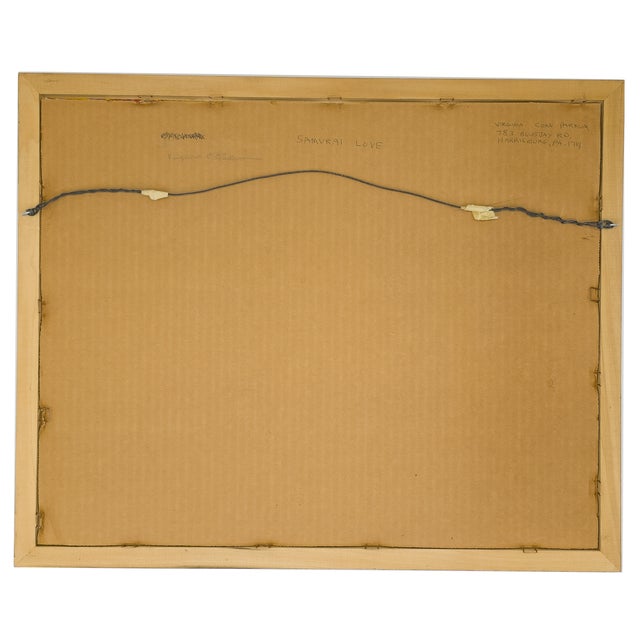
- Please note that this item is vintage and shows wear consistent with age, use, and history. Signs of wear may … morePlease note that this item is vintage and shows wear consistent with age, use, and history. Signs of wear may include, but are not limited to, minor surface marks, patina, fading, or imperfections typical of older items. All items are sold as-is, which is standard with vintage and pre-owned goods and cannot be returned on the basis of condition. Measurements are approximate. We do our best to describe items accurately; however, condition assessments are subjective. If you would like additional details, images, or clarification before purchasing, please contact us. Special Condition Notes: Purposeful slice to the image by the artist. less
Questions about the item?
Returns & Cancellations
Return Policy - All sales are final 48 hours after delivery, unless otherwise specified in the description of the product.
Cancellation Policy - Prior to shipping or local pickup, buyers may cancel an order for up to 48 hours, unless otherwise specified.
Related Collections
- Photorealism Canvas Paintings
- Ed Ruscha Paintings
- Photorealism Paintings in New York
- Richard Serra Paintings
- Jo Baskerville Paintings
- Louise Nevelson Paintings
- Karen Offutt Paintings
- Nicola Simbari Paintings
- Herman Miller Paintings
- BDDW Paintings
- James McCray Paintings
- Leroy Neiman Paintings
- Jaanika Peerna Paintings
- Johannes Andersen Paintings
- Pedro Friedeberg Paintings
- Peter Behrens Paintings
- Piet Hein Eek Paintings
- Raphael Paintings
- Vienna Secession Paintings
- Photorealism Paintings in Los Angeles
- Carl-Axel Acking Paintings
- Karl-Erik Ekselius Paintings
- Hans Andersen Paintings
- Jean-Paul Barray Paintings
- Cassina Paintings