

Details
Description
Artwork Description
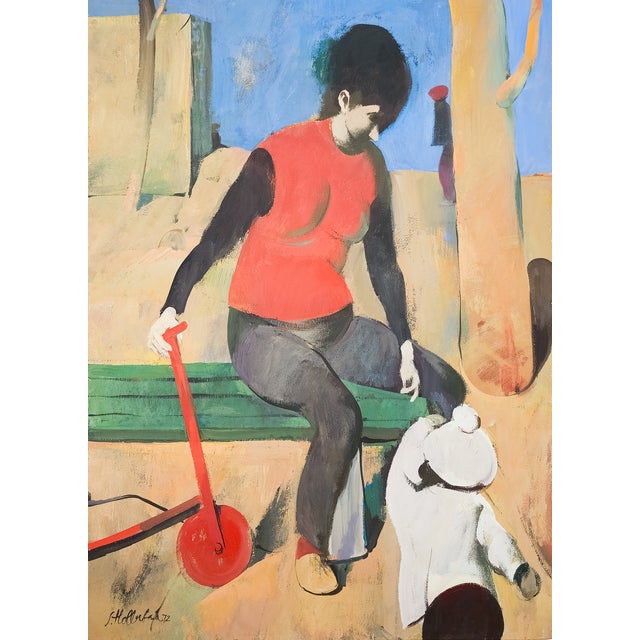
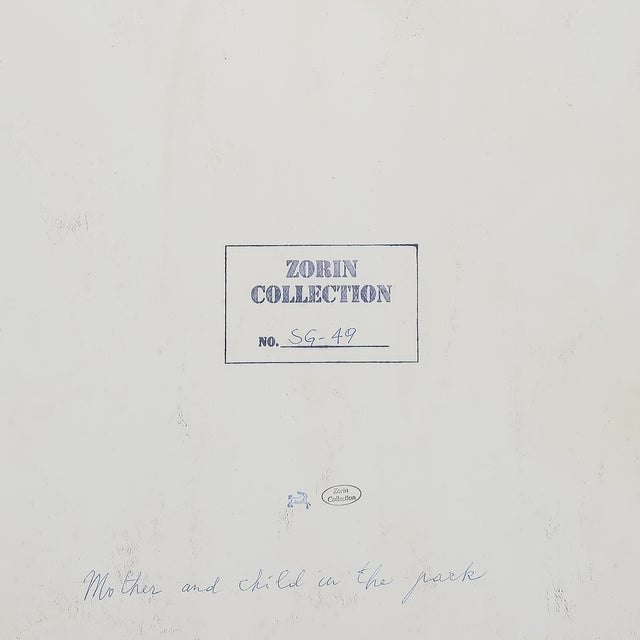
A Mother and Child in the Park
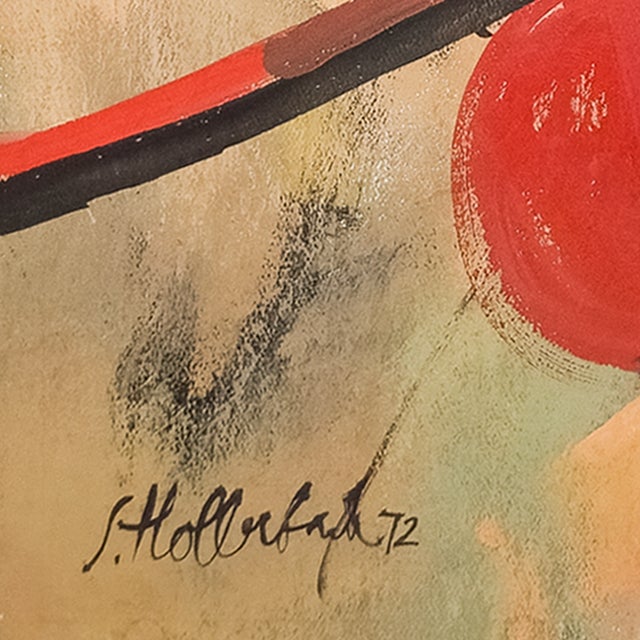
Serge Hollerbach, c. 1972
Reframed through the lens of environmental unease, …
Read more
Artwork Description
A Mother and Child in the Park
Serge Hollerbach, c. 1972
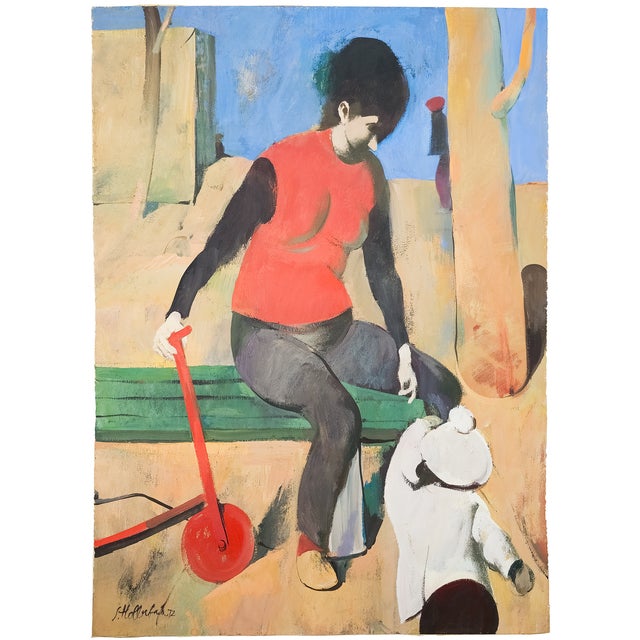
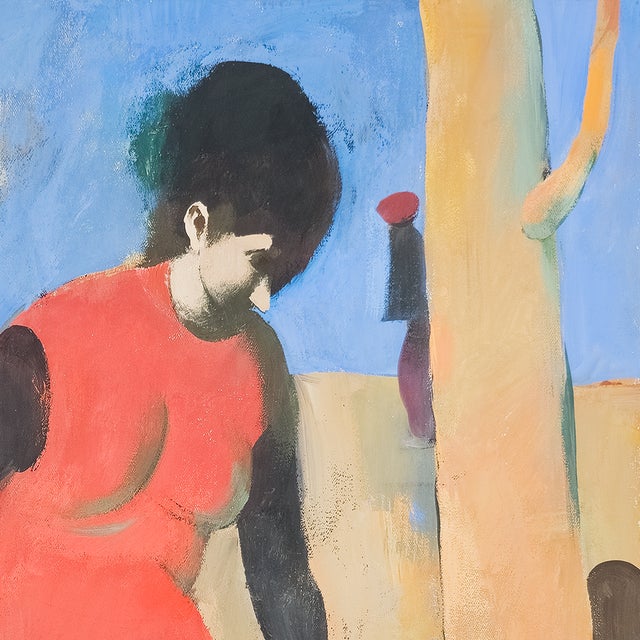
Reframed through the lens of environmental unease, Mother and Child at the Park reads less as a pastoral interlude and more as a scene shaped by the psychological residue of conflict—an interpretation deeply resonant with Serge Hollerbach’s lived experience of war and displacement.
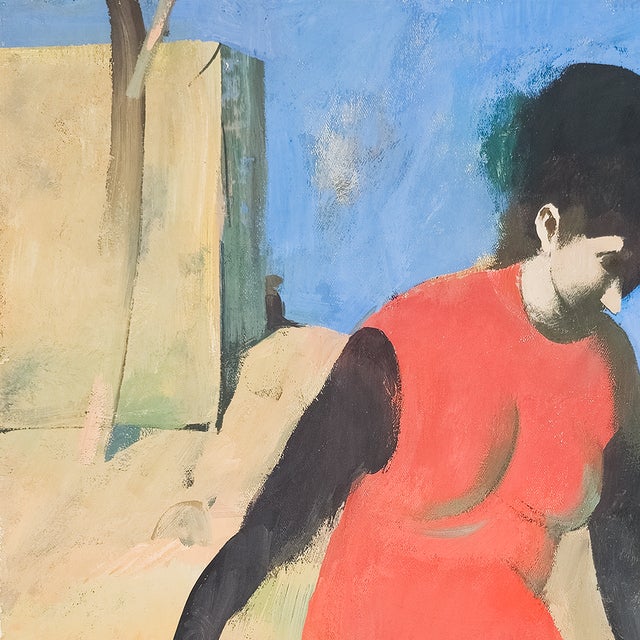
Although the setting is nominally a park, the space lacks the softness and vitality typically associated with leisure or nature. The ground is rendered in dry, ochre tones that feel closer to dust or worn earth than grass, while the background structures—flat planes, block-like forms, and vertical posts—suggest built remnants rather than organic landscape. The blue sky, instead of opening into atmosphere, reads as a hard, almost stage-like backdrop, compressing rather than expanding space. This spatial ambiguity creates an environment that feels stripped down, exposed, and psychologically barren. The “park” becomes a provisional space, one that may exist amid recovery, aftermath, or survival rather than recreation.
The seated mother’s posture takes on new meaning within this context. Her inward-turned body and lowered head suggest not simply introspection, but fatigue and guardedness. Her stillness reads as watchful rather than restful, the kind of pause born from endurance. The red of her garment—previously a compositional anchor—acquires a more somber resonance, evoking not vitality alone but emotional intensity and lived strain. Hollerbach often used strong color not for decorative flourish but to mark psychological weight, and here the red torso becomes a locus of human persistence within an austere setting.
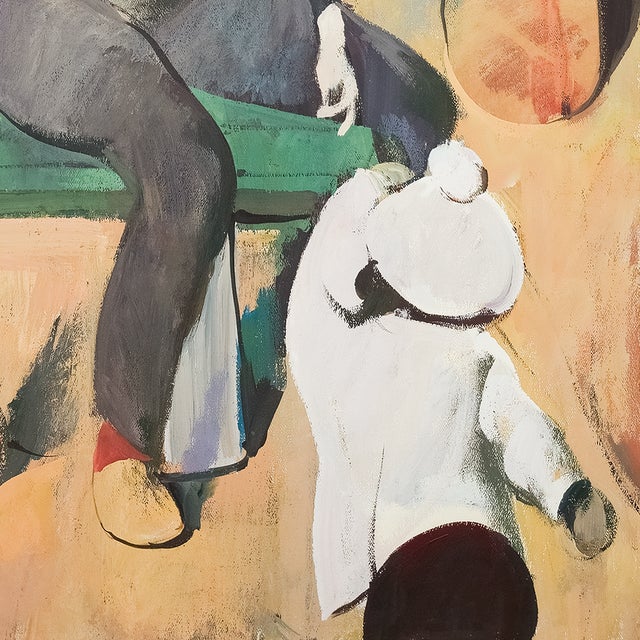
The child’s presence in the foreground reinforces this tension. Dressed in luminous white, the child embodies vulnerability and continuity, yet is positioned low and close to the mother’s knees, almost sheltering within her physical field. Their relationship appears protective but restrained; there is no overt gesture of play or delight. Instead, the space between them feels charged with quiet vigilance. The mother does not reach outward expansively; her care is contained, internalized, as though shaped by a world in which safety is not assumed.
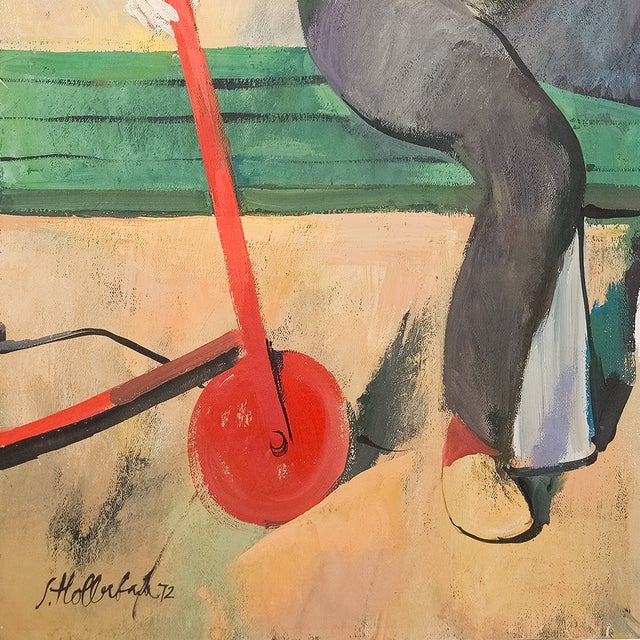
The surrounding forms—particularly the stark verticals and the red wheel-like object—introduce subtle visual dissonance. These elements can be read as fragments of infrastructure or utilitarian objects, recalling the built environment more than natural scenery. Their presence contributes to a sense that this is a space of habitation marked by use, wear, and endurance rather than idyllic retreat. Hollerbach’s compressed, stage-like spatial construction reinforces the impression that the figures exist in a psychological terrain shaped by memory as much as by place.
Within the broader arc of Hollerbach’s work, this reading aligns with his recurring focus on human presence in environments marked by austerity and emotional gravity. Having lived through wartime upheaval and displacement, he often approached everyday scenes with an undercurrent of historical consciousness. Mother and Child at the Park thus becomes less a genre depiction and more a meditation on survival: motherhood not as sentimental ideal but as steadfast continuity amid uncertainty. The painting suggests that even spaces meant for respite carry the imprint of larger histories, and that the ordinary act of sitting beside one’s child can hold the quiet weight of endurance in a world still bearing the marks of conflict.
-Jonathan Flike
See less
- Dimensions
- 26.5ʺW × 0.1ʺD × 32ʺH
- Frame Type
- Unframed
- Period
- 1970s
- Country of Origin
- United States
- Item Type
- Vintage, Antique or Pre-owned
- Materials
- Acrylic Paint
- Condition
- Good Condition, Original Condition Unaltered, Some Imperfections
- Color
- Red
- Condition Notes
- Please note that this item is vintage and shows wear consistent with age, use, and history. Signs of wear may … morePlease note that this item is vintage and shows wear consistent with age, use, and history. Signs of wear may include, but are not limited to, minor surface marks, patina, fading, or imperfections typical of older items. All items are sold as-is, which is standard with vintage and pre-owned goods and cannot be returned on the basis of condition. Measurements are approximate. We do our best to describe items accurately; however, condition assessments are subjective. If you would like additional details, images, or clarification before purchasing, please contact us. less
Questions about the item?
Returns & Cancellations
Return Policy - All sales are final 48 hours after delivery, unless otherwise specified in the description of the product.
Cancellation Policy - Prior to shipping or local pickup, buyers may cancel an order for up to 48 hours, unless otherwise specified.
Related Collections
- Photorealism Canvas Paintings
- Photorealism Paintings in New York
- Ed Ruscha Paintings
- Richard Serra Paintings
- Herman Miller Paintings
- Jo Baskerville Paintings
- Louise Nevelson Paintings
- Karen Offutt Paintings
- Nicola Simbari Paintings
- BDDW Paintings
- Joseph Stella Paintings
- Karl-Erik Ekselius Paintings
- James McCray Paintings
- Jaanika Peerna Paintings
- Leroy Neiman Paintings
- Cassina Paintings
- Black Photorealism Paintings
- Lawson-Fenning Paintings
- Jeff Slemmons Paintings
- Gold-filled Paintings
- Milton Avery Paintings
- Soicher Marin Paintings
- Vienna Secession Paintings
- Jean-Paul Barray Paintings
- Hans Andersen Paintings