


Details
Description
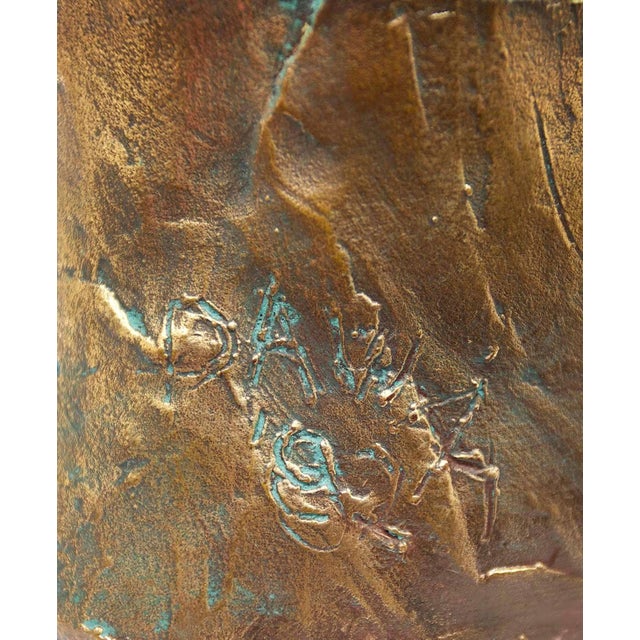
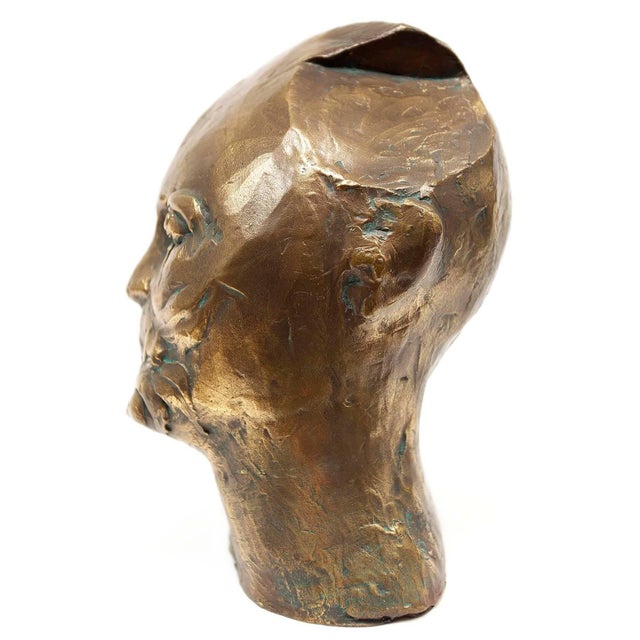
This is a bronze cast sculpture by Philip Pavia is part of his series of "Imaginary Portraits from the Club" …
Read more
This is a bronze cast sculpture by Philip Pavia is part of his series of "Imaginary Portraits from the Club" , a one-man exhibition at Max Protetch Gallery, New York in 1982. The approach at rendering the figure is grotesque, and the facial features have been severely distorted to the point were the portrait becomes an abstract interpretation of the subject.
As an artist and writer, Philip Pavia was a committed member of the Abstract Art community throughout his long, distinguished career. Pavia was active in the art world until his death in 2005 and received immense critical praise for his artistic and literary contributions. Recognized for his signature work The Ides of March, he produced monumental pieces that alternated between figurative and abstract styles. While he was a dedicated sculptor, Pavia extended that passion into writing and published It is: A Magazine for Abstract Art.
Born in 1911 of Provencal-Italian descent, the Stratford, Connecticut native received early inspiration from his father, a professional stone cutter. Pavia's sculptures are characterized by rough, chiseled bronze and marble, his father's trade was no doubt a significant influence. In fact, by 1934, his father was so enthusiastic about his son's passion that he encouraged young Philip to study at the Academia delle Belle Arti in Florence, Italy.
Before his studies in Europe, Pavia was briefly a student at Yale University but quickly dropped out and enrolled at New York's Art Student League. While attending school, he befriended artists Jackson Pollock and Arshile Gorky. All three were to become major players of the vibrant new Abstract Art movement. At his father's advice, Pavia embarked on his European experience and was introduced to other influential artists of his time. Traveling between Italy and Paris, Pavia met John Ferren, John Graham, Landes Lewitin, and writer Henry Miller.
In the 1940s, Pavia's career started to take form and he became a founding member of the art and intellectual group, The Club. Amongst the group's membership were legendary artists and thinkers including Willem and Elaine de Kooning, Franz Kline, John Cage, Robert Motherwell, Joseph Campbell, Barnett Newman, Hannah Arendt, and Leo Castelli. The group organized discussions that proved critical for the expansion of Abstract Art. The experience would inspire Pavia’s later writings. While flourishing as a facilitator of art theory, Pavia also showcased his sculpture in the 1946 exhibit "Five Americans: Sculpture Heads."
Well into the 1950s, Philip Pavia ended his work with The Club and, in 1956, founded the magazine It is: A Magazine for Abstract Art. In the publication, he reinforced his devotion to abstract art and expressed a dissenting opinion about surrealism and other art styles that favored a dreamy, fantasy-like direction. During this time of literary progress, he participated in a series of shows which included the Stable Gallery's annual exhibition and two self-titled shows at the Great Jones and Samuel Kootz galleries in New York. Pavia also made a television appearance in the feature Twelve Sculptors for NBC.
Pavia's art success continued into the 1960s with a group exhibition at New York's Museum of Modern Art. He was also featured in the BBC television program Twentieth Century American Sculptors in 1963. Pavia participated in another group show at New York's Green Gallery and returned to his native Connecticut for the show "Continuity and Change: Old and New Work by Contemporary Artists." There wasn't any shortage of coverage for Pavia as he landed more solo exhibitions at the Guggenheim Museum, San Francisco Museum of Art, and The Gallery of Modern Art in Washington, D.C.
However, his staggering success in the 1960s is not complete without the production of the renowned work The Ides of March. Crafted in 1963, this piece was commissioned by the New York Hilton to grace the entrance of their hotel. Comprising of four rhombus-shaped sculptures ranging in size of 6ft to 10ft, The Ides of March glistens with the natural bronze hues of moss green and rusted orange. The epic piece features Pavia’s signature rough, chiseled texture and abstract style. The masterpiece stood tall at the Hilton until it was eventually moved to the Hippodrome building in 1988.
Throughout his long career, Pavia crafted a range of different works that included abstracted heads in bronze, marble, and painted terracotta. He continued to produce more abstract works that favored simplistic yet heavily textured shapes, and sculptures were chiseled to look unrefined and mimic the action of pieces breaking in the process. The work never detoured from the realms of abstract and figurative, proving his devotion to the movement he helped shape.
His career momentum continued through the 1970s with the unveiling of his John F. Kennedy portrait at the Metropolitan Museum of Art. The unconventional portrait sculpture was crafted as a 6-foot bronze abstracted head. Pavia produced more large-scale works which included the colossal 10-foot tall marble piece Wind, Sand and Stars. More one-man exhibitions and group shows followed in the 1980s, and his signature bronze heads appeared in their own exhibition, Five Bronze Heads, for a show in Washington, D.C. By the late 1980s and early 1990s, he produced a great deal of marble works featured at New York's Thorp Gallery, Italy's Il Salotto Galleria, and the Guild Hall Museum.
Toward the end of his career, Philip Pavia continued to produce and exhibit works which showcased that lifelong devotion to the craft. Starting in 1995, he garnered a stream of accolades that included an honorary doctorate from the Pennsylvania Academy of Painting and Sculpture, becoming a 2002 Artists Equity honoree, receiving the prestigious Pollock-Krasner grant, and winning the Guggenheim Award for Sculpture. Two years before his death, Pavia exhibited his final collection of new works entitled "latest decade, black and white sculptures and related water colors."
Pavia remained active in the art world up until his death in 2005. However, an artist's life is never complete without a little controversy. One month before his death, a suspected art heist took place which involved his seminal work, The Ides of March. In preparation for its move to Hofstra University, the sculpture was packed up at a storage facility near its home at the Hippodrome. However, while waiting for the big move, three of the four pieces mysteriously went missing. A devastation for Pavia and the art community, people feared the pieces would never be recovered. However, as luck should have it, the pieces were found by a scrap metal dealer in the Bronx, and the work become whole once again before Philip Pavia passed.
See less
- Dimensions
- 8.5ʺW × 7ʺD × 11.5ʺH
- Styles
- Abstract Expressionism
- Art Subjects
- Figure
- Period
- 1980s
- Country of Origin
- United States
- Item Type
- Vintage, Antique or Pre-owned
- Materials
- Bronze
- Condition
- Good Condition, Original Condition Unaltered, Some Imperfections
- Color
- Bronze
- Condition Notes
- Good Good less
Questions about the item?
Returns & Cancellations
Return Policy - All sales are final 48 hours after delivery, unless otherwise specified in the description of the product.
Cancellation Policy - Prior to shipping or local pickup, buyers may cancel an order for up to 48 hours, unless otherwise specified.
Related Collections
- Roman Bronze Works Sculpture
- Mathurin Moreau Sculpture
- Loredano Rosin Sculpture
- Lime Sculpture
- Bakelite Sculpture
- Albert Ernest Carrier-Belleuse Sculpture
- Georgian Sculpture
- Peter Shire Sculpture
- Chaim Gross Sculpture
- Boris Lovet-Lorski Sculpture
- David Palombo Sculpture
- Gourd Sculpture
- Recycled/Repurposed Sculpture
- Polycarbonate Sculpture
- Worlds Away Sculpture
- Constantin Brancusi Sculpture
- Maison Jansen Sculpture
- Fernando Botero Sculpture
- Straw Sculpture
- Far Pavilions Sculpture
- Oil-Rubbed Bronze Finish Sculpture
- Sculpture in Panama City, FL
- Austin Productions Sculpture
- Mid-Century Modern Sculpture
- Brutalist Sculpture