

Details
Description
Paul jouve (1878-1973)
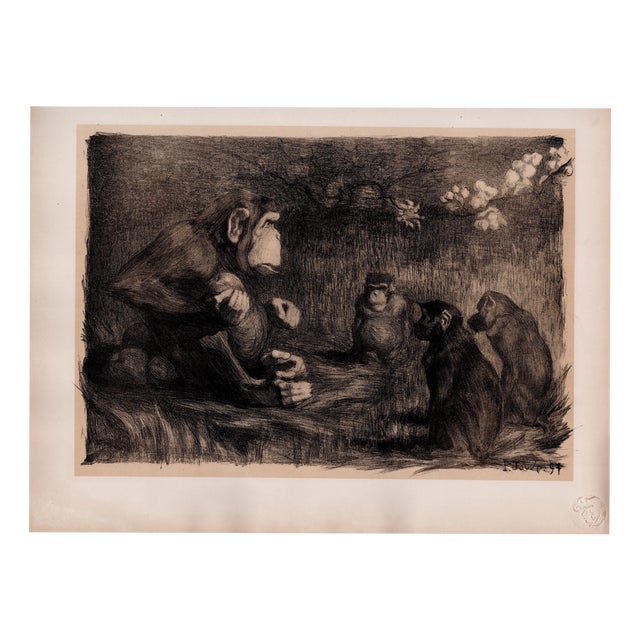
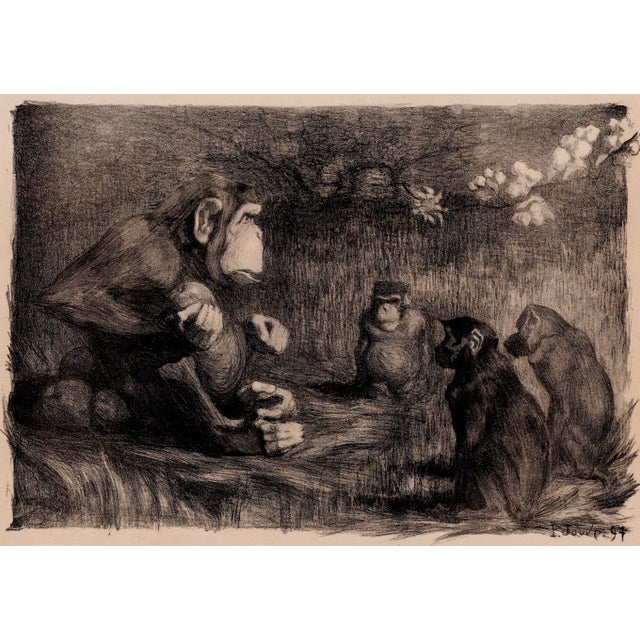
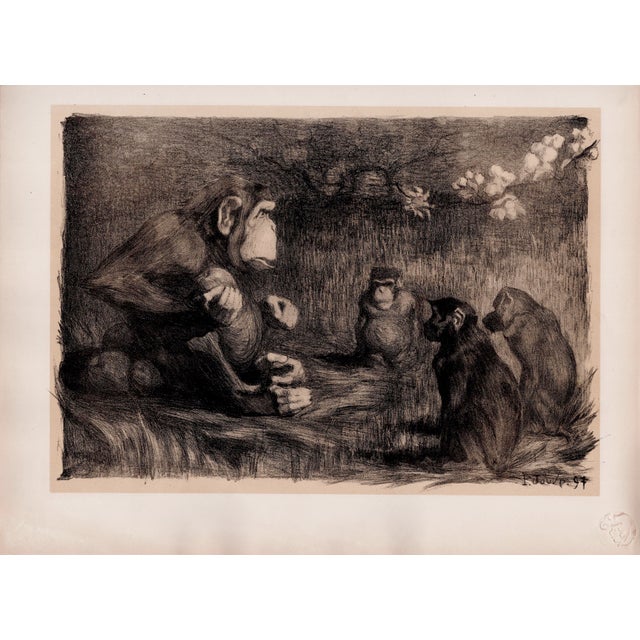
le jugement de paris
(the judgment of paris)
original lithograph from the glorious portfolio "l'estampe moderne", …
Read more
Paul jouve (1878-1973)
le jugement de paris
(the judgment of paris)
original lithograph from the glorious portfolio "l'estampe moderne", issue #6 (october 1897)
on wove paper
year: 1897
size (sheet): 405 x 305 mm
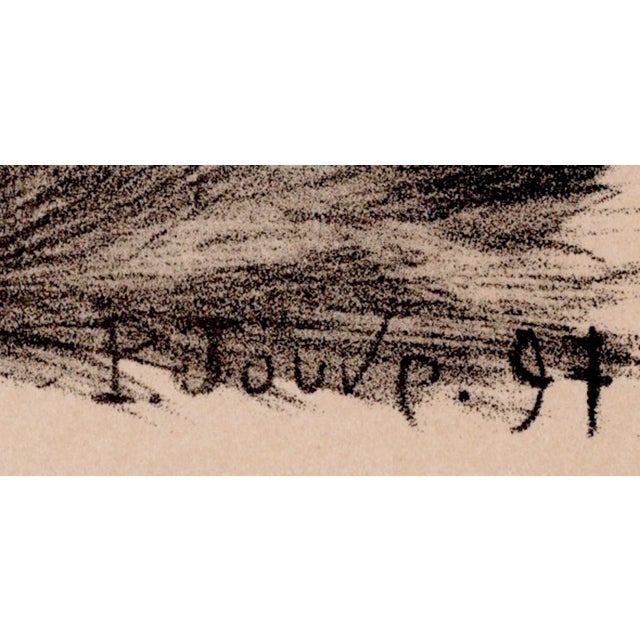
signed on the plate "p. Jouve 97", lower right
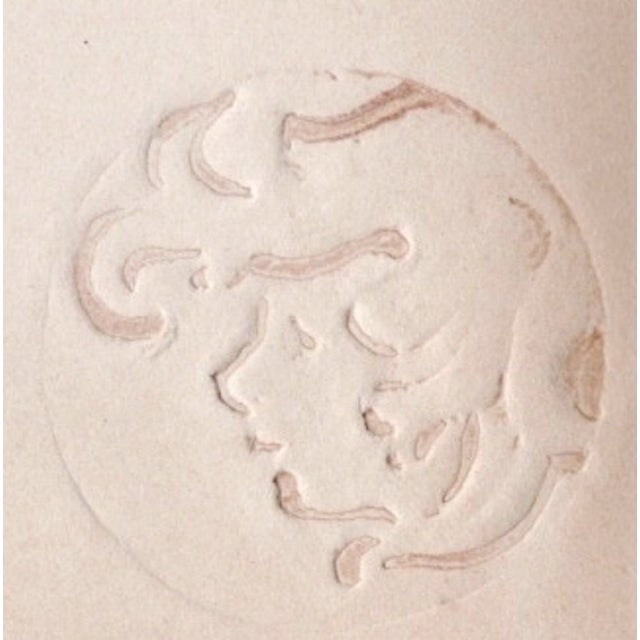
blind stamp of the publisher, lower right
excellent condition: minor signs of age and handling
full margins (not cropped, not trimmed)
___
about the collection (l'estampe moderne)
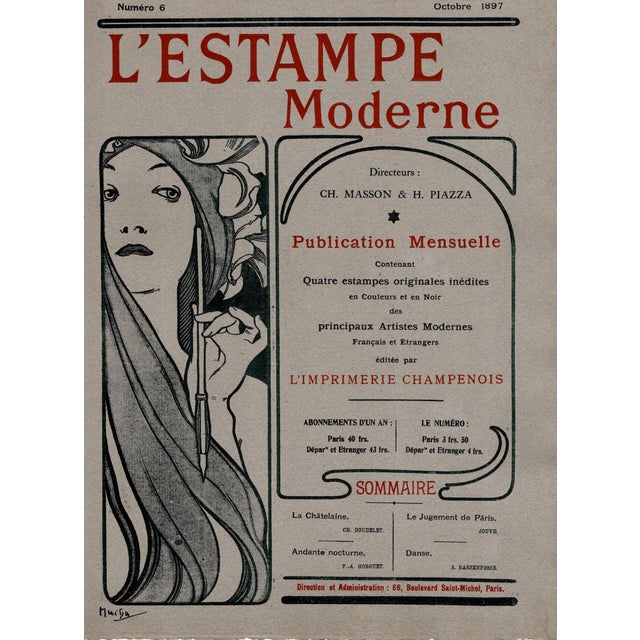
l'estampe moderne appeared in 1897-1899 as a series of 24 monthly fascicles, each containing 4 original lithographs, printed by parisian imprimerie champenois. Many accomplished european art nouveau painters contributed works to this publication, which contained only original prints invented and produced especially for this collection. The publication was edited by charles masson and h. Piazza. Each issue came in a paper cover bearing an original lithograph by alphonse mucha.
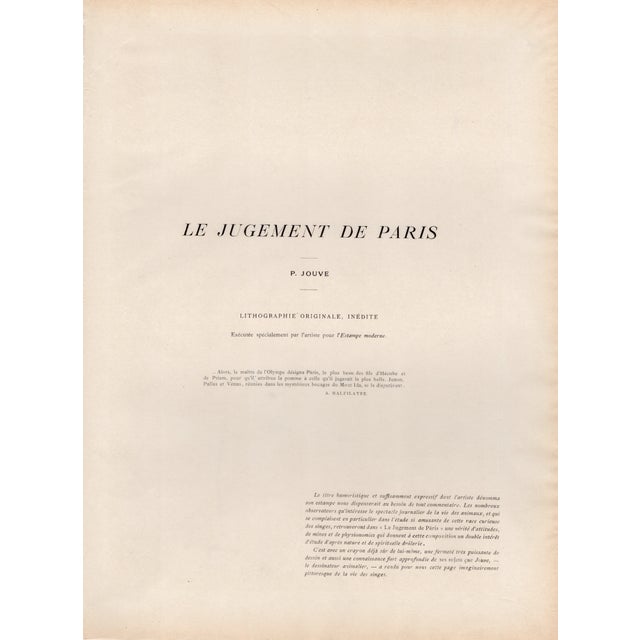
each lithograph was accompanied by a tissue containing the details (title of the artwork, name of the artist, etc.) and a short text by a well-known author who inspired the artist.
___
the artist
paul jouve (1875–1973) was a preeminent figure in the french art deco movement, best known for his powerful and stylized depictions of animals. The son of a painter and a regular at the jardin des plantes in paris, jouve developed an anatomical precision that he combined with a modern, monumental aesthetic. He gained international fame for his stunning illustrations of rudyard kipling’s the jungle book, which established him as the leading "animalier" of his generation. His style is defined by bold, thick outlines, a dramatic use of gold and silver leaf, and a sense of primal energy. Jouve’s creatures—panthers, lions, and serpents—are rarely mere biological studies; they are regal, totemic figures that embody both danger and decorative grace. His work across painting, sculpture, and etching remains a testament to the sophisticated, exotic elegance that defined early 20th-century french luxury and design.
in this lithograph, jouve’s irony lies in the subversion of classical grandeur. By casting primates in a legendary tale of divine beauty, he pokes fun at human pretension and the vanity of the "golden apple." he suggests that our complex social rituals and obsession with status are, at their core, merely sophisticated animal instincts.
___
from the text on the tissue paper:
"\. Alors, le maître de l'olympe désigna pâris, le plus beau des fils d'hécube et de priam, pour qu'il attribue la pomme à celle qu'il jugerait la plus belle. Junon, pallas et vénus, réunies dans les mystérieux bocages du mont ida, se la disputèrent.
a. Malfilatre.
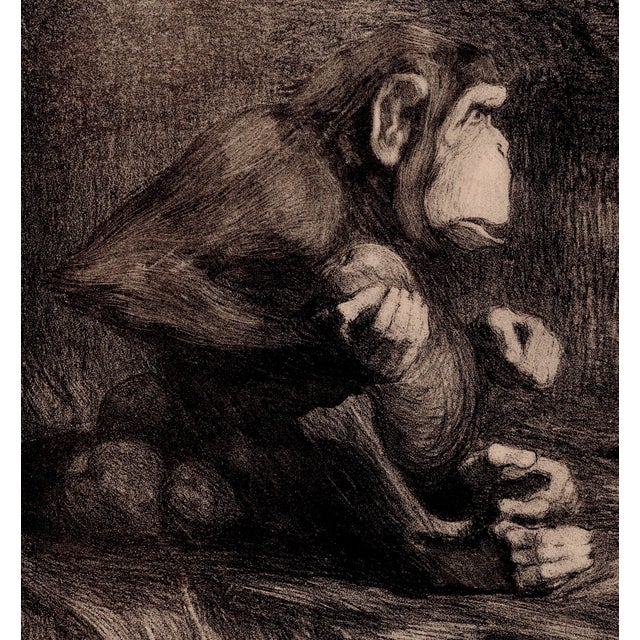
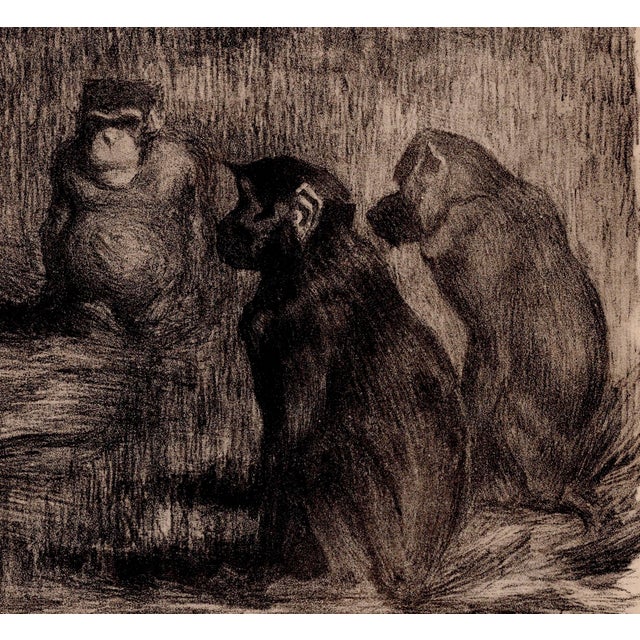
le titre humoristique et suffisamment expressif dont l'artiste dénomma son estampe nous dispenserait au besoin de tout commentaire. Les nombreux observateurs qu'intéresse le spectacle journalier de la vie des animaux, et qui se complaisent en particulier dans l'étude si amusante de cette race curieuse des singes, retrouveront dans « le jugement de pâris » une vérité d'attitudes, de mines et de physionomies qui donnent à cette composition un double intérêt d'étude d'après nature et de spirituelle drôlerie.
c'est avec un crayon déjà sûr de lui-même, une fermeté très puissante de dessin et aussi une connaissance fort approfondie de ses sujets que jouve, le dessinateur animalier, - a rendu pour nous cette page imaginairement pittoresque de la vie des singes."
english translation:
\.then, the master of olympus designated paris, the most handsome of the sons of hecuba and priam, to award the apple to the one he judged the most beautiful. Juno, pallas, and venus, gathered in the mysterious groves of mount ida, fought over it.
— a. Malfilâtre
the humorous and sufficiently expressive title with which the artist named his print would, if necessary, spare us from any commentary. The many observers interested in the daily spectacle of animal life, and who especially delight in the amusing study of that curious race of monkeys, will find in "the judgment of paris" a truthfulness of attitudes, expressions, and countenances that give this composition a double interest: a study from nature and a display of witty drollery.
it is with a pencil already sure of itself, a very powerful firmness of line, and also a highly profound knowledge of his subjects that jouve—the animal artist—has rendered for us this imaginatively picturesque page from the life of monkeys.
___
important:
. The listing is for the original print, in the above mentioned excellent condition.
. The original tissue paper introduction will be given to the buyer as a gift
. The cover by mucha and the edition (back of the cover) are shown as a reference and proof of authenticity and edition this piece has an attribution mark,
i am sure that it is completely authentic and take full responsibility for any authenticity
issues arising from misattribution
See less
Returns & Cancellations
Return Policy - All sales are final 48 hours after delivery, unless otherwise specified in the description of the product.
Cancellation Policy - Prior to shipping or local pickup, buyers may cancel an order for up to 48 hours, unless otherwise specified.
Related Collections
- Patrick Nagel Reproduction Prints
- William Hogarth Reproduction Prints
- Hable Reproduction Prints
- Reproduction Prints in Panama City, FL
- Reproduction Prints in Boise
- Alvar Aalto Reproduction Prints
- Daylight Dream Editions Reproduction Prints
- Leather Reproduction Prints
- Edward S. Curtis Reproduction Prints
- Mark D. Sikes Reproduction Prints
- Polychrome Reproduction Prints
- Dorothy Draper Reproduction Prints
- Restoration Hardware Reproduction Prints
- Lauren Ralph Lauren Reproduction Prints
- Ralph Lauren Home Reproduction Prints
- Serena and Lily Reproduction Prints
- Tuscan Reproduction Prints
- Bunny Williams Home Reproduction Prints
- Ralph Lauren Reproduction Prints
- Sister Parish Reproduction Prints
- Jonathan Adler Reproduction Prints
- Gold-Plate Reproduction Prints
- Reproduction Prints in Mobile
- Utagawa Kunisada (Toyokuni Iii) Reproduction Prints
- Port 68 Reproduction Prints