

Details
Description
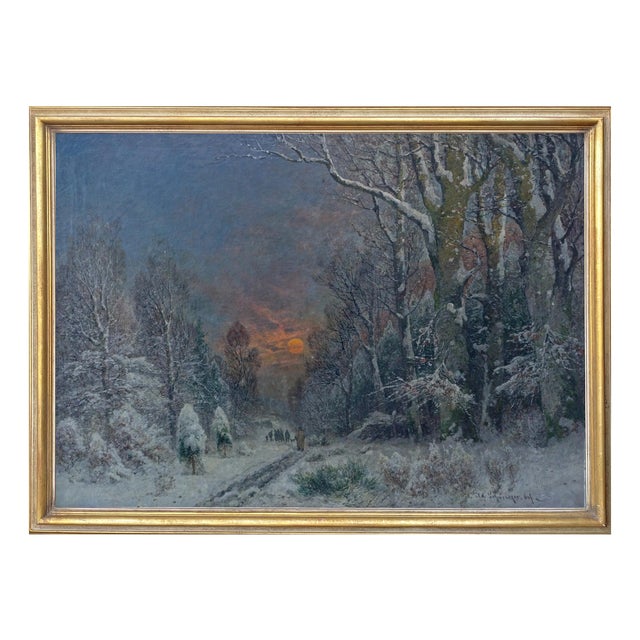
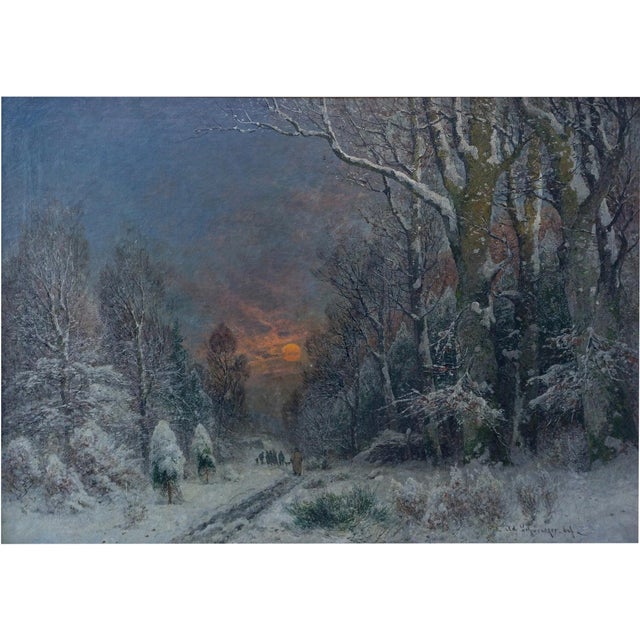
Winter night landscape by a. Gustav schweitzer
winter nocturne with snow depicting a wooded winter landscape illuminated by moonlight, with …
Read more
Winter night landscape by a. Gustav schweitzer
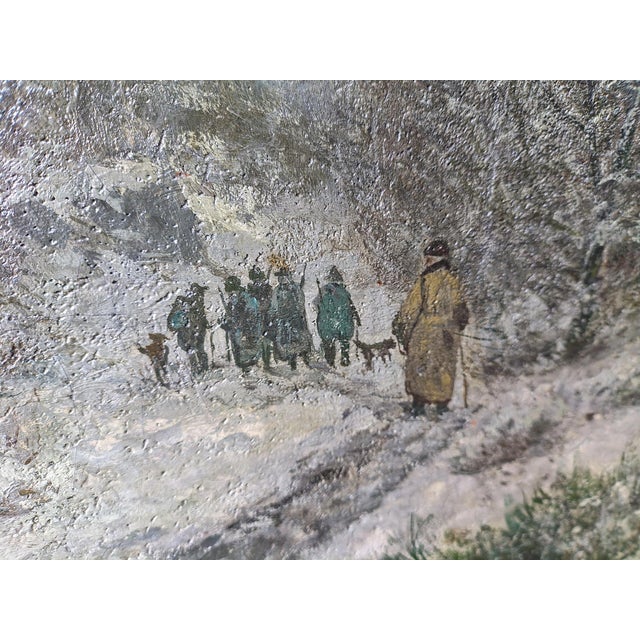
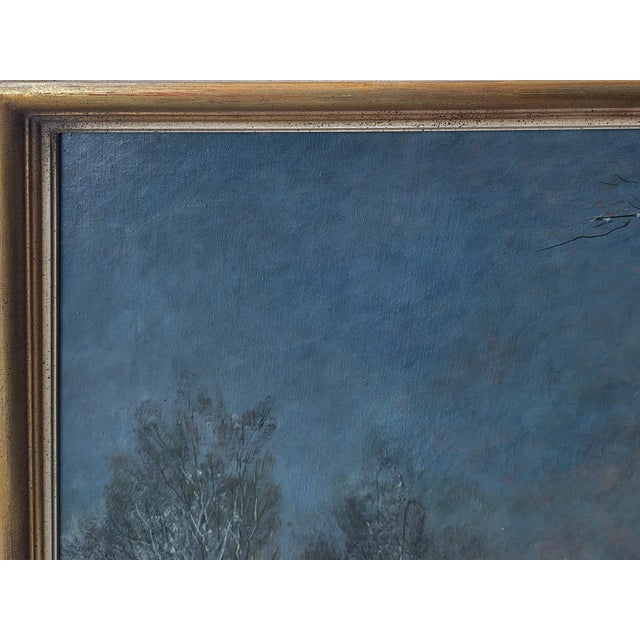
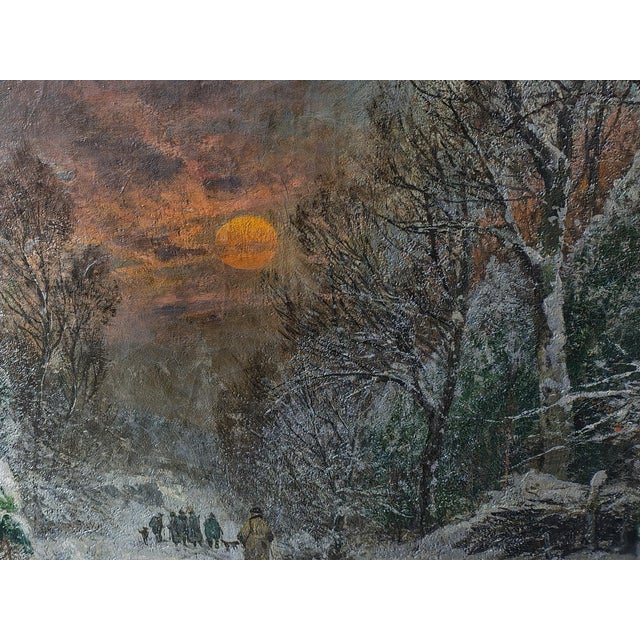
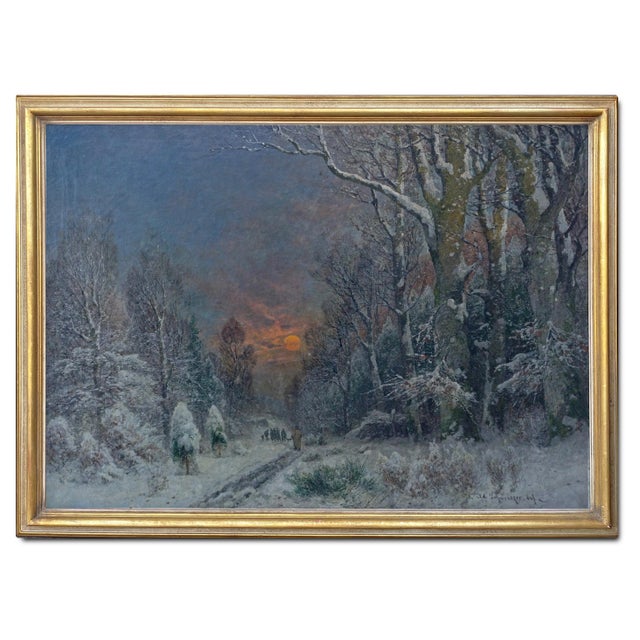
winter nocturne with snow depicting a wooded winter landscape illuminated by moonlight, with figures walking and gradually entering the forest.
technical information
period: 1880 – 1890
origin: germany
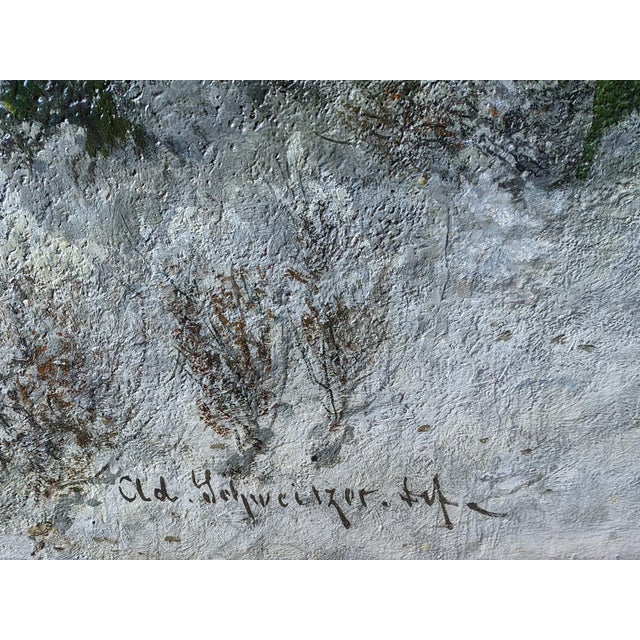
artist: a. Gustav schweitzer
technique: oil on canvas
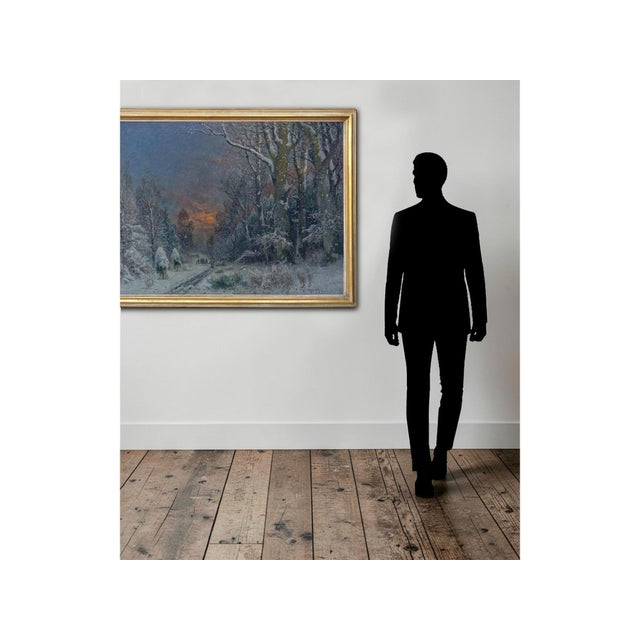
artwork dimensions: 90 × 125 cm (35.43 × 49.21 in)
night has only recently fallen over the forest, and the snow that stopped a few hours earlier seems to have softened every element of the landscape, as if the world had been wrapped in a silent breath. The air is still and muted; the tree branches, weighed down by snow, stand out darkly against a sky that is slowly fading.
in the distance, the only sound is the faint crunch of snow beneath footsteps. A small group of figures advances along the path, accompanied by two dogs, gradually disappearing into the heart of the forest. Their silhouettes become increasingly indistinct, absorbed by the depth of the trees and the shadows of evening.
when even the last trace of their passage fades away, absolute silence will return: the dense, muffled silence that only a snowy forest at night can offer—a silence that is not empty, but filled with quiet and anticipation.
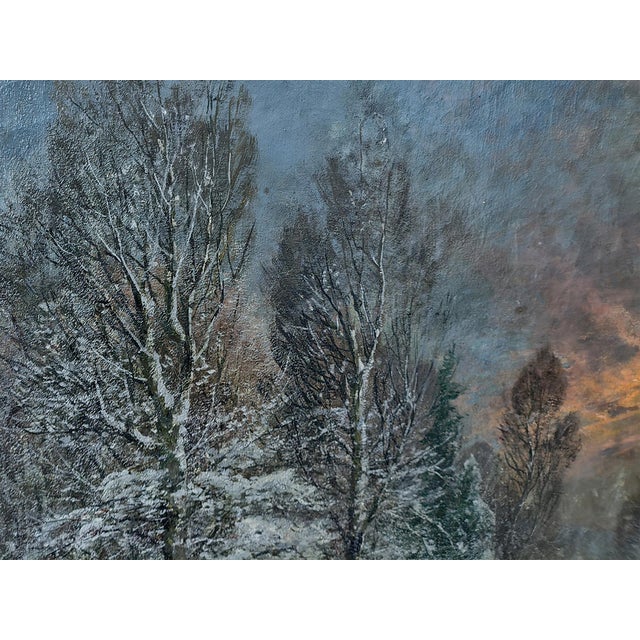
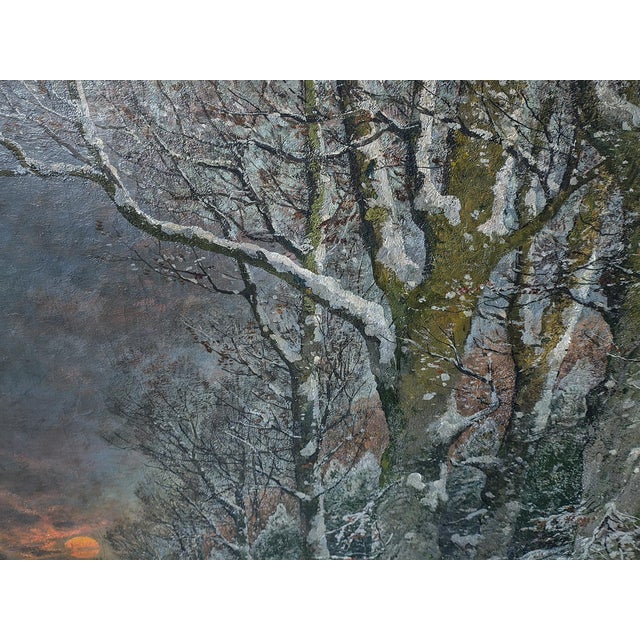
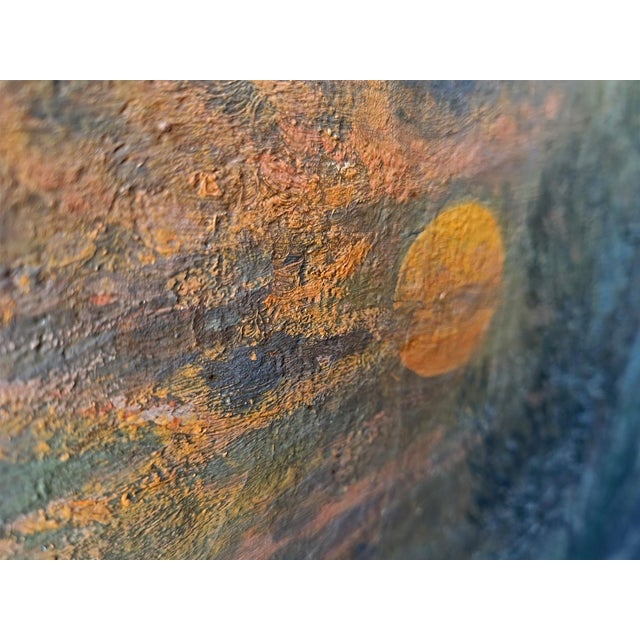
the composition is dominated by leafless trees whose vertical masses articulate the pictorial space and frame the twilight sky. In the background, a veiled lunar disc emerges through dense clouds, spreading a warm, subdued light that contrasts with the cold tones of the snow and shadows.
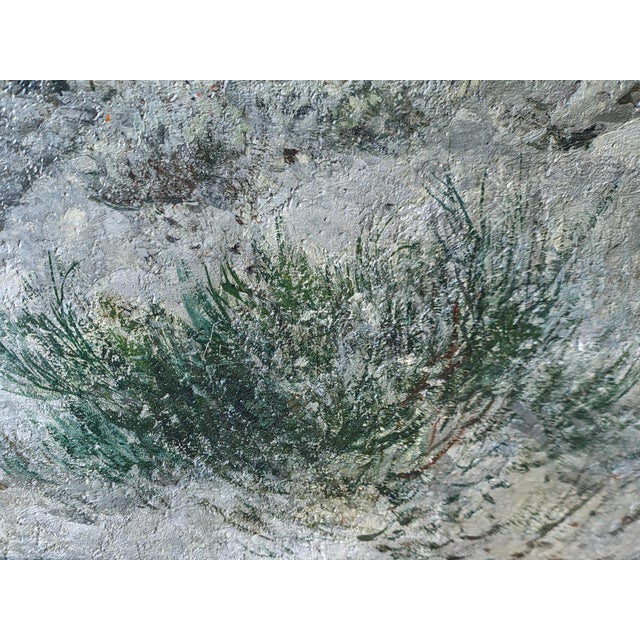
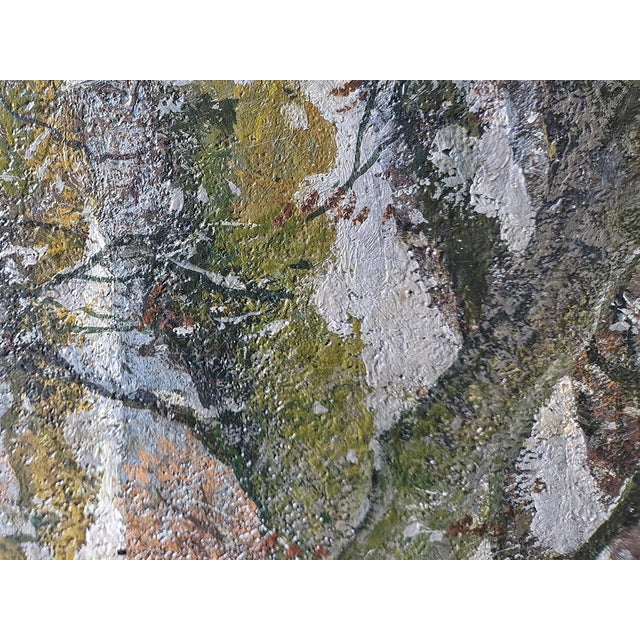
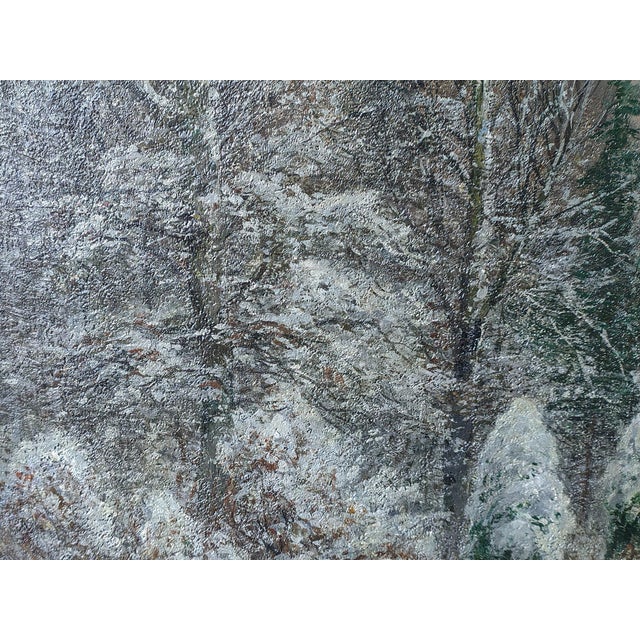
the paint surface is compact, with a visible and layered application, particularly evident in the sky and the tree trunks, where form is built through overlapping strokes and tonal variations. The atmosphere is silent and suspended, conveyed through the dialogue between nocturnal light, the snowy landscape, and a human presence reduced to a secondary narrative element.
adolf gustav schweitzer (1847–1914)
gustav adolf schweitzer (dessau, 1847 – düsseldorf, 1914) was a german landscape painter active in the second half of the nineteenth century and associated with the düsseldorf school, one of the most important centers of european landscape painting of the period. Born in the duchy of anhalt, he received his artistic training at the kunstakademie düsseldorf, where he studied between 1866 and 1868 in the class of oswald achenbach, a key figure in the naturalistic renewal of romantic landscape painting.
his career was temporarily interrupted by his voluntary participation in the franco-prussian war (1870–1871). After returning to artistic activity, schweitzer completed his training under eugen dücker and albert flamm, developing a painting style attentive to atmospheric values, luminous effects, and balanced spatial construction. Although he settled permanently in düsseldorf, he remained a deeply itinerant artist, undertaking numerous study trips throughout germany, belgium, and france.
his works are characterized by views of fjords, rocky coastlines, harbors, and inlets, alongside an extensive production of winter landscapes: snow-covered forests, roads immersed in silence, sledges, and figures set within vast and contemplative natural environments. In these paintings, human presence is always subordinate to the majesty of nature, reflecting a distinctly nineteenth-century vision of the landscape as a space of reflection and measure.
stylistically, schweitzer maintained a restrained and realistic language faithful to the principles of the düsseldorf school, enriched by a lyrical sensitivity that emerges especially in twilight and nocturnal scenes, often illuminated by moonlight or the glow of sunset. His painting avoids spectacular effects, instead favoring a quiet, atmospheric narrative built through a sober palette, cool tones, and meticulous attention to seasonal and climatic conditions.
from 1872 onward, schweitzer exhibited regularly in major german cities including düsseldorf, berlin, dresden, and vienna, achieving solid public and critical success. His works were also appreciated in official circles of the german empire, and among his admirers was emperor wilhelm ii. At his death in düsseldorf in 1914, he left behind a coherent and recognizable body of work, now held in museum and private collections and still valued on the art market for its technical quality and compositional balance.
See less
- Dimensions
- 49.21ʺW × 3.94ʺD × 35.43ʺH
- Styles
- Rustic
- Country of Origin
- Germany
- Item Type
- Vintage, Antique or Pre-owned
- Condition
- Unknown, Some Imperfections
- Color
- Blue
- Condition Notes
- Patina Consistent with Age and Use,Completely Restored Patina Consistent with Age and Use,Completely Restored less
Returns & Cancellations
Return Policy - All sales are final 48 hours after delivery, unless otherwise specified in the description of the product.
Cancellation Policy - Prior to shipping or local pickup, buyers may cancel an order for up to 48 hours, unless otherwise specified.
Related Collections
- Photorealism Canvas Paintings
- Ed Ruscha Paintings
- Photorealism Paintings in New York
- Richard Serra Paintings
- Louise Nevelson Paintings
- Silk Velvet Paintings
- Herman Miller Paintings
- BDDW Paintings
- Karl-Erik Ekselius Paintings
- Carl-Axel Acking Paintings
- Joseph Stella Paintings
- James McCray Paintings
- Milton Avery Paintings
- Photorealism Paintings in Los Angeles
- Leroy Neiman Paintings
- Jaanika Peerna Paintings
- Jo Baskerville Paintings
- Nicola Simbari Paintings
- Soicher Marin Paintings
- Cassina Paintings
- Black Photorealism Paintings
- Lawson-Fenning Paintings
- White Abstract Paintings
- Vienna Secession Paintings
- Red Abstract Paintings