



Details
Description
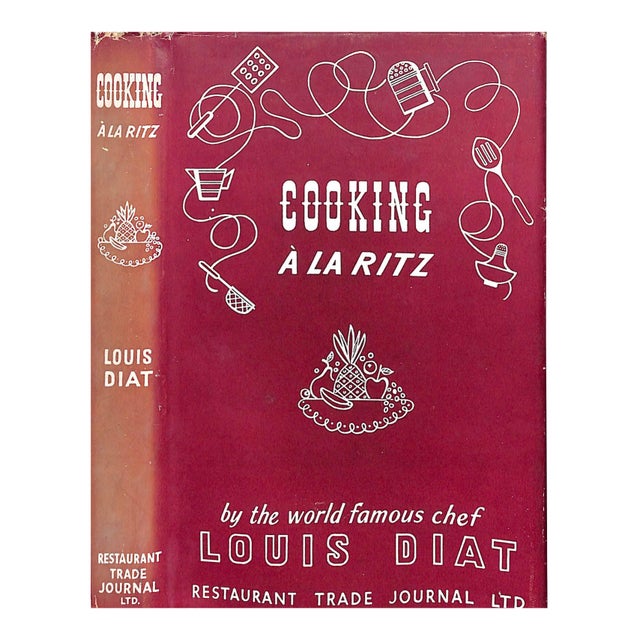
DIAT, Louis
Louis Felix Diat (May 5, 1885 – August 29, 1957) was a French-American chef and culinary writer. It …
Read more
DIAT, Louis
Louis Felix Diat (May 5, 1885 – August 29, 1957) was a French-American chef and culinary writer. It is also believed that he created vichyssoise soup during his time at the Ritz-Carlton.
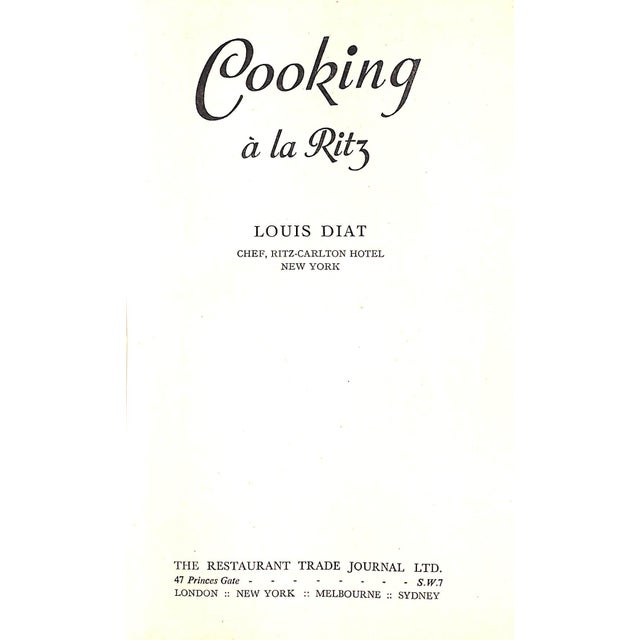
Chef, Ritz-Carlton Hotel New York City
[255] pp.
The Restaurant Trade Journal Ltd.
1946
Second Printing
8 3/4" x 6"
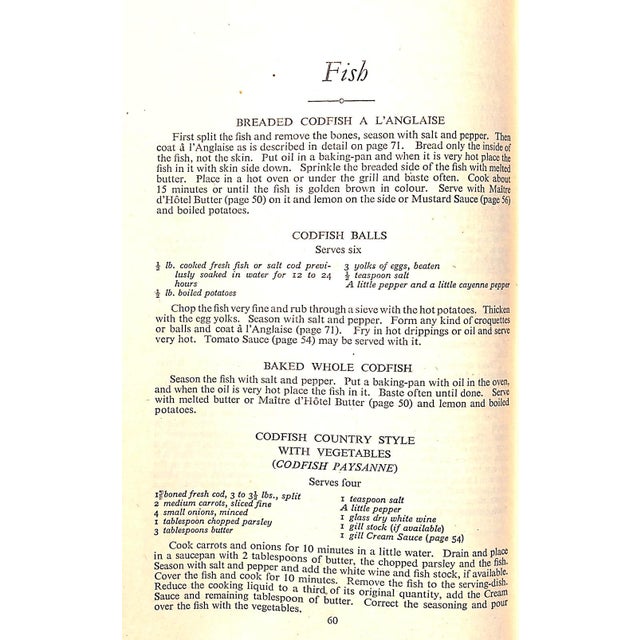
Virtually everyone enjoys the peasant-style cooking of France- the pot au feu, petite marmite and so on a fact that is proved by the popularity of restaurants specializing in that simple, yet imaginative, sort of food. Yet few of us try to imitate such cookery in our own kitchens. If we did, we would not only gain gastronomically but be surprised at the difference in our grocery bills. For aside from being delicious, the meals of the French provinces are thrifty, too. Though he has been chef of the Ritz-Carlton Hotel for more than thirty-five years, Louis Diat knows the cooking of the French country- side as well as he does the more elaborate-and much more expensive-haute cuisine of the big cities, for which his establishment is noted. He grew up in the district of Bourbon, and remembering his mother's delicious, unpretentious dishes, he wrote his "Home Cook Book," subtitled "French Cooking for Americans," which is published today (J. B. Lippincott, $2,50). The author of "Cooking a la Ritz,” a previous volume that deals, as the title suggests, with the haute cuisine, reminded us yesterday that staying within a budget means know-how with leftovers, which all French cooks have. When we asked the whys of their knowledge-what they have that we lack -he shook his head.
Main Need Is Interest
"No, Americans have every- thing,' he said. “They could do it as well as the French, but one has to be interested. In France girls of 11 already are able to prepare meals from watching and helping their mothers. It's early training that does it, especially when it comes to making a left-over vegetable taste like a first- appearance dish.” And how do you do that? Mr. Diat explained it like this: "Suppose you have a few vegetables you want to use up. Take a large onion, or a turnip, if you prefer, parboil it and remove the center. Chop the center and mix it with chopped leftover vegetables- carrots, celery ends, a little potato perhaps, to thicken it-stuff the onion or turnip with the mixture, season and sprinkle with fine breadcrumbs. Cook with a little gravy: in a hot oven till brown. What have you got? Ragout of vegetables, a meal in itself."
When it comes to meat it's a simple matter-and an economical one-to plan two or three meals from the same roast without making them dull, Mr. Diat said. "In France all the bones are cooked so much that there's nothing left on them when they're thrown away. Meat has never been too plentiful in the country, nor have the best cuts always been available. So the French prepare braised dishes that take long, gentle cooking to make the meat tender. It must simmer so quietly that it hardly bubbles.
"Suppose you plan a pot roast one night. The next day the meat can be sautéed with a piquant sauce. Or dip the sliced pieces into mustard, bread them and broil. If there's just a cup of chopped meat left it will stuff that onion or turnip or a head of lettuce. Then there's always the possibility of soup, made with a stock from the leftover meat, plus vegetables and anything flavorful that finds no other use to be cooked unhurriedly in the earthenware marmite. French soups are often complete meals."
Mr. Diat had a word to say about gravies. Thickening them with flour a scarce commodity at the moment-is nothing short of an abomination at any time, he declared, pointing out that a little water in the bottom of the pan, or wine if you have it, combined with the drippings from the roast, gives a gravy that really tastes of the chicken, veal or whatever, while flour ruins the flavor.
Some Pointers About Fish
As to fish, which is almost always available and inexpensive, Mr. Diat is convinced that it is less popular here than in France simply because it is not treated with the proper respect. Fried or plain boiled fish gets tiresome, he admitted, but with a good sauce you will like any fish. Incidentally, Mr. Diat favors using what little butter you may be able to get in cooking rather than put it on the table. That not only saves butter but, in his opinion, is the only way to eat it. Especially does he recommend saving it for fish and vegetable dishes. What about salads? A French salad is very dry, Mr. Diat pointed out, which saves oil. It should be well mixed, but there should be no liquid on the plate. His own favorite consists of chopped radishes, a little dandelion greens, watercress and lettuce, topped with Yogurt instead of a dressing, which, of course, eliminates oil altogether, in line with current conservation measures. Mr. Diat firmly believes that fine cooking is the basis of a happy life. "Men like to eat well," was his final bit of advice, “so if you want to keep your husband home, learn to be a good cook." We can add that if you are lacking in inspiration, you will find it in his book, which, among many others, offers this recipe-thrifty, yes, but not dismal:
BEEF HASH A LA BOURBONNAISE
2 tablespoons fat
1 large onion, finely chopped
2 cups leftover boiled, braised or roasted beef, chopped
2 cups freshly cooked potatoes, chopped
½ teaspoon salt
A little pepper
1 teaspoon chopped parsley
Fine breadcrumbs
1 tablespoon butter.
Melt fat, add onion and cook until golden. Remove from fire, add remaining ingredients and mix all together well. Spread in a well- greased, flat, earthenware dish and sprinkle top with crumbs and dot with butter. Put in a moderately hot oven (400 degrees F.) and cook until brown on top. Serves three
See less
- Dimensions
- 6ʺW × 1ʺD × 8.75ʺH
- Styles
- Traditional
- Period
- 1940s
- Country of Origin
- United States
- Item Type
- Vintage, Antique or Pre-owned
- Materials
- Paper
- Condition
- Good Condition, Original Condition Unaltered, Some Imperfections
- Color
- Brown
- Condition Notes
- Very good/ Very good Very good/ Very good less
Questions about the item?
Returns & Cancellations
Return Policy - All sales are final 48 hours after delivery, unless otherwise specified in the description of the product.
Cancellation Policy - Prior to shipping or local pickup, buyers may cancel an order for up to 48 hours, unless otherwise specified.
Related Collections
- Bone Books
- Porcelain Books
- Celadon Books
- Digital Books
- René Magritte Books
- Oyster Gray Books
- The Hudson River School Books
- Gustav Klimt Books
- Vienna Secession Books
- Raoul Dufy Books
- Fernand Léger Books
- Gemstone Books
- Leather Books
- Coffee Table Books
- Pink Books
- Cartier Books
- Decorative Books
- Byzantine Books
- Alabaster Books
- Classical Greek Books