










Details
Description
ANTONIO CANOVA (AFTER)
Italian, 1757-1822
"Hebe Descending"
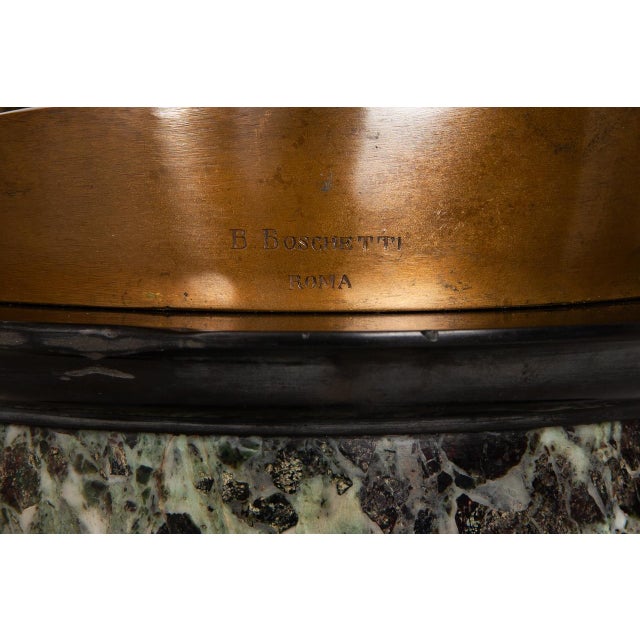
Cast by the foundry of B. Boschetti, Rome circa 1870
Patinated bronze raised …
Read more
ANTONIO CANOVA (AFTER)
Italian, 1757-1822
"Hebe Descending"
Cast by the foundry of B. Boschetti, Rome circa 1870
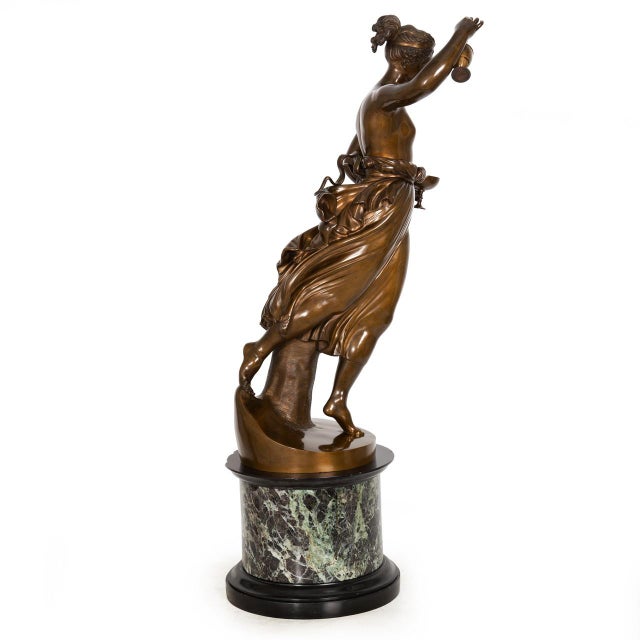
Patinated bronze raised over the original cylindrical black and verde marble base
31 5/8" H x 10" diameter (with base)
24 1/8" H x 7 1/2" diameter (sculpture only)
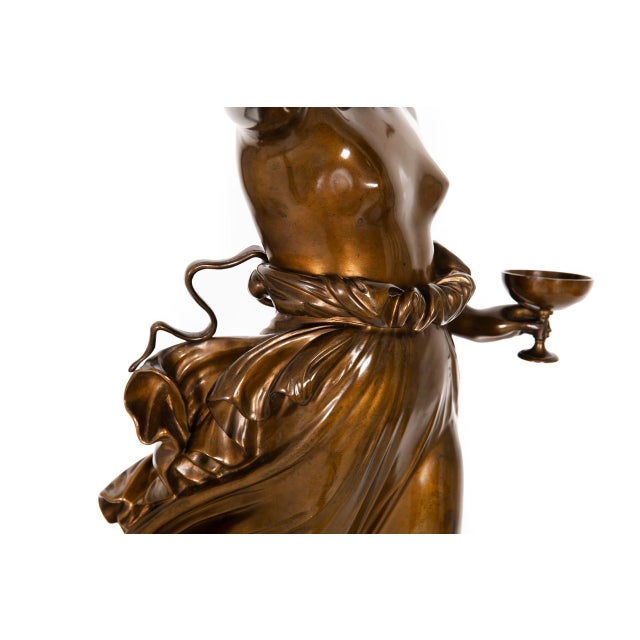
A finely cast bronze reduction of Hebe, after the celebrated model executed in marble in 1796 by Antonio Canova held in the permanent collection of the Nationalgalerie (National Museums in Berlin). Goddess of youth and cupbearer to the gods, Hebe advances with measured grace, one arm raised to pour from her ewer while the other steadies a shallow tazza. The composition conveys forward movement, the figure poised as if descending lightly from the clouds. Her gestures are restrained yet generous, embodying the ceremonial offering of the elixir of immortality. Viewed from the side, Hebe is in full motion and almost stepping over the edge of her plinth in a highly dramatic modeling that makes the use of a heavy marble base as a counterbalance an important design consideration.
The drapery gathers and releases in fluid bands across her hips and legs, accentuating rather than obscuring the form beneath. The upper torso is modeled with characteristic restraint, capturing Hebe in an almost dream-like removal from reality while maintaining perfect realism. In this bronze reduction, the glowing light-brown patina echoes the translucence of Canova's marble and achieves the impossible task of making a cold and unforgiving metal surface feel warm and tactile.
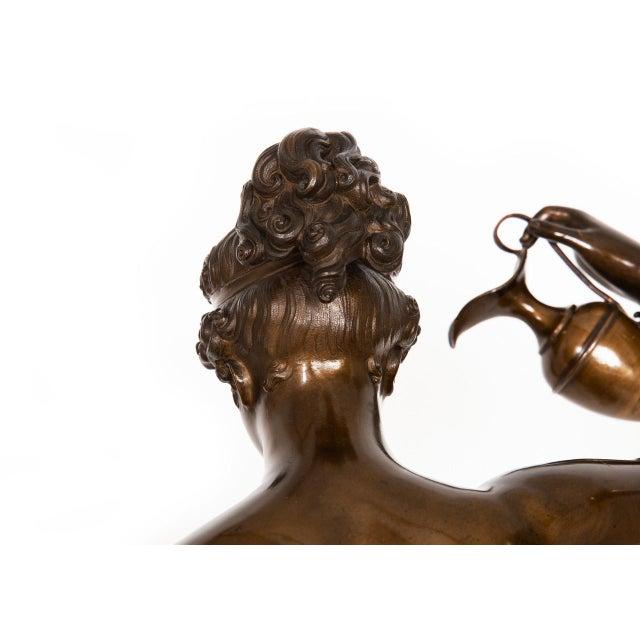
This example was cast by the Roman foundry of Benedetto Boschetti, active in the second half of the nineteenth century and well-known for the extraordinary quality of reductions his firm cast after canonical Italian sculpture for the Grand Tour market. The present model is no exception with exceedingly high degree of care shown to even the smallest details - her hair is hammered and chiseled with precision, her eyelids and fingernails treated with a jeweler-grade attention to detail, the surface literally flawless in its smooth presentation. The figure rests over a pintle mounted on a cylindrical verde antico marble socle above a black marble plinth, forming a balanced architectural support for the ascending pose and also being free to easily rotate.
An exceedingly rare example, this model is all the more precious for the retention of the original jug (with a replaced handle) and tazza. An example was offered at Sotheby's, London on 12 December 2018 (lot no. 1) missing the jug, the tazza and without a base where it achieved 7500 GBP (or roughly $ 9,500 USD at the time of sale).
Antonio Canova was born in Possagno, Italy, on November 1, 1757. Trained in drawing and sculpture from an early age, he became a pupil of Giuseppe Torretto at thirteen. By his late teens he was receiving commissions from prominent Venetian patrons.
In 1779 he relocated to Rome, where he established the foundation of his international reputation. There he developed the sculptural language that came to define European Neoclassicism. His work was characterized by clarity of contour, refined modeling, and an idealized treatment of the human figure grounded in the study of antiquity.
Around 1800 Canova enjoyed widespread acclaim throughout Europe. His sculptures, including Perseus with the Head of Medusa and The Three Graces, were regarded as the very embodiment of contemporary ideals of sentiment and cultivated sensibility.
Canova died in Venice on October 13, 1822.
Condition: A fine even light-brown patina with very minor wear and discoloration, carefully cleaned and sealed in conservator’s wax. The handle and socle of the ewer are replaced, front of ewer drilled and tapped to allow the ewer to be properly and permanently joined to her forearm. Ewer and tazza are otherwise original. Large worn loss to the uppermost edge of the black marble base rim, with other minor chips to the marble. A very fine presentation, ready to place.
ref. 512KHP12A
See less
- Dimensions
- 20ʺW × 10ʺD × 31.63ʺH
- Styles
- Italian
- Art Subjects
- Figure
- Period
- 19th Century
- Country of Origin
- Italy
- Item Type
- Vintage, Antique or Pre-owned
- Materials
- Bronze
- Marble
- Condition
- Good Condition, Restored, Some Imperfections
- Color
- Brown
- Condition Notes
- A fine even light-brown patina with very minor wear and discoloration, carefully cleaned and sealed in conservator’s wax. The handle … moreA fine even light-brown patina with very minor wear and discoloration, carefully cleaned and sealed in conservator’s wax. The handle and socle of the ewer are replaced, front of ewer drilled and tapped to allow the ewer to be properly and permanently joined to her forearm. Ewer and tazza are otherwise original. Large worn loss to the uppermost edge of the black marble base rim, with other minor chips to the marble. A very fine presentation, ready to place. less
Questions about the item?
Returns & Cancellations
Return Policy - All sales are final 48 hours after delivery, unless otherwise specified in the description of the product.
Cancellation Policy - Prior to shipping or local pickup, buyers may cancel an order for up to 48 hours, unless otherwise specified.
Related Collections
- Straw Sculpture
- Louis XIV Sculpture
- Fernando Botero Sculpture
- Constantin Brancusi Sculpture
- Roman Bronze Works Sculpture
- Worlds Away Sculpture
- Flavio Poli Sculpture
- Far Pavilions Sculpture
- Georgian Sculpture
- Magenta Sculpture
- Antique Iron Finish Sculpture
- Medium-Density Fibreboard Sculpture
- Gold-Plate Sculpture
- Bakelite Sculpture
- Maison Jansen Sculpture
- Sculpture in Columbus
- Polished Brass Finish Sculpture
- René Lalique Sculpture
- Albert Ernest Carrier-Belleuse Sculpture
- Sculpture in Panama City, FL
- Barovier and Toso Sculpture
- Gourd Sculpture
- Recycled/Repurposed Sculpture
- Photography Sculpture
- Geode Sculpture