

Details
Description
Robert Longo (American, born 1953)
Charles Clough (American, born 1951)
Collaboration
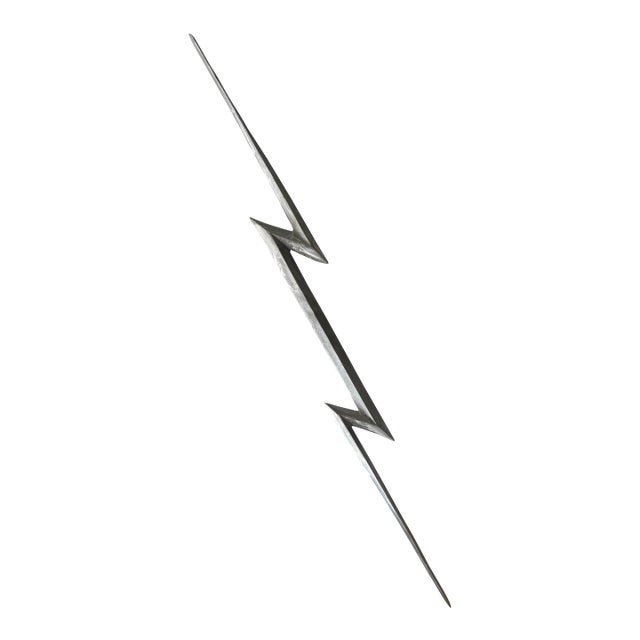
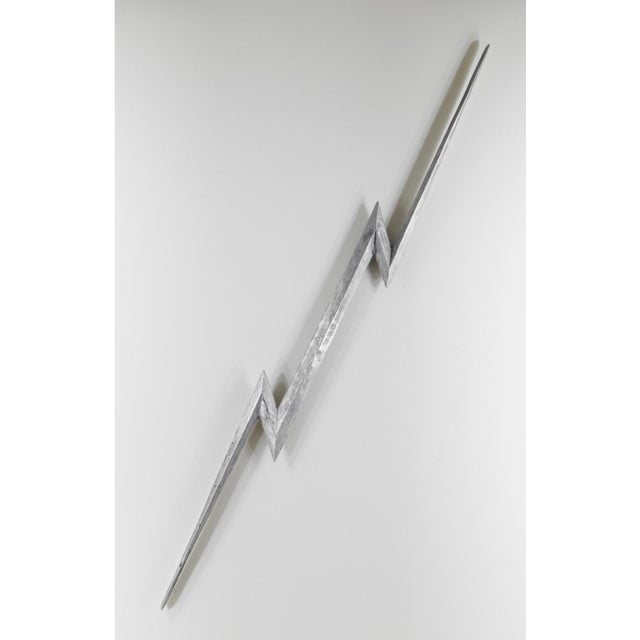
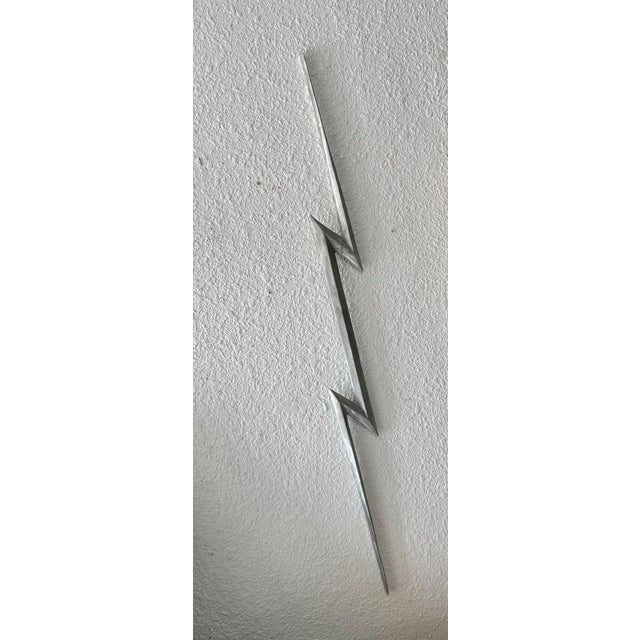
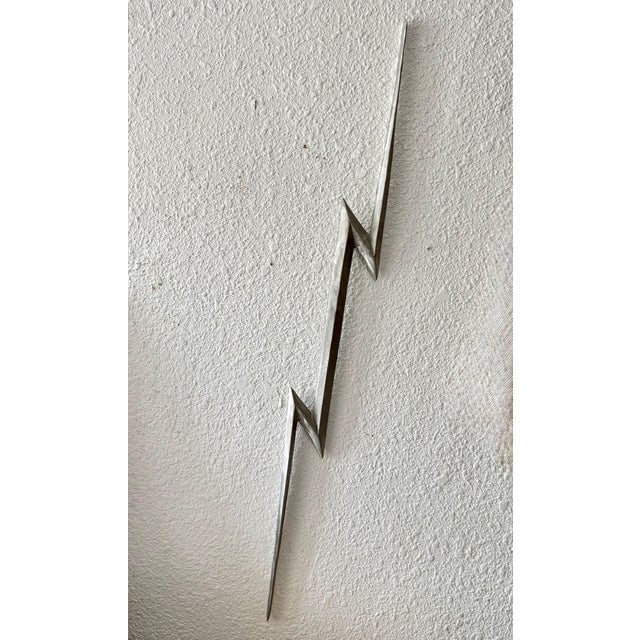
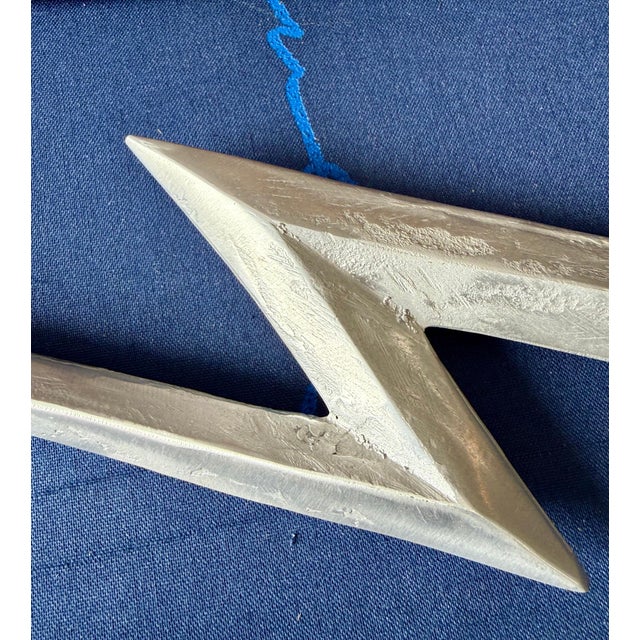
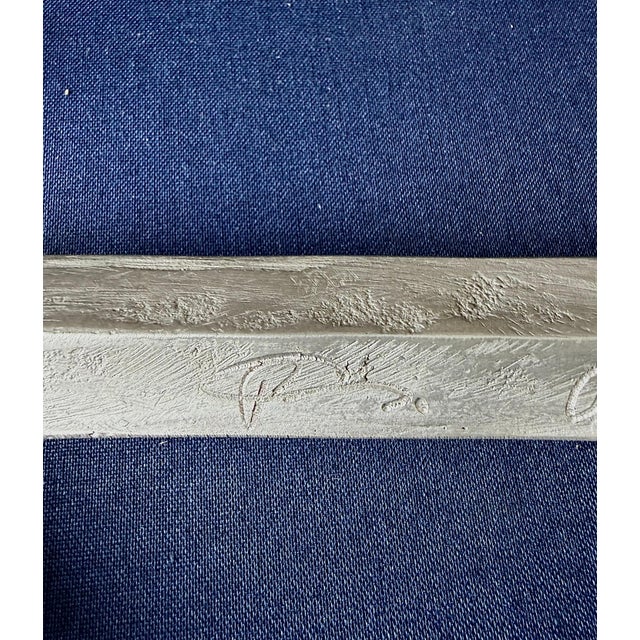
Thunderbolt, Lightning Bolt
Prototype for a Fundraiser for Hallwalls
…
Read more
Robert Longo (American, born 1953)
Charles Clough (American, born 1951)
Collaboration
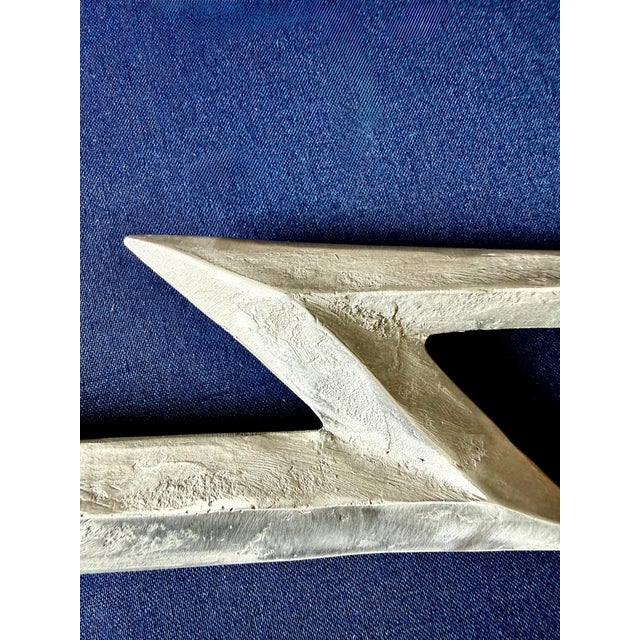
Thunderbolt, Lightning Bolt
Prototype for a Fundraiser for Hallwalls
1976/2013 (this was produced in 2013 from a prototype designed in 1976)
Cast aluminum
Dimensions: 39 x 5 x 1 inches
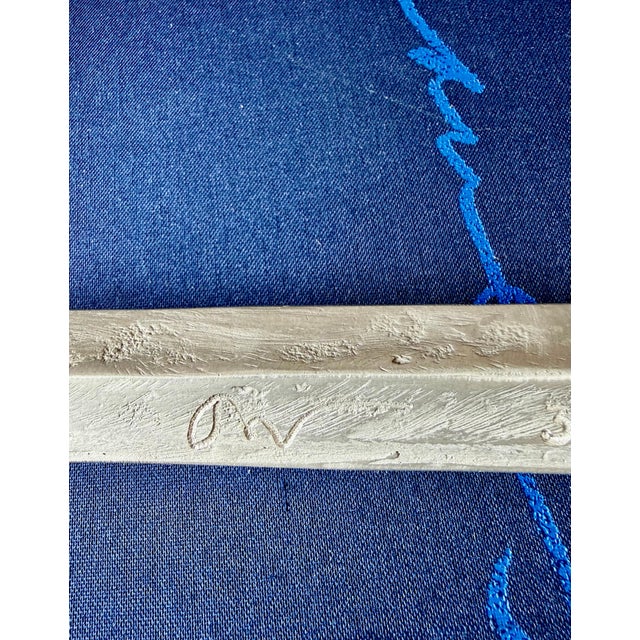
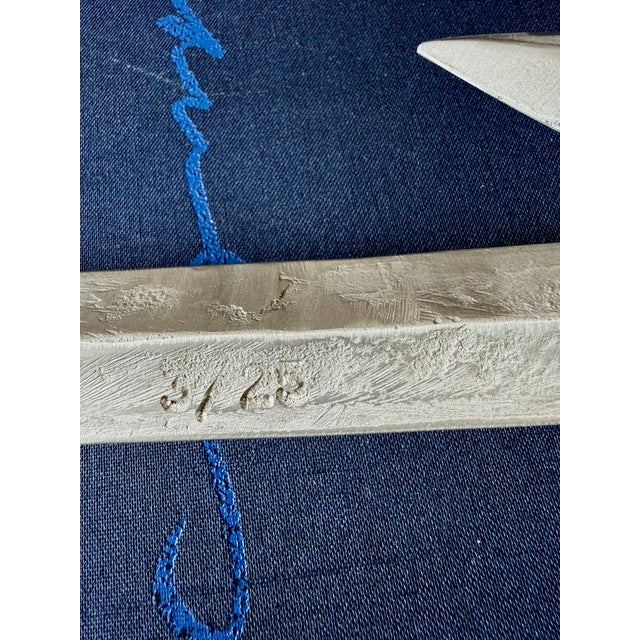
Edition 3 of 25, Signed and numbered
It works horizontally, vertically, or diagonally. It could also be framed.
In 1976 when Charles Clough and Robert Longo worked in adjacent studios, exploring symbolic imagery. Clough carved a thunderbolt and Longo cast two copies in bronze and one in aluminum. Only the aluminum version represents the full length of the wooden original.
This was done as an edition for Hallwalls
The original bolt was prominently exhibited as part of the major exhibition Wish You Were Here: The Buffalo Avant-garde in the 1970s at the Albright Knox Art Gallery, Buffalo, NY, March 30 to July 8, 2012.
Born in Brooklyn, 1953 Robert Longo became synonymous with American pictorial art during the 80s, his ambitious large-scale works seemingly synchronized with the booming economy and boisterous values of the Reagan era. In 1974, whilst studying at State University College, Buffalo, Longo co-founded Hallwalls. As a studio and exhibition space for contemporary art, Hallwalls was the precursor of Longo's ongoing concern for utilizing art's multi-disciplinary potential. His partner in this venture was Cindy Sherman. After graduation Longo showed in 1979 at The Kitchen, a downtown space which encouraged artistic experimentation and collaboration. In the following year, he had his first one-person exhibition in Europe, at Studio d'Arte Cannaviello in Milan. Since then, Longo has shown continuously in Europe and America. However, it was his first solo exhibition at Metro Pictures, New York, in 1981 that brought him international critical acclaim. This installation of Men in the Cities presented his charcoal, graphite and dye studies of office workers. This interruption of a smooth linear reading, notably used in Dada and Surrealist collage, undermines assumptions, whether they be cultural, social or political. In 'Men in the Cities' Longo cuts anonymous people from their environments, then splices their portraits in amongst blocks of buildings. The association is made between the private and the corporate, the human and the industrial, the fragile and the impervious. Engagement with the social and political can be seen in Longo's work throughout the 80s, setting him apart from fellow artists David Salle and Julian Schnabel. Following a major retrospective at The Los Angeles County Museum of Art in 1989, Longo began to focus on single themes, rather than montages of associations. Furthermore, he moved to Paris the following year. The 'Black Flag' series resulted from this change in direction, and location. Taking the Stars and Stripes as his subject, Longo re-worked the treatment of the pop art spangled banner by Pop artist Jasper Johns. Longo is a multi talented artist who works equally successfully in a variety of media. He is equally well known as a sculptor and film director as he is as a draftsman/painter, and like the best of the contemporary film directors, his aim is to seduce, elucidate, transform, and instruct.
SELECTED PERMANENT COLLECTIONS Art Institute of Chicago, USA Guggenheim Museum, New York Los Angeles County Museum of Art, Los Angeles, USA Musee d'Art Contemporain, Montreal, Canada Museum of Modern Art, New York Saatchi Collection, London Stedelijk Museum, Amsterdam, The Netherlands Tate Gallery, London Walker Art Center, Minneapolis, USA The Whitney Museum of American Art, New York SELECTED SOLO EXHIBITIONS 'Das Magellan Projekt', Kunsthalle Tubingen, Germany, 1997 'Das Magellan Projekt', Kunsthal Rotterdam, Rotterdam, The Netherlands, 1997 'Das Magellan Projekt', Kunsthalle Bielefeld, Bielefeld, Germany, 1997 'Robert Longo: Kreuze', Museum Fridericianum, Kassel, Germany, 1996 'Robert Longo: A Retrospective', The Isetan Museum of Art, Tokyo, 1995 'Robert Longo: A Retrospective', Ashikaga City Museum, Kirin Plaza Art Space, Osaka, Japan, 1995 'Faith in Zero' Project: Galerie Daniel Templon, Galerie Antoine Candau, Galerie Thaddaeus Ropac, A.B. Galleries, Galerie Gordon Pym et Fils, Paris, France, 1991 'Black Flags', Galerie Daniel Templon, Paris, 1990 'Robert Longo 1976 - 1989', The Los Angeles County Museum of Art, Los Angeles, 1989 'Robert Longo 1976 - 1989', Museum of Contemporary Art, Chicago, USA, 1989 'Robert Longo 1976 - 1989', Wadsworth Atheneum, Hartford, CT, USA, 1989 'Sequences/Men in the Cities', University Art Museum, California State University, Long Beach, USA, 1986 'Sequences/Men in the Cities', Contemporary Arts Museum, Houston, Texas, USA, 1986 'Sequences/Men in the Cities', Fort Wayne Museum of Art, Fort Wayne, Indiana, USA, 1986 Stedelijk Museum, Amsterdam, The Netherlands, 1985 Metro Pictures, New York, 1981 SELECTED GROUP EXHIBITIONS La Biennale di Venezia: XLVII Esposizioione Internationale d'Arte, Venice, Italy, 1997 'Views From Abroad: European Perspectives on American Art 3', Whitney Museum of American Art, New York, 1997 'Allegories of Modernism: Contemporary Drawing', The Museum of Modern Art, New York, 1992 'A Forest of Signs: Art in the Crisis of Representation', The Museum of Contemporary Art, Los Angeles, USA, 1989 'Documenta 8', Kassel, Germany, 1987 L?epoque, La Mode, La Morale, La Passion, 1977 - 1987', Mus'e National d'Art Moderne, Centre Georges Pompidou, Paris, France, 1987 "New York '85" (with Jasper Johns, Ellsworth Kelly, Christo, David Salle, J.M. Basquiat, Kenny Scharf, Robert Rauschenberg, and others), ARCA, Marseille Gabrielle Bryers Gallery, New York City 'Correspondences', Laforet Museum, Tokyo, 1985 Tochigi Prefectural Museum of Fine Arts, Tochigi, Japan, 1985 Tazaki Hall Espace Media, Kobe, Japan, 1985 '1983 Biennial Exhibition', The Whitney Museum of American Art, New York, 1983 The New Art, Tate Gallery, London, 1983 'Documenta 7', Kassel, Germany, 1982Charles Sidney Clough (born February 2, 1951, in Buffalo, New York) is an American painter. His art has been exhibited in over 70 solo and over 150 group exhibitions throughout North America and Europe and is included in the permanent collections of over 70 museums, including the Metropolitan Museum of Art, National Gallery of Art, and Smithsonian American Art Museum. Clough has received fellowships and grants from the New York State Council on the Arts, National Endowment for the Arts, Adolph Gottlieb Foundation, the Jackson Pollock-Lee Krasner Foundation, and the John Simon Guggenheim Foundation.
Charles Clough was born and raised in Buffalo, New York where he attended Hutchinson Central Technical High School. He then attended Pratt Institute in Brooklyn from 1969-1970 where the two-dimensional design teacher Joseph Phillips, introduced Artforum magazine to him. Clough dropped out and on January 5, 1971 decided that he would devote his life to art. He traded his sculptor's assistant services for studio space with artist Larry W. Griffis Jr., at the Ashford Hollow Foundation's 30 Essex Street former ice-house facility. From 1971-1972 he attended the Ontario College of Art and was introduced to the artists and galleries of Toronto, Ontario, Canada. By 1973 many of the University at Buffalo's and Buffalo State's art professors had rented studios at 30 Essex Street. One of these, Joseph Panone, brought his student, Robert Longo and introduced him to Clough, which resulted in the program of exhibitions and artists' visits which became Hallwalls in 1974. Panone and his wife, Cindy Sherman, assisted in presenting, amongst many others, the works of Vito Acconci, Kathy Acker, Laurie Anderson, Lynda Benglis, Ross Bleckner, Barbara Bloom, Eric Bogosian, Jonathan Borofsky, Chris Burden, Robert Creeley, Eric Fischl, Philip Glass, Jack Goldstein, Dan Graham, Robert Irwin, Sol LeWitt, Robert Mangold, Malcolm Morley, David Salle, Julian Schnabel and Michael Snow. In 1978 after separating Hallwalls from the Ashford Hollow Foundation, establishing its board of directors and obtaining its own 501c3 status, Clough returned to New York City to pursue his art.
Clough has said, of his artwork, "What I like most about painting, all kinds of painting, is that it ain't what it looks like. Not that it's simply an illusion. I like the contradiction, that my things can have an old master look, the look of Abstract Expressionism and a look of shiny smoothness. I like those paradoxes—flatness and its opposite, the way the photo reveals and the paint conceals. Shuffling and reshuffling, then adding another deck and reshuffling that." In his autobiographical book of images, Pepfog Cluff, Clough has written of the period following his commitment to art that: "my examination of impulses, desires, and intentions finally began to coalesce in my journal-like Studio Notes with which I have developed the themes and procedures which articulate my meanings to this day. At that point I had abandoned illustrational strategies for paint-as-material processes, generally, as established by Pollock and his progeny. My wood carving gave way to making maquettes for Tony Smith-like sculptures. My photographs reflected Walker Evans on the one hand and Jan Dibbets on the other."
Beginning in 1978 Herbert and Dorothy Vogel (New York City) began collecting Clough's art and since then acquired over four hundred works, many of which were distributed to a museum in each of the fifty (United) States through a project implemented by the National Gallery of Art (Washington). Clough has been awarded grants by National Endowment for the Arts (1982, 1989), New York State Council on the Arts (1983) and the Pollock-Krasner Foundation (2009). His work was included in The Metropolitan Museum of Art's The Pictures Generation, 1974–84, from April 21-August 2, 2009. (along with 1980's art stars Cindy Sherman, Barbara Kruger, Louise Lawler, Robert Longo, David Salle, Richard Prince, Sherrie Levine, John Baldessari and Allan McCollum). As of July, 2015 Clough established his studio, and the Clufffalo Institute, on the Roycroft Campus in East Aurora, New York, outside of Buffalo, New York.
Charles Clough is married to book designer Liz Trovato.
See less
- Dimensions
- 5ʺW × 1ʺD × 39ʺH
- Styles
- Postmodern
- Art Subjects
- Other
- Period
- 1970s
- Country of Origin
- United States
- Item Type
- Vintage, Antique or Pre-owned
- Materials
- Metal
- Condition
- Good Condition, Original Condition Unaltered, Some Imperfections
- Color
- Charcoal
- Condition Notes
- Good MInor wear. the base is 5 inches in height for a total height of 24. Good MInor wear. the base is 5 inches in height for a total height of 24. less
Questions about the item?
Returns & Cancellations
Return Policy - All sales are final 48 hours after delivery, unless otherwise specified in the description of the product.
Cancellation Policy - Prior to shipping or local pickup, buyers may cancel an order for up to 48 hours, unless otherwise specified.
Related Collections
- Lime Sculpture
- Mathurin Moreau Sculpture
- Oil-Rubbed Bronze Finish Sculpture
- Straw Sculpture
- Maison Jansen Sculpture
- Far Pavilions Sculpture
- Roman Bronze Works Sculpture
- Georgian Sculpture
- Hagenauer Werkstätte Sculpture
- Gourd Sculpture
- Recycled/Repurposed Sculpture
- Polycarbonate Sculpture
- Chaim Gross Sculpture
- Photorealism Sculpture
- Constantin Brancusi Sculpture
- Fernando Botero Sculpture
- Austin Productions Sculpture
- Mid-Century Modern Sculpture
- Brutalist Sculpture
- Folk Art Sculpture
- Alabaster Sculpture
- Nude Sculptures
- Jade Sculpture
- Isamu Noguchi Sculpture
- Large Sculptures