




Details
Description
Rare Biedermeier Chest of Drawers in Urn Form, Central Europe, circa 1830
A refined and highly distinctive Biedermeier chest of …
Read more
Rare Biedermeier Chest of Drawers in Urn Form, Central Europe, circa 1830
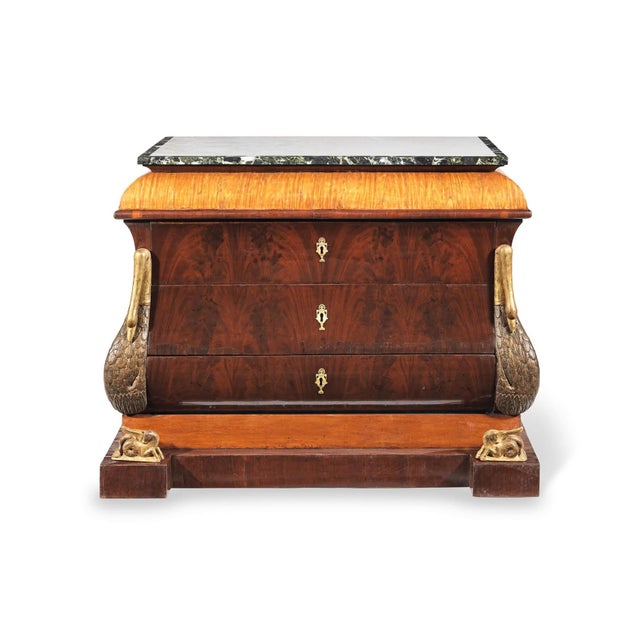
A refined and highly distinctive Biedermeier chest of drawers of rare urn-shaped form, combining architectural balance with sculptural decoration and symbolic elegance.
This remarkable piece stands apart from traditional Biedermeier commodes through its unusual silhouette and sophisticated decorative conception. The structure develops in soft, continuous curves, creating a harmonious volume that recalls classical urn forms, a motif deeply connected to Neoclassical aesthetics and reinterpreted here with the refined sensibility typical of the Biedermeier period.
Symbolism and Decorative Composition
The upper section is crowned by a white marble top framed by a green perimeter band, introducing a refined chromatic contrast and emphasizing the architectural clarity of the piece. Beneath it, a large rounded drawer veneered in satinwood briar visually merges with the upper structure, creating the impression of a continuous sculpted surface.
On both sides, finely carved wooden swans — painted and partially gilded — form elegant vertical supports. The swan, traditionally associated with beauty, grace, and harmony, becomes here a defining symbolic element, reinforcing the poetic and refined character of the furniture.
The central body contains three generously proportioned drawers veneered in richly figured mahogany, whose warm tones contrast beautifully with the lighter satinwood elements. The careful selection of veneers and the balanced proportions demonstrate cabinetmaking of high quality and artistic intention.
At the base, a satinwood briar band transitions into a solid mahogany plinth supporting two small mythological figures in the form of winged horses. These sculptural elements introduce a dynamic and imaginative note rarely encountered in Biedermeier furniture, elevating the piece beyond functional design into the realm of decorative sculpture. The chest rests on elegant spherical feet that complete the composition with visual stability and refinement.
This fine chest of drawers differs significantly from conventional Biedermeier examples, presenting a highly individual stylistic interpretation in which sculptural symbolism and refined craftsmanship coexist harmoniously. The presence of the swans — symbols of elegance and beauty — further underlines the exceptional character of the piece.
Comparative Reference
A closely comparable chest of drawers, featuring analogous urn-shaped proportions, sculptural swan supports, and mythological decorative elements, is illustrated in the reference example included in the documentation. The comparison highlights shared compositional principles and confirms the existence of a distinctive decorative typology within high-quality Central European Biedermeier production.
Such parallels reinforce the attribution of the present piece to an ambitious cabinetmaking workshop capable of combining neoclassical inspiration with the imaginative sculptural vocabulary characteristic of the later Biedermeier period.
Biedermeier Background
The Biedermeier period refers to an era in Central Europe between 1815 and 1848, beginning after the Congress of Vienna at the end of the Napoleonic Wars and concluding with the European Revolutions of 1848. The term is used primarily to describe the artistic and cultural styles that flourished in literature, music, visual arts, and interior design during this period.
Rather than defining an entire historical era, Biedermeier reflects a particular cultural mood shaped by social transformation. Growing urbanization and industrialization led to the emergence of a new middle class, creating a broader audience for the arts and encouraging a shift toward domestic comfort and refined interiors. Under the political stability associated with Klemens Wenzel von Metternich, artistic production focused increasingly on private life and interior refinement rather than public or political themes, resulting in a remarkable flourishing of furniture design.
The continental blockade imposed by Napoleon in 1806, which restricted imports from England, reduced the availability of mahogany across Europe and encouraged the use of lighter woods such as satinwood, cherry, ash, oak, lemonwood, and birch. Despite this tendency, mahogany continued to be employed for the finest furniture, particularly in prestigious commissions, often combined with lighter veneers to create refined visual contrasts.
Between 1815 and 1830, Biedermeier furniture remained strongly influenced by Neoclassical ideals, while the later phase of the period (1830–1848) introduced increasingly imaginative and expressive forms — a development clearly reflected in the sculptural and decorative richness of the present chest of drawers.
See less
- Dimensions
- 51.97ʺW × 26.38ʺD × 38.58ʺH
- Styles
- Empire
- Period
- 19th Century
- Country of Origin
- Austria
- Item Type
- Vintage, Antique or Pre-owned
- Materials
- Wood
- Condition
- Good Condition, Unknown, Some Imperfections
- Color
- Brown
- Condition Notes
- Very Good — This vintage item has no defects, but it may show slight traces of use. Very Good — This vintage item has no defects, but it may show slight traces of use. less
Returns & Cancellations
Return Policy - All sales are final 48 hours after delivery, unless otherwise specified in the description of the product.
Cancellation Policy - Prior to shipping or local pickup, buyers may cancel an order for up to 48 hours, unless otherwise specified.
Related Collections
- Hickory Manufacturing Company Chests of Drawers
- Chests of Drawers in Monterey, CA
- Nautical Chests of Drawers
- Satin Brass Finish Chests of Drawers
- Cast Iron Chests of Drawers
- Rope Chests of Drawers
- Chinoiserie Chests of Drawers
- Campaign Chests of Drawers
- Thomasville Chests of Drawers
- Pennsylvania House Chests of Drawers
- Mahogany Chests of Drawers
- Burlwood Chests of Drawers
- Painted Chests Of Drawers
- Ethan Allen Chests of Drawers
- French Provincial Chests of Drawers
- Hitchcock Chests of Drawers
- Davis Cabinet Company Chests of Drawers
- Asian Chests of Drawers
- Chests of Drawers in Los Angeles
- Gilbert Rohde Chests of Drawers
- Bunny Williams Home Chests of Drawers
- Grosfeld House Chests of Drawers
- Edmond J. Spence Chests of Drawers
- Canvas Chests of Drawers
- Boxwood Chests of Drawers