

Details
Description
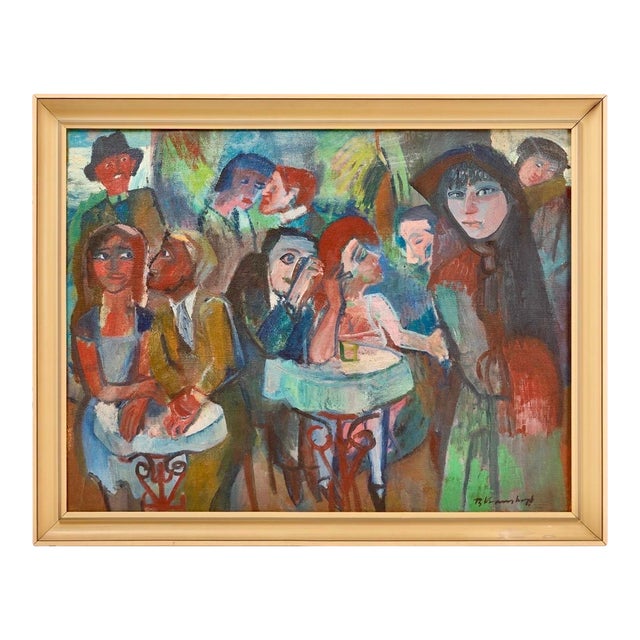
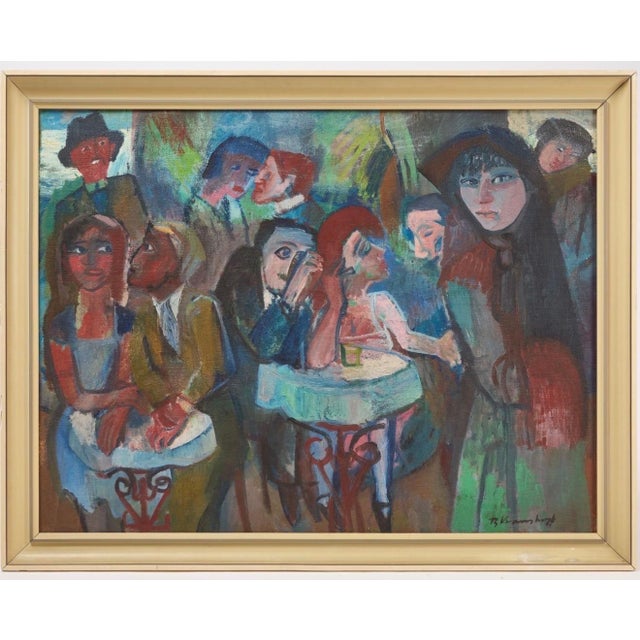
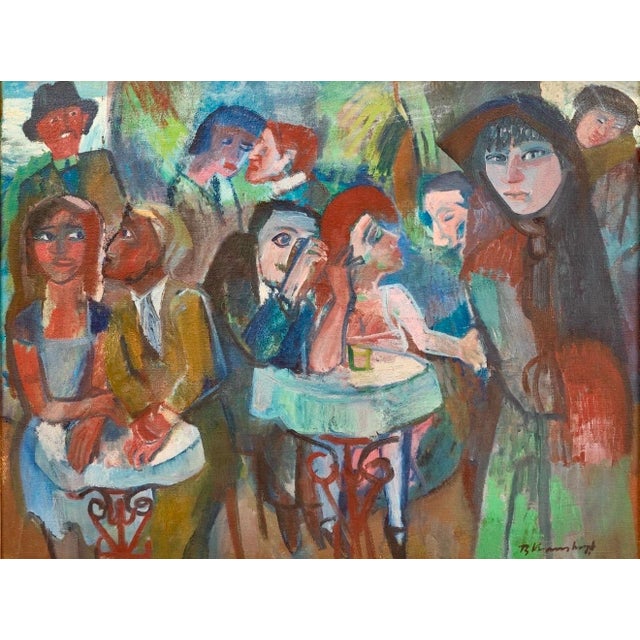
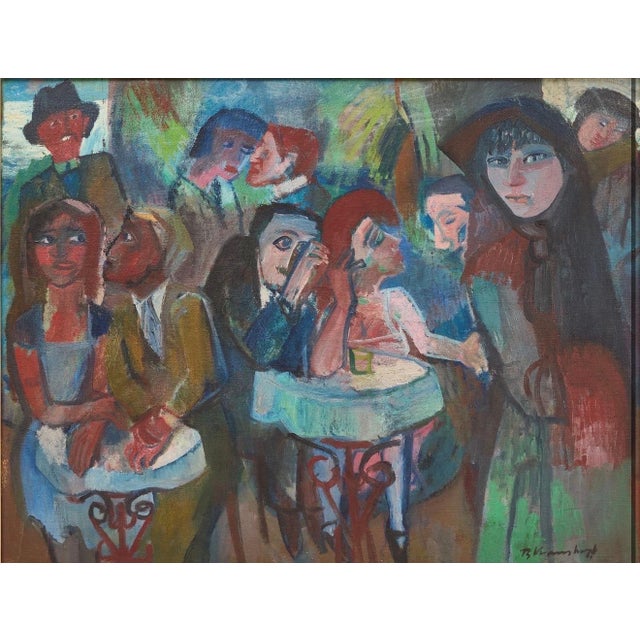
Bruno Krauskopf (Germany, 1892-1960)
Outdoor Restaurant Bar Cafe Scene
Oil on canvas
Dimensions: Frame: H 34 in W 44 in. …
Read more
Bruno Krauskopf (Germany, 1892-1960)
Outdoor Restaurant Bar Cafe Scene
Oil on canvas
Dimensions: Frame: H 34 in W 44 in. Canvas: H 30-1/2 in. W 40 in.
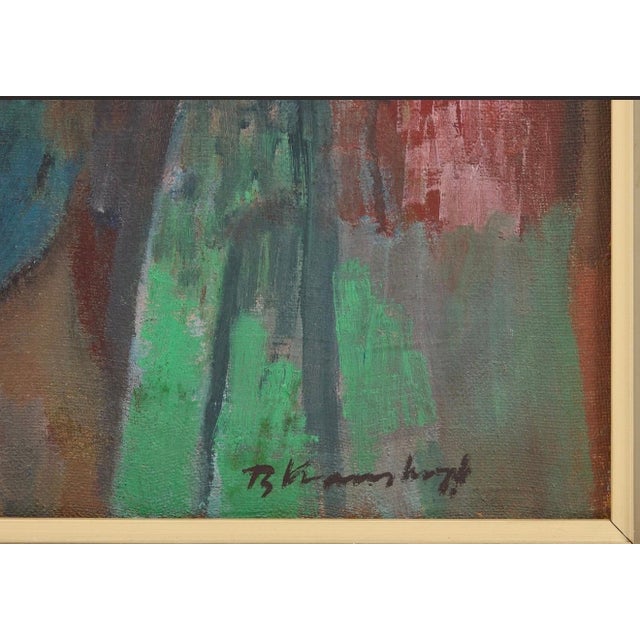
Hand signed B Krauskopf lower right
Provenance: Gift of the artist to owners father. Sold in Modern and Contemporary Art: Including Property of the Estate of Vera G. List Sotheby's New York. Feb 12, 2004 lot 51.
Bruno Krauskopf (Born 1892 in Marienburg, West Prussia, Died in 1960 in West Berlin) was a German painter and graphic artist.
At the age of fourteen, Bruno Krauskopf began his apprenticeship as a chromolithograph printer in Berlin, which lasted until 1908. From 1910 to 1915, he studied at the Royal Museum of Decorative Arts in Berlin under Emil Doepler. As early as 1912, he had his first solo exhibition at the Casper Gallery in Berlin. From 1914 onward, he formed a studio partnership with Wilhelm Kohlhoff and Harry Deierling and exhibited his works at the Great Berlin Art Exhibition. Between 1913 and 1916, he created his graphic oeuvre, consisting of lithographs, woodcuts, and linocuts.
From 1914 to 1916, he served as a soldier in Alsace and Russia. He was an active artist in the Jazz era weimar republic. Krauskopf became a member of the Free (Berlin) Secession (a group that included leading modern artists like Max Liebermann, Käthe Kollwitz, Otto Mueller, Max Beckmann, and Karl Schmidt-Rottluff to champion Expressionism and other avant-garde styles against traditional art, fostering progressive exhibitions until the early 1920s. in 1916 and remained a member of the Berlin Secession from 1917 to 1933. There, he also served on the board and jury and participated in exhibitions. During this time, he created numerous illustrations for books by Tolstoy, Dostoevsky, Eulenberg, and Reisiger. From 1918 onward, he was also a member of the November Group. (a prominent group of German expressionist artists and architects.
The group was led by Max Pechstein and César Klein. The artists' group was joined by Italian Futurists, important DADA artists as well as important Bauhaus members. It bore elements of Cubism, Futurism and Expressionism. Members included artist Hannah Höch, Hilla Rebay, Otto Dix, George Grosz, Raoul Hausmann, John Heartfield, Rudolf Schlichter and Georg Scholz. Ludwig Mies van der Rohe took over the chairmanship of the association. In the early 1920s, his painting style shifted from Expressionism to Impressionism. The colors became fresher and more vibrant. Between 1923 and 1933, Krauskopf undertook several study trips to France, Poland, Italy, and Switzerland. In addition to his paintings, Krauskopf illustrated various books, designed film sets for UFA, and created costume and stage designs for film and theater.
In 1933, his works were denounced as degenerate art, entartete kunst by the Nazi government, whereupon he emigrated to Norway that same year. In 1937, as part of the nationwide concerted action against "Degenerate Art" ten paintings by Krauskopf were confiscated from the city of Berlin, the National Gallery ( Crown Prince's Palace ) Berlin, the Kupferstichkabinett (Museum of Prints and Drawings ) Berlin, the Anhaltische Gemäldegalerie (Anhalt Art Gallery) Dessau, the Städel Art Institute and Städtische Galerie (Municipal Gallery) Frankfurt/Main, and the Kaiser Wilhelm Museum Krefeld. Krauskopf settled in Stavanger. After 1940, when Norway was occupied by Germany, he lived underground. On May 12, 1945, he was accused by the Norwegian police of spying for Germany, imprisoned for ten weeks, and had all his assets confiscated. After being declared an undesirable alien in 1948 and having all his property seized by the Norwegian state, he emigrated to New York with his second wife. With the support of George Grosz, he made his first contacts with the New York art scene. In 1957, he returned to Berlin for a time, and in 1959 he closed his New York studio and moved to West Berlin.
Awards
1919 and 1920 Prize of the Berlin Secession
Wertheim Prize, Berlin
Prize of the City of Bordeaux
Günter Wagner Prize, German Artists' Association , awarded by the Hanover Art Association
1923 Great Prussian Art Prize
1930 Albrecht Dürer Prize of the City of Nuremberg
1934 Museum Prize of the City of Stavanger
Select Exhibitions
Between 1919 and 1933, exhibitions at the Kestner Society , Hanover; Academy of Arts , Berlin; Exhibition at the International Building, Berlin
1932 Exhibition at the Hartberg Gallery, Berlin
1933 Exhibition at the Flechtheim Gallery, Berlin
1933 Hanover, Künstlerhaus (“101st Great Spring Exhibition” of the Hanover Art Association)
1934 Exhibition at the Stavanger Art Association
1935 Exhibition at the Blomquist Gallery, Oslo
Exhibitions in Stavanger, Oslo, Bergen, Haugesund and Kristiansand from 1936 to 1940
After 1945, a significant number of exhibitions took place in the USA, the Federal Republic of Germany, West Berlin, the Soviet occupation zone, and the GDR: including Galerie Weyhe, New York; Galerie Feigl, New York; Whitney Museum, New York; Carnegie International Exhibition Center, Pennsylvania Academy of Fine Arts, Pittsburgh; Richmond and Art Center Des Moines, Iowa; Städtisches Museum Mönchengladbach; Galerie Hella Nebelung, Düsseldorf.
1957 Exhibitions at the Kunsthalle Bremen, the Kunstamt Berlin-Wilmersdorf and the Kunstverein Karlsruhe.
Posthumous Exhibitions
1972 Memorial exhibition in the Berlin-Charlottenburg town hall
1981 Exhibition at the Michael Haas Gallery, Berlin
1985 Exhibition Kunstforening Stavanger
1991 Exhibition at the Galerie Norbert Blaeser
In 1992, traveling exhibitions in Norway on the occasion of his 100th birthday, an exhibition in the Kunsthalle Darmstadt under the motto: I am still alive and continue to paint , and in the Galerie Abercron, Munich.
1999 Exhibition: Four Artists of the Lost Generation at the Blaeser Gallery
2002 Stations of a painter from West Prussia in the West Prussian State Museum Münster
2005 Norbert Blaeser Gallery with works from the estate of Krauskopf
Literature
Hans Sahl : Bruno Krauskopf. In: Die Kunst und das schöne Heim.
Margareta Friesen: Bruno Krauskopf (1892–1960) “I still paint and live on”. Galerie Margareta Friesen Dresden 1992,
Jutta Fethke: Bruno Krauskopf (1892–1960) Marienburg-Berlin-Stavanger-New York. Stations of a painter from West Prussia. Exhibition at the West Prussian State Museum, Münster 2003
Rainer Zimmermann : Expressive Realism: Painting of the Lost Generation . Hirmer, Berlin 1994
See less
- Dimensions
- 44ʺW × 1ʺD × 34ʺH
- Styles
- Expressionism
- Art Subjects
- Other
- Frame Type
- Framed
- Period
- Mid 20th Century
- Country of Origin
- United States
- Item Type
- Vintage, Antique or Pre-owned
- Materials
- Canvas
- Oil Paint
- Condition
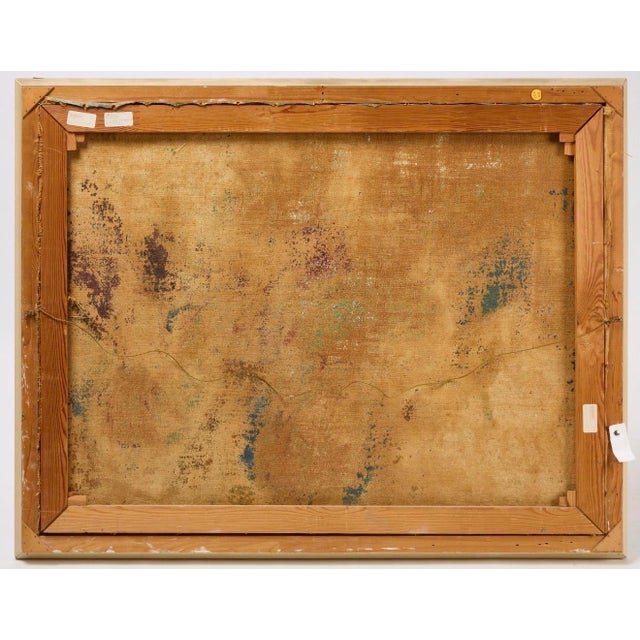
- Good Condition, Original Condition Unaltered, Some Imperfections
- Color
- Green
- Condition Notes
- Good frame has wear commensurate with age. painting is good. Good frame has wear commensurate with age. painting is good. less
Questions about the item?
Returns & Cancellations
Return Policy - All sales are final 48 hours after delivery, unless otherwise specified in the description of the product.
Cancellation Policy - Prior to shipping or local pickup, buyers may cancel an order for up to 48 hours, unless otherwise specified.
Related Collections
- Ed Ruscha Paintings
- Ralph Lauren Paintings
- Photorealism Canvas Paintings
- Photorealism Paintings in New York
- Karen Offutt Paintings
- Richard Serra Paintings
- Silk Velvet Paintings
- Jo Baskerville Paintings
- Jeff Slemmons Paintings
- Black Photorealism Paintings
- Herman Miller Paintings
- Cassina Paintings
- Louise Nevelson Paintings
- Mark Lewis Paintings
- Mark Lewis Art Paintings
- Vienna Secession Paintings
- Jaanika Peerna Paintings
- Photorealism Paintings in Los Angeles
- BDDW Paintings
- Lee Reynolds Paintings
- Mid-Century Modern Paintings
- Abstract Paintings
- Nautical Paintings
- Velvet Paintings
- Landscape Paintings