

Details
Description
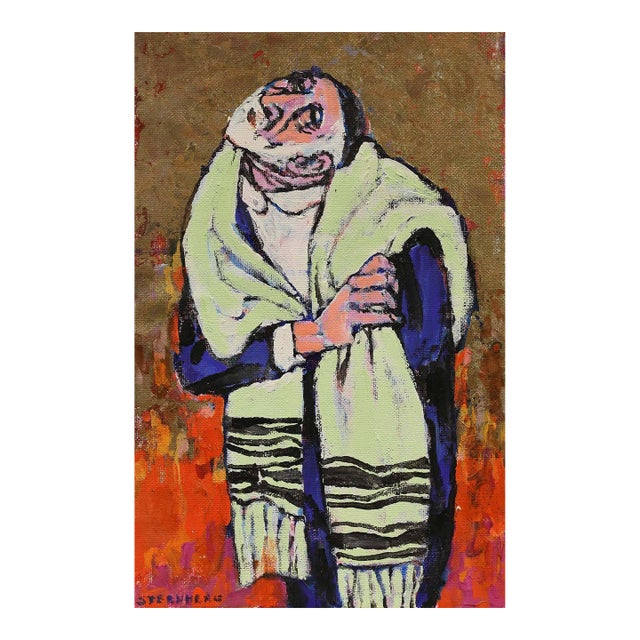
A contorted Rabbi looking upward is depicted in a naive, and almost child-like manner. Vibrant colors, and gestural brushstrokes fill …
Read more
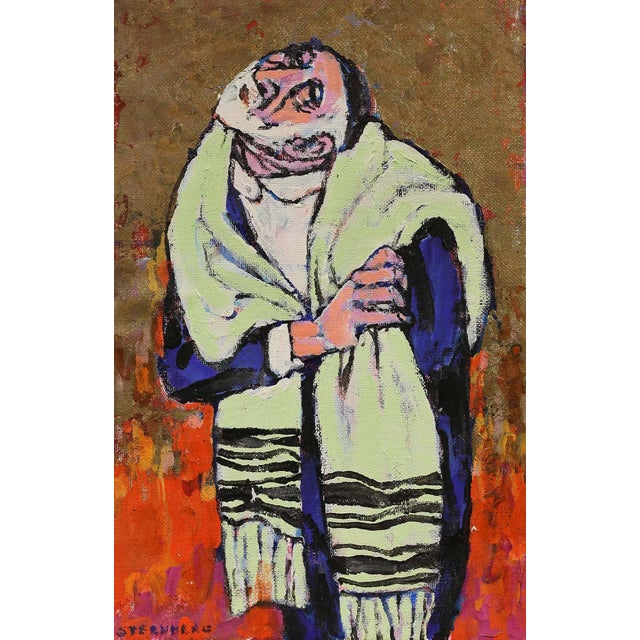
A contorted Rabbi looking upward is depicted in a naive, and almost child-like manner. Vibrant colors, and gestural brushstrokes fill the composition, enhancing the flatness of the figure.
Harry Sternberg, artist, teacher, and political activist was born in New York City's lower east side in 1904. He was the youngest of eight children born to his mother, a hungarian immigrant, and his father, an immigrant from Russia, .
His passion for art came early; by age 12 he had begun saturday art classes at the Brooklyn Museum of Art. Sternberg continued to advance his formal art education through 1922, studying at at New York's prestigious Arts Students League alongside Raphael Soyer, Yasuo Kuniyoshi and other notables of the day.
His career as a professional artist began in 1928 when he consigned a group of his early prints with the dealer Frederick Keppel in New York.
In 1933 he returned to the Art Students League of New York as an instructor, where he taught etching, lithography and composition, continuing to teach there for over 34 years.
During the Great Depression he was a WPA artist, and his murals are in post offices in Chicago, Chester and Sellersville, Pennsylvania.
Sternberg came to national prominence as a printmaker, painter, and muralist, in the Depression era and during World War II. Sternberg was an acclaimed member of a vital generation of American artists dedicated to exposing social injustices and offering support for an egalitarian society.
His interest in the plight of American workers, particularly those engaged in coal mining and the manufacturing of steel, first manifested itself in the mid-1930s with a series of paintings and prints on the subject funded by a 1936 Guggenheim grant. It was these works that would first bring him to national prominence. During the war, Sternberg went on to produce anti-fascist works of art in support of the war effort. Sternberg's paintings and prints addressing the labor movement and the war against fascism and racial injustice are among his most memorable images.
Sternberg also developed an allegorical mode of social critique. His dark satires in this vein owe much to Goya. An etching/aquatint from the 1931 series, "Principles," critiques the duplicity rampant in everyday social intercourse by showing a crowded street scene in which every man and woman is literally two-faced, a mask concealing his or her true expression. A few elbow-high children are the only honest souls around, unmasked, pure, exposed.
Sternberg contributed drawings to the leftist magazine New Masses for 17 years and worked actively in organizations defending the rights of both artists and laborers. His contempt for racism, fascism and other, more subtle indignities surfaces regularly in his art. He recognized the great political potential of prints, thanks to their affordability and easy distribution, and he spoke eloquently of their social impact at the First American Artists' Congress in 1936. In subsequent decades, he published five technical handbooks and developed several innovative printmaking methods, such as power-tool engraving.
Sternberg made his first trip to the west in 1957, falling in love with its rugged mountains and high deserts. In 1966, on the advice of his doctor, he left New York permanently and settled in Escondido. He continued to teach at local colleges and universities and reveled in the unique qualities of Southern California's light. Still painting and making prints well into his nineties, he added landscapes and portraits to his repertoire and increasingly turned to autobiographical subject matter. "As long as I have an easel, paints, and good light, I'm happy," he enthused, shortly before his death in 2001.
In addition to his prodigious artistic output, Sternberg was an influential teacher at various universities and art schools, From 1934 to 1968, he taught painting and graphics at the Art Students League in New York, from 1942 to 1945 graphics at the New School of Social Research, and from 1959 to 1969 was head of the Art Department in the Idyllwild School of Music and the Arts (ISOMATA) at the University of Southern California. Sternberg held prominent positions in many artist's societies.
See less
- Dimensions
- 8ʺW × 1ʺD × 12ʺH
- Styles
- Modern
- Frame Type
- Unframed
- Art Subjects
- Other
- Period
- Mid 20th Century
- Country of Origin
- United States
- Item Type
- Vintage, Antique or Pre-owned
- Materials
- Acrylic
- Condition
- Good Condition, Original Condition Unaltered, Some Imperfections
- Color
- Red
- Condition Notes
- Good it is not framed. roughness to back of board from last framing/mounting. Good it is not framed. roughness to back of board from last framing/mounting. less
Questions about the item?
Returns & Cancellations
Return Policy - All sales are final 48 hours after delivery, unless otherwise specified in the description of the product.
Cancellation Policy - Prior to shipping or local pickup, buyers may cancel an order for up to 48 hours, unless otherwise specified.
Related Collections
- Ed Ruscha Paintings
- Ralph Lauren Paintings
- Photorealism Canvas Paintings
- Photorealism Paintings in New York
- Karen Offutt Paintings
- Richard Serra Paintings
- FM Mobler Paintings
- Jo Baskerville Paintings
- Silk Velvet Paintings
- Jeff Slemmons Paintings
- Photorealism Paintings in Los Angeles
- Michelle Arnold Paine Paintings
- BDDW Paintings
- Black Photorealism Paintings
- Herman Miller Paintings
- Cassina Paintings
- Louise Nevelson Paintings
- Mark Lewis Paintings
- Mark Lewis Art Paintings
- Vienna Secession Paintings
- Lee Reynolds Paintings
- Mid-Century Modern Paintings
- Abstract Paintings
- Nautical Paintings
- Velvet Paintings