

Details
Description
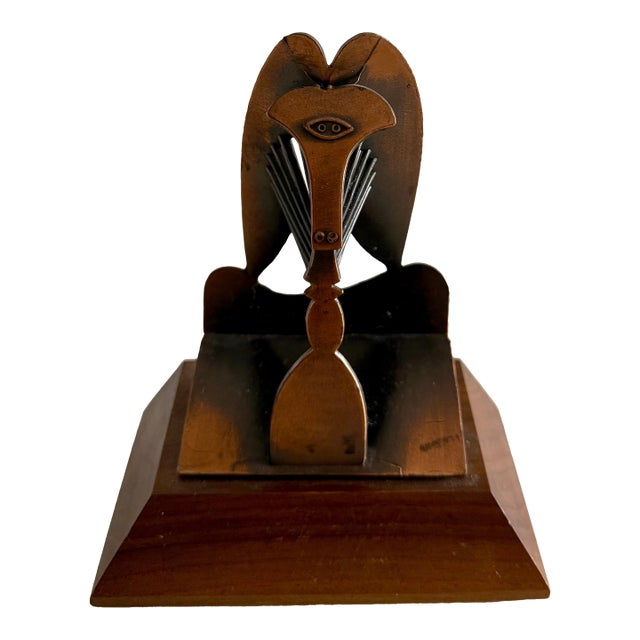
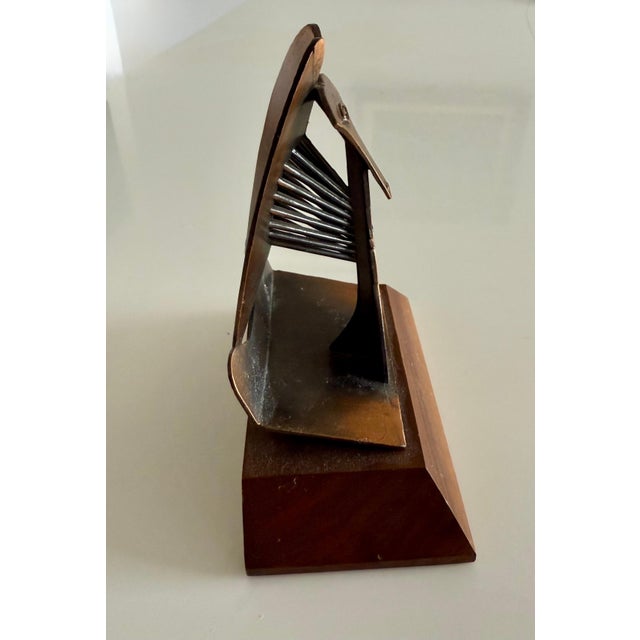
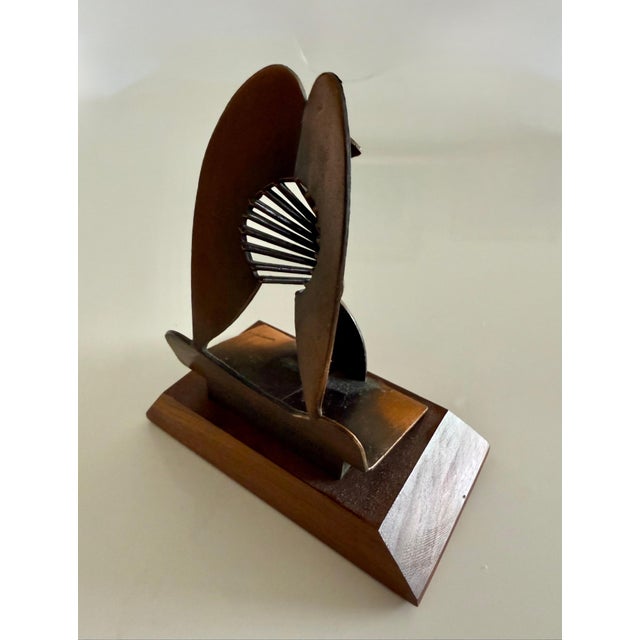
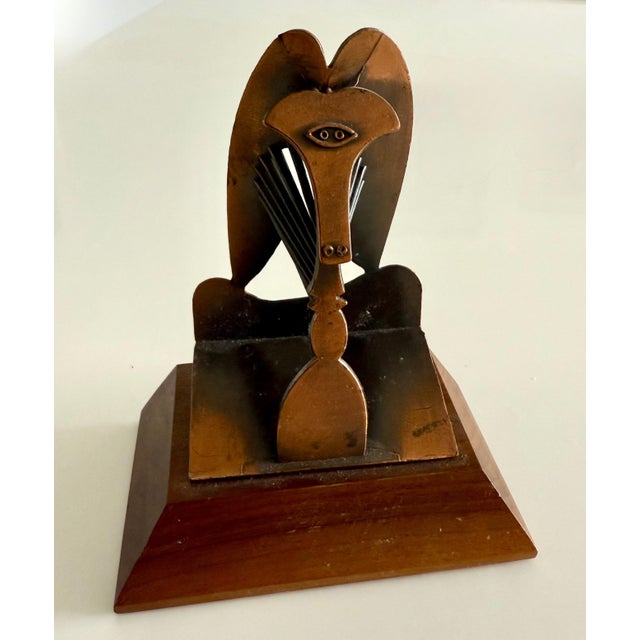
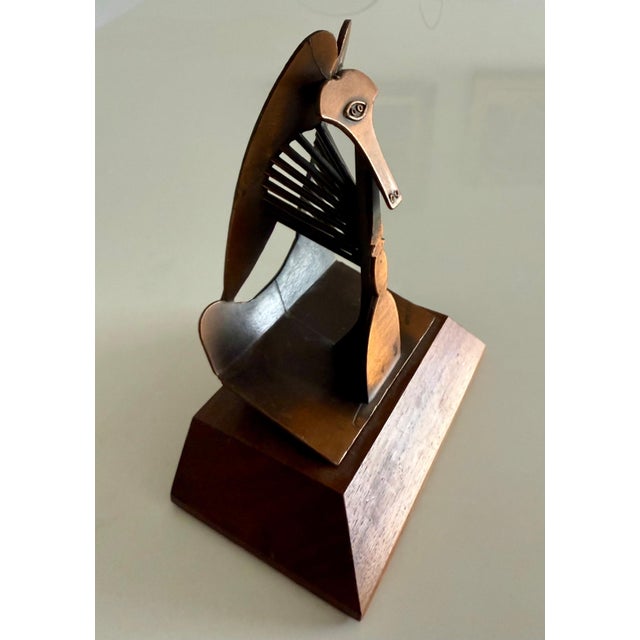
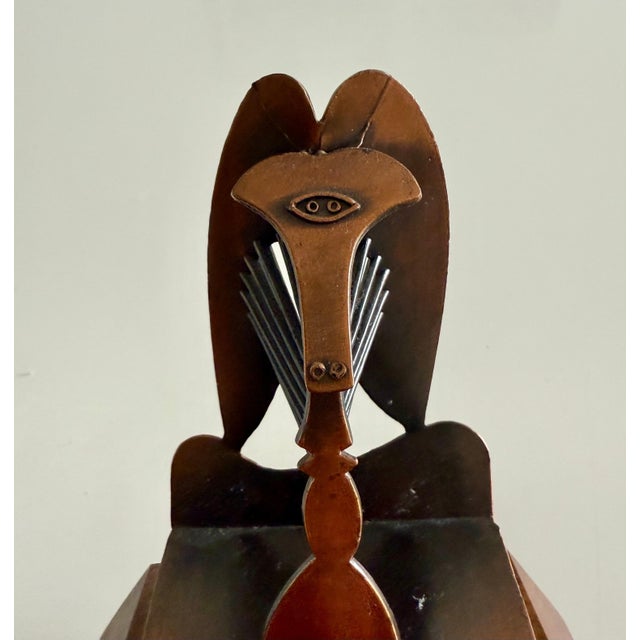
This is a souvenir model of the large Picasso sculpture in Chicago it is a vintage piece. it is marked …
Read more
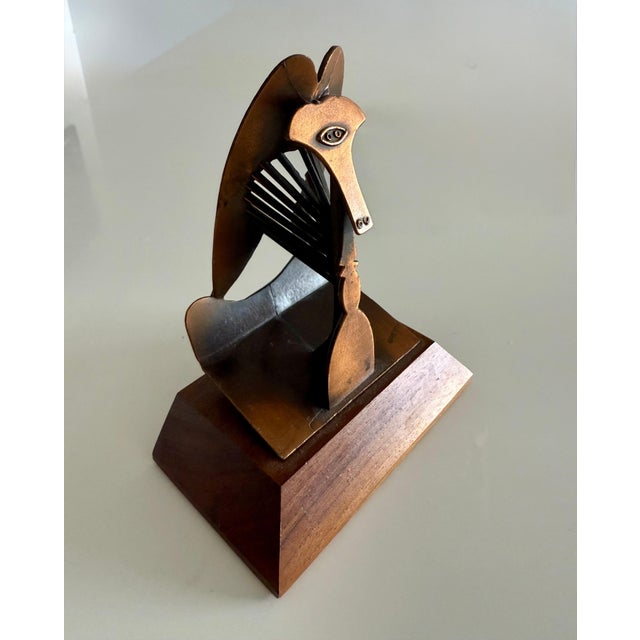
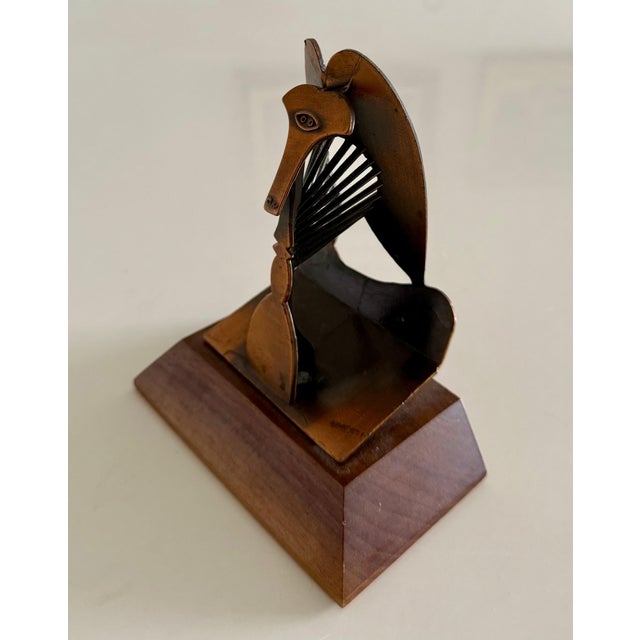
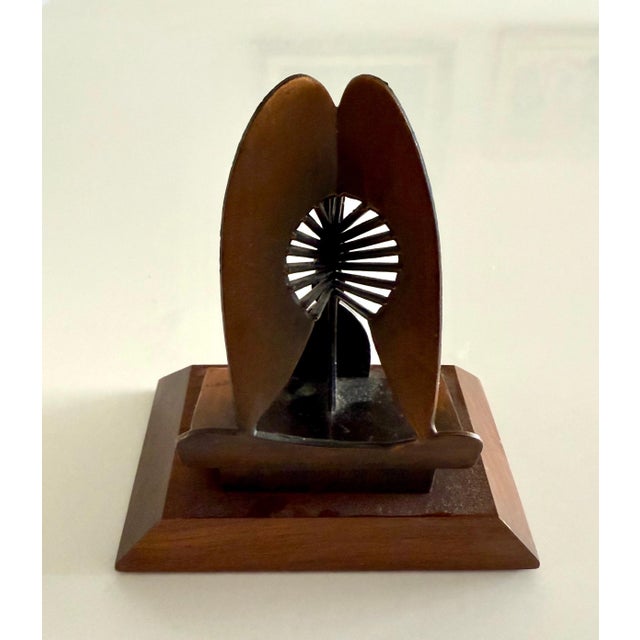
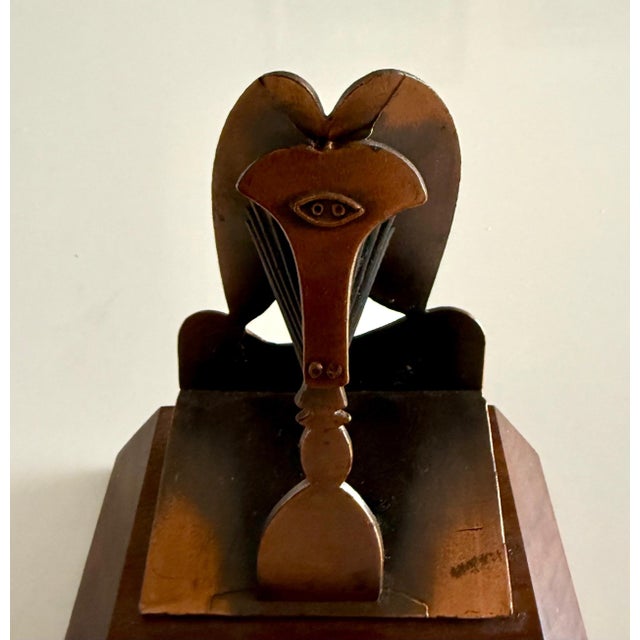
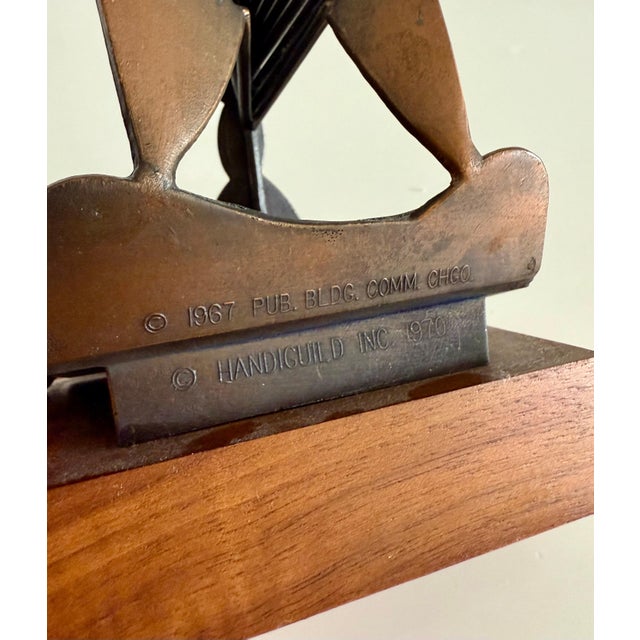
This is a souvenir model of the large Picasso sculpture in Chicago it is a vintage piece. it is marked 1967 and 1970 and was made for the Chicago Public Building Commission. it is also marked Handiguild inc. 1970.
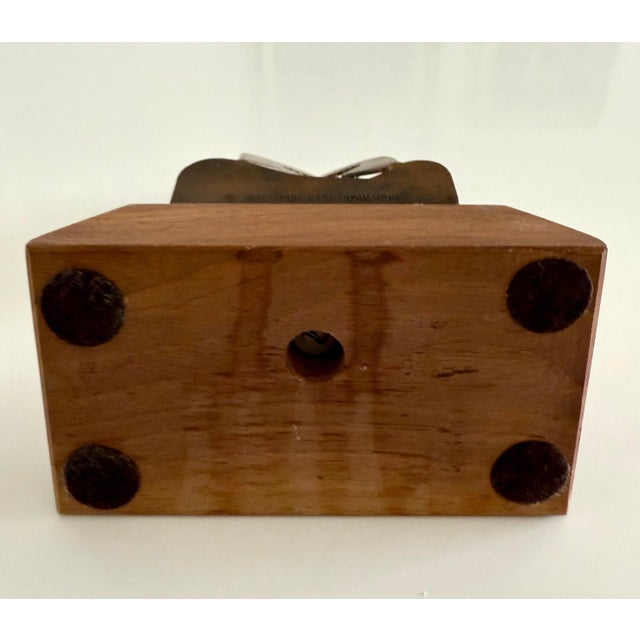
there is a bronze colored patina to the piece. Mounted to a wood base.
with base it measures 7.5 height by 6 width aby 3.25 depth.
piece itself measures 6 height by 2.25 by 3.35 inches.
The Chicago Picasso (often just The Picasso) is an untitled monumental sculpture by Pablo Picasso in Daley Plaza in Chicago, Illinois. The 1967 installation of The Picasso, "precipitated an aesthetic shift in civic and urban planning, broadening the idea of public art beyond the commemorative."
The COR-TEN steel structure, dedicated on August 15, 1967, in the civic plaza in the Chicago Loop, is 50 feet (15.2 m) tall and weighs 162 short tons (147 t). The Cubist sculpture by Picasso, who later said that it represented the head of his Afghan Hound, was the first monumental abstract public artwork in Downtown Chicago, and has become a well-known landmark. Publicly accessible, it is known for its inviting jungle gym-like characteristics. Visitors to Daley Plaza can often be seen climbing on and sliding down the base of the sculpture.
The sculpture was commissioned in 1963 by the architects of the Chicago Civic Center (now known as the Richard J. Daley Center), a modernist government office building and courthouse (also clad in COR-TEN), with an open granite-paved plaza. The commission was facilitated by the architect William Hartmann of the architectural firm of Skidmore, Owings & Merrill. Picasso completed a maquette of the sculpture in 1965, and approved a final model of the sculpture in 1966. The cost of constructing the sculpture was $351,959.17 (equivalent to $3.2 million in 2022), paid mostly by three charitable foundations: the Woods Charitable Fund, the Chauncey and Marion Deering McCormick Foundation, and the Field Foundation of Illinois. Picasso himself was offered payment of $100,000 but refused, stating that he wanted to make his work a gift to the city.
There was speculation on the subject, which has ranged from an abstract bird, or aardvark to Picasso's pet Afghan Hound, a baboon head or Sylvette David, one of his models.
Some have speculated it may have been inspired by a French woman, Sylvette David, now known as Lydia Corbett, who posed for Picasso in 1954. Then 19 years old and living in Vallauris, France, Corbett would accompany her artist boyfriend as he delivered chairs made of metal, wood and rope. One of those deliveries was to Picasso, who was struck by her high ponytail and long neck. "He made many portraits of her. At the time, most people thought he was drawing the actress Brigitte Bardot. But in fact, he was inspired by [Corbett]", Picasso's grandson Olivier Widmaier Picasso told the Chicago Sun-Times in 2004.
"I think the Chicago Sculpture was inspired by her", said the grandson, author of Picasso, the Real Family Story. Picasso made 40 works inspired by her, said the grandson, including The Girl Who Said No, reflecting their platonic relationship. The quality of the Picasso sculpture inspired other artists such as Alexander Calder, Marc Chagall, Joan Miró, Claes Oldenburg and Henry Moore. There was an ongoing dialogue between Picasso's sculpture and his painting. A further possible influence could lie in his portraits of Jacqueline herself, made in the early 1960s, specifically Bust of a Woman (Jacqueline) from May 1962
The Picasso was the site of an August 23, 1968, press conference in which Yippies Jerry Rubin, Phil Ochs, and others were arrested after nominating a pig — Pigasus — for president of the United States. This event was held days before the opening of the 1968 Democratic National Convention, which became known for its anti-Vietnam war protests.
The sculpture was mentioned (and appears) in the 1980 film The Blues Brothers during the chase scene leading to the Richard J. Daley Center. It can also be seen briefly in the 1993 film The Fugitive, as Harrison Ford, playing Richard Kimble, and his pursuers run across the plaza, and in the 1986 film Ferris Bueller's Day Off as people in and under a reviewing stand dance to a song sung by Matthew Broderick, who plays Bueller. The sculpture also makes an appearance in the 1988 film Switching Channels starring Kathleen Turner, Burt Reynolds and Christopher Reeve.
The Chicago Picasso became and continues to be a well-known meeting spot for Chicagoans. Depending on the season and time of the month, there are musical performances, farmers' markets, a Christkindlmarkt, and other Chicago affairs which are held around the Picasso in Daley Plaza.
Pablo Ruiz Picasso (1881 – 1973) was a Spanish painter, sculptor, printmaker, ceramicist, stage designer, poet and playwright who spent most of his adult life in France. Regarded as one of the most influential artists of the 20th century, he is known for co-founding the Cubist movement, the invention of constructed sculpture, the co-invention of collage, and for the wide variety of styles that he helped develop and explore. Among his most famous works are the proto-Cubist Les Demoiselles d'Avignon (1907), and Guernica (1937), a dramatic portrayal of the bombing of Guernica by the German and Italian air forces during the Spanish Civil War.
Picasso demonstrated extraordinary artistic talent in his early years, painting in a naturalistic manner through his childhood and adolescence. During the first decade of the 20th century, his style changed as he experimented with different theories, techniques, and ideas. After 1906, the Fauvist work of the slightly older artist Henri Matisse motivated Picasso to explore more radical styles, beginning a fruitful rivalry between the two artists, who subsequently were often paired by critics as the leaders of modern art.
Picasso's work is often categorized into periods. While the names of many of his later periods are debated, the most commonly accepted periods in his work are the Blue Period (1901–1904), the Rose Period (1904–1906), the African-influenced Period (1907–1909), Analytic Cubism (1909–1912), and Synthetic Cubism (1912–1919), also referred to as the Crystal period. Much of Picasso's work of the late 1910s and early 1920s is in a neoclassical style, and his work in the mid-1920s often has characteristics of Surrealism. His later work often combines elements of his earlier styles.
In 1907, Picasso joined an art gallery that had recently been opened in Paris by Daniel-Henry Kahnweiler. Kahnweiler was a German art historian and art collector who became one of the premier French art dealers of the 20th century. He was among the first champions of Pablo Picasso, Georges Braque and the Cubism that they jointly developed. Kahnweiler promoted burgeoning artists such as André Derain, Kees van Dongen, Fernand Léger, Juan Gris, Maurice de Vlaminck and several others who had come from all over the globe to live and work in Montparnasse at the time.
See less
- Dimensions
- 6ʺW × 3.25ʺD × 7.5ʺH
- Styles
- Modern
- Art Subjects
- Other
- Period
- 1960s
- Country of Origin
- United States
- Item Type
- Vintage, Antique or Pre-owned
- Materials
- Metal
- Wood
- Condition
- Good Condition, Original Condition Unaltered, Some Imperfections
- Color
- Brown
- Condition Notes
- Good minor wear. please see photos. Good minor wear. please see photos. less
Questions about the item?
Returns & Cancellations
Return Policy - All sales are final 48 hours after delivery, unless otherwise specified in the description of the product.
Cancellation Policy - Prior to shipping or local pickup, buyers may cancel an order for up to 48 hours, unless otherwise specified.
Related Collections
- Mathurin Moreau Sculpture
- Roman Bronze Works Sculpture
- Loredano Rosin Sculpture
- Lime Sculpture
- Albert Ernest Carrier-Belleuse Sculpture
- Bakelite Sculpture
- Polycarbonate Sculpture
- Constantin Brancusi Sculpture
- Peter Shire Sculpture
- Chaim Gross Sculpture
- Boris Lovet-Lorski Sculpture
- Gourd Sculpture
- Recycled/Repurposed Sculpture
- Sculpture in Panama City, FL
- Fernando Botero Sculpture
- Straw Sculpture
- Maison Jansen Sculpture
- Georgian Sculpture
- Worlds Away Sculpture
- Far Pavilions Sculpture
- Oil-Rubbed Bronze Finish Sculpture
- David Palombo Sculpture
- Austin Productions Sculpture
- Mid-Century Modern Sculpture
- Brutalist Sculpture