

Details
Description
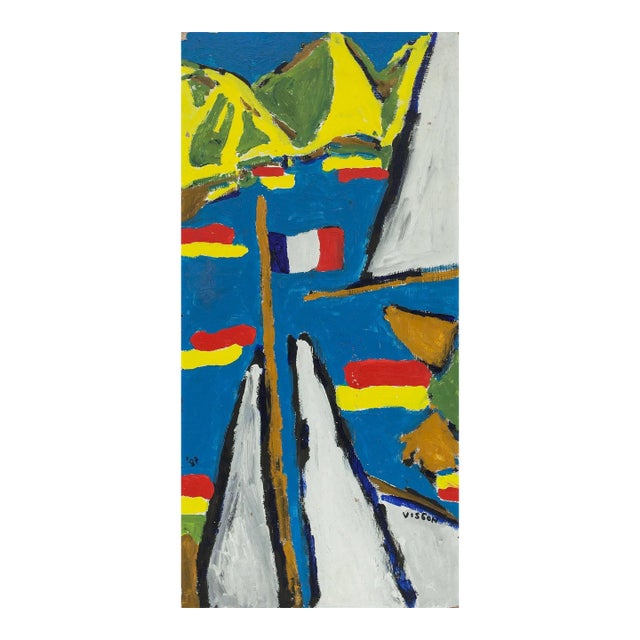
Philippe Visson, (1942-2008), whose parents were both of Russian origin, was born in New York in 1942.
His mother, a …
Read more
Philippe Visson, (1942-2008), whose parents were both of Russian origin, was born in New York in 1942.
His mother, a Parisian art historian, was the Editor of La Gazette des Beaux-Arts from 1930 to 1960, and had always frequented the international artistic milieu. His father was a major political journalist for The Washington Post and Roving Editor for The Reader’s Digest. Philippe Visson therefore was raised in a cosmopolitan milieu between the United States and Europe. At the Vissons, one devours; one spends beyond one’s means; one falls, but only to land on one’s feet.
Visson is a painter to whom it is difficult to assign a particular movement in art history; and that, principally for two reasons: firstly, his origins,his education and his way of life have produced a personality without any true roots, but rather a citizen of the world, who carries with him all cultures, from pre-Revolutionary Russia to the black ghetto of Washington, D.C.
Secondly, he is self-taught, and can work in complete solitude, as well as before a large audience. His art is therefore uniquely his own, and certainly not that of an Art Brut ‘author’. His faces, his anti-portraits, reveal a continuum of humanity’s facets: from Christ to the demon, from the child to the aged, from the Caucasion to the African.
Biography
Philippe Visson, whose parents were both of Russian origin, was born in New York in 1942. His mother, a Parisian art historian, was the Editor of “The Gazette des Beaux-Arts” and had always frequented the international artistic milieu. His father was a major American political journalist for “The Washington Post” and “The Readers Digest”. Philippe Visson therefore was raised in a cosmopolitan milieu between the United States and Europe.
He starts to paint in the bathroom of Parisian luxury hotel at the age of 16, working in a frenzy and without art lessons. He’s immediately confronted with the scrutiny of professional experts that surround his parents. He has instant success when he shows at the Craven Gallery in Paris in December, 1958, quickly offered to him; then in New York in the Milch Galleries in May, 1959; followed by shows in Monte Carlo, Geneva and New York again. It was too much, too soon. Visson falls into drinking.
Returning to Washington, D.C. on 1960, the period 1963-1979 is differentiated by a life that is sometimes social, sometimes reclusive, which continues when his family settles in a large villa in Switzerland (Epalinges above Lausanne) in the mid-sixties. Visson has stopped drinking. He paints in one of the rooms of his parents’ house and inundates all the empty rooms with his productions that remain hidden from the public, allowing them to be seen only by personalities such as Marcel Brion and René Huyghe, both of the Académie Française; or Jean Leymarie, Director of the Museum of Modern Art in Paris.
It’s only at the start of the seventies that he once again opens his work to the public. He meets several important cultural figures of the time, such as René Berger, Director of the State Fine Arts Museum of Lausanne; and Michel Thévoz, future Director of the Art brut Museum.
After the death of his father in 1973, he settles without money with his mother in a luxury hotel in Paris. It’s only after a year and a half of perpetual and colorful adventures that they return to Washington, D.C., where he resumes painting and produces a unique period of abstracts.
Returning to Switzerland at the death of his mother in the beginning of the eighties, Visson meets with blatant success in Switzerland, where institutions exhibit and purchase his paintings (Aarau State Fine Arts Museum, the Federal Office of Culture in Bern). His fury for painting takes the form of an explosion while remaining focused (he always keeps what he considers the best paintings for himself).
After the life of a hermit in the Paccots, Visson comes down from his mountain to settle in Montreux on the Swiss Riveria. This moving is marked by a sort of return to social life, despite the fact that he paints in a cellar. A period of public projects with charitable goals is launched. Visson thrives on this contact with the public.
This changes somewhat when he receives a working studio in The Montreux Palace in the late nineties. This emerging from the cellars denotes a new era for the artist. He starts an intense period of painting, and moves six thousand of his paintings to the Palace. He continues his public projects, including the acquisition against paintings of a Stradivarius violin that will bear his name. He establishes his Visson Foundation to support the SVPA (Vaudoise Society for the Protection of Animals).
See less
- Dimensions
- 12.25ʺW × 1ʺD × 25.5ʺH
- Styles
- Modern
- Frame Type
- Unframed
- Art Subjects
- Abstract
- Period
- Mid 20th Century
- Country of Origin
- United States
- Item Type
- Vintage, Antique or Pre-owned
- Materials
- Acrylic Paint
- Condition
- Good Condition, Original Condition Unaltered, Some Imperfections
- Color
- Blue
- Condition Notes
- Good Good less
Questions about the item?
Returns & Cancellations
Return Policy - All sales are final 48 hours after delivery, unless otherwise specified in the description of the product.
Cancellation Policy - Prior to shipping or local pickup, buyers may cancel an order for up to 48 hours, unless otherwise specified.
Related Collections
- Ed Ruscha Paintings
- Ralph Lauren Paintings
- Photorealism Paintings in New York
- Photorealism Canvas Paintings
- Donald Judd Paintings
- Joseph Solman Paintings
- Karen Offutt Paintings
- Laddie John Dill Paintings
- Richard Serra Paintings
- Lowell Nesbitt Paintings
- William IV Paintings
- FM Mobler Paintings
- Jean Calogero Paintings
- Francine Tint Paintings
- Louis Wolchonok Paintings
- Mark Lewis Art Paintings
- Mark Lewis Paintings
- Jo Baskerville Paintings
- Vienna Secession Paintings
- René Magritte Paintings
- Jeff Slemmons Paintings
- BandB Italia Paintings
- Photorealism Paintings in Los Angeles
- Black Photorealism Paintings
- BDDW Paintings