

Details
Description
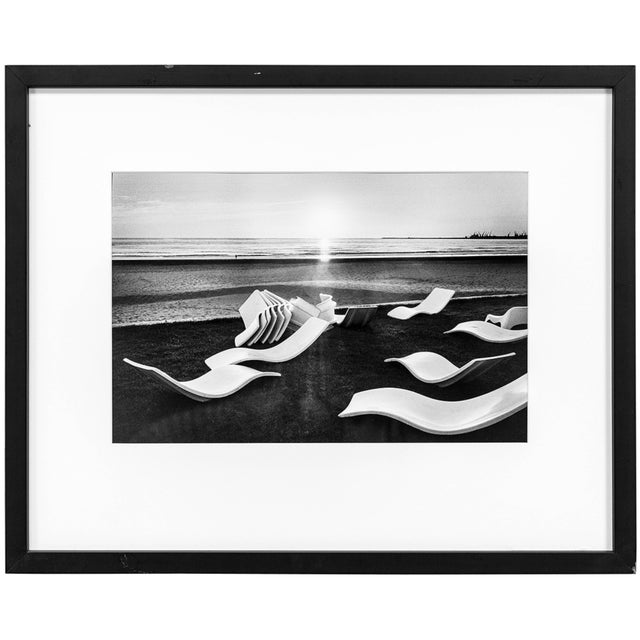
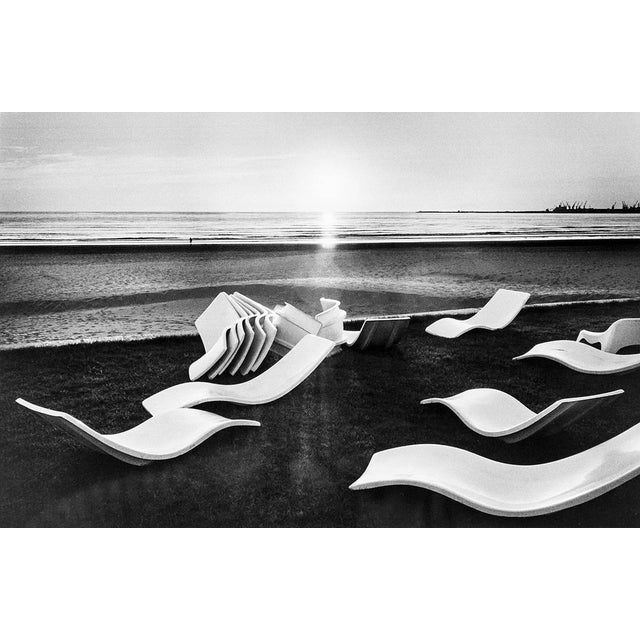
Black and white Maritime 1970's Seascape Photograph. Martine Franck (2 April 1938 – 16 August 2012) was a Belgian documentary … Read more Black and white Maritime 1970's Seascape Photograph. Martine Franck (2 April 1938 – 16 August 2012) was a Belgian documentary and portrait photographer. She was a member of Magnum Photos for over 32 years. Franck was the second wife of Henri Cartier-Bresson and co-founder and president of the Henri Cartier-Bresson Foundation. Franck studied art history at the University of Madrid and at the Ecole du Louvre in Paris. After struggling through her thesis (on French sculptor Henri Gaudier-Brzeska and the influence of cubism on sculpture), she said she realized she had no particular talent for writing, and turned to photography instead. In 1963, Franck's photography kick started following trips to the Far East, having taken pictures with her cousin’s Leica camera. Returning to France in 1964, now possessing a camera of her own, Franck became an assistant to photographers Eliot Elisofon and Gjon Mili at Time-Life. By 1969 she was a busy freelance photographer for magazines such as Vogue, Life and Sports Illustrated, and the official photographer of the Théâtre du Soleil (a position she held for 48 years). From 1970 to 1971 she worked in Paris at the Agence Vu photo agency, and in 1972 she co-founded the Viva agency. In 1980, Franck joined the Magnum Photos cooperative agency as a "nominee", and in 1983 she became a full member. She was one of a very small number of women to be accepted into the agency. In 1983, she completed a project for the now-defunct French Ministry of Women's Rights and in 1985 she began collaborating with the non-profit International Federation of Little Brothers of the Poor. In 1993, she first traveled to the Irish island of Tory where she documented the tiny Gaelic community living there. She also traveled to Tibet and Nepal, and with the help of Marilyn Silverstone photographed the education system of the Tibetan Tulkus monks. In 2003 and 2004 she returned to Paris to document the work of theater director Robert Wilson who was staging La Fontaine's fables at the Comédie Française. Nine books of Franck's photographs have been published, and in 2005 Franck was made a chevalier of the French Légion d'Honneur. Franck continued working even after she was diagnosed with bone cancer in 2010. Her last exhibition was in October 2011 at the Maison Européenne de la Photographie. The exhibit consisted of 62 portraits of artists "coming from somewhere else” collected from 1965 through 2010. This same year, there were collections of portraits shown at New York's Howard Greenberg Gallery and at the Claude Bernard Gallery, Paris. Franck was well known for her documentary-style photographs of important cultural figures such as painter Marc Chagall, philosopher Michel Foucault and poet Seamus Heaney, and of remote or marginalized communities such as Tibetan Buddhist monks, elderly French people, and isolated Gaelic speakers. Michael Pritchard, the Director-General of the Royal Photographic Society, observed: "Martine was able to work with her subjects and bring out their emotions and record their expressions on film, helping the viewer understand what she had seen in person. Her images were always empathetic with her subject." In 1976, Frank took one of her most iconic photos of bathers beside a pool in Le Brusc, Provence. By her account, she saw them from a distance and rushed to photograph the moment, all the while changing the roll of film in her camera. She quickly closed the lens just at the right moment, when happened to be most intense. She cited as influences the portraits of British photographer Julia Margaret Cameron, the work of American photojournalist Dorothea Lange and American documentary photographer Margaret Bourke-White.[8] In 2010, she told The New York Times that photography "suits my curiosity about people and human situations." She worked outside the studio, using a 35 mm Leica camera, and preferring black and white film. The British Royal Photographic Society has described her work as "firmly rooted in the tradition of French humanist documentary photography." See less
- Dimensions
- 21ʺW × 1ʺD × 17ʺH
- Styles
- Contemporary
- Art Subjects
- Seascape
- Frame Type
- Framed
- Period
- Mid 20th Century
- Item Type
- Vintage, Antique or Pre-owned
- Materials
- Photography
- Silver Gelatin
- Condition
- Good Condition, Original Condition Unaltered, Some Imperfections
- Color
- Black
- Condition Notes
- Good Good less
Questions about the item?
Returns & Cancellations
Return Policy - All sales are final 48 hours after delivery, unless otherwise specified in the description of the product.
Cancellation Policy - Prior to shipping or local pickup, buyers may cancel an order for up to 48 hours, unless otherwise specified.
Related Collections
- Graphite Photography
- Bright Green Photography
- Herbert List Photography
- Edwardian Photography
- Edward S. Curtis Photography
- Color Pencil Photography
- Raymond Loewy Photography
- Cubism Photography
- Andreas Feininger Photography
- Black and White Photos
- Nick Mele Photography
- Photography in Minneapolis
- Gustavian (Swedish) Photography