


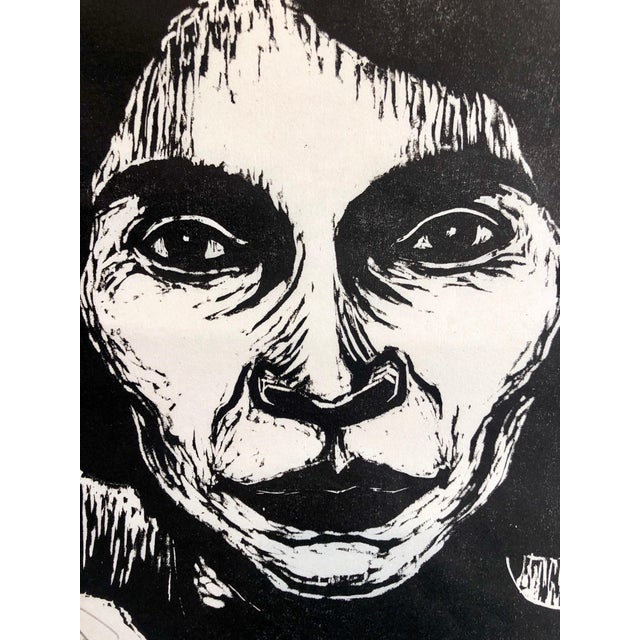


Details
Description
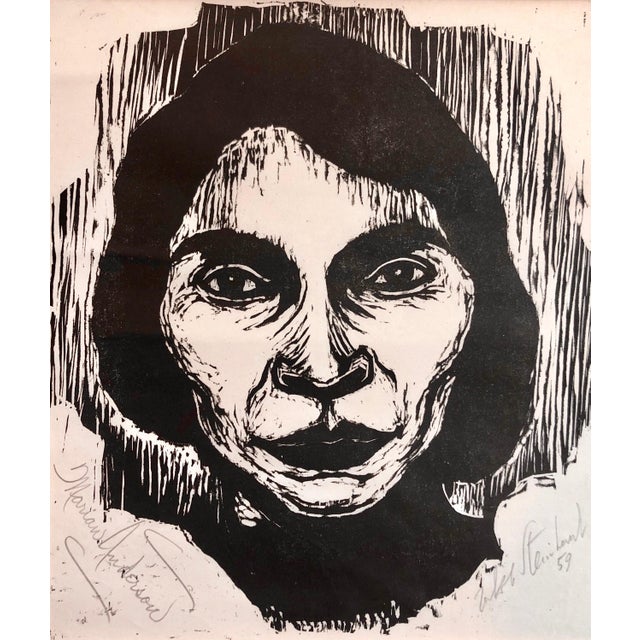
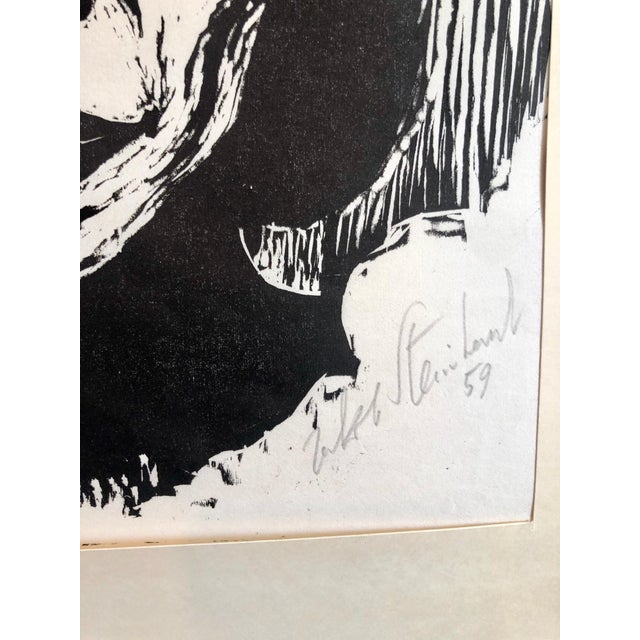
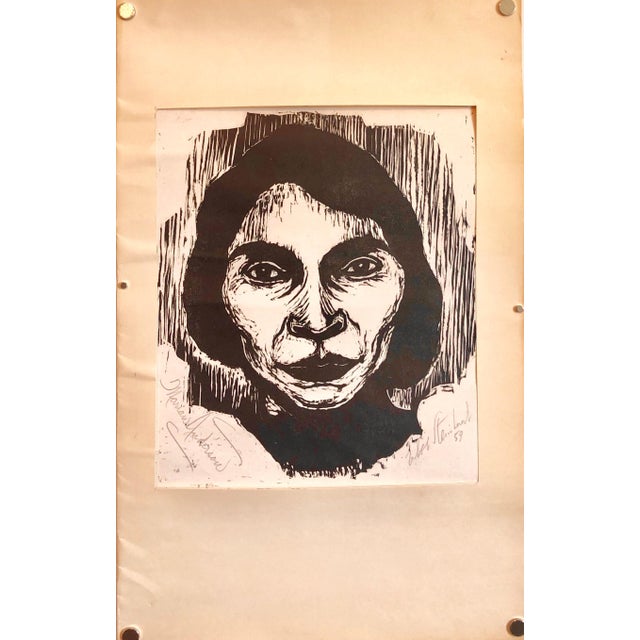
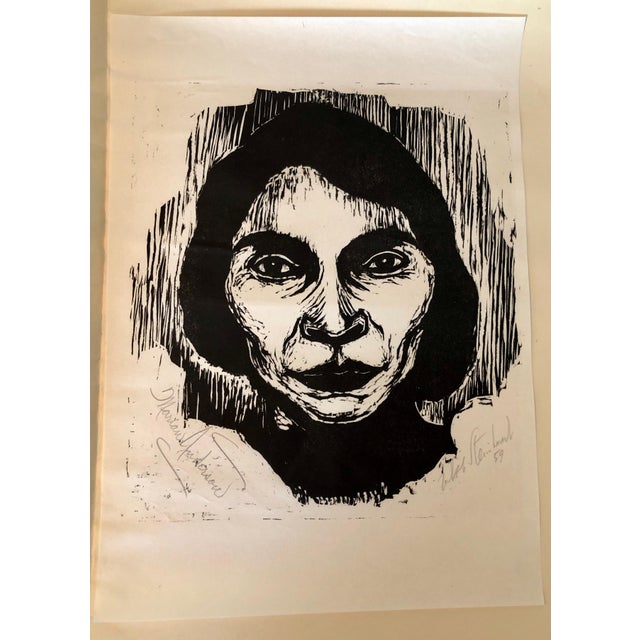
Portrait in black and white, woodblock print. Pencil signed by both Jacob Steinhardt 1887-1968 and Marian Anderson. Very rare thus. … Read more Portrait in black and white, woodblock print. Pencil signed by both Jacob Steinhardt 1887-1968 and Marian Anderson. Very rare thus. (Commissioned by Dr. Leon Kolb, San Francisco) 35.8 x 23.6 cm (image) Marian Anderson is remembered as one of the best American contraltos (women with lower singing voices) of all time. She was the first African American singer to perform at the White House and the first African American to sing with New York's Metropolitan Opera. Marian Anderson was born in Philadelphia, Pennsylvania, on February 27, 1897. She was educated in the public schools. She displayed a remarkable skill for singing when she was very young, and she loved singing for her church choir. When she could not afford singing lessons, her fellow choir members raised the money that allowed her to study with a famous singing teacher. When Anderson was twenty-three years old, she entered a competition and won first place over three hundred other singers. The prize was the opportunity to sing with the New York Philharmonic orchestra. Further sponsorships enabled her to continue her studies in both the United States and in Europe. Following Anderson's debuts (first performances on stage in a particular city) in Berlin, Germany, in 1930 and London, England, in 1932, she performed in Scandinavia (northern Europe), South America, and the Soviet Union. In Salzburg, Austria, she gave a sensational performance. The famous conductor Arturo Toscanini (1867–1957) was in the audience. After hearing her sing, Toscanini said she had "a voice heard but once in a century." At the end of Anderson's European tour, she was signed to a contract for fifteen concerts in the United States. On December 30, 1935, she opened her American tour at New York's Town Hall. She performed pieces by European classical composers as well as several African American spirituals (traditional religious songs). The performance was a great success. Critics welcomed her as a "new high priestess of song." In the words of a writer for the New York Times, the concert established her as "one of the great singers of our time." Over the next several years Anderson sang for U.S. president Franklin Delano Roosevelt (1882–1945) at the White House and for Great Britain's King George VI (1895–1952) during his 1939 visit to the United States. After World War II (1939–45; a war fought between Great Britain, France, the Soviet Union, and the United States against Germany, Italy, and Japan) ended, she performed in major European cities again. By 1950 it was estimated that she had performed before nearly four million listeners. Anderson was a pioneer in winning recognition at home and abroad for African American artists. In 1939 an incident involving the Daughters of the American Revolution (DAR) helped focus public attention on racism. The DAR denied Anderson use of their Constitution Hall in Washington, D.C., for an April concert. First Lady Eleanor Roosevelt resigned from the DAR in protest and had the U.S. government allow Anderson to perform at the Lincoln Memorial. Her concert there, on Easter morning, drew a live audience of seventy-five thousand, and millions more heard it over the radio. Among the people influenced by the concert was 10-year-old Martin Luther King, Jr. Five years later, King won a speaking contest at his Atlanta high school, using the topic “The Negro and the Constitution,” and mentioning the event. As a high school junior, King said: “She sang as never before with tears in her eyes. When the words of ‘America’ and ‘Nobody Knows De Trouble I Seen’ rang out over that great gathering, there was a hush on the sea of uplifted faces, black and white, and a new baptism of liberty, equality and fraternity. That was a touching tribute, but Miss Anderson may not as yet spend the night in any good hotel in America.” In 1955, and again in 1956, Anderson sang in an opera at New York's Metropolitan Opera House. This was the first time an African American had sung with the Metropolitan since it opened in 1883. Over the years Anderson continued to add to her accomplishments. She sang at the presidential inaugurations of Dwight D. Eisenhower (1890–1969) and John F. Kennedy (1917–1963). In 1957 Anderson made a concert tour of India and the Far East for the U.S. State Department. In 1958 President Eisenhower appointed her a delegate (representative) to the Thirteenth General Assembly of the United Nations (UN). She was awarded the UN Peace Prize in 1977. Anderson gave her farewell concert (last public performance) at Carnegie Hall in New York on Easter Sunday in 1965. She died on April 8, 1993, in Portland, Oregon. Steinhardt, Jakob, Painter and Woodcut Artist. b. 1887, Yaacov Steinhardt was born in the then remote, largely Polish town of Zerkow in the Posen District of Germany. (poland/german) Immigrated 1933. Studies: 1906 School of Art, 1906 Studied in Berlin Arts and Crafts School. Berlin; 1907 painting with Lovis Corinth and engraving and etching with Hermann Struck; advanced studies, 1908-10 Paris, with Henri Matisse and Steinlen; 1911 Italy. Teaching: Bezalel, Jerusalem, 1953-57 Director. 1910 Participated in the “New Sezession”, Berlin. 1912 together with Ludwig Meidner and Janthur he founded the "Pathetiker" group very early in the German expressionist movement. Running afoul of the Nazis, he fled to Tel-Aviv and then Jerusalem in the early 30s, showing in “Der Sturm” Gallery. 1914 Exhibited with ludwig Meidner at first Expressionist Exhibition in Berlin. Worked mainly in woodcuts depicting biblical and other Jewish subjects. 1955-58 International awards for his woodcuts. receives graphic commissions from Fritz Gurlitt. 1922 Marries Minni Gumpert. Active in organizing Secession exhibits. 1925 Trips to Mark Brandenburg and Holy Land. Turns primarily to painting; stops work on etchings and lithographs. 1933 Emigrates to the Palestine. 1934 Moves to Jerusalem and opens an art school; attempts some etchings. 1948 Closes the art school and becomes Chairman of Graphics Department, Bezalel School for Arts and Crafts. 1954-57 Director of Bezalel School for Arts and Crafts. Taken up by J. B. Neumann who became the agent for his etchings. Exhibited Sturm Gallery, Herbst-salon. 1914 Outbreak of World War I; Steinhardt enlists in German army. 1916-18 First on Eastern Front in Poland and Lithuania, then after short training period in Berlin, sent to Macedonia. 1917 Exhibition of Lithuanian drawings at Berlin Secession in Spring. Elected member of the Secession. He often used wood-cutting techniques that were popular amongst German Expressionists. Steinhardt was driven to express ideas clearly and decisively through art. Amongst the themes found in his work the prophets of the Bible, such as Jonah, are noticeable. Steinhardt identified deeply with Jonah due to his attempt to run from God's call to duty. Additionally, the image of beggars was often found in Steinhardt's works and in his artistic presentation of the less fortunate, the artist's love for his fellow man becomes evident. Moreover, the grotesque was a theme noticeable in Steinhardt's earliest pieces. These were fantastical images; it was unclear whether or not they were human or demon. In the 1950's, Steinhardt returned to these images upon learning of the Holocaust of Europe's Jews. At that time he resided in New York and there, in the shadow of the skyscrapers, Steinhardt's reaction to WWII was expressed through his art. A Collection of Works by Artists of the Land of IsraelThe Bezalel National Museum, Jerusalem 1940 Artists: Shemi, Menahem Rubin, Reuven Avni, Aharon Mokady, Moshe Jonas, Ludwig Steinhardt, Jakob Ticho, Anna Krakauer, Leopold Gutman, Nachum Budko, Joseph Ardon, Mordecai Sima, Miron Castel, Moshe Pann, Abel Struck, Hermann Gur Arie, Meir Ben Zvi, Zeev Litvinovsky, Pinchas Education 1906 Berlin Art Museum, Berlin 1907 painting with Louis Corinth and engraving with Hermann Struck, Berlin 1909-1910 Académie Julian, Paris 1909-1910 Académie Colarossi, Paris 1909-1910 Académie Matisse, Paris Teaching 1934-1949 Instructor drawing, painting and printing, The Studio 1949-1957 Instructor, New Bezalel, Jerusalem 1949-1953 Head of graphics department, New Bezalel, Jerusalem 1953-1957 Director, Bezalel Academy of Arts and Design, Jerusalem Awards And Prizes 1939 IBM prize, New York World's Fair, New York, USA 1955 First Prize, Sao Paolo Biennale, Brazil 1958 California Print Makers Prize, San Francisco, USA 1959 Arte Liturgica Prize, Venice Biennale, Italy 1961 Arte Sacra Prize, The International Biennial for Religious Art, Trieste, Italy See less
- Dimensions
- 14.25ʺW × 0.1ʺD × 22.75ʺH
- Styles
- Expressionism
- Frame Type
- Unframed
- Art Subjects
- Portrait
- Period
- 1950s
- Country of Origin
- Israel
- Item Type
- Vintage, Antique or Pre-owned
- Materials
- Woodcut
- Condition
- Good Condition, Original Condition Unaltered, Some Imperfections
- Color
- Black
- Condition Notes
- Good good. image measures 35.8 x 23.6 cm. original matting has light creasing, minor wear. Good good. image measures 35.8 x 23.6 cm. original matting has light creasing, minor wear. less
Questions about the item?
Returns & Cancellations
Return Policy - All sales are final 48 hours after delivery, unless otherwise specified in the description of the product.
Cancellation Policy - Prior to shipping or local pickup, buyers may cancel an order for up to 48 hours, unless otherwise specified.
Related Collections
- Patrick Nagel Reproduction Prints
- Reproduction Prints in Panama City, FL
- Qing Reproduction Prints
- William Hogarth Reproduction Prints
- Classical Greek Reproduction Prints
- Monotype Reproduction Prints
- Sol LeWitt Reproduction Prints
- Utagawa Kunisada (Toyokuni Iii) Reproduction Prints
- Reproduction Prints in Mobile
- William Gropper Reproduction Prints
- Ethan Allen Reproduction Prints
- Paule Marrot Reproduction Prints