

Details
Description
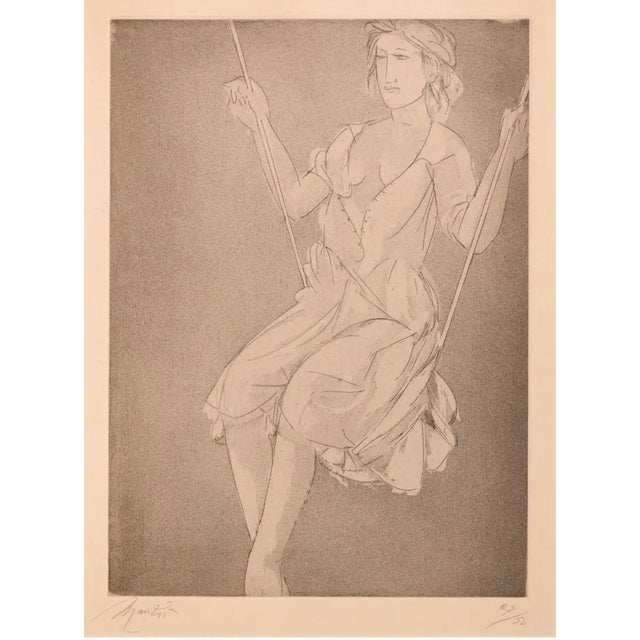
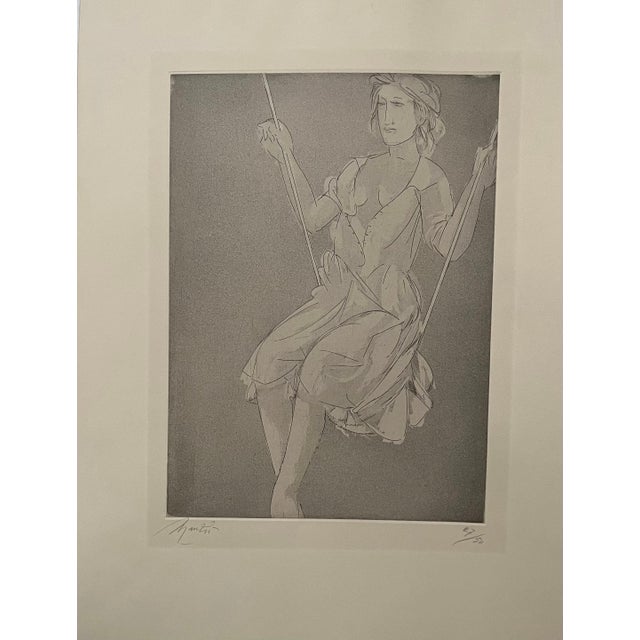
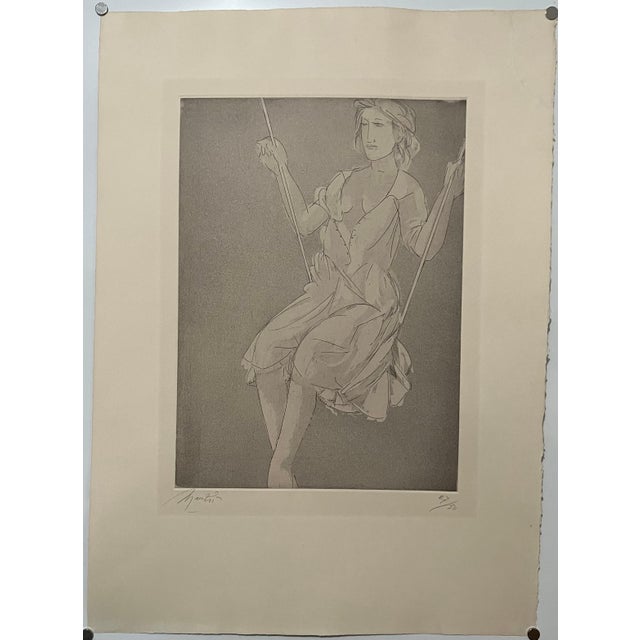
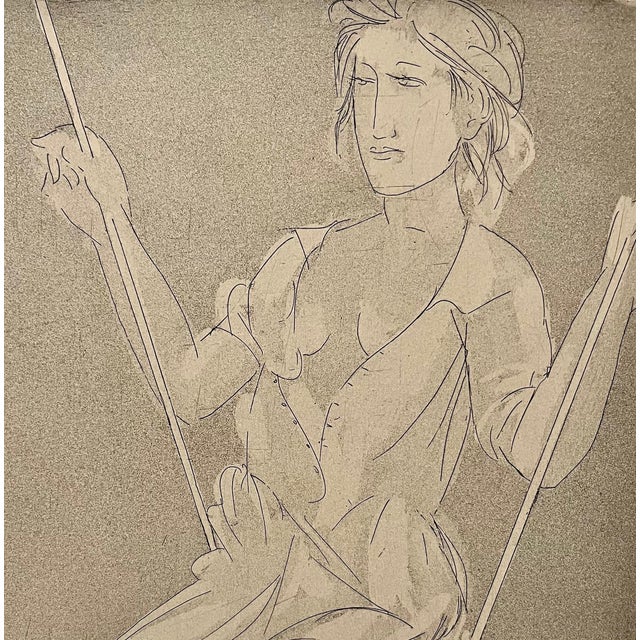
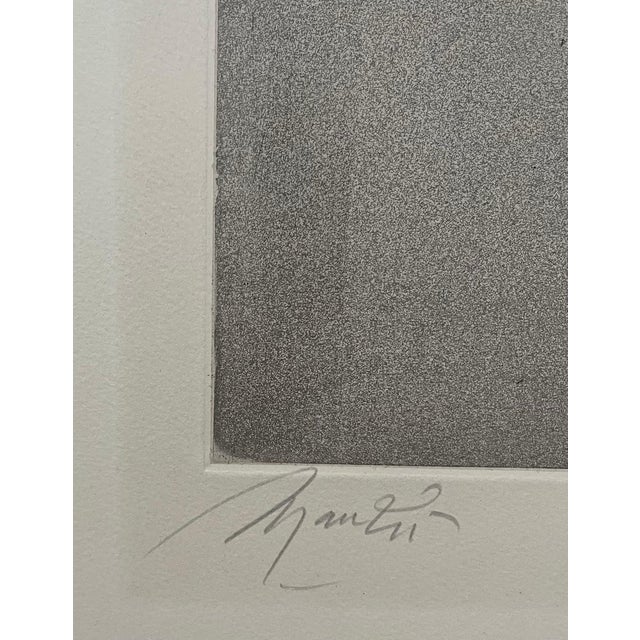
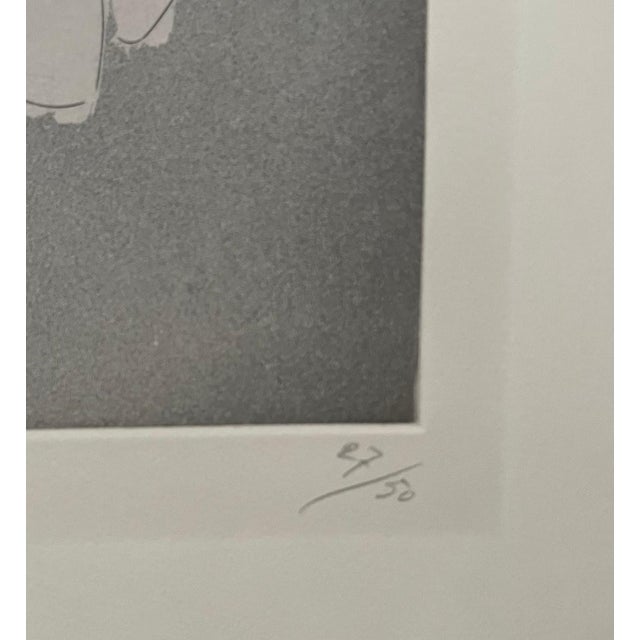
Giacomo Manzu (Italian, 1908-1991) 'La Balance' Etching and Aquatint Undated, hand signed lower left, #27/50, depicting a swinging figure, in … Read more Giacomo Manzu (Italian, 1908-1991) 'La Balance' Etching and Aquatint Undated, hand signed lower left, #27/50, depicting a swinging figure, in copper-tone wood frame. Woman on Swing. Giacomo Manzoni (1908 –1991), known professionally as Giacomo Manzù, was an Italian sculptor. Manzù was born in Bergamo. His father was a shoemaker and sacristan. Other than a few evening art classes, he was self-taught in sculpture, and later became a professor himself. He started working with wood during his military service in Verona in 1928; later, after a short stay in Paris, he moved to Milan, where architect Giovanni Muzio commissioned him the decoration of the chapel of Università Cattolica del Sacro Cuore (1931–1932). In 1933 he exhibited a series of busts at the Triennale di Milano, which granted him national popularity. In 1933, he completed the reliefs for the Monument to the Brothers Calvi located in front of the city hall of Bergamo, a monument inaugurated by Mussolini and the poet D'Annunzio. The following year he held a personal exhibition in Rome with the painter Aligi Sassu, with whom he shared a studio. In 1939 Manzù started a series of bronze bas-reliefs the works, exhibited in Rome in 1942, were criticized by the Fascist government and the ecclesiastical authorities. In 1940 he obtained a teaching position in the Accademia di Brera in Milan, but later he moved to the Accademia Albertina in Turin. During World War II Manzù moved to Clusone, returning to teach at Brera after the end of the conflict. He held his teaching position until 1954 when he moved to Salzburg, where he lived until 1960. Here he met Inge Schabel, ballerina and his future wife, who was the model of a large number of his portraits and sculptures. He was commissioned in 1957 to design the central doors for Salzburg Cathedral, completed in bronze in 1959. In 1964 he completed perhaps his most important work, the "Doors of Death" for the St. Peter's Basilica in Rome, the first new doors in the cathedral in 500 years. That same year, he moved to Ardea, near Rome, in a locality now rechristened Colle Manzù in his honour. He created two sculptures in stiacciato relief at Rockefeller Center on the former Italian building in the 1960s, one titled "The Immigrant" and the other "A Fruitful Harvest". In the late 1960s, Manzù started to work also as scenographer. In 1977 he completed a "Monument to the Partisan" in Bergamo. His last great work was the 6 m-tall sculpture facing the ONU seat in New York City, inaugurated in 1989. He was the subject of a famous photograph portrait by Yousuf Karsh and in 1968 his friendship with Pope John XXIII was documented in the book "An Artist and The Pope" by Curtis Bill Pepper. His works are displayed in prestigious museums and private collections throughout the world. Tasende Gallery inaugurated their first location in La Jolla, California on 1 June 1979 with a solo presentation of Manzu's work, attended by his wife Inge. Although he was an atheist, he was a personal friend of Pope John XXIII and had important liturgical commissions for the Vatican. In the United States, architect Minoru Yamasaki commissioned him the Passo di Danza (dance step) sculpture at the One Woodward Avenue building in Detroit. He also carved the Nymph and Faun at Wayne State University's McGreagor Memorial Sculpture Garden. His son Pio was an automotive and industrial designer. Giacomo Manzù died in Rome on 17 January 1991. Awards Gold medal: Italian Order of Merit for Culture and Art (1981) Lenin Peace Prize (1965) Knighthood: Order of Merit of the Italian Republic (1960) Postwar Italian sculpture has both the figurative tradition represented by Marino Marini and Giacomo Manzù and an equally energetic commitment to abstract art has been pursued by artists such as Pietro Consagra, Mirko, and the Pomodoro brothers, Giò and Arnaldo. Although apprenticed to various craftsmen from an early age, Manzù was largely self- taught. Key influences on his style include the sculptors Auguste Rodin and Medardo Rosso – the latter’s realism and ability to capture fleeting sensations and expressions being of particular importance.In the late 1930s Manzù began his renowned series of Cardinals, sculpting his sitters enveloped in their liturgical vestments, and a series of bas-reliefs on the theme of the Crucifixion which were also passionate and unflinching indictments of Nazi-Fascist violence. After the war Manzù would establish himself as one of Italy’s foremost sculptors of religious subjects but, like his contemporary Emilio Greco, was drawn as much to the sensual world as to that of the spirit. His vigorous sculptures of entwined lovers are infused with a playful character that frequently verges on the bawdy. See less
- Dimensions
- 21.5ʺW × 1ʺD × 29.5ʺH
- Styles
- Modern
- Art Subjects
- Figure
- Frame Type
- Framed
- Period
- Early 20th Century
- Item Type
- Vintage, Antique or Pre-owned
- Materials
- Etching
- Paper
- Condition
- Good Condition, Original Condition Unaltered, Some Imperfections
- Color
- Gray
- Condition Notes
- Good Refer to photos. Good Refer to photos. less
Questions about the item?
Returns & Cancellations
Return Policy - All sales are final 48 hours after delivery, unless otherwise specified in the description of the product.
Cancellation Policy - Prior to shipping or local pickup, buyers may cancel an order for up to 48 hours, unless otherwise specified.
Related Collections
- Patrick Nagel Reproduction Prints
- Reproduction Prints in Panama City, FL
- Jute Reproduction Prints
- Sam Francis Reproduction Prints
- Leather Reproduction Prints
- Utagawa Kunisada (Toyokuni Iii) Reproduction Prints
- Reproduction Prints in Mobile
- Alvar Aalto Reproduction Prints
- Tuscan Reproduction Prints
- William Hogarth Reproduction Prints
- Daylight Dream Editions Reproduction Prints
- Gold-Plate Reproduction Prints
- Polychrome Reproduction Prints
- Ethan Allen Reproduction Prints
- Paule Marrot Reproduction Prints
- Jim Dine Reproduction Prints
- Qing Reproduction Prints
- Francis Orpen Morris Reproduction Prints