

Details
Description
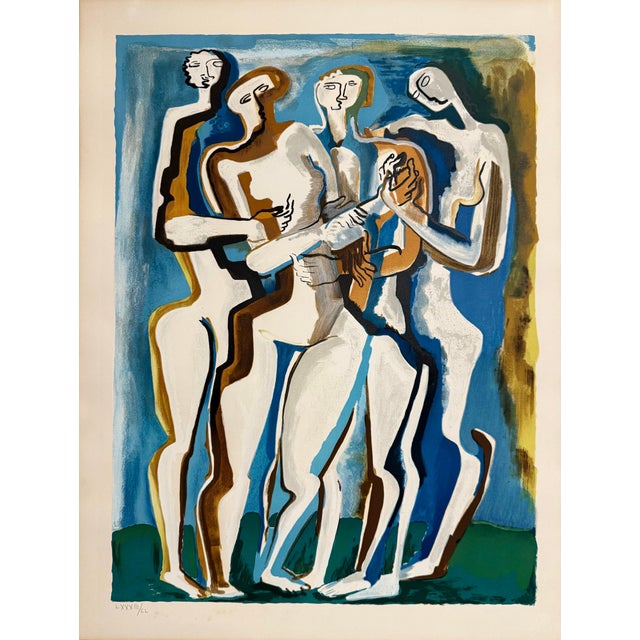
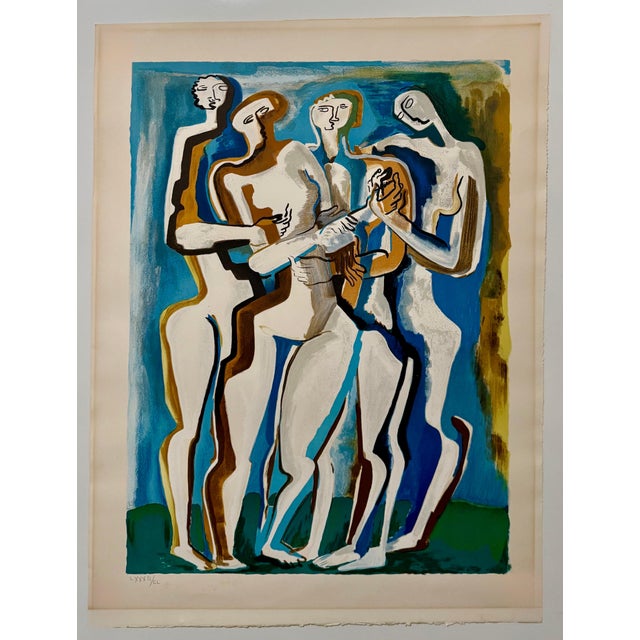
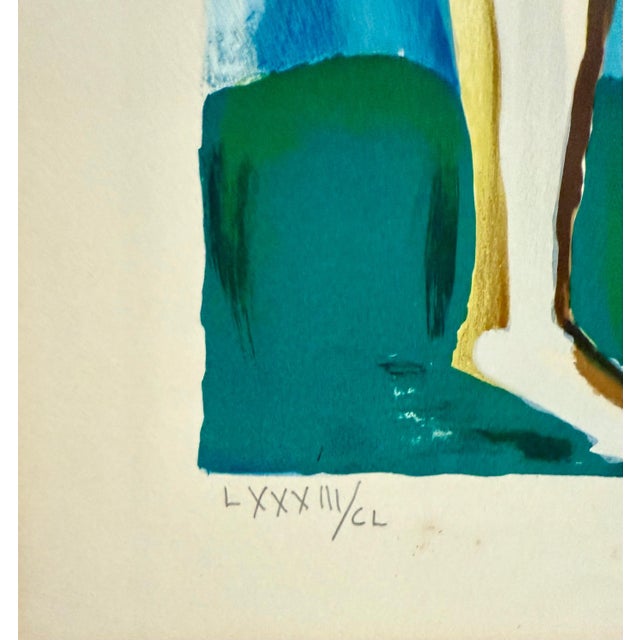
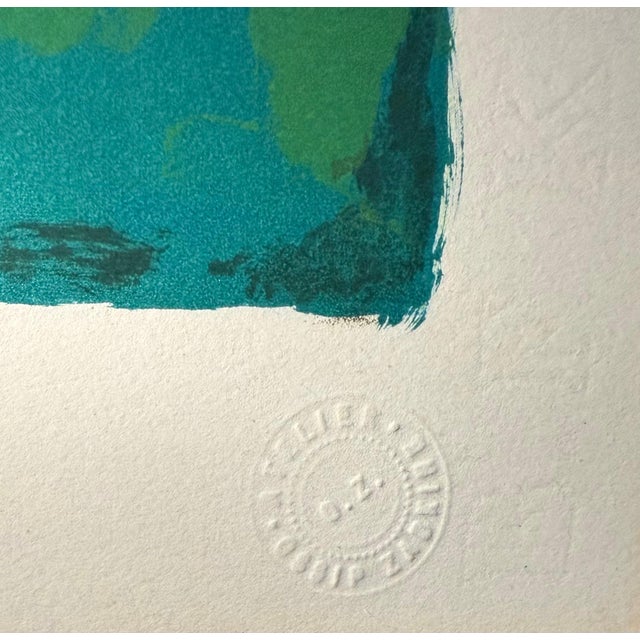
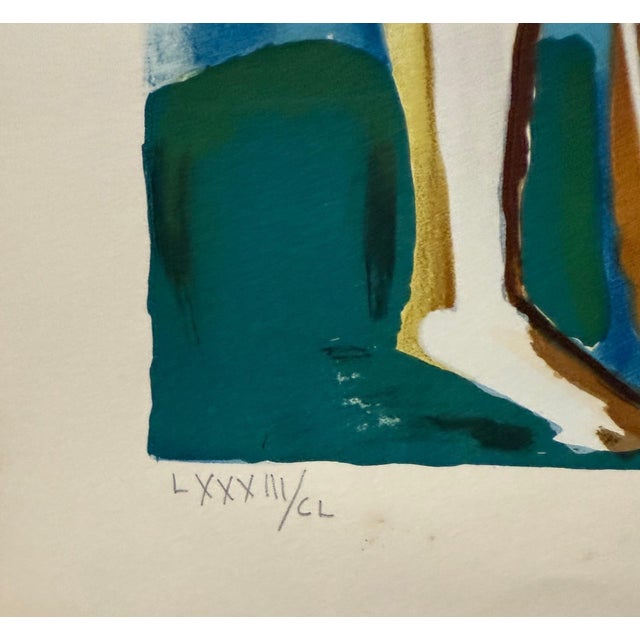
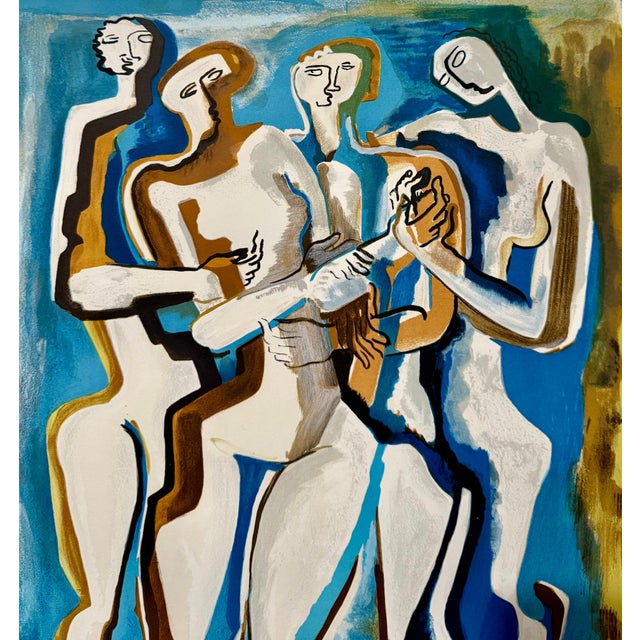
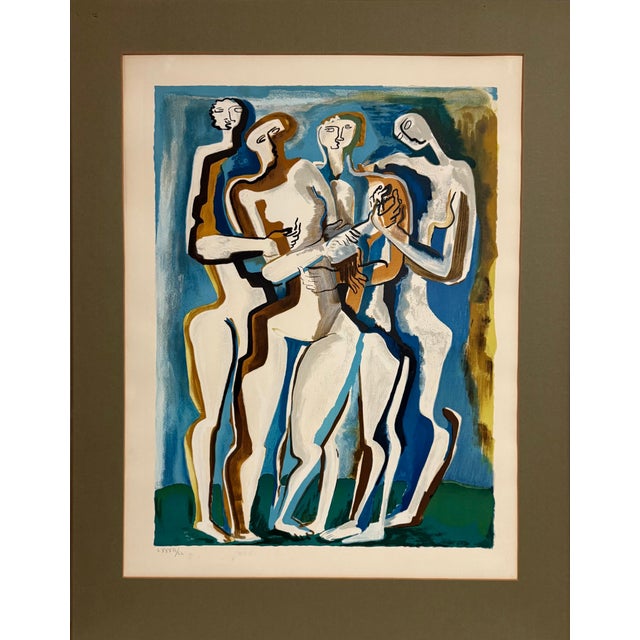
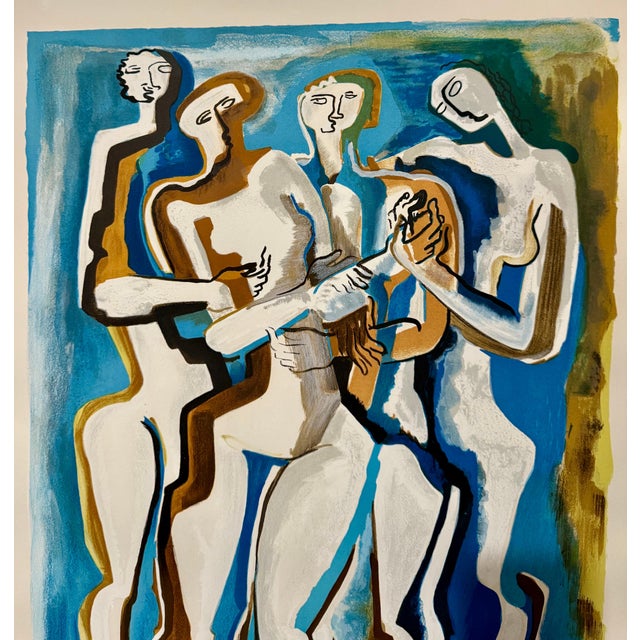
Ossip Zadkine (French-Russian, 1890-1967), limited edition color lithograph on paper titled La Famille (The Family), depicting intertwined figures in a … Read more Ossip Zadkine (French-Russian, 1890-1967), limited edition color lithograph on paper titled La Famille (The Family), depicting intertwined figures in a Cubist-inspired style. The print is hand-numbered LXXXII/CL (82/150) as part of a limited edition of 150 and bears the atelier Zadkine stamp in the lower right corner. This is not hand signed. as issued. Ossip Zadkine (Russian 1888 – 1967) was a Russian-born artist who lived in France. He is primarily known as a Cubist sculptor, but in in addition to sculpture also produced paintings and lithographs, Zadkine was born on 28 January 1888 as Yossel Aronovich Tsadkin in the city of Vitebsk, part of the Russian Empire (now Belarus). He was born to a Jewish father and a mother named Zippa-Dvoyra, who he claimed to be of Scottish origin. After attending art school in London, Zadkine settled in Paris in 1910. He studied at the Ecole des Beaux-Arts for six months. In 1911 he lived and worked in La Ruche. Among the other artists to live or frequent La Ruche between 1910 and 1914 were Alexander Archipenko, Moïse Kisling, Moïse Kogan, Marc Chagall, Jacques Lipchitz, Chaim Soutine, and Ossip Zadkine. Many of these émigré artists were also attracted to the religious tolerance of Paris, which provided a relatively safe new working environment free from the pogroms and persecution that their Jewish families had endured for generations in their former homelands of Russia, Poland, and other Eastern European countries. The French artist Fernand Léger also worked at La Ruche during this time, as did the Italian Jewish painter and sculptor Amedeo Modigliani. While in Paris he joined the Cubist movement, working in a Cubist idiom from 1914 to 1925. He later developed his own style, one that was strongly influenced by African and Greek art. In 1921 he obtained French citizenship. Zadkine served as a stretcher-bearer in the French Army during World War I, and was wounded in action. During World War II he was forced to seek refuge in New York in 1941, and then close to Tucson, Arizona, in 1944. He taught at the Art Students League of New York where he trained many artists, including Kenneth Noland. In March 1942 the Pierre Matisse Gallery invited him to take part in the exhibition Artists in Exile, along with Léger, Chagall and Lipchitz. He won international recognition with exhibitions in the Palais des Beaux-Arts in Brussels (1948), the Boymans Museum in Rotterdam (1949), the Fujikawa Gallery in Japan (1954). The Wallraf-Richartz Museum in Cologne (1960), the Tate Gallery in London (1961) and Kunsthaus Zurich (1965) put on big Zadkine retrospectives. The bronze sculpture Statue for a Garden (1958), from the Maeght Foundation Collection, is known in several versions, of which the first, from 1927, was probably wooden. His best-known work is probably the sculpture The Destroyed City (1951-1953), representing a man without a heart, a memorial to the destruction of the center of the Dutch city of Rotterdam in 1940 by the German Luftwaffe. In August 1920, Zadkine married Valentine Prax (1899—1991), an Algerian-born painter of Sicilian and French Catalan descent. They had no children. Zadkine had a wartime relationship with American artist Carol Janeway while living in self-exile in Manhattan 1942-1945. He created several portraits of her. Zadkine was a friend of Henry Miller and was represented by the character Borowski in Miller's Tropic of Cancer. Zadkine died in Paris in 1967 at the age of 79 after undergoing abdominal surgery and was interred in the Cimetière du Montparnasse. His former home and studio is now the Musee Zadkine. There is also a Musée Zadkine in the village of Les Arques in the Midi-Pyrénées region. Zadkine lived in Les Arques for a number of years, and while there, carved an enormous Christ on the Cross and Pieta that are featured in the 12th-century church which stands opposite the museum. Awards 1950 Venice Biennale sculpture prize 1961 Grand Prix National des Art Public collections Van Abbemuseum, Eindhoven, Netherlands Museum de Fundatie, Zwolle, Netherlands Los Angeles County Museum of Art, Los Angeles Musée Zadkine, Paris Museum of Modern Art, New York City National Gallery of Art, Washington, D.C. Tate Gallery, London Tel Aviv Museum of Art, Israel See less
- Dimensions
- 22.25ʺW × 1ʺD × 30ʺH
- Styles
- Cubism
- Frame Type
- Unframed
- Art Subjects
- Figure
- Period
- 1960s
- Item Type
- Vintage, Antique or Pre-owned
- Materials
- Lithograph
- Condition
- Good Condition, Original Condition Unaltered, Some Imperfections
- Color
- Blue
- Condition Notes
- Good minor wear. please see photos. this is being sold unframed without the mat for shipping. Good minor wear. please see photos. this is being sold unframed without the mat for shipping. less
Questions about the item?
Returns & Cancellations
Return Policy - All sales are final 48 hours after delivery, unless otherwise specified in the description of the product.
Cancellation Policy - Prior to shipping or local pickup, buyers may cancel an order for up to 48 hours, unless otherwise specified.
Related Collections
- Patrick Nagel Reproduction Prints
- Reproduction Prints in Panama City, FL
- William Hogarth Reproduction Prints
- Polychrome Reproduction Prints
- Gold-Plate Reproduction Prints
- Classical Greek Reproduction Prints
- Jute Reproduction Prints
- Utagawa Kunisada (Toyokuni Iii) Reproduction Prints
- William Gropper Reproduction Prints
- Monotype Reproduction Prints
- Daylight Dream Editions Reproduction Prints
- Ethan Allen Reproduction Prints
- Paule Marrot Reproduction Prints
- Jim Dine Reproduction Prints
- Francis Orpen Morris Reproduction Prints