


Details
Description
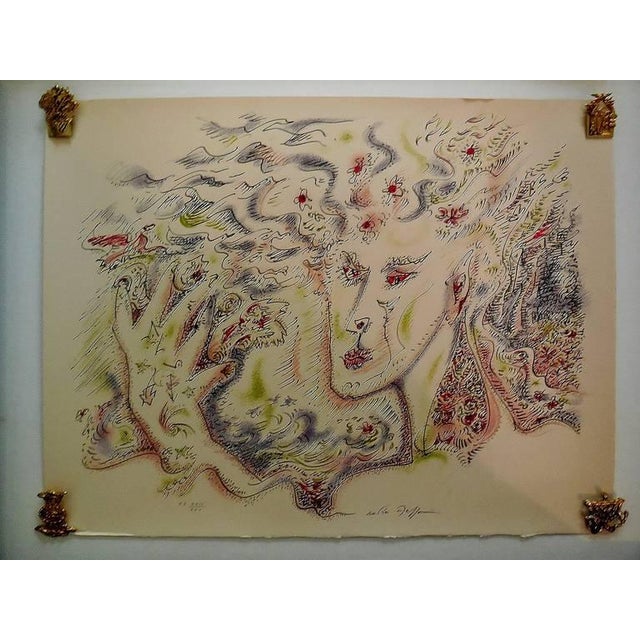
His early works display an interest in cubism. He later became associated with surrealism, and he was one of the … Read more His early works display an interest in cubism. He later became associated with surrealism, and he was one of the most enthusiastic employers of automatic drawing, making a number of automatic works in pen and ink. Masson would often force himself to work under strict conditions, for example, after long periods of time without food or sleep, or under the influence of drugs. He believed forcing himself into a reduced state of consciousness would help his art be free from rational control, and hence get closer to the workings of his subconscious mind.[citation needed] Masson experimented with altered states of consciousness with artists such as Antonin Artaud, Michel Leiris, Joan Miró, Georges Bataille, Jean Dubuffet, and Georges Malkine, who were neighbors of his studio in Paris. From around 1926 he experimented by throwing sand and glue onto canvas and making oil paintings based around the shapes that formed. By the end of the 1920s, however, he was finding automatic drawing rather restricting, and he left the surrealist movement and turned instead to a more structured style, often producing works with a violent or erotic theme, and making a number of paintings in reaction to the Spanish Civil War (he associated once more with the surrealists at the end of the 1930s). Under the German occupation of France during World War II, his work was condemned by the Nazis as degenerate. With the assistance of Varian Fry in Marseille, Masson escaped the Nazi regime on a ship to the French island of Martinique from where he went on to the United States. Upon arrival in New York City, U.S. customs officials inspecting Masson's luggage found a cache of his erotic drawings. Denouncing them as pornographic, they ripped them up before the artist's eyes.[citation needed] Living in New Preston, Connecticut his work became an important influence on American abstract expressionists, such as Jackson Pollock. Following the war, he returned to France and settled in Aix-en-Provence where he painted a number of landscapes. Masson drew the cover of the first issue of Georges Bataille's review, Acéphale, in 1936, and participated in all its issues until 1939. His brother-in-law, the psychoanalyst Jacques Lacan, was the last private owner of Gustave Courbet's provocative painting L'Origine du monde (The Origin of the World); Lacan asked Masson to paint a surrealist variant. See less
- Dimensions
- 25.82ʺW × 1ʺD × 19.82ʺH
- Styles
- Surrealism
- Art Subjects
- Figure
- Frame Type
- Unframed
- Period
- 1970s
- Item Type
- Vintage, Antique or Pre-owned
- Materials
- Lithograph
- Condition
- Good Condition, Original Condition Unaltered, Some Imperfections
- Color
- Cream
- Condition Notes
- Excellent Excellent less
Questions about the item?
Returns & Cancellations
Return Policy - All sales are final 48 hours after delivery, unless otherwise specified in the description of the product.
Cancellation Policy - Prior to shipping or local pickup, buyers may cancel an order for up to 48 hours, unless otherwise specified.
Related Collections
- Donald Judd Paintings
- Margaret Kennedy Paintings
- Paul Jenkins Paintings
- Richard Serra Paintings
- Joseph Solman Paintings
- Photorealism Paintings in New York
- George Coggeshall Paintings
- Photorealism Canvas Paintings
- Vienna Secession Paintings
- Jeff Slemmons Paintings
- Karen Offutt Paintings
- Damien Hirst Paintings
- Sol LeWitt Paintings
- William IV Paintings
- Keith Haring Paintings
- Jacobean Paintings
- Lowell Nesbitt Paintings
- Francine Tint Paintings
- Louis Wolchonok Paintings
- Jean Calogero Paintings
- Michelle Arnold Paine Paintings
- Black Photorealism Paintings
- Photorealism Paintings in Los Angeles
- Paintings in Panama City, FL
- Lee Reynolds Paintings