


Details
Description
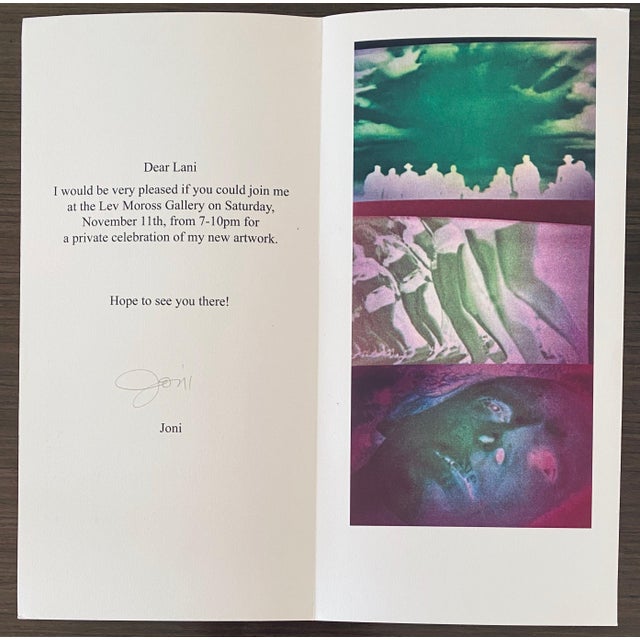
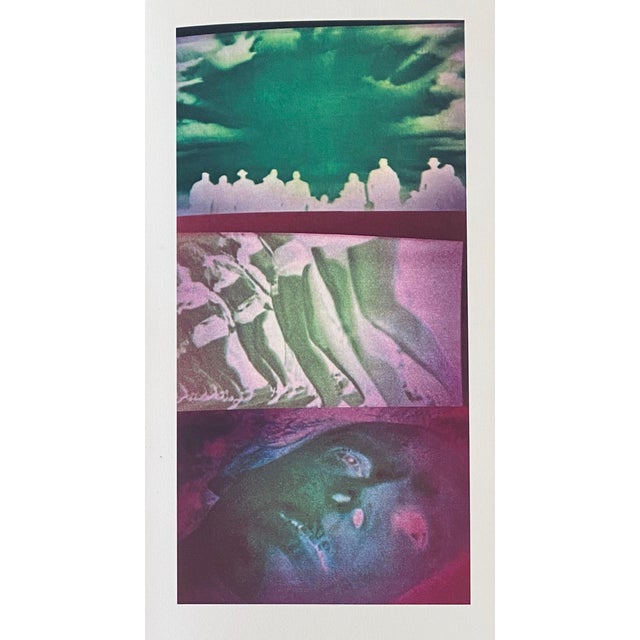
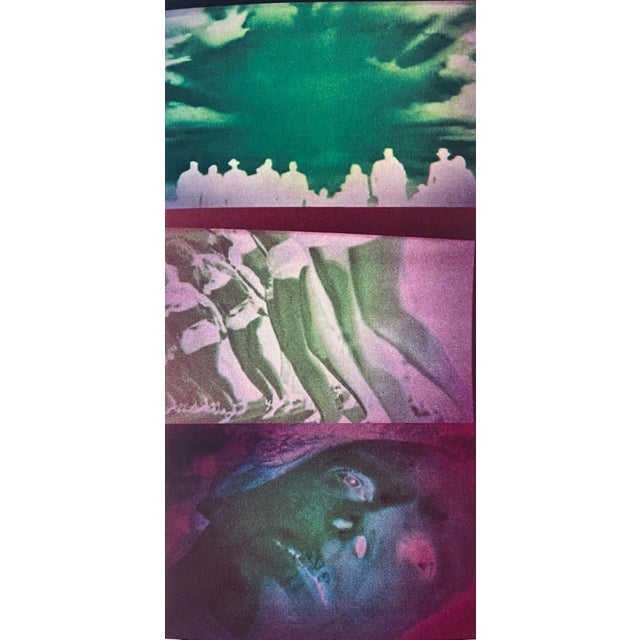
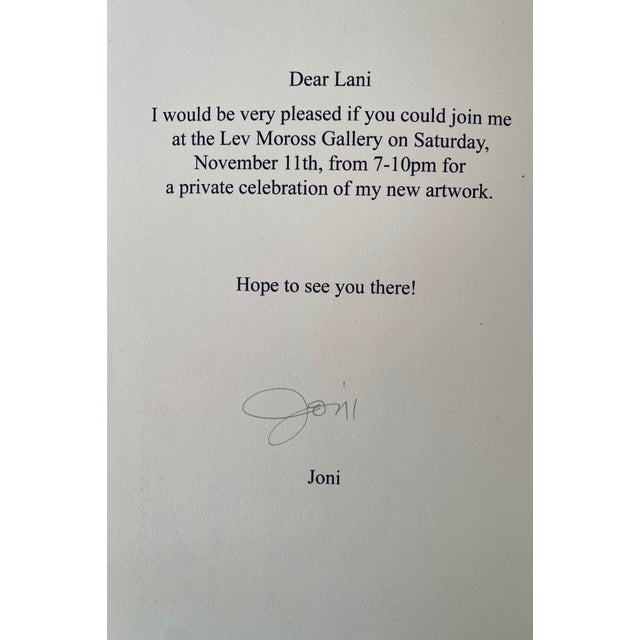
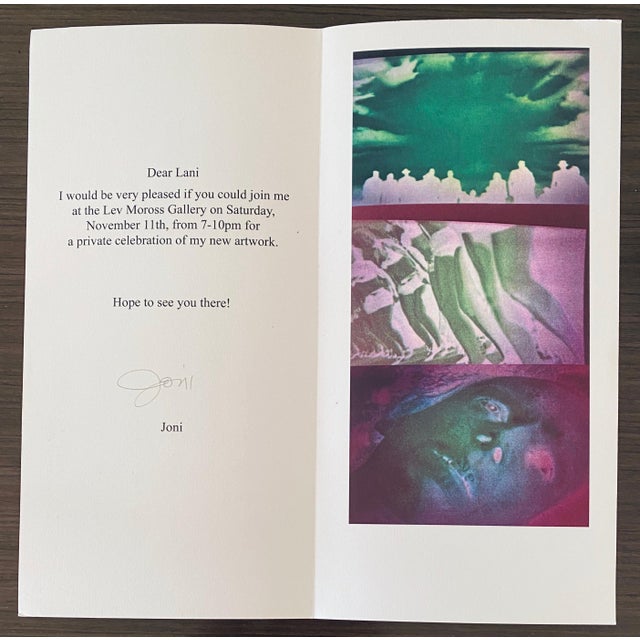
Joni Mitchell “Green Flag Song,” Published by Lev Moross Gallery. Los Angeles, CA From an exhibition of 60 large photographic … Read more Joni Mitchell “Green Flag Song,” Published by Lev Moross Gallery. Los Angeles, CA From an exhibition of 60 large photographic triptychs. When Mitchell’s television set broke, it began emitting images that looked like photographic negatives with a green tint. She took photos of the screen, which resulted in dark, jarring, semiabstract images that he enlarged and printed on canvas. The artwork Mitchell characterized as “riding the cusp of photography, impressionism and expressionism.” She said the photographs were infused with political undertones that somehow felt urgent. Though the images, if you look close, range from shots from old movies to talk-show hosts to news coverage, the overall effect has the whiff of brutality. “The theme of this show is ‘war, revolution and torture,’ ” she told me. “I was in such despair about the world’s current state of affairs that I didn’t even know where to start. I was taking a lot of landscape photos near my home in Canada. Then I got back to L.A. and suddenly I had this magical TV set.” Mitchell talked a lot about the photos — “my bedroom lamp is reflected in a lot of them” — and about how she has ideas for more exhibitions. Though she “retired” from music several years ago, she’s writing new songs. She said they were hard in coming, that it’s easy to doubt yourself. Roberta Joan Anderson was born on November 7, 1943, in Fort Macleod, Alberta, Canada. Her parents, Bill and Myrtle (Her father was a grocer, and her mother a schoolteacher), moved with their young daughter to North Battleford, Saskatchewan after the end of World War II. When she was 9 years old, Joni and her family moved to Saskatoon, Saskatchewan, the "city of bridges," which Joni has since referred to as her hometown. Inspired when her slightly older friend Frankie McKitrick, a piano prodigy, introduced her to classical composers like Schubert and Mozart, Joni begged her parents to let her study the piano. Her piano lessons started at age seven, but lasted all of a year and a half; It was a time when the "knuckle-rapping school" was in effect. Although Joni heard melodies in her head that she wanted to get out, she felt stifled when her teacher asked her "why would you want to make up your own songs when you can have the masters under your fingers?" She also discovered early in her life that her drawing skills were much praised by her elders and peers. In fact, her main sense of identity as she grew up was as the classroom artist. In Grade 7, Joni met a teacher who would have a great effect on her direction. Mr. Kratzman was an Australian who taught English at Queen Elizabeth school and the 12 year old Joni discovered him at the end of schoolyear while hanging her paintings at school. Joni describes him this way: "he looked like Clark Gable and Gregory Peck rolled into one, with gray sideburns", and he told her: "If you can paint with a brush, you can paint with words." And this is what she's been doing ever since. The next year in his class she wrote a poem about stallions and he circled the paper over and over with "cliche". He told her to write about things she knew, and thus helped to mold her remarkable ability for imagery and description. In the credits for her first album, Joni wrote: "This album is dedicated to Mr. Kratzman, who taught me to love words." As a teen she listened to rock-n-roll radio broadcasts out of Texas. She bought herself a baritone ukelele for $36 because she couldn't afford a guitar. She played at parties and get-togethers, and also hung out at a local coffeehouse in Saskatoon called the Louis Riel. After high school, Joni enrolled in the Alberta College of Art in Calgary, but stayed only one year. She'd discovered a club called The Depression in Calgary and become a regular performer there. She says: "My childhood longing mostly was to be a painter, yet before I went to art college my mother said to me that my stick-to-it-iveness in certain things was never that great, and she said you're going to get to art college and you're going to get distracted, you know. Yet all I wanted to do was paint. When I got there, however, it seemed that a lot of the courses were meaningless to me and not particularly creative. And so, at the end of the year I said to my mother: 'I'm going to Toronto to be a folksinger.' And I fulfilled her prophecy." Mitchell was born Roberta Joan Anderson on November 7, 1943, in Fort Macleod, Alberta, Canada, the daughter of Myrtle Marguerite (McKee) and William Andrew Anderson. Her mother's ancestors were Scottish and Irish; her father was from a Norwegian family that possibly had some Sámi ancestry. Her mother was a teacher, while her father was a Royal Canadian Air Force flight lieutenant who instructed new pilots at RCAF Station Fort Macleod. At this time, country music began to eclipse rock, and Mitchell wanted to play the guitar. As her mother disapproved of its hillbilly associations, she settled initially for the ukulele. Eventually she taught herself guitar from a Pete Seeger songbook. Polio had weakened her left hand, so she devised alternative tunings to compensate; she later used these tunings to create non-standard approaches to harmony and structure in her songwriting. Mitchell started singing with her friends at bonfires around Waskesiu Lake, northwest of Prince Albert, Saskatchewan. Her first paid performance was on October 31, 1962, at a Saskatoon club that featured folk and jazz performers. At 18, she widened her repertoire to include her favorite performers, such as Edith Piaf and Miles Davis. Although she never performed jazz herself in those days, Mitchell and her friends sought out gigs by jazz musicians. Mitchell said, "My jazz background began with one of the early Lambert, Hendricks and Ross albums." That album, The Hottest New Group in Jazz, was hard to find in Canada, she says. "So I saved up and bought it at a bootleg price. I considered that album to be my Beatles. I learned every song off of it, and I don't think there is another album anywhere—including my own—on which I know every note and word of every song." But art was still her chief passion at this stage. When she finished high school at Aden Bowman Collegiate in Saskatoon, she took art classes at the Saskatoon Technical Collegiate with abstract expressionist painter Henry Bonli and then left home to attend the Alberta College of Art in Calgary for the 1963–64 school year. Here she felt disillusioned about the high priority given to technical skill over free-class creativity, and felt out of step with the trend toward pure abstraction and the tendency to move into commercial art. After a year, at age 20, she dropped out of school, a decision that much displeased her parents, who could remember the Great Depression and valued education highly. In 2015, Mitchell had a brain aneurysm, which required her to undergo physical therapy, and take part in daily rehabilitation. Mitchell made her first public appearance following the aneurysm when she attended a Chick Corea concert in Los Angeles in August 2016. She has made a few other appearances,] and in November 2018, David Crosby said that she was learning to walk again.On November 7, 2018 Mitchell attended Both Sides Now - Joni 75, a Birthday Celebration in Los Angeles. To celebrate her 75th birthday a select group of artists, among them James Taylor, Graham Nash, Seal and Kris Kristofferson, interpreted songs written by Mitchell. On June 25, 2019, The New York Times Magazine listed Joni Mitchell among hundreds of artists whose master tape recordings were reportedly destroyed in the 2008 Universal fire. See less
- Dimensions
- 14.8ʺW × 1ʺD × 15ʺH
- Styles
- Abstract
- Art Subjects
- Figure
- Frame Type
- Unframed
- Period
- 2000 - 2009
- Country of Origin
- Canada
- Item Type
- Vintage, Antique or Pre-owned
- Materials
- Paper
- Condition
- Good Condition, Original Condition Unaltered, Some Imperfections
- Color
- Green
- Condition Notes
- Good minor wear. Good minor wear. less
Questions about the item?
Returns & Cancellations
Return Policy - All sales are final 48 hours after delivery, unless otherwise specified in the description of the product.
Cancellation Policy - Prior to shipping or local pickup, buyers may cancel an order for up to 48 hours, unless otherwise specified.
Related Collections
- Reproduction Prints in Panama City, FL
- Jute Reproduction Prints
- William Gropper Reproduction Prints
- Monotype Reproduction Prints
- Alvar Aalto Reproduction Prints
- Daylight Dream Editions Reproduction Prints
- Gold-Plate Reproduction Prints
- Polychrome Reproduction Prints
- William Hogarth Reproduction Prints
- Utagawa Kunisada (Toyokuni Iii) Reproduction Prints
- Ethan Allen Reproduction Prints
- Paule Marrot Reproduction Prints
- Jim Dine Reproduction Prints
- Francis Orpen Morris Reproduction Prints