


Details
Description
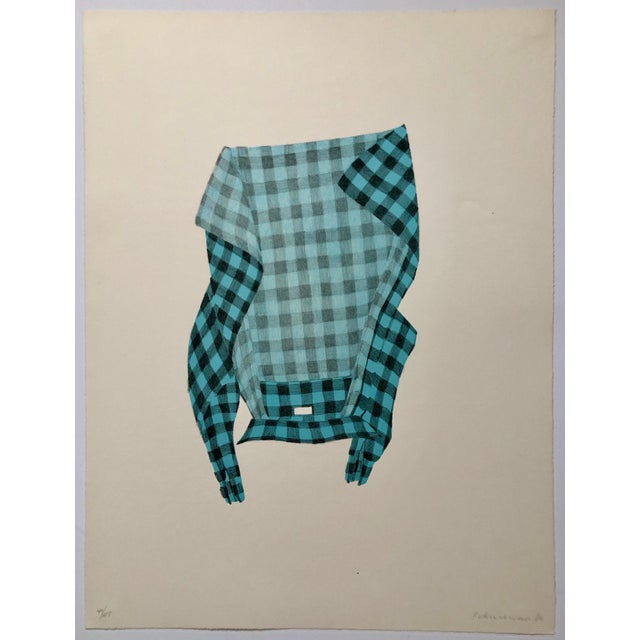
Signed, numbered and dated limited edition lithograph print. The number might not match the photo as I had more than … Read more Signed, numbered and dated limited edition lithograph print. The number might not match the photo as I had more than one. George Schneeman (March 11, 1934 – January 27, 2009) was an American painter who lived in Tuscany, Italy, and New York City. George Schneeman was born on March 11, 1934 in St. Paul, Minnesota. He received a B.A. in Philosophy and English Literature from St Mary’s College, Winona, Minnesota, and then began graduate work in English Literature at the University of Minnesota. He then enlisted in the army. Having shown an aptitude for languages, he was posted to Verona, Italy. The following excerpt is from an autobiographical statement Schneeman wrote in 2007 on the occasion of an exhibition at the Instituto Italiano di Cultura: I began painting, oddly enough, while on active duty in the U.S. Army, in Verona, Italy, 1958. Shortly thereafter I married Katie Schneeman, was discharged from the service, and moved with my wife to rural Tuscany, where I remained for seven years, painting landscapes and figures. My attitudes toward painting were markedly shaped by early renaissance art, an influence that has never left me. Contemporary Art, Printed Matter, 20th Century Art, Advertising and Brands, Comic/Cartoon, Process-Oriented, Miniature and Small-Scale Paintings, Appropriation, Nude, Human Figure. In Italy I eked out a living giving English lessons and teaching Italian and Art History to American colleges groups in Siena. With three children of our own, my wife and I, living in a farmhouse with neither electricity nor running water, led a secluded life, out of touch with contemporary art, but very much in touch with Sienese and Florentine art. In 1966, when it came time to decide whether our three boys were going to grow up as Americans or Tuscan peasants, we moved to New York City, where we have lived ever since. In Italy, Schneeman had met Renzo Sommaruga, a well known Italian artist who lived in Verona and with whom was born a deep and lasting friendship and with whom he shared the passion for painting and poetry. He also had met two young New York writers, Peter Schjeldahl and Ron Padgett. On his move to New York City, Schneeman immediately became part of a group of poets centered around the St. Mark's Church in-the-Bowery and began to work extensively with them, painting many portraits of these poets, producing flyers for their readings, covers for their books and collaborating with them extensively. Schneeman is known for being one of the most prolific collaborators in a milieu frequently characterized by its collaborative spirit; over approximately forty years, he collaborated on hundreds of pieces of art with, amongst others, Ted Berrigan, Anne Waldman, Allen Ginsberg, Larry Fagin, Dick Gallup, Michael Brownstein, Lewis MacAdams, Alice Notley, Bill Berkson, Tom Clark, Steve Katz, Ted Greenwald and Lewis Warsh. Many of these collaborations were documented in Painter Among Poets: The Collaborative Art of George Schneeman, edited by Ron Padgett (Granary Books, 2004). Painters and poets collaborated often in the New York School. Larry Rivers teamed up with Frank O’Hara for works such as the lithographic prints that make up the Stones series (1957–59) and Portrait and Poem Painting (1961). Painters like Alex Katz, Wynn Chamberlain, Elaine de Kooning, and Jane Freilicher frequently painted their writer-peers. Rudy Burckhardt enlisted poets and painters for key roles in his many films. Joe Brainard, whose work pivoted nonstop between poetry and visual art, joined New York poets for such hybrids of poetry and art as Bean Spasms. But perhaps the most prolific exemplar of free-spirited collaboration from the New York art scene of the 1960s was the painter George Schneeman, the unofficial artist-in-residence of the Poetry Project at St. Marks Church from its earliest days. In fact he remained in that role well into the current millennium. Schneeman’s art both dovetailed with and diverged from the painting of his New York peers. Like Alex Katz and Fairfield Porter, he worked frequently in a style of exuberant portraiture that balanced a vibrant palette with simplified forms. In his collaborative collages, the deployment of advertising, consumer packaging, cartoons, how-to manuals, and newspaper clippings resituates those elements into finely painted compositions. The resultant works integrate secondhand kitsch into spontaneous phrases and gnomic sentences and original, imaginative drawings. Schneeman’s art redeems the mundane into multi-textured and highly refined creations. Scheenman's artwork has been featured on Comes Through in the Call Hold, a recording with Clark Coolidge, Anne Waldman, and Thurston Moore, released by Fast Speaking Music. In the 1970s, Schneeman turned to fresco painting, which he had learned in Italy, and in the 1980s, he began to paint on ceramics, eventually learning to throw and slip-cast his own ceramics. From the late 1990s onwards, he spent part of the year in Tuscany, Italy, where he began to paint landscapes once again. Schneeman showed at the Holly Solomon Gallery from 1976 through 1982, and at the Donahue / Sosinski in 2002 and 2002. From 1982 till 1996, he mounted his own solo exhibitions every two years at his studio on the Lower East Side, showing paintings and collages along with his ceramics. In 2006, he had a retrospective exhibition in a private home on the Lower East Side, which included a comprehensive selection of his work and various media: large figures on canvas, egg tempera landscapes on board, oil pastel drawings, fresco portraits, collages, ceramics, and missed media collaborations with poets. He received several grants and awards, including the Rosenthal Award from the American Academy of Arts and Letters (1969), a National Endowment for the Arts grant (1980) and a grant from the Fund for Poetry (1996). As Art in America has noted, Schneeman was largely self-taught, and though his work was critically well received, he never experienced sustained commercial success during his life. Schneeman was wary of art-world careerism, and viewed the relationship between his work as an artist and his broader life with family as friends as one; from his days as an Italian contadini (farmer) living a rural life in Tuscany, he designed and built most of his homes, including furniture, toys, musical instruments and dining ware. His work is in numerous private and public collections including the Achenbach Foundation, Fine Arts Museum of San Francisco, the National Portrait Gallery, Smithsonian Institution, Washington, D.C., the Museum of Modern Art, New York, the Minneapolis Institute of Art, the American Academy of Arts and Letters, New York and the Berkeley Art Museum, California. He was the recipient of numerous grants, including the Rosenthal Award from the American Academy of Arts and Letters, the National Endowment for the Arts and the Fund for Poetry grant for his numerous collaborations with poets. Select Galleries Holly Solomon Gallery Donahue / Sosinski Gallery Tibor de Nagy Gallery Pavel Zoubok See less
Questions about the item?
Returns & Cancellations
Return Policy - All sales are final 48 hours after delivery, unless otherwise specified in the description of the product.
Cancellation Policy - Prior to shipping or local pickup, buyers may cancel an order for up to 48 hours, unless otherwise specified.
Related Collections
- Patrick Nagel Reproduction Prints
- Reproduction Prints in Panama City, FL
- Qing Reproduction Prints
- Monotype Reproduction Prints
- Sol LeWitt Reproduction Prints
- Utagawa Kunisada (Toyokuni Iii) Reproduction Prints
- Reproduction Prints in Mobile
- William Gropper Reproduction Prints
- Daylight Dream Editions Reproduction Prints
- Classical Greek Reproduction Prints
- William Hogarth Reproduction Prints
- Polychrome Reproduction Prints
- Gold-Plate Reproduction Prints
- Ethan Allen Reproduction Prints
- Paule Marrot Reproduction Prints